Foundations of Auditing: Concept, Independence, Evidence and Regulatory History
Abstract
Is chapter mein audit ko ek assurance service ke roop mein define kiya gaya hai: ek independent vyakti saboot (evidence) ke aadhar par financial statements par opinion deta hai.[1] Chapter paanch sawaalon ka jawab deta hai. Audit kya hai aur kya nahi? Independence kyun audit ki sabse badi shart hai? Auditor kis tarah ka saboot zyada bharosemand maanta hai? India mein audit ka kanooni itihaas kaise bana? Aur Enron, Satyam, Carillion, IL&FS aur Wirecard jaise cases ne regulation ko kaise badla? Chapter ke ant mein worked problems, summary, review questions aur sourced notes diye gaye hain.
Learning objectives
Is chapter ko padhne ke baad aap:
- audit ko define kar paayenge aur audit, accounting aur forensic audit ke beech fark distinguish kar paayenge;
- independence of mind aur independence in appearance ko explain kar paayenge;
- existence, completeness, valuation aur cut-off assertions ko ek kirana example par apply kar paayenge;
- ek bank reconciliation compute karke unreconciled difference ko evaluate kar paayenge;
- India mein audit regulation ki timeline (1857 se 2018) ko sahi order mein likh paayenge;
- ICAI, CAG, NFRA, PCAOB aur Standards on Auditing ki bhumikaon ko distinguish kar paayenge;
- Enron aur Satyam cases se audit failure ke karan aur regulatory outcome evaluate kar paayenge.
1. Introduction and research question
Kisi chhote canteen ka malik mahine ke ant mein kehta hai ki "is mahine 50,000 ka profit hua." Sawaal ye hai ki isse koi aur kyun maane. Jab hisaab dikhane wala aur hisaab se fayda lene wala ek hi vyakti ho, to jaanch ek bahari vyakti se karwana tarksangat hai. Audit isi zaroorat se paida hota hai.
Is chapter ka research question hai: audit ko bharosemand banane ke liye kaun si shartein zaroori hain, aur kanoon ne ye shartein itihaas mein kaise tay ki? Chapter ka tark teen charan mein chalta hai. Pehle concept aur independence (Section 1.1 se 1.2). Phir evidence aur assertions (Section 1.3). Phir itihaas aur regulators (Section 1.4 se 1.6). Case study mein dekha jayega ki in shartein ke toot jaane par kya hota hai.
1.1 Meaning and nature of audit
Audit ka matlab hai saboot ke aadhar par kisi cheez ki independent jaanch aur uske baare mein opinion. Is chapter mein audit ka focus financial statements par hai. Auditor ka output ek audit report hai, jisme wo opinion deta hai ki statements mein koi material misstatement (aisi galti jo users ke faisle badal sake) nahi hai.[1]
Shabd "audit" Latin shabd audire (sunna) se aaya hai. Purane Britain mein auditor accounts ko padhwakar sunta tha aur check karta tha ki koi lapravahi ya dhokha to nahi hua.[1] Aaj audit sirf finance tak seemit nahi hai. Internal controls, quality, project aur energy jaise kshetra bhi audit hote hain.[1]
Audit ek assurance service hai. Auditor propositions ko evidence se evaluate karta hai, findings document karta hai aur report mein opinion deta hai.[1] Audit mehnga hota hai, isliye "optimal auditing" naam ki ek research field economics aur computer science mein ye study karti hai ki kitna audit karna sabse sahi hai.[1]
Audit ka faayda tab hai jab bahar ke log (investors, banks, sarkar, public) us par bharosa karein. Isi karan kai deshon mein badi entities ke liye audit kanooni zaroorat ban gaya hai, kyunki jin logon ke paas financial information hoti hai wo use apne faayde ke liye galat bhi dikha sakte hain.[1]
Critical discussion
Teen baatein dhyan dene layak hain. Pehli, audit "accounting" nahi hai. Accounting hisaab banana hai, audit us bane hue hisaab ki jaanch. Doosri, audit koi guarantee nahi deta. Statutory audit reasonable assurance deta hai, yaani high lekin absolute nahi.[4] Teesri, audit ke fayde ko uski lagat ke saath tolna padta hai, isiliye auditor aksar sampling (test check) karta hai, har transaction nahi dekhta.[4] Exam mein sabse common galti ye likhna hai ki "audit ka kaam fraud pakadna hai". Sahi kathan ye hai ki auditor ko reasonable assurance dena hota hai ki statements mein material misstatement nahi hai, chahe wo fraud se ho ya galti se.[4]
Table 1.1. Common misconceptions about audit
| Misconception | Correct position |
|---|---|
| Audit = accounting | Accounting hisaab likhna hai, audit uski jaanch hai |
| Audit = 100% guarantee | Reasonable assurance, absolute nahi |
| Auditor = company ka naukar | Auditor members (shareholders) ka pratinidhi hai |
| Auditor har transaction dekhta hai | Aksar sampling (test check) hoti hai |
| Audit = fraud pakadna | Forensic audit fraud dhoondhta hai; statutory audit financial statements par opinion deta hai |
| Audit = tax bharna | Tax audit alag cheez hai (Chapter 3) |
Table ke sampling aur reasonable assurance wale points ke liye dekhein note [4].
1.2 Independence: the central condition
Independence ka matlab hai ki auditor ko us company se koi fayda ya dabav na ho jiska hisaab wo check kar raha hai. Ek simple tulna: agar koi teacher apni hi class ki copies check kare, to result par bharosa kam hoga. Board exam isiliye bahari examiner se check hota hai. Company ka result (profit) achha dikhana management ka hit hai, isliye shareholders ek bahari auditor lagate hain.
Independence ke do roop hote hain. Independence of mind ka matlab hai andar se neutral rehna. Independence in appearance ka matlab hai bahar se neutral dikhna. Dono zaroori hain, kyunki audit ka fayda tab hai jab bahar ke log auditor par bharosa karein. Agency theory ke hisaab se auditor ek monitoring device hai jo owners aur managers ke beech information asymmetry (ek paksh ke paas zyada jaankari hona) kam karta hai.
Table 1.2. School board analogy for company audit
| School | Company |
|---|---|
| Student | Management |
| Marks sheet | Financial statements |
| Board examiner | Auditor |
| Result par public ka bharosa | Shareholders aur banks ka bharosa |
| Copy check karna | Books aur saboot check karna |
Worked example: fees ka sawaal
Sabse purana sawaal ye hai ki agar company hi auditor ko fees deti hai, to wo independent kaise? Iska jawab kanooni dhancha deta hai: appointment aur fees ka faisla members ke haath mein, aur auditor par kuch services dene ki rok. Ye detail Chapter 4 mein aayegi. Ek aur khatra self-interest threat hai: agar auditor ke paas client ke shares hon, to share ka daam badhne par use fayda hoga. Isse rokne ke liye rules chahiye, sirf achhi niyat kaafi nahi.
Critical discussion
Independence ko ek "rasta" nahi, ek poori deewar ke roop mein samajhna chahiye jisme kai ent lagti hain: appointment ki prakriya, fees ka tareeka, non-audit services par rok, rotation aur regulator ki nigaraani. Enron case (Section 2.1) dikhata hai ki jab ek ent, yaani consulting fees, zyada bhaari ho jaye to poori deewar kamzor padti hai.
1.3 Audit evidence and assertions
1.3.1 Evidence ki reliability
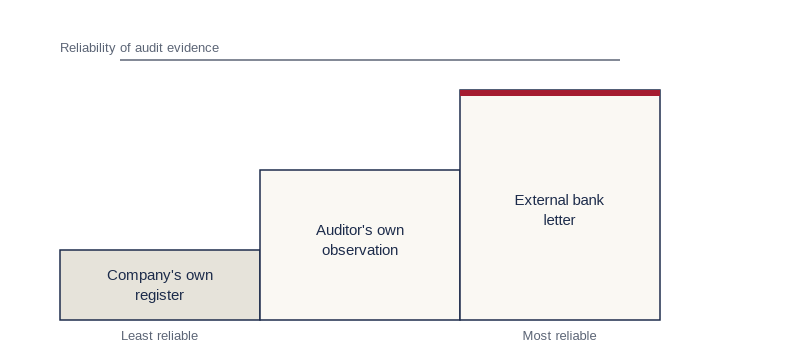
Auditor "andaaza" nahi lagata. Uske paas ya to saboot hota hai ya difference ka note. Saboot ki reliability uske source par nirbhar karti hai:
- Company ke control ke bahar ke doosre party se seedha mila hua saboot (jaise bank ka confirmation letter). Ye sabse zyada reliable hai.
- Auditor ka khud dekha hua saboot (jaise physical ginti).
- Company ke andar ka saboot (jaise khud ka register). Ye sabse kam reliable hai.
Kaafi aur sahi (sufficient and appropriate) saboot mil jaye, tabhi reasonable assurance banta hai. Bank balance ke liye auditor khud bank se confirmation maangta hai, company se nahi, kyunki company ka statement badla ja sakta hai jabki bank ka letter bahar se aata hai. Isse external confirmation kehte hain. Is baat ka ek dukhad udaharan Wirecard hai: jo cash "bank mein" bataya gaya tha, uska saboot nahi mila (Section 2.3).
1.3.2 Assertions
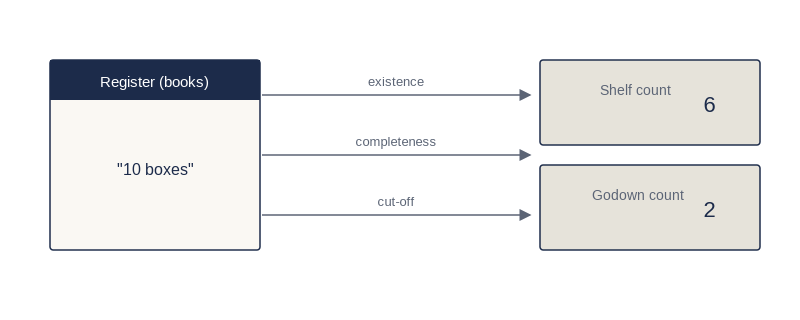
Assertions management ke woh claims hain jinhe auditor verify karta hai. Ye audit ke "steps" nahi hain. Chaar assertions is chapter mein padhe jaate hain.
Table 1.3. Four assertions on a kirana stock example (illustrative numbers)
| Assertion | Auditor ka sawaal | Kaise check hota hai | Is example mein |
|---|---|---|---|
| Existence | Kya 10 dabbe sach mein hain? | Shelf par ginti | 6 dabbe mile |
| Completeness | Kya sab dabbe likhe gaye? | Godown ka maal bhi dekhna | Godown mein 2 aur mile, kaapi mein nahi |
| Valuation | Keemat sahi hai? | Purchase bill se milan | Bill par Rs 100 ka rate mila, theek |
| Cut-off | Maal sahi mahine ka hai? | Aakhri din ke bills | 1 tareekh ka bill 30 tareekh mein likha gaya |
Ye numbers kalpanik hain aur sirf samajhne ke liye hain, kisi real company ke nahi hain.
Risk-based approach kehta hai ki jis item mein zyada risk ho, us par zyada saboot lena chahiye. Chhoti dukaan mein inherent risk aksar cash aur stock mein hota hai, kyunki controls kam hote hain.
1.3.3 Materiality aur voluntary audit
Maan lijiye kaapi mein 10 dabbe likhe the aur asli mein 6 + 2 = 8 mile. Do dabbe kam hain, jo Rs 200 ki baat hai. Ye ek saal ke poore hisaab mein chhoti ho sakti hai. Isi ko materiality kehte hain. Lekin agar koi jaanbujhkar har mahine dabbe chhupa raha hai, to chhoti baat bhi badi ban jaati hai, kyunki yahan gunaa matra ka nahi, niyat ka hai.
Audit ke liye company hona zaroori nahi. Koi bhi vyakti ya firm apni marzi se kisi doosre se hisaab check karwa sakta hai. Isse voluntary audit kehte hain. Lekin auditor ko us vyakti se alag hona padta hai jiska hisaab check ho raha hai: ek bete se apne pita ki dukaan ka audit karwane mein independence nahi bachti.
Critical discussion
Exam trap: "Audit sirf badi companies ka hota hai" galat hai. Kuch companies ke liye audit kanoon se zaroori hai, par voluntary audit kisi ka bhi ho sakta hai. Doosra trap: bank balance aur apni kaapi mein difference ka matlab hamesha chori nahi hota. Cheque abhi clear na hona ya bank charge ka na likha jaana bhi karan ho sakte hain, jise bank reconciliation se samjha jaata hai (Worked Problem 2).
1.4 Historical development of audit regulation in India
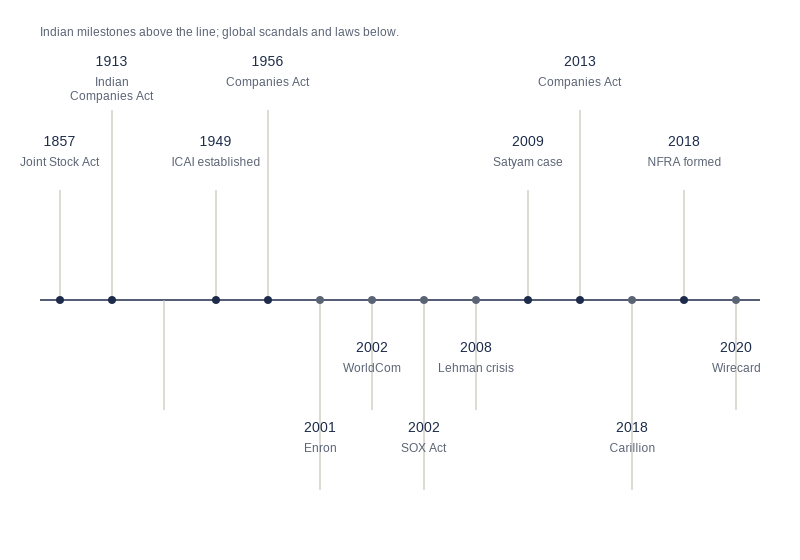
Audit pehle zyadatar bookkeeping ki ginti ka verification tha. Jab badi companies aayi aur shareholders alag, managers alag ho gaye, tab audit kanooni zaroorat ban gaya.[1] India mein is vikas ko neeche ki master timeline se dekha ja sakta hai.
Table 1.4. Master timeline of audit history and regulation
| Year | Event | Country | Significance |
|---|---|---|---|
| 1857 | First Act on joint-stock companies | British India | Company banane ka kanooni raasta |
| 1860 | First Auditor General appointed | India | Sarkari paise ke audit ki neev |
| 1866 | Indian Companies Act mandated accounts and audit | India | Company audit ka pehla kanooni roop |
| 1913 | Indian Companies Act, 1913 | India | Modern corporate governance ki neev |
| 1932 | First Accountancy Board | India | Auditors ki qualification aur conduct par salah |
| 1 July 1949 | ICAI formed under Chartered Accountants Act, 1949 | India | CA profession ka statutory regulator |
| 18 Jan 1956 | Companies Act, 1956 | India | Azaadi ke baad ka bada company law |
| 1971 | CAG (Duties, Powers and Conditions of Service) Act | India | CAG ke audit duties ka kanoon |
| 2 Dec 2001 | Enron bankruptcy | USA | Auditor independence par sawal |
| 30 Jul 2002 | Sarbanes-Oxley Act, PCAOB | USA | Auditors ki public nigaraani |
| 7 Jan 2009 | Satyam confession | India | NFRA ki soch ka beej |
| 29 Aug 2013 | Companies Act, 2013 assent | India | 1956 Act ki jagah |
| 15 Jan 2018 | Carillion compulsory liquidation | UK | Auditors par zyada nigaah |
| 1 Oct 2018 | NFRA formed; IL&FS board replaced | India | Audit oversight ka naya adhikaran |
| 25 Jun 2020 | Wirecard insolvency | Germany | Cash ke saboot ki ahmiyat |
Table ke saal in sources se liye gaye hain: 1857, 1866, 1913, 1932, 1949 aur 1956 ke liye ICAI Southern Region ki history PDF[9]; 1860 ke liye CAG ki official history page[10]; 1971 ke liye CAG ka Wikipedia page[11]; ICAI aur Companies Act, 1956 ke liye [5] aur [6]; Enron ke liye [2]; SOX aur PCAOB ke liye [12]; Satyam ke liye [3]; NFRA ke liye [13]; Companies Act, 2013 ke liye [7]; Carillion ke liye [14]; IL&FS ke liye [15]; Wirecard ke liye [16].
1.4.1 Company law aur audit (1857 se 1913)
Jab company banti hai to paise bahut logon ke hote hain, par chalate ek-do log hain. 1866 ke Indian Companies Act mein company ko accounts rakhne aur audit karwane ke liye bandh diya gaya.[9] ICAI ki history ke mutabik 1913 ke Act ne modern corporate governance ki neev rakhi, aur 1932 mein Accountancy Board bana jo auditors ki qualification aur conduct ke standard par salah deta tha.[9] Britain ka bhi ek Companies Act 1913 tha, jisne 1908 ke Act ko private companies ke liye badla (royal assent 15 August 1913), lekin wo ek alag kanoon hai. "Indian Companies Act, 1913" aaye to India wala hi samjhein.[17]
Exam trap. "Companies Act, 1956 India ka pehla company law hai" galat hai. Usse pehle 1857, 1866 aur 1913 ke Act aa chuke the.
1.4.2 Sarkari paisa aur CAG (1858 se 1976)
CAG ke office ki shuruaat 1858 se maani jaati hai, jab British Crown ne East India Company se shasan liya. 1860 mein pehla Auditor General appoint hua, jiske paas accounting aur audit dono ke kaam the.[10] Is book mein official CAG page wali spelling "Edward Drummond" rakhi gayi hai.[10] Aaj ka CAG Constitution ke Article 148 se bana hai. Uski reports Parliament ya Vidhan Sabha mein rakhi jaati hain aur Public Accounts Committees unpar charcha karti hain. 1971 mein DPC Act aaya, aur 1976 mein CAG ko accounting ke kaam se mukt kiya gaya taaki uska kaam sirf audit rahe.[11] CAG ko sirf dono Houses of Parliament ke address par, proved misbehaviour ya incapacity ke aadhar par hataya ja sakta hai, taaki sarkar use dara na sake.[11]
Exam trap. CAG ko "audit aur accounts dono" karne wala na likhein. 1976 ke baad CAG accounting functions se mukt hai. ICAI aur CAG ko bhi na milayein: ICAI CA profession ka body hai, CAG sarkari paise ka auditor.
1.4.3 ICAI aur Companies Acts (1949 se 2013)
ICAI (Institute of Chartered Accountants of India) 1 July 1949 ko Chartered Accountants Act, 1949 ke tahat bana.[5] Isse pehle 1930 mein Government of India ne Register of Accountants banane ka faisla kiya tha aur 1948 mein ek expert committee ne accountancy ke regulation par kaam kiya tha.[5] ICAI CA banne ki qualification tay karta hai, exams leta hai aur certificate of practice deta hai. Companies Act, 2013 ke tahat sirf wahi member statutory auditor ban sakta hai jiske paas valid certificate of practice ho.[5] India mein "chartered" ka matlab royal charter nahi hai.[5] ICAI ka motto "Ya Aeshu Suptaeshu Jagruti" hai, jo Katha Upanishad se liya gaya hai.[5]
Companies Act, 1956 (18 January 1956) ko 2013 ke Act ne lagbhag replace kiya.[6] 2013 ke Act ko President ki manzoori 29 August 2013 ko mili. Uske 98 sections 12 September 2013 se aur 183 sections 1 April 2014 se lagu hue.[7] NCLT 1 June 2016 ko constitute hua.[7] NFRA ko oversight body ke roop mein banaya gaya jo chartered accountants ke professional misconduct ki jaanch kar sake.[7]
Table 1.5. Statutory milestones in India
| Date | Milestone | Source |
|---|---|---|
| 1930 | Register of Accountants decided | [5] |
| 1948 | Expert committee on accountancy | [5] |
| 1 July 1949 | ICAI formed | [5] |
| 18 January 1956 | Companies Act, 1956 | [6] |
| 29 August 2013 | Companies Act, 2013 assent | [7] |
| 1 June 2016 | NCLT constituted | [7] |
| 1 March 2018 | Union Cabinet approval for NFRA | [13] |
| 1 October 2018 | NFRA formed | [13] |
Exam trap. ICAI aur NFRA ko na milayein. ICAI qualification aur discipline ka institute hai. NFRA alag oversight body hai jo Companies Act, 2013 ke Section 132 se judi hai.
1.5 Standards and regulators
1.5.1 Standards on Auditing
ICAI ne Standards on Auditing (SA) banaye hain. ICAI ki list SA 200 se shuru hoti hai: "Overall Objectives of the Independent Auditor and the Conduct of an Audit in Accordance with Standards on Auditing". SA 240 fraud par auditor ki zimmedari batata hai, SA 500 audit evidence par, aur SA 700 opinion banane aur report karne par.[18]
Companies Act, 2013 ke Section 143(10) ke tahat Central Government standards prescribe kar sakti hai, ICAI ki sifarish par aur NFRA se salah karke. Jab tak government apne standards notify nahi karti, ICAI ke standards ko hi auditing standards maana jaata hai. Section 143(9) ke tahat har auditor ko auditing standards follow karne hote hain.[19]
1.5.2 NFRA
NFRA ka vichar Satyam ke baad Parliament ki Standing Committee on Finance ki 21st report mein pehli baar aaya. Union Cabinet ne 1 March 2018 ko manzoori di aur NFRA 1 October 2018 ko bani.[13] Section 132 ke tahat wo standards par salah de sakti hai, investigations kar sakti hai, aur defaulting auditors ya firms par monetary penalty aur debarment laga sakti hai, jo 10 saal tak ho sakta hai.[13]
1.5.3 SOX aur PCAOB (USA)
Enron ke baad America ne Sarbanes-Oxley Act (SOX) 30 July 2002 ko banaya. Isse PCAOB bana aur auditor independence ke naye rules aaye; Title II ek hi client ko non-audit services (jaise consulting) dene par rok lagata hai.[8] SOX se pehle auditors ki profession self-regulated thi. PCAOB ke baad registration, inspection, standard-setting aur enforcement ki independent nigaraani shuru hui.[12]
Table 1.6. Who regulates whom
| Body | Kiska regulator | Kanooni aadhar |
|---|---|---|
| ICAI | CA profession: qualification, exams, certificate of practice | Chartered Accountants Act, 1949 |
| NFRA | Auditors ka professional misconduct, standards par salah | Companies Act, 2013, Section 132 |
| CAG | Sarkari receipts aur expenditure ka audit | Constitution, Article 148; DPC Act, 1971 |
| PCAOB | US public company auditors | Sarbanes-Oxley Act, 2002 |
Sources: [5], [13], [11], [12].
Critical discussion
Is itihaas ka ek pattern hai: pehle failure, phir sudhar. SOX Enron ke baad aaya aur NFRA ki soch Satyam ke baad. Pattern ka ek risk ye hai ki kanoon aksar nuksaan hone ke baad aate hain. Ek aur baat: standards (SA) aur regulator (NFRA, PCAOB) alag cheezein hain. Standard batata hai ki audit kaise ho, regulator dekhta hai ki hua ya nahi.
2. Case studies
2.1 Enron and Arthur Andersen (USA, 2001)
What happened. Enron ek US energy company thi jo 1985 mein bani.[2] Executives ne accounting ke loopholes aur special purpose entities (SPE) ka use karke billions dollars ka karz chhupaya. 2 December 2001 ko Enron ne bankruptcy file ki, jiske assets $63.4 billion the. Stock $90.75 (August 2000) se girkar November 2001 ke ant tak 1 dollar se neeche aa gaya.[2]
Audit failure. Arthur Andersen Enron ka auditor tha. 2000 mein Andersen ne Enron se $25 million audit fees aur $27 million consulting fees kamaye. Yaani consulting audit se zyada thi.[2] Ye self-interest threat ka seedha udaharan hai: jab consulting ki kamai audit se badi ho, to "nahi" kehna mushkil ho jaata hai.
Regulatory outcome. Andersen 15 June 2002 ko obstruction of justice mein convict hui aur 31 August 2002 ko CPA licenses surrender kar diye. US Supreme Court ne 31 May 2005 ko conviction palat di, lekin tab tak firm khatam ho chuki thi.[20] Enron ke baad SOX aaya.[8]
Lessons. Auditor ki independence aur imandari sabse badi cheez hai. Consulting aur audit ko ek hi client par milana conflict of interest banata hai. Exam answer: "Enron audit failure ka ek mukhya karan?" Auditor ka consulting fees se conflict of interest aur management ka dabav.
2.2 Satyam and Price Waterhouse (India, 2009)
What happened. Satyam Computer Services Hyderabad ki IT company thi. 7 January 2009 ko chairman Byrraju Ramalinga Raju ne resign kiya aur maana ki accounts mein lagbhag Rs 7,000 crore ka manipulation hua. Accounts mein aise profit aur bank cash dikhaye gaye jo the hi nahi.[3]
Audit failure. Satyam ka auditor Price Waterhouse tha, jo PwC ki affiliate hai.[3] US SEC ne PwC India ki affiliate firms par $6 million ka jurmana lagaya (SEC press release 2011-82).[3] 2018 mein SEBI ne Price Waterhouse ko listed companies ke audit se 2 saal ke liye roka (SEBI order, January 2018).[3]
Regulatory and court outcome. Hyderabad ki special CBI court ne 9 April 2015 ko Raju aur 9 aur logon ko 7 saal ki saza di.[3] Satyam ke baad NFRA ka vichar aaya (Section 1.5.2).
Lessons. Bank balance aur cash ka saboot company ke andar se nahi, bahar se aana chahiye.
2.3 Three further cases in brief: Carillion, IL&FS, Wirecard
Carillion (UK). Carillion 15 January 2018 ko compulsory liquidation mein gayi. UK Parliament ki inquiry ne KPMG, EY, PwC aur Deloitte se poochha ki unhone kya services di thi.[14]
IL&FS (India). 2018 mein IL&FS ne loan chukane mein default kiya aur 1 October 2018 ko sarkar ne control lekar nayi board banayi. Wikipedia ke mutabik SFIO ki shuruaati jaanch ne Deloitte ke audit mein badi kamiyan batayi, lekin Bombay High Court ne sarkar ko "coercive action" se rokne ka interim order diya. Ye sab "report kiya gaya" hai aur case aage badh sakta hai.[15] NFRA ne IL&FS Financial Services ke FY 2017-18 audit mein Deloitte ke teen partners ke khilaf Section 132(4) orders diye: engagement partner ko 7 saal debarment aur Rs 25 lakh fine, additional partner ko 5 saal aur Rs 15 lakh, EQCR partner ko 5 saal aur Rs 5 lakh. Ye orders NCLAT mein appeal mein gaye.[21] February 2025 mein Delhi High Court ne NFRA ke kuch notices technical grounds par quash kiye, lekin NFRA ki powers ko endorse kiya.[22] Ek May 2023 ka Supreme Court ruling technical tha aur usne merits par kuch nahi kaha; Deloitte firm par abhi tak koi final sanction nahi hai.[23] April 2020 mein Corporate Affairs Secretary Injeti Srinivas ne kaha ki ye ajeeb baat hai ki kisi ne ye pehle nahi dekha: na statutory auditors, na independent directors, na credit rating agencies.[15]
Wirecard (Germany). Wirecard ne June 2020 mein kaha ki EUR 1.9 billion cash "missing" hai aur 25 June 2020 ko insolvency file ki.[16] Isse cash ke saboot ki ahmiyat saaf hoti hai. Carillion aur Wirecard ke detailed case studies Chapter 2 mein hain.
Critical discussion
Ye cases ek jaisa sabak dete hain: jab auditor aur independent directors dono dekhte rah jaate hain, to kanoon badalte hain. Yahan fact aur allegation ka fark rakhna zaroori hai. IL&FS ke maamle mein court proceedings abhi chal sakti hain, isliye in findings ko final nirnay ke roop mein nahi likha gaya hai.
3. Worked problems
Worked Problem 1: Kirana stock existence and completeness
Problem. Kaapi mein chai-patti ke 10 dabbe, har dabba Rs 100, yaani stock Rs 1,000 likha hai. Shelf par 6 dabbe mile aur godown mein 2 aur. Bill par rate Rs 100 hai. Kya galti hai?
Solution. Kaapi mein 10, asli 6 + 2 = 8. Do dabbe kam, yaani 2 x Rs 100 = Rs 200. Existence: kaapi ke 10 mein se 2 dabbe nahi mile. Completeness: godown ke 2 dabbe kaapi mein nahi likhe the, isliye shelf aur godown dono ginne par hi 8 bante hain. Valuation: rate Rs 100 bill se match hua, theek. Auditor ka kaam andaaza lagana nahi hai. Uska kaam hai pata lagana ki difference hai, aur use document karna. Karan chori, galat ginti ya bina likhe udhaar ho sakta hai.
Worked Problem 2: Bank reconciliation
Problem. Ramesh ka kaapi balance Rs 15,000 hai aur bank statement balance Rs 12,430. Rs 3,000 ka ek item abhi bank mein process nahi hua. Bank ne Rs 430 ka charge kata, jo kaapi mein nahi likha. Reconcile kijiye. (Numbers kalpanik hain.)
Solution. Pehle kaapi balance ko bank charge se adjust karein: 15,000 - 430 = Rs 14,570.
Ab Rs 3,000 ke item ka treatment dekhein. Source example ne use bank balance mein jodkar 12,430 + 3,000 = Rs 15,430 nikala. Ye arithmetic tab sahi hai jab Rs 3,000 ek deposit in transit ho, yaani kaapi mein jama likha ho par bank mein abhi credit na hua ho. Us case mein 15,430 aur 14,570 mein Rs 860 ka unreconciled difference bacha.
Lekin agar Rs 3,000 ka item ek uncleared cheque ho (kaapi mein payment ke roop mein ghatya gaya par bank se abhi cash nahi hua), to wo bank balance se ghatana chahiye: 12,430 - 3,000 = Rs 9,430. Tab 14,570 aur 9,430 mein Rs 5,140 ka difference bachta hai.
Dono case mein difference khatam nahi hua, isliye kisi aur entry ki jaanch baaki hai. Ye ek entry do baar likhi gayi ho sakti hai ya ek deposit chhoot gaya ho sakta hai. Auditor us difference par ruk jaata hai. Agar wo bhi samjha na paaye, to auditor apni report mein likhta hai ki use poora saboot nahi mila. Isse limitation kehte hain.
(Is chapter mein cheque ke direction wali galti sudhari gayi hai; dekhein rewrite notes.)
Worked Problem 3: Timeline matching
Problem. Sahi order mein likhein: Companies Act 2013 ka assent, ICAI ka gathan, SOX, NFRA ka gathan, Satyam confession.
Solution. ICAI (1 July 1949), SOX (30 July 2002), Satyam confession (7 January 2009), Companies Act 2013 assent (29 August 2013), NFRA (1 October 2018). Sources: Table 1.4 aur notes [5], [8], [3], [7], [13].
Worked Problem 4: Classify the failure
Problem. Ek auditor ko apne client se audit fees ke saath bade consulting contracts bhi milte hain, aur wo management ke dabav mein ek sandehaspad entry ko pass kar deta hai. Kaun si threat hai, aur kaun sa case yaad aata hai?
Solution. Ye self-interest threat hai. Enron aur Arthur Andersen se milta hai, jahan 2000 mein consulting fees ($27 million) audit fees ($25 million) se zyada thi.[2] SOX ke Title II ne isi tarah ki services par rok lagayi.[8]
4. Chapter summary
Audit ek independent jaanch hai jo saboot ke aadhar par financial statements par opinion deti hai. Shabd audire se aaya hai, jiska matlab "sunna" hai. Audit reasonable assurance deta hai, guarantee nahi, aur aksar sampling par chalta hai. Independence dimaag aur dikhawat dono mein chahiye, kyunki bharosa tabhi banta hai jab bahar ke log auditor ko neutral samjhein. Saboot jitna company ke bahar se aaye, utna reliable. Assertions, yaani existence, completeness, valuation aur cut-off, management ke claims hain jinhe auditor verify karta hai. India mein company audit ka kanooni raasta 1866 ke Act se shuru hua aur 1913, 1949 (ICAI), 1956 aur 2013 ke Acts se hote hue NFRA (2018) tak pahuncha. CAG sarkari paise ka auditor hai aur 1976 ke baad accounting se mukt hai. Standards on Auditing ICAI banata hai aur Section 143(9) unhe follow karna zaroori banata hai. Enron mein consulting fees audit fees se zyada thi, aur Satyam mein bank cash ka saboot company ke andar se liya gaya. Dono ne regulation badla: SOX aur PCAOB, phir NFRA ki soch.
5. Review questions
Short answer questions
- Audit shabd ki utpatti aur uska original matlab likhiye.
- Audit aur accounting mein fark samjhaiye.
- Independence of mind aur independence in appearance mein kya fark hai?
- Existence aur completeness assertion ko ek udaharan se distinguish kijiye.
- External confirmation internal register se zyada reliable kyun hai?
- Voluntary audit kya hai? Ek udaharan dijiye.
- ICAI aur NFRA ki bhumikaon mein fark likhiye.
- CAG ko 1976 mein accounting ke kaam se mukt kyun kiya gaya?
- SOX ne auditor independence ke liye kya badla?
- Satyam case ne India mein regulation ko kaise prabhavit kiya?
Multiple choice questions
Neeche ke MCQ mein har sawaal ka ek hi sahi option hai. Answer key aur ek line ki explanation har sawaal ke baad di gayi hai.
Q1. "Audit" shabd kis Latin shabd se aaya hai?
(a) auditor (b) audire (c) audere (d) audio
Answer: (b). Audire ka matlab "to hear" hai. Purane samay mein accounts sunkar check hote the.[1]
Q2. Audit ka mool uddeshya kya hai?
(a) Hisaab likhna (b) Tax bharna (c) Loan dena (d) Financial statements par independent opinion dena
Answer: (d). Auditor saboot dekhkar opinion deta hai ki statements mein material misstatement hai ya nahi.
Q3. Voluntary audit kya hai?
(a) Apni marzi se karwaya gaya audit (b) Kanoon se zaroori audit (c) Sirf sarkari audit (d) Sirf bank ka audit
Answer: (a). Jaise ek chhoti dukaan ka malik apni kitaabein kisi bahari vyakti se check karwaye.
Q4. Auditor ke liye sabse bharosemand saboot kaun sa hai?
(a) Company ka apna register (b) Maalik ka zabani bayan (c) Bahar ke third party se aaya bank confirmation (d) Manager ka note
Answer: (c). Jo saboot company ke control ke bahar se aata hai wo zyada reliable hota hai.
Q5. "Existence" assertion ka matlab kya hai?
(a) Cheez poori likhi gayi hai (b) Keemat sahi hai (c) Cheez sach mein maujood hai (d) Cheez sahi period mein hai
Answer: (c). Existence poochta hai ki jo likha hai wo sach mein hai ya nahi.
Q6. "Completeness" assertion ka matlab kya hai?
(a) Jo hua wo sab likha gaya (b) Cheez maujood hai (c) Keemat sahi hai (d) Tareekh sahi hai
Answer: (a). Godown mein jo maal tha par kaapi mein nahi, wo completeness ki galti hai.
Q7. Cut-off galti ka udaharan kaun sa hai?
(a) Cash chori (b) Rate ki galti (c) Signature ki galti (d) Agle mahine ka bill is mahine mein likhna
Answer: (d). Cut-off ka sawaal sahi accounting period mein entry ka hai.
Q8. ICAI ki sthapna kab hui?
(a) 1 April 1956 (b) 1 July 1949 (c) 29 August 2013 (d) 1 January 1950
Answer: (b). ICAI 1 July 1949 ko bana.[5]
Q9. ICAI kis Act ke tahat bana?
(a) Chartered Accountants Act, 1949 (b) Companies Act, 1956 (c) Companies Act, 2013 (d) Income-tax Act
Answer: (a). Parliament ke Act se ye statutory body bana.[5]
Q10. ICAI ka motto kya hai?
(a) Satyameva Jayate (b) Yato Dharmastato Jaya (c) Ya Aeshu Suptaeshu Jagruti (d) Sarve Bhavantu Sukhinah
Answer: (c). Ye motto Katha Upanishad se liya gaya hai.[5]
Q11. Companies Act, 2013 ko President ki manzoori kab mili?
(a) 18 January 1956 (b) 29 August 2013 (c) 1 April 2014 (d) 1 July 1949
Answer: (b). Presidential assent 29 August 2013 ko mila.[7]
Q12. Companies Act, 1956 ko kisne lagbhag replace kiya?
(a) Sarbanes-Oxley Act (b) Chartered Accountants Act, 1949 (c) Income-tax Act (d) Companies Act, 2013
Answer: (d). 2013 ke Act ne 1956 ke Act ko lagbhag badal diya.[6][7]
Q13. NFRA kya hai?
(a) Tax department (b) Bank (c) Stock exchange (d) Auditors ke professional misconduct ki jaanch karne wali oversight body
Answer: (d). NFRA Companies Act, 2013 ke Section 132 ke tahat bani.[13]
Q14. NCLT kab constitute hua?
(a) 1 April 2014 (b) 1 June 2016 (c) 18 January 1956 (d) 30 July 2002
Answer: (b). NCLT 1 June 2016 ko constitute hua.[7]
Q15. Sarbanes-Oxley Act kis desh ka kanoon hai?
(a) India (b) UK (c) USA (d) Germany
Answer: (c). Ye 30 July 2002 ko Enron ke baad pass hua.[8]
Q16. PCAOB ka kaam kya hai?
(a) Public company auditors ki nigaraani (b) Tax collection (c) Share trading (d) Insurance
Answer: (a). Registration, inspection, standard-setting aur enforcement PCAOB ke kaam hain.[12]
Q17. Enron ne bankruptcy kab file ki?
(a) 7 January 2009 (b) 2 December 2001 (c) 25 June 2020 (d) 15 January 2018
Answer: (b). Bankruptcy 2 December 2001 ko file hui.[2]
Q18. Satyam ke chairman ne accounts manipulation kab maana?
(a) 2 December 2001 (b) 25 June 2020 (c) 15 January 2018 (d) 7 January 2009
Answer: (d). Resignation aur confession 7 January 2009 ko hue.[3]
Q19. Audit ke baare mein sahi kathan kaun sa hai?
(a) Audit reasonable assurance deta hai (b) Audit 100% guarantee deta hai (c) Audit sirf fraud pakadta hai (d) Audit accounting hai
Answer: (a). Statutory audit absolute nahi, reasonable assurance deta hai.[4]
Q20. Bank reconciliation mein "deposit in transit" ka matlab kya hai?
(a) Bank ka charge (b) Cash chori (c) Kaapi mein jama likha, par bank ne abhi credit nahi kiya (d) Naya account
Answer: (c). Isse kaapi aur bank balance ke beech timing difference banta hai.
Q21. Indian Companies Act jisne accounts aur audit mandatory kiya (ICAI history ke mutabik) kab aaya?
(a) 1857 (b) 1913 (c) 1866 (d) 1956
Answer: (c). ICAI Southern Region ki history PDF ke mutabik 1866 ke Act ne accounts rakhna aur audit karwana zaroori kiya.[9]
Q22. CAG ka office Constitution ke kis Article ke tahat bana?
(a) Article 148 (b) Article 124 (c) Article 280 (d) Article 324
Answer: (a). Article 148 se CAG ka office bana.[11]
Q23. CAG ke Duties, Powers and Conditions of Service Act kab pass hua?
(a) 1949 (b) 1956 (c) 2013 (d) 1971
Answer: (d). DPC Act 1971 mein aaya.[11]
Q24. CAG ko accounting ke kaam se mukt kab kiya gaya?
(a) 1860 (b) 1976 (c) 2002 (d) 2018
Answer: (b). 1976 mein accounting functions hataye gaye taaki CAG sirf audit kare.[11]
Q25. NFRA kab bani?
(a) 1 October 2018 (b) 1 April 2014 (c) 1 July 1949 (d) 30 July 2002
Answer: (a). Cabinet approval 1 March 2018 ko hua aur NFRA 1 October 2018 ko bani.[13]
Q26. NFRA ka concept pehli baar kis ghatna ke baad aaya?
(a) Enron (b) Wirecard (c) Satyam (d) Carillion
Answer: (c). Parliament ki Standing Committee on Finance ki 21st report ne Satyam ke baad ye vichar rakha.[13]
Q27. NFRA Section 132 ke tahat debarment adhiktam kitne saal tak laga sakti hai?
(a) 5 saal (b) 10 saal (c) 7 saal (d) 20 saal
Answer: (b). Section 132 ke tahat 10 saal tak debarment ho sakta hai.[13]
Q28. SOX se pehle US mein auditors ki profession kaisi thi?
(a) Government-run (b) Banned (c) Audit committee controlled (d) Self-regulated
Answer: (d). PCAOB ke baad independent oversight shuru hui.[12]
Q29. Carillion ki compulsory liquidation kab hui?
(a) 25 June 2020 (b) 2 December 2001 (c) 7 January 2009 (d) 15 January 2018
Answer: (d). Carillion 15 January 2018 ko compulsory liquidation mein gayi.[14]
Q30. Wirecard mein "missing" cash kitna bataya gaya?
(a) USD 63.4 billion (b) EUR 1.9 billion (c) Rs 7,000 crore (d) GBP 6.9 billion
Answer: (b). Wirecard ne EUR 1.9 billion cash missing bataya.[16]
Q31. IL&FS par sarkar ne nayi board kab banayi?
(a) 1 April 2014 (b) 1 June 2016 (c) 1 October 2018 (d) 25 June 2020
Answer: (c). Government ne 1 October 2018 ko control lekar nayi board banayi.[15]
Notes and references
[1] Wikipedia, "Audit", Wikipedia, accessed 27 Nov 2026, https://en.wikipedia.org/wiki/Audit. Supports: definition and etymology (audire), medieval British auditors, audit as assurance service, optimal auditing, legal requirement for many entities, types of auditors.
[2] Wikipedia, "Enron scandal", Wikipedia, accessed 27 Nov 2026, https://en.wikipedia.org/wiki/Enron_scandal. Supports: formed 1985; $63.4 billion assets; bankruptcy 2 Dec 2001; stock high $90.75 (Aug 2000) to under $1 by end Nov 2001; Andersen fees $25 million audit and $27 million consulting in 2000; Arthur Andersen dissolved.
[3] Wikipedia, "Satyam scandal", Wikipedia, accessed 27 Nov 2026, https://en.wikipedia.org/wiki/Satyam_scandal. Supports: 7 Jan 2009 confession, Rs 7,000 crore; PwC India fined $6 million by SEC; SEBI 2018 two-year bar; 9 Apr 2015 verdict. The source chapter also records that these were checked against SEC press release 2011-82 (sec.gov), the SEBI order of January 2018 (sebi.gov.in) and Hindustan Times, Mint and LiveLaw reports of 9 and 10 April 2015; those pages are not linked in the source.
[4] Wikipedia, "Statutory audit", Wikipedia, accessed 27 Nov 2026, https://en.wikipedia.org/wiki/Statutory_audit. Supports: audit seeks reasonable assurance that statements are free from material error; statistical sampling is often used.
[5] Wikipedia, "Institute of Chartered Accountants of India", Wikipedia, accessed 27 Nov 2026, https://en.wikipedia.org/wiki/Institute_of_Chartered_Accountants_of_India. Supports: 1930 Register of Accountants; 1948 expert committee; established 1 July 1949 under Chartered Accountants Act, 1949; qualifications, exams, certificate of practice; only a member with certificate of practice can be statutory auditor under the Companies Act, 2013; "chartered" does not refer to a Royal Charter; motto from Katha Upanishad.
[6] Wikipedia, "Companies Act 1956", Wikipedia, accessed 27 Nov 2026, https://en.wikipedia.org/wiki/Companies_Act_1956. Supports: enacted 18 January 1956; repealed and replaced by the 2013 Act.
[7] Wikipedia, "Companies Act 2013", Wikipedia, accessed 27 Nov 2026, https://en.wikipedia.org/wiki/Companies_Act_2013. Supports: presidential assent 29 August 2013; 98 sections commenced 12 September 2013 and another 183 sections from 1 April 2014; NCLT constituted 1 June 2016; NFRA as oversight body for misconduct by chartered accountants.
[8] Wikipedia, "Sarbanes-Oxley Act", Wikipedia, accessed 27 Nov 2026, https://en.wikipedia.org/wiki/Sarbanes%E2%80%93Oxley_Act. Supports: enacted 30 July 2002; created PCAOB; Title II auditor independence and limits on non-audit services to the same client.
[9] Institute of Chartered Accountants of India (Southern India Regional Council), "Accounting Standards: History", sirc-icai.org, accessed 27 Nov 2026, https://www.sirc-icai.org/past_programmes_uploads/Accounting%20Standards%20-%20History.pdf. Supports: 1857 joint-stock companies Act; 1866 Indian Companies Act mandated accounts and audit; 1913 Act laid foundation for modern corporate governance; 1932 first Accountancy Board; Chartered Accountants Act 1949 effective 1 July; 1956 Companies Act.
[10] Comptroller and Auditor General of India, "History of the Indian Audit and Accounts Department" (official page), cag.gov.in, accessed 27 Nov 2026, https://www.cag.gov.in/en/pages/single/5082. Supports: office begins 1858; first Auditor General (Sir Edward Drummond) appointed 1860 with accounting and auditing functions.
[11] Wikipedia, "Comptroller and Auditor General of India", Wikipedia, accessed 27 Nov 2026, https://en.wikipedia.org/wiki/Comptroller_and_Auditor_General_of_India. Supports: Article 148; Articles 148 to 151; reports laid before Parliament and taken up by PACs; DPC Act 1971; relieved of accounting functions in 1976; removal only on address by both Houses on proved misbehaviour or incapacity.
[12] Wikipedia, "Public Company Accounting Oversight Board", Wikipedia, accessed 27 Nov 2026, https://en.wikipedia.org/wiki/Public_Company_Accounting_Oversight_Board. Supports: founded 30 July 2002 under SOX; previously self-regulated; functions of registration, inspection, standard-setting, enforcement.
[13] Wikipedia, "National Financial Reporting Authority", Wikipedia, accessed 27 Nov 2026, https://en.wikipedia.org/wiki/National_Financial_Reporting_Authority. Supports: formed 1 October 2018; proposed after Satyam in the 21st report of the Standing Committee on Finance; Cabinet approval 1 March 2018; Section 132 powers including investigations, penalties and debarment up to 10 years.
[14] Wikipedia, "Carillion", Wikipedia, accessed 27 Nov 2026, https://en.wikipedia.org/wiki/Carillion. Supports: compulsory liquidation 15 January 2018; committees wrote to the Big Four about services and fees since 2008.
[15] Wikipedia, "Infrastructure Leasing & Financial Services", Wikipedia, accessed 27 Nov 2026, https://en.wikipedia.org/wiki/Infrastructure_Leasing_%26_Financial_Services. Supports: government took control and appointed new board 1 October 2018; SFIO initial probe and Deloitte audit lapses; Bombay High Court interim order; April 2020 remarks by the Corporate Affairs Secretary.
[16] Wikipedia, "Wirecard", Wikipedia, accessed 27 Nov 2026, https://en.wikipedia.org/wiki/Wirecard. Supports: EUR 1.9 billion missing; insolvency filed 25 June 2020.
[17] Wikipedia, "Companies Act 1913", Wikipedia, accessed 27 Nov 2026, https://en.wikipedia.org/wiki/Companies_Act_1913. Supports: UK Act amended the 1908 Act for private companies; royal assent 15 August 1913.
[18] Institute of Chartered Accountants of India, "Auditing, Review and Other Standards (formerly known as AAS): complete text", icai.org, accessed 27 Nov 2026, https://www.icai.org/post/auditing-review-and-other-standards-formerly-known-as-aas-complete-text. Supports: SA titles for SA 200, SA 240, SA 500, SA 700.
[19] Indian Kanoon, Companies Act, 2013, Section 143, indiankanoon.org, accessed 27 Nov 2026, https://indiankanoon.org/doc/39856074/. Supports: Section 143(10) and 143(9).
[20] Wikipedia, "Arthur Andersen", Wikipedia, accessed 27 Nov 2026, https://en.wikipedia.org/wiki/Arthur_Andersen. Supports: convicted 15 June 2002; licenses surrendered 31 August 2002; Supreme Court reversed 31 May 2005.
[21] Indian Institute of Management Ahmedabad, Working Paper 2023-05-02, iima.ac.in, accessed 27 Nov 2026, https://www.iima.ac.in/sites/default/files/2023-06/WP%202023-05-02.pdf. Supports: NFRA Section 132(4) orders in the IL&FS audit and their amounts; appeal before NCLAT.
[22] Mint, report on Delhi High Court and NFRA notices (IL&FS audit quality), livemint.com, accessed 27 Nov 2026, https://www.livemint.com/industry/nfra-delhi-high-court-notices-auditors-ilfs-audit-quality-case-disciplinary-action-11739097413021.html. Supports: Delhi HC, February 2025, quashed NFRA notices to DHS LLP and SRBC on technical grounds but endorsed NFRA powers.
[23] Deloitte Haskins & Sells LLP, website statement, deloittehaskinssells.com, accessed 27 Nov 2026, https://www.deloittehaskinssells.com/. Supports: Supreme Court ruling of 3 May 2023 was technical, took no view on merits; no sanction on DHS LLP affecting practice.