The Companies Act, 2013 and the Auditor (Chapter X, Sections 139 to 148)
Source note: Section text yahan apne shabdon mein paraphrase kiya gaya hai. Exact shabdon ke liye Companies Act, 2013 ka original text (India Code, MCA) dekhiye. Kanoon mein exact words matter karte hain.
Abstract
Is chapter mein Companies Act, 2013 ke Chapter X (Sections 139 se 148) ke tahat auditor ki poori life cycle samjhayi gayi hai: appointment, eligibility, rotation, removal aur resignation, powers aur duties, prohibited services, aur penalties. Saath hi Act ke un sections ka map diya gaya hai jo audit se jude hain (128, 129, 134, 177, 178, 197, 245, 447). Section 143 ki reporting, CARO 2020 ka structure aur Section 144 ki prohibited services list detail mein hai. Case studies Satyam, IL&FS aur DHFL ki hain. Worked problems rotation calendar aur penalty calculation par hain. Research question: Act auditor ko independent rakhne ke liye kaun se structural rules lagata hai, aur jab ye rules fail hote hain to kya consequences milte hain.
Learning objectives
Is chapter ke baad reader:
- Define karega auditor ki appointment, eligibility aur disqualification ke rules (Sections 139, 141).
- Compute karega rotation calendar aur cooling-off ka earliest return year.
- Compute karega Section 147(2) ke tahat maximum fine, "whichever is less" ke formula se.
- Distinguish karega Act ke duty aur Rules ke process ke beech, jaise Section 143(12) aur Rule 13.
- Evaluate karega Section 144 ke tahat kaun si services allowed hain aur kaun si prohibited.
- Analyse karega Satyam, IL&FS aur DHFL ko Chapter X ke provisions ke context mein.
12.1 Introduction and research question
Maan lijiye ek private company ka CA 22 saal se wahi hai. Har saal sign karta hai aur chala jata hai. Dikkat familiarity hai: jab ek hi vyakti bahut saal tak wahi cheez check karta hai, to wo sawal poochna kam kar deta hai aur client ka hissa jaisa lagne lagta hai. Isliye kanoon auditor ko badalne aur kuch kaam auditor ko karne hi na dene ke rules lagata hai.
Research question: Companies Act, 2013 ka Chapter X auditor ki independence ko structurally kaise surakshit karta hai (appointment, rotation, prohibited services), aur Satyam, IL&FS aur DHFL jaise cases is structure ki seemayen kaise dikhate hain?
| Stage | Section | Ek line mein |
|---|---|---|
| Appointment | 139 | Members AGM mein, sixth-AGM cycle; government company ke liye CAG |
| Eligibility | 141 | Chartered Accountant hona zaroori; disqualification list; 20 company limit |
| Rotation | 139(2) | Individual 5 saal, firm 10 saal, phir 5 saal cooling-off |
| Removal aur resignation | 140 | Special resolution aur Central Government approval; resignation statement 30 din mein |
| Remuneration | 142 | General meeting mein fix |
| Powers aur duties | 143 | Books tak access, inquiry, standards, reporting, fraud reporting |
| Prohibited services | 144 | Internal audit, book-keeping aadi nahi |
| Signing aur qualifications | 145 | Qualifications general meeting mein padhi jati hain |
| Attendance at meetings | 146 | Auditor ko notices milte hain; sune jane ka haq |
| Penalty | 147 | Fine, jail (jaanbujh kar), refund, damages |
| Cost audit | 148 | Alag cost auditor |
12.2 Appointment, eligibility and rotation (Sections 139 and 141)
Appointment (Section 139)
Auditor ko members (shareholders) AGM mein appoint karte hain. Appointment chhathe AGM ke end tak rehti hai aur yeh cycle har chhathe AGM par chalti hai (Section 139(1)) [1].
Pehla auditor members nahi, Board appoint karta hai, company register hone ke 30 din ke andar. Board na kare to members 90 din ke andar EGM mein appoint karte hain (Section 139(6)) [1].
Government company mein CAG (Comptroller and Auditor General) auditor appoint karta hai, financial year shuru hone ke 180 din ke andar (Section 139(5)). Pehla auditor CAG 60 din ke andar appoint karta hai (Section 139(7)) [1].
Auditor se pehle written consent aur certificate lena hota hai ki wo Section 141 ki shartein poori karta hai. Company 15 din ke andar Registrar ko notice deti hai [1].
Casual vacancy
Section 139(8): casual vacancy aaye to Board 30 din ke andar bharta hai. Agar vacancy resignation se aayi hai, to Board ki recommendation ko company ko general meeting mein 3 mahine ke andar approve bhi karna hota hai, aur naya auditor next AGM tak rehta hai. Government company mein CAG 30 din mein bharta hai [1]. Section 139(11): jahan Audit Committee mandatory hai (Section 177), auditor ki har appointment us committee ki recommendations ko dhyan mein rakh kar hoti hai [1].
Eligibility (Section 141)
Auditor nahi ban sakte: body corporate (LLP ke alawa), company ke officer ya employee, aise vyakti ka partner ya employee, aur wo jiske relative director ya KMP hon. Ek bada number: jo already 20 se zyada companies ka auditor ho (Section 141(3)(g)) [3].
Firm appoint ho to sirf chartered accountant partners firm ki taraf se act aur sign kar sakte hain (Section 141(2)) [3]. Section 141(3)(d) ke proviso ke anusaar auditor ka relative company mein security rakh sakta hai, par face value Rs 1,000 se zyada nahi, ya jo sum prescribe ho [3]. Companies (Audit and Auditors) Rules, 2014 ka Rule 10(1) yeh limit Rs 1 lakh prescribe karta hai, aur limit cross hone par 60 din ke andar corrective action lena hota hai [35]. Isliye Act text poochha jaye to Rs 1,000; Rules ke anusaar poochha jaye to Rs 1 lakh.
Section 141(4): appointment ke baad disqualification lag jaye to auditor ko office vacate karna hota hai aur wo vacation casual vacancy maani jati hai. Yeh self-executing provision hai [3].
Rotation (Section 139(2))
Listed companies aur prescribed classes mein individual auditor sirf ek term of 5 consecutive years ke liye ho sakta hai. Audit firm maximum 2 terms of 5 years, yaani 10 saal. Iske baad 5 saal ka cooling-off. Common partner wali firm bhi agle 5 saal ke liye roki gayi hai [1]. Rotation ka matlab beech mein hatana nahi hai; hatana Section 140 ka alag rule hai.
Critical discussion
Rotation familiarity threat ko structurally kam karta hai. Teen baatein dhyan dene layak hain. Pehli, yeh sabhi companies par nahi, sirf listed aur prescribed classes par laagu hai. Doosri, "firm badal kar wahi partner wapas" wala route band hai. Teesri, sirf rotation kafi nahi: Sections 143(12), 144 aur 147 mil kar kaam karte hain.
12.3 Removal, resignation and the retiring auditor (Section 140)
Removal. Auditor ko term se pehle sirf special resolution se aur pehle Central Government ki approval se hataya ja sakta hai. Auditor ko sune jane ka mauka dena zaroori hai (Section 140(1)) [2].
Resignation. Auditor resign kare to 30 din ke andar company aur Registrar ko reasons ke saath statement dega; government company mein CAG ko bhi (Section 140(2)). Na kare to penalty Rs 50,000 ya remuneration, jo kam ho. Continuing failure par Rs 500 per day extra, maximum Rs 5 lakh (Section 140(3)) [2].
Special notice (Section 140(4)). Aise resolution ke liye jo retiring auditor ke alawa kisi aur ko appoint kare, ya expressly kahe ki retiring auditor re-appoint nahi hoga, special notice chahiye. Exception: retiring auditor ne 5 saal (individual) ya 10 saal (firm) ka consecutive tenure poora kar liya ho to special notice nahi chahiye [2]. Company notice ki copy turant retiring auditor ko bhejti hai. Auditor written representation bhej sakta hai aur members ko circulate karne ki request kar sakta hai. Company default kare ya representation der se aaye, to auditor maang sakta hai ki representation meeting mein padhi jaye aur Registrar ko file ho. Tribunal rights ke abuse par circulation ya read-out rok sakta hai [2]. Matlab: company auditor ko chupchaap nahi nikal sakti.
Fraud aur Tribunal (Section 140(5)). Agar auditor ne fraud kiya ya fraud mein abet ya collude kiya, to Tribunal (suo motu ya application par) auditor badalne ka order de sakta hai. Central Government ke application par Tribunal 15 din mein order karta hai ki auditor function nahi karega. Final order ke baad auditor (individual ya firm) 5 saal tak kisi company ka auditor nahi ban sakta, aur Section 447 ki liability bhi lagti hai [2].
12.4 Powers, duties and reporting (Section 143)
Powers and inquiries
Auditor ko books of account aur vouchers tak har waqt access hai, aur officers se jankari aur explanations maangne ka haq hai. Section 143(1) ke tahat kuch matters par inquiry karni hoti hai: loans secured hain ya nahi, personal expenses revenue mein to nahi dale gaye, shares ke badle cash mila ya nahi [4].
Standards
Har auditor ko auditing standards follow karne hote hain (Section 143(9)). Jab tak Government naye notify na kare, ICAI ke standards hi maane jate hain (Section 143(10)) [4].
The report: Sections 143(2) to 143(6), (8) and (11)
Auditor apni report members ko deta hai (143(2)) aur kehta hai ki accounts, Act, accounting aur auditing standards, aur 143(11) ke order ke matters ko dhyan mein rakh kar, statements true and fair view dete hain [4]. Section 143(3) ke tahat report mein yeh state hota hai:
| Clause | Matter |
|---|---|
| (a) | Audit ke liye zaroori information aur explanations maangi aur mili ya nahi |
| (b) | Proper books of account rakhe gaye, aur branches se proper returns aaye |
| (c) | Branch auditor ki report mili ya nahi aur usse kaise deal kiya gaya |
| (d) | Balance sheet aur P&L books of account aur returns se agree karte hain |
| (e) | Statements accounting standards ke anusaar hain |
| (f) | Financial transactions ya matters par observations jo company ke functioning par adversely affect karte hon |
| (g) | Koi director Section 164(2) ke tahat disqualified to nahi |
| (h) | Accounts ke maintenance se jude qualification, reservation ya adverse remark |
| (i) | Internal financial controls ki adequacy aur operating effectiveness |
| (j) | Jo aur matters prescribe hon |
Clause (i) ki reporting se OPC, small company, aur aisi private companies exempt hain jinka turnover Rs 50 crore se kam aur borrowings Rs 25 crore se kam ho, aur jinhone filing default na kiya ho [28]. Yeh clauses report ke "Report on Other Legal and Regulatory Requirements" section ka hissa hain (Chapter 11).
143(4): agar koi answer negative ya qualified hai, to report mein reasons dene padte hain. 143(5): government company mein CAG auditor ko directions deta hai aur auditor report ki copy CAG ko bhejta hai. 143(6): CAG ke paas report milne se 60 din ke andar supplementary audit ka right hai, isliye government company mein do layer ki audit hoti hai [4]. 143(8): branch accounts company ka auditor ya koi aur qualified person audit karta hai; foreign branch mein local law ke anusaar qualified accountant bhi ho sakta hai, aur branch auditor apni report company auditor ko bhejta hai [4]. 143(11): Central Government order kar sakti hai ki specified class ki companies ki report mein specified matters hon. Wahi order CARO hai.
Fraud reporting: Section 143(12) and Rule 13
Audit ke dauran fraud ka pata chale to auditor report karta hai. Threshold Act ke Section mein nahi, Rule 13 mein hai. MCA notification G.S.R. 972(E) (14 December 2015) se substituted Rule 13 ke anusaar Rs 1 crore ya usse zyada ka fraud Central Government ko report hota hai. Isse kam ka fraud audit committee ya Board ko 2 din ke andar report hota hai, Board se 45 din mein reply maanga jata hai, aur Central Government ko 15 din ke andar forward kiya jata hai [7][8]. Good faith mein report karne par auditor ka duty-breach nahi maana jata (Section 143(13)) [4]. Ek secondary source (Cyril Amarchand blog) ke anusaar NFRA circular (para 4.2) kehta hai ki auditor ko ADT-4 submit karna hai, chahe fraud pehli baar usne identify na kiya ho [9].
Yaad rakhiye: Act duty deta hai, Rule process deta hai.
Critical discussion
143(12) mandatory aur amount-based hai, par Rule 13 ka timeline current rule se verify karna chahiye (source mein yeh note hai). Doosra trap: 143(3), 143(11) aur 143(12) teen alag kaam hain: reporting ka content, CARO ka legal hook, aur fraud reporting.
12.5 Remuneration, prohibited services, signing and meetings (Sections 142, 144, 145, 146)
Remuneration (Section 142)
Auditor ki fees general meeting fix karti hai, ya us tareeke se jo meeting decide kare. Sirf pehle auditor ki remuneration Board fix kar sakta hai. Remuneration mein audit ke expenses aur facilities include hote hain, par auditor ki dusri services ke paise nahi [24].
Prohibited services (Section 144)
Auditor sirf wo dusri services de sakta hai jo Board ya audit committee approve kare, aur wo niche ki services mein se koi na ho, directly ya indirectly, company ko ya uski holding ya subsidiary company ko [5]:
| Clause | Prohibited service |
|---|---|
| (a) | Accounting aur book-keeping |
| (b) | Internal audit |
| (c) | Financial information system ka design aur implementation |
| (d) | Actuarial services |
| (e) | Investment advisory |
| (f) | Investment banking |
| (g) | Outsourced financial services |
| (h) | Management services |
| (i) | Jo aur prescribed ho |
Tax services list mein nahi hain, isliye Board ya audit committee approval se allowed hain. Jo banned hai, wo approval se bhi nahi mil sakta. Yeh self-review threat ka structural jawab hai.
Signing and qualifications (Section 145)
Auditor report par sign karta hai. Qualifications, observations aur comments jo company ke functioning par adverse effect rakhte hain, general meeting mein padhe jate hain aur kisi bhi member ke inspection ke liye open hote hain [25].
Meetings (Section 146)
Auditor ko general meeting ke saare notices aur communications milte hain. Use meeting attend karni chahiye, khud ya apne authorised representative ke through (jo auditor banne ke layak ho); company use exempt kar sakti hai. Meeting mein auditor ko related business par sune jane ka haq hai [26]. Vote ka haq nahi hai.
12.6 Cost audit (Section 148)
Central Government kuch classes ki companies ke liye cost records aur cost audit specify kar sakti hai. Cost auditor cost accountant hota hai, jise Board appoint karta hai. Section 139 ke tahat appoint hua statutory auditor cost auditor nahi ban sakta; kaaran independence hai, kyunki apne hi audited numbers ki cost detail khud check karna self-review hoga [27]. Cost audit Section 143 ki audit ka replacement nahi, additional hai. Cost auditor Board ko report deta hai aur company use qualifications ke explanations ke saath 30 din ke andar Central Government ko deti hai. Cost auditing standards Institute of Cost Accountants of India Central Government ki approval se issue karta hai [27].
12.7 Act map: other sections relevant to audit
Companies Act, 2013 ko President ki assent 29 August 2013 ko mili aur 30 August 2013 ko Official Gazette mein notify hua [13]. Act mein 470 sections, 29 chapters aur 7 schedules hain [14][15].
| Section | Ek line mein |
|---|---|
| 128 | Books of account registered office par, accrual aur double entry basis par |
| 129 | Financial statements true and fair view dein, Schedule III ke form mein |
| 134 | Board's report aur uski disclosures |
| 177 | Audit Committee: listed public companies aur prescribed classes; kam se kam 3 directors, majority independent; auditors aur KMP ko sune jane ka haq, vote nahi |
| 178 | Nomination and Remuneration Committee aur Stakeholders Relationship Committee |
| 197 | Managerial remuneration: overall cap 11% of net profits; auditor 143 report mein statement deta hai (197(16)) |
| 245 | Class action: members aur depositors Tribunal mein auditor (audit firm sahit) ke against damages |
| 447 | Fraud ki saza |
Sources: 128 [16], 129 [17], 134 [18], 177 [19], 178 [21], 197 [22], 245 [23], 447 [20].
Section 177 ke tahat Rs 1 crore tak ka related-party transaction 3 mahine mein ratify na ho to Audit Committee ke option par voidable hai [19]. Section 197 mein auditor khud remuneration fix ya recover nahi karta, sirf report karta hai ki limit cross hui ya nahi [22]. Section 245 banking companies par laagu nahi (245(9)) [23].
Section 447
Fraud ke liye 6 mahine se 10 saal tak imprisonment, aur fine jo fraud amount se kam nahi aur uske 3 guna tak ho sakta hai. Public interest involved ho to minimum 3 saal. Chhote fraud (threshold se kam, no public interest) par bhi saza hai: jail up to 5 saal ya fine up to Rs 50 lakh ya dono [20]. Threshold Rs 10 lakh ya 1% of turnover, jo kam ho. Rs 1 crore Rule 13 ka threshold hai; dono ko mix na karein.
12.8 Penalties: Section 147 and the master table
Section 139, 143, 144 ya 145 todne par auditor par fine Rs 25,000 se Rs 5 lakh, ya remuneration ka 4 guna, jo kam ho (Section 147(2)). Jaanbujh kar, dhokha dene ke irade se kiya to jail up to 1 saal, aur fine Rs 50,000 se Rs 25 lakh ya remuneration ka 8 guna, jo kam ho [6]. Convicted hone par fee wapas aur company, members, creditors ko damages (147(3)). Firm ho to galat partner aur firm dono jointly and severally liable (147(5)) [6].
| Section | Kisne toda | Saza |
|---|---|---|
| 128(6) | MD, WTD (finance), CFO ya charged person | Jail up to 1 saal, ya fine Rs 50,000 se 5 lakh, ya dono [16] |
| 129(7) | Wahi officers (warna sab directors) | Jail up to 1 saal, ya fine Rs 50,000 se 5 lakh, ya dono [17] |
| 134(8) | Company aur officer in default | Company: Rs 50,000 se 25 lakh; officer: jail up to 3 saal ya Rs 50,000 se 5 lakh ya dono [18] |
| 140(3) | Resign kiya, statement nahi di | Rs 50,000 ya remuneration, jo kam [2] |
| 147(2) | Auditor (139, 143, 144, 145 breach) | Rs 25,000 se 5 lakh ya 4x remuneration (kam); knowing: jail up to 1 saal plus Rs 50,000 se 25 lakh ya 8x remuneration (kam) [6] |
| 178(8) | 177 ya 178 breach | Company: Rs 1 lakh se 5 lakh; officer: jail up to 1 saal ya Rs 25,000 se 1 lakh ya dono [21] |
| 197(15) | Remuneration cap breach | Person: Rs 1 lakh; company: Rs 5 lakh [22] |
| 447 | Fraud | 6 mahine se 10 saal, plus fine amount se 3x tak; public interest: minimum 3 saal [20] |
"Companies Act mein jail kabhi nahi hoti" jaisa blanket statement galat hai: 134(8), 147(2) aur 447 mein imprisonment hai.
12.9 CARO 2020
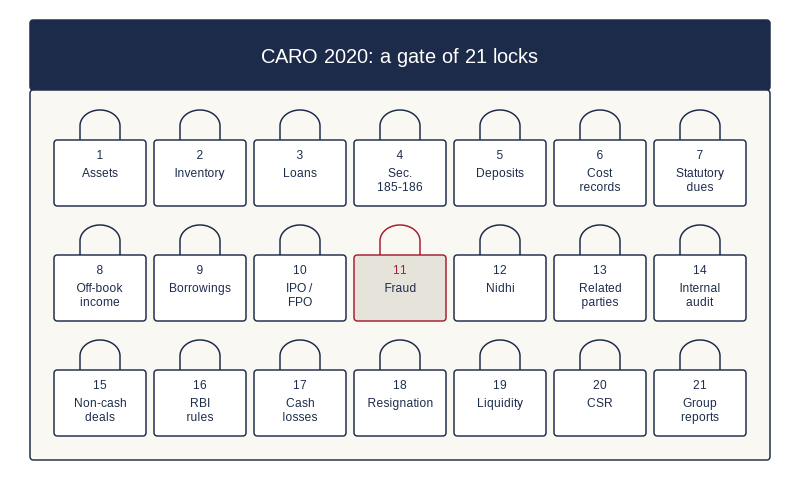
CARO 2020 ko Central Government ne 25 February 2020 ko S.O. 849(E) se notify kiya, Section 143(11) ki powers se, CARO 2016 (S.O. 1228(E), 29 March 2016) ko supersede karte hue, NFRA ke saath consultation ke baad [36]. PIB press release bhi yahi date aur 143(11) hook confirm karta hai [37]. Order 21 matters (clauses (i) se (xxi)) report karwata hai [36].
Applicability. CARO 2020 har company par lagta hai, except banking company, insurance company, Section 8 company, One Person Company, small company, aur chhoti private company jiska paid-up capital plus reserves Rs 1 crore se zyada nahi, bank ya financial institution borrowings Rs 1 crore se zyada nahi, aur revenue Rs 10 crore se zyada nahi. Foreign company par bhi lagta hai [36]. Consolidated financial statements par CARO nahi lagta, sirf clause (xxi) ko chhod kar: constituent companies ke CARO reports mein qualifications ya adverse remarks the ya nahi [36].
| Clause | Subject [36] |
|---|---|
| (xiv) | Internal audit system company ke size aur nature ke anuroop hai ya nahi |
| (xv) | Directors ke saath non-cash transactions, Section 192 compliance |
| (xvi) | RBI registration ki zaroorat aur NBFC ya HFC activities |
| (xvii) | Cash losses, is saal aur pichle saal |
| (xviii) | Statutory auditors ki resignation hui to outgoing auditor ke issues, objections ya concerns consider kiye gaye ya nahi |
| (xix) | Ratios, ageing aur realisation dates ke basis par auditor ka opinion ki company apni liabilities ek saal mein meet kar paayegi, material uncertainty to nahi |
| (xx) | CSR ke unspent amounts Section 135 ke anusaar transfer hue ya nahi |
| (xxi) | Consolidated statements mein constituent companies ke CARO remarks |
Clause (xviii) resignation ko silent exit nahi rehne deta.
Applicability date. CARO 2020 pehle FY commencing on or after 1 April 2019 par lagna tha. MCA ne S.O. 1219(E) (24 March 2020) se ise 1 April 2020 kiya, aur S.O. 4588(E) (17 December 2020) se 1 April 2021 kar diya. Yaani CARO 2020 FY 2021-22 se lagu hai; FY 2020-21 mein CARO 2016 chala [38][39].
12.10 Case study: Satyam (2009) and the sentencing
What happened
7 January 2009 ko Satyam ke chairman Ramalinga Raju ne istifa diya aur maana ki accounts mein Rs 7,000 crore ka hera-pheri hua tha [10]. Auditor PricewaterhouseCoopers ke Indian affiliates the. SEC (US) ne PwC ke India affiliates par $6 million ka fine lagaya, code of conduct aur auditing standards na follow karne ke liye [10]. 2018 mein SEBI ne Price Waterhouse ko 2 saal ke liye kisi listed company ka audit karne se roka, disgorgement Rs 13 crore se zyada [10]. Court mein kaha gaya ki Satyam mein sirf 40,000 employees the jabki 53,000 report huye the, aur har mahine Rs 200 million 13,000 non-existent employees ke naam par nikale ja rahe the [10]. Aise ghost items pakadna auditor ki duty hai. Wikipedia ke anusaar Satyam ke baad Standing Committee on Finance ne NFRA ka idea apni 21st report mein diya [11].
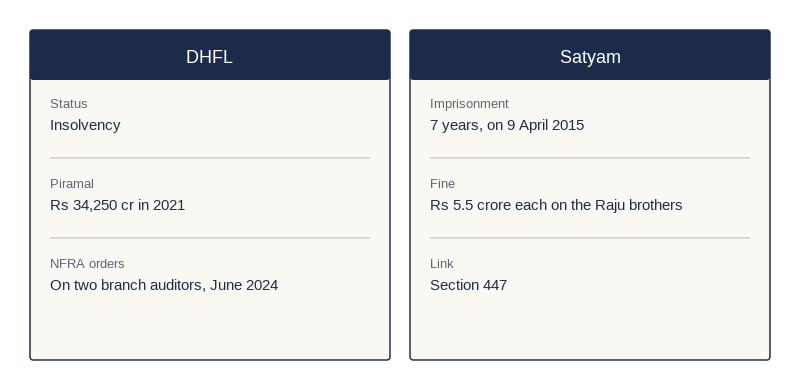
CBI ne February 2009 mein case Andhra Pradesh CID se takeover kiya (FIR 20 February 2009) aur 7 April 2009 ko pehli charge sheet file ki [33]. 9 April 2015 ko Hyderabad ki special CBI court ne Ramalinga Raju aur 9 others ko guilty paya aur 7 saal imprisonment ki saza di. Ramalinga Raju aur Rama Raju par Rs 5.5 crore each ka fine bhi laga [34].
Link to the Act
Satyam Companies Act, 1956 ke time ka tha, par aaj hota to Section 447 lagta: 6 mahine se 10 saal imprisonment aur fine amount ke 3 guna tak; public interest wala ho to minimum 3 saal [20]. Satyam ka fraud public interest wala tha (listed company, lakhon shareholders). Section 245(1)(g)(ii) ke tahat members aur depositors auditor (audit firm sahit) ke against class action mein damages claim kar sakte hain agar audit report mein improper ya misleading statement ho; Tribunal ka order company, members, depositors aur auditor par binding hota hai [23].
Lessons
Audit report ke words ke civil aur criminal dono consequences hain. 7 saal ki saza dikhati hai ki accounts falsify karna asli jail wala crime hai. Section 245 shareholders ko collective weapon deta hai.
12.11 Case study: IL&FS and DHFL
IL&FS (2018)
IL&FS ek infrastructure finance group hai. Wikipedia ke anusaar 2018 mein iski 256 group companies thi, aur Government ne 1 October 2018 ko naya board bana diya kyunki purana board apna kaam nahi nibha paya [12]. SFIO ki shuruati jaanch mein Deloitte ke audit mein kai kamiyan batayi gayi, par Bombay High Court ne Government ko Deloitte par coercive action se roka (interim relief). Source mein interim order ki date ek jagah October 2019 aur doosri jagah 4 September 2019 (first ad-interim order) hai, isliye exact date yahan nahi di gayi [12]. Corporate Affairs Secretary ne April 2020 mein kaha ki ajeeb hai ki statutory auditors, independent directors aur rating agencies mein se kisi ko pehle problem nahi dikhi; debt Rs 94,000 crore thi [12]. Kaun doshi tha, yeh court aur regulators tay karte hain; jahan court order stay hai wahan "alleged" shabd yaad rakhiye. Section 140(5) Tribunal ko auditor hatane ka power deta hai, aur 143(12) fraud reporting ka hook hai.
DHFL
Dewan Housing Finance Corporation (DHFL) India ki bada housing finance company thi. 29 January 2019 ko Cobrapost ne Rs 31,000 crore se zyada ke fraud ka allegation lagaya (DHFL ne ise mischief bataya) [29]. Baad mein DHFL IBC ke tahat insolvency mein gayi. 29 September 2021 ko Piramal Group ne DHFL ka acquisition Rs 34,250 crore total consideration (Rs 14,700 crore upfront cash aur Rs 19,550 crore NCDs) dekar poora kiya, Committee of Creditors ke approved resolution plan ke tahat [30].
NFRA ki orders list ke anusaar 21 June 2024 ko NFRA ne DHFL ke branch audit ke matter mein do alag orders pass kiye: CA Kashinath Chaturvedi ke against aur CA Krishna Bihari Chaturvedi ke against [31]. NFRA Order 017/2024 (21.06.2024) ke anusaar branch auditors ki appointment AGM mein approve nahi hui thi, yaani Section 139 ka process follow nahi hua; CA Kashinath Chaturvedi par Rs 1 lakh penalty aur 1 saal debarment laga [32].
Lessons
Branch audit bhi audit hai aur NFRA ne branch auditors ko individually target kiya. Collapse ke kai saal baad bhi orders aa sakte hain, isliye audit documentation (SA 230) auditor ka insurance hai. Yeh cases Chapter X ke rules aur enforcement ke beech ka gap dikhate hain: appointment process ka palan, fraud reporting, aur auditor ki individual accountability.
12.12 Worked problems
Problem 1 (rotation, firm). XYZ Ltd listed company hai. "M/s Sharma and Co." ne FY 2015-16 se audit shuru kiya. Kab tak audit kar sakti hai, kab cooling-off, kab wapas? Solution. Firm ka maximum tenure 2 x 5 = 10 consecutive years (Section 139(2)). FY16 se FY20 term 1; FY21 se FY25 term 2. Tenure FY 2024-25 par khatam. Cooling-off 5 saal: FY 2025-26 se FY 2029-30 (common-partner wali firms bhi). Earliest return FY 2030-31 [1].
Problem 2 (rotation, individual). Wahi company; individual CA Sharma ne FY 2015-16 se audit shuru kiya. Solution. Ek term, 5 saal: FY16 se FY20. Cooling-off FY 2020-21 se FY 2024-25. FY 2025-26 se wapas possible [1].
Problem 3 (Section 147(2) penalty). Auditor ki remuneration Rs 80,000. Usne Section 143 violate kiya (bina jaanbujhe). Maximum fine? Aur jaanbujh kar, dhokha dene ke irade se kiya ho to? Solution. Normal breach: min(Rs 5 lakh, 4 x 80,000) = min(5,00,000, 3,20,000) = Rs 3,20,000; range Rs 25,000 se Rs 3,20,000. Knowing breach: min(Rs 25 lakh, 8 x 80,000) = min(25,00,000, 6,40,000) = Rs 6,40,000; range Rs 50,000 se Rs 6,40,000, plus jail up to 1 saal [6]. Formula: min(absolute cap, multiplier x fees).
Problem 4 (Section 144). Client kehta hai, "internal audit bhi tum hi kar lo, extra fees denge." Solution. Internal audit Section 144(b) mein prohibited hai. Board approval se bhi nahi mil sakta, aur prohibition holding aur subsidiary ko service par bhi laagu hai. Refuse karna hoga [5].
Problem 5 (relative's shareholding). Partner ki wife ne client company ke shares kharide, face value Rs 5 lakh. Solution. Act text mein limit Rs 1,000 ya prescribed sum; Rule 10(1) mein prescribed sum Rs 1 lakh. Rs 5 lakh us se upar hai, to disqualification trigger hoti hai. Appointment ke baad ho to Section 141(4) ke tahat office vacate karna hoga. Shares dispose karwaye jayen ya appointment na li jaye [3][35].
Problem 6 (fraud route). Audit mein pata chala ki director ke relative ko Rs 40 lakh ka loan bina approval ke diya gaya, aur management kehta hai isse audit mein na uthayein. Solution. Pehle 143(1) ke tahat information maangiye. Misstatement ya illegality material ho to report mein qualify kijiye (143(3), reasons ke saath 143(4)). Agar yeh fraud hai: Rs 40 lakh Rs 1 crore se kam hai, to Rule 13 ke anusaar audit committee ya Board ko 2 din ke andar report [7][8]. Management ke pressure par jhukne se Section 147(2) aur NFRA ya ICAI action ka risk badhta hai.
12.13 Chapter summary
Companies Act, 2013 ka Chapter X (Sections 139 se 148) auditor ki appointment, eligibility, rotation, removal, powers, prohibited services aur penalties cover karta hai. Auditor ko members AGM mein appoint karte hain; pehla auditor Board aur government company ka auditor CAG appoint karta hai. Listed aur prescribed companies mein individual auditor 5 saal aur firm 10 saal tak rehti hai, phir 5 saal ka cooling-off. Ek auditor 20 se zyada companies ka auditor nahi ho sakta. Removal ke liye special resolution aur Central Government ki previous approval chahiye, aur retiring auditor ko apni baat kehne ka haq hai. Section 143 auditor ke powers, report ke contents aur fraud reporting deta hai; fraud threshold Rule 13 mein Rs 1 crore hai. Section 144 nau services prohibit karta hai, jinme internal audit aur book-keeping hain. Section 147 fine, jail, refund aur damages deta hai. CARO 2020 21 clauses ka additional reporting order hai jo FY 2021-22 se lagu hai. Satyam, IL&FS aur DHFL dikhate hain ki rules aur enforcement ke beech gap hota hai.
12.14 Review questions
Short answer
- Auditor ki appointment kaun karta hai, aur pehle auditor aur government company ke auditor ke liye rule alag kyon hain?
- Rotation ke rules (individual aur firm) aur cooling-off samjhaiye.
- Auditor ko term se pehle kaise hataya ja sakta hai?
- Section 140(4) ke tahat retiring auditor ke rights kya hain?
- Section 143(3) ke ten clauses mein se paanch batayiye.
- Section 143(12) aur Rule 13 ka relation aur Rs 1 crore ka matlab batayiye.
- Section 144 ki prohibited services kaun si hain, aur holding ya subsidiary ke baare mein rule kya hai?
- Section 147(2) ki penalty "whichever is less" ke saath samjhaiye.
- CARO 2020 kis par lagta hai aur consolidated statements par iska treatment kya hai?
- Satyam ke case se Section 447 aur Section 245 ka kya link banta hai?
Multiple choice
Q1. Listed company mein audit firm maximum kitne consecutive saal auditor reh sakti hai? (a) 5 saal (b) 15 saal (c) 10 saal (d) 20 saal
Answer: (c). 2 terms of 5 years (Section 139(2)). Individual ke liye sirf 5 saal.
Q2. Ek CA maximum kitni companies ka auditor ban sakta hai? (a) 10 (b) 20 (c) 15 (d) 25
Answer: (b). Section 141(3)(g): 20 companies se zyada nahi.
Q3. Government company ka auditor kaun appoint karta hai? (a) Shareholders (b) Board (c) CAG (d) Registrar
Answer: (c). Section 139(5), financial year shuru hone ke 180 din ke andar.
Q4. Auditor ko term se pehle hatane ke liye kya zaroori hai? (a) Special resolution aur Central Government ki previous approval (b) Sirf Board resolution (c) Sirf ordinary resolution (d) ICAI ka letter
Answer: (a). Section 140(1).
Q5. Kaun si service Section 144 ke tahat prohibited hai? (a) Statutory audit (b) Tax return preparation (c) AGM attend karna (d) Internal audit
Answer: (d). Internal audit clause (b) mein hai. Tax services list mein nahi hain.
Q6. Cost audit report company Central Government ko kitne din mein deti hai? (a) 30 din (b) 15 din (c) 45 din (d) 60 din
Answer: (a). Section 148: cost audit report milne ke 30 din ke andar, qualifications ke explanations ke saath.
Q7. Section 447 ke fraud ka threshold kya hai? (a) Rs 1 crore (b) Rs 5 lakh (c) Rs 10 lakh ya 1% of turnover, jo kam ho (d) Rs 50 lakh
Answer: (c). Rs 1 crore Rule 13 ka threshold hai, Section 447 ka nahi.
Q8. Rs 80,000 remuneration wale auditor ne bina jaanbujhe Section 143 violate kiya. Maximum fine? (a) Rs 5 lakh (b) Rs 6.4 lakh (c) Rs 25 lakh (d) Rs 3.2 lakh
Answer: (d). min(5 lakh, 4 x 80,000) = Rs 3.2 lakh.
Q9. Satyam case mein Hyderabad CBI court (9 April 2015) ne Ramalinga Raju aur 9 others ko kitni saza di? (a) 5 saal (b) 10 saal (c) Life imprisonment (d) 7 saal
Answer: (d). 7 saal imprisonment.
Q10. CARO 2020 ke clause (xviii) ka subject kya hai? (a) Cash losses (b) Statutory auditors ki resignation (c) CSR (d) Consolidated statements
Answer: (b). Clause (xvii) cash losses hai; (xx) CSR; (xxi) consolidated statements.
Notes and references
[1] Companies Act 2013, Section 139, kanoonhq.in, accessed 2026-11-27, https://kanoonhq.in/laws/A2013-18/sections/139. Claims: sixth AGM cycle; first auditor 30 days Board, 90 days EGM; CAG 180 and 60 days; 15 days notice to Registrar; individual 1 term of 5 years, firm 2 terms of 5 years, cooling-off 5 years; casual vacancy 139(8); 139(11). [2] Companies Act 2013, Section 140, https://kanoonhq.in/laws/A2013-18/sections/140 (accessed 2026-11-27). Claims: removal by special resolution with prior Central Government approval; resignation statement within 30 days; penalty Rs 50,000 or remuneration whichever less, Rs 500 per day continuing, maximum Rs 5 lakh; special notice 140(4); Tribunal order, 15 days, five-year bar, s.447 liability. [3] Companies Act 2013, Section 141, https://kanoonhq.in/laws/A2013-18/sections/141 (accessed 2026-11-27). Claims: 141(2) CA partners sign for the firm; 141(3)(d) proviso Rs 1,000 or prescribed sum; 141(3)(g) 20 companies; 141(4) vacation on disqualification. [4] Companies Act 2013, Section 143, https://kanoonhq.in/laws/A2013-18/sections/143 (accessed 2026-11-27). Claims: 143(1), (2), (3)(a)-(j), (4), (5), (6), (8), (9), (10), (11), (13). [5] Companies Act 2013, Section 144, https://kanoonhq.in/laws/A2013-18/sections/144 (accessed 2026-11-27). Claim: prohibited services (a)-(i); Board or audit committee approval; directly or indirectly to company, holding or subsidiary. [6] Companies Act 2013, Section 147, https://kanoonhq.in/laws/A2013-18/sections/147 (accessed 2026-11-27). Claims: 147(1)-(2) fines and knowing-breach penalties; 147(3) refund and damages; 147(5) firm and partner. [7] MCA notification G.S.R. 972(E) dated 14 December 2015 (substituted Rule 13), indiacode.nic.in, accessed 2026-11-27, https://www.indiacode.nic.in/ViewFileUploaded?file=companies_audit+and_auditors.pdf&path=AC_CEN_22_29_00008_201318_1517807327856%2Frulesindividualfile%2F. Claim: Rs 1 crore or above to Central Government; below that to Audit Committee or Board within two days; Board reply within 45 days; forward to Central Government within 15 days of reply. [8] CA Samaaj, "Section 143(12) auditor fraud reporting threshold timeline ADT-4", casamaaj.com, accessed 2026-11-27, https://www.casamaaj.com/articles/section-143-12-auditor-fraud-reporting-threshold-timeline-adt-4. Claim: Rule 13 threshold Rs 1 crore; below that to audit committee or Board. [9] Cyril Amarchand Mangaldas blog, "NFRA circular on fraud reporting and India Inc's dilemma", January 2024, https://corporate.cyrilamarchandblogs.com/2024/01/nfra-circular-on-fraud-reporting-and-india-inc-s-dilemma/ (accessed 2026-11-27). Claim: NFRA circular para 4.2 (secondary source). [10] Wikipedia, "Satyam scandal", accessed 2026-11-27, https://en.wikipedia.org/wiki/Satyam_scandal. Claims: Rs 7,000 crore manipulation, resignation 7 January 2009; $6 million SEC fine on PwC India arm; SEBI 2-year bar in 2018, disgorgement over Rs 13 crore; 40,000 vs 53,000 employees, Rs 200 million monthly. [11] Wikipedia, "National Financial Reporting Authority", accessed 2026-11-27, https://en.wikipedia.org/wiki/National_Financial_Reporting_Authority. Claim: Standing Committee on Finance proposed NFRA in its 21st report after Satyam. [12] Wikipedia, "Infrastructure Leasing and Financial Services", accessed 2026-11-27, https://en.wikipedia.org/wiki/Infrastructure_Leasing%26_Financial_Services. Claims: 256 group companies as of 2018; new board 1 October 2018; SFIO probe lapses in Deloitte audit; Bombay HC interim relief; Rs 94,000 crore debt; April 2020 statement by Corporate Affairs Secretary. [13] Ministry of Corporate Affairs, Companies Act 2013 page, mca.gov.in, accessed 2026-11-27, https://www.mca.gov.in/mca/html/mcav2_en/home/actsandrules/companies+act++2013/companiesact2013.html. Claim: assent 29 August 2013, gazette 30 August 2013. [14] ICSI, "The Companies Act 2013: A Ready Reference", docslib.org, accessed 2026-11-27, https://docslib.org/doc/4420680/the-companies-act-2013-a-ready-reference-cover. Claim: 470 sections, 29 chapters, 7 schedules. [15] DComply Academy, "The shape of the Act", accessed 2026-11-27, https://academy.dcomply.in/courses/companies-act-mca-practitioner/m/67/the-shape-of-the-act. Claim: 29 chapters, 470 sections, 7 schedules; Chapter X audit (139-148). [16] Companies Act 2013, Section 128, https://kanoonhq.in/laws/A2013-18/sections/128 (accessed 2026-11-27). Claim: books at registered office; 128(6) penalty. [17] Companies Act 2013, Section 129, https://kanoonhq.in/laws/A2013-18/sections/129 (accessed 2026-11-27). Claim: true and fair, Schedule III; 129(7) penalty. [18] Companies Act 2013, Section 134, https://kanoonhq.in/laws/A2013-18/sections/134 (accessed 2026-11-27). Claim: 134(8) penalties. [19] Companies Act 2013, Section 177, https://kanoonhq.in/laws/A2013-18/sections/177 (accessed 2026-11-27). Claim: audit committee composition; auditors' right to be heard without vote; Rs 1 crore ratification within 3 months. [20] Companies Act 2013, Section 447, https://kanoonhq.in/laws/A2013-18/sections/447 (accessed 2026-11-27). Claim: 6 months to 10 years, fine up to 3x amount, public interest minimum 3 years; smaller fraud proviso. [21] Companies Act 2013, Section 178, https://kanoonhq.in/laws/A2013-18/sections/178 (accessed 2026-11-27). Claim: 178(8) penalties. [22] Companies Act 2013, Section 197, https://kanoonhq.in/laws/A2013-18/sections/197 (accessed 2026-11-27). Claim: 197(1) 11% cap; 197(15) penalties; 197(16) auditor's statement. [23] Companies Act 2013, Section 245, https://kanoonhq.in/laws/A2013-18/sections/245 (accessed 2026-11-27). Claim: 245(1)(g)(ii); 245(6); 245(9) banking exclusion. [24] Companies Act 2013, Section 142, https://kanoonhq.in/laws/A2013-18/sections/142 (accessed 2026-11-27). Claim: remuneration in general meeting; Board for first auditor; excludes other services. [25] Companies Act 2013, Section 145, https://kanoonhq.in/laws/A2013-18/sections/145 (accessed 2026-11-27). Claim: qualifications read in general meeting, open to inspection. [26] Companies Act 2013, Section 146, https://kanoonhq.in/laws/A2013-18/sections/146 (accessed 2026-11-27). Claim: notices to auditor; attendance; right to be heard. [27] Companies Act 2013, Section 148, https://kanoonhq.in/laws/A2013-18/sections/148 (accessed 2026-11-27). Claim: cost records and cost auditor; s.139 auditor barred; filing within 30 days; cost auditing standards by the Institute of Cost Accountants of India. [28] MCA notification G.S.R. 583(E) dated 13 June 2017, serial 9A, upload.indiacode.nic.in, accessed 2026-11-27, https://upload.indiacode.nic.in/showfile?actid=AC_CEN_22_29_00008_201318_1517807327856&filename=Exemption+to+Private+Companies+under+section+462+of+CA%2C+2013.pdf&type=notification. Claim: s.143(3)(i) exemption, corrected to "and" by S.O. 2218(E) dated 13 July 2017. [29] The Hindu, "Cobrapost alleges Rs 31,000 crore fraud, DHFL calls report mischief with mala fide intent", 29 January 2019, https://www.thehindu.com/news/national/cobrapost-alleges-31000-crore-fraud-dhfl-calls-report-mischief-with-mala-fide-intent/article26122803.ece (accessed 2026-11-27). [30] Business Standard, "Piramal Group acquires DHFL for total consideration of Rs 34,250 cr", 29 September 2021, https://www.business-standard.com/article/companies/piramal-group-acquires-dhfl-for-total-consideration-of-rs-34-250-cr-121092900395_1.html (accessed 2026-11-27). [31] NFRA, Orders page, nfra.gov.in, accessed 2026-11-27, https://nfra.gov.in/document-category/orders/. Claim: two DHFL Branch Audit orders dated 21/06/2024. [32] TaxGuru, "NFRA penalizes CA for professional misconduct in auditing DHFL branches", accessed 2026-11-27, https://taxguru.in/company-law/nfra-penalizes-ca-professional-misconduct-auditing-dhfl-branches.html. Claim: NFRA Order 017/2024; Rs 1 lakh penalty and 1 year debarment. [33] The New Indian Express, "CBI files charge sheet in Satyam fraud case", 7 April 2009, https://www.newindianexpress.com/states/andhra-pradesh/2009/Apr/07/cbi-files-charge-sheet-in-satyam-fraud-case-39267.html (accessed 2026-11-27). [34] The Hindu, "All 10 accused found guilty in Satyam case", https://www.thehindu.com/business/All-10-accused-found-guilty-in-Satyam-case/article60344158.ece (accessed 2026-11-27). [35] Companies (Audit and Auditors) Rules 2014, Rule 10, ca2013.com, accessed 2026-11-27, https://ca2013.com/rule/10-10-audit-auditors/. [36] TaxGuru, "CARO 2020", https://taxguru.in/company-law/caro-2020.html (accessed 2026-11-27). Claims: S.O. 849(E), 25 February 2020; applicability; clauses (i)-(xxi). [37] PIB press release, https://www.pib.gov.in/PressReleasePage.aspx?PRID=1604390&lang=2®=48 (accessed 2026-11-27). [38] ICAI, "Extension of applicability date of CARO 2020 for one year", 19 December 2020, https://icai.org/post/extension-applicability-date-caro-2020-for-one-year (accessed 2026-11-27). [39] TaxGuru, "MCA defers applicability of CARO 2020 to FY 2021-22", https://taxguru.in/company-law/mca-deffers-applicability-caro-2020-fy-2021-22.html (accessed 2026-11-27).