Audit of Assets and Liabilities
Abstract
Is chapter mein balance sheet ke dono taraf ki audit samjhayi gayi hai: assets ka verification aur liabilities ka completeness test. Pehle vouching aur verification ka farq define kiya gaya hai. Phir fixed assets, inventory, receivables, cash aur bank ke procedures diye gaye hain, jo SA 501, SA 505, SA 540, SA 560 aur SA 570 se jude hain. Liabilities mein mukhya risk understatement hai, isliye subsequent payments, unrecorded liabilities search aur legal confirmation par dhyan diya gaya hai. Case study Carillion plc (UK) ki hai. Short cases Olympus, Toshiba, Autonomy, Valeant aur Kingfisher Airlines par hain. Chapter ka research question yeh hai: auditor kaise tay kare ki balance sheet na assets ko badha kar dikha rahi hai, na liabilities ko ghata kar.
Learning objectives
Is chapter ke baad reader:
- Distinguish karega vouching (P&L ke transactions) aur verification (balance sheet ke items) ke beech.
- Define karega existence, ownership, possession aur valuation, aur liabilities ke liye completeness test.
- Evaluate karega har asset class ke liye sahi audit procedure: fixed assets, inventory, receivables, cash aur bank.
- Explain karega inventory count mein floor-to-sheet aur sheet-to-floor direction ka farq aur lower of cost and NRV ka rule.
- Evaluate karega unrecorded liabilities, contingent liabilities aur going concern ka audit treatment.
- Analyse karega Carillion ke case mein estimates, liabilities aur auditor tenure ki failures.
10.1 Introduction and research question
Balance sheet ek tarah se company ki sthiti ki photograph hai, jo ek tay tareekh par li jati hai (jaise 31 March). Yeh photograph tab bharosemand hoti hai jab (a) jo assets dikhaye gaye hain wo sach mein hain, company ke hain aur sahi value par hain, aur (b) jo liabilities honi chahiye wo sab dikhayi gayi hain. Management ke paas dono taraf temptation rehta hai: assets ko phulana (overstatement) aur liabilities ko chhupana ya ghatana (understatement). Profit aur net worth, dono, isi se banta hai. Isliye assets aur liabilities dono ki audit equally zaroori hai.
Is chapter ka research question: ek auditor evidence ke saath yeh kaise sthapit kare ki balance sheet ke assets sahi hain aur liabilities poori hain, aur jab yeh kaam fail hota hai to uska natija kya hota hai? Carillion plc iska sabse bada udaharan hai, jahan 2018 mein company lagbhag £7 billion liabilities ke saath collapse hui.
10.2 Vouching and verification
Vouching transactions ki checking hai: kya kharcha sahi amount ka tha, sahi authority se hua, aur voucher maujood hai. Iska focus profit and loss account par hota hai. Verification assets aur liabilities ki checking hai: kya balance sahi hai, exist karta hai, company ka hai aur sahi value par hai. Iska focus balance sheet par hota hai.
Ek upyogi tulna: P&L poore saal ki film hai, balance sheet ek tareekh ki photograph. Vouching film ke frames check karta hai, verification photograph ki authenticity.
| Basis | Vouching | Verification |
|---|---|---|
| Focus | Transactions aur P&L account | Assets, liabilities aur balance sheet |
| Prashn | Transaction sahi, authorised aur supported hai? | Balance exist karta hai, company ka hai, sahi value par hai? |
| Samay ka drishtikon | Poore saal ka record | Reporting date ki sthiti |
Four tests for assets
Assets ke liye auditor chaar cheezein check karta hai.
- Existence: asset sach mein maujood hai.
- Ownership: asset company ka hai (title documents se).
- Possession: asset company ke paas hai.
- Valuation: asset sahi value par dikhaya gaya hai.
Completeness test for liabilities
Liabilities ke liye risk ulta hai. Yahan sabse bada khatra overstatement nahi, understatement hai. Auditor poochta hai: koi liability chhupi to nahi? Is test ko completeness test kehte hain.
Critical discussion
Existing vs completeness ka farq exam mein aksar ulta kar diya jata hai. Assets ke liye prashn "jo dikhaya hai wo hai ya nahi" (existence) pehle aata hai. Liabilities ke liye prashn "jo hona chahiye wo dikhaya hai ya nahi" (completeness) pehle aata hai. Isliye sampling ki disha bhi alag hoti hai: assets mein books se asli cheez ki taraf, liabilities mein bahar ke records se books ki taraf.
10.3 Verification of fixed assets
Fixed assets mein teen kaam hote hain.
Existence and possession. Physical inspection aur site visit karke fixed assets register ka asli assets se match karna. Register mein likhi jo machine physically maujood nahi hai, use ghost asset kehte hain. Existence test isi ko pakadta hai.
Ownership. Title deeds, purchase documents aur registration papers dekhna. Building ke papers kiske naam par hain, yeh dekhna zaroori hai.
Valuation. Cost minus depreciation. Auditor dekhta hai ki depreciation sahi rate se lagi aur useful life sahi hai ya nahi.
Charges
Agar machinery ya property kisi ke paas mortgage hai, to Registrar of Companies ke records mein registered charges dekhne chahiye. Mortgaged asset ko free asset ki tarah nahi dikhana chahiye, aur balance sheet notes mein disclosure zaroori hai.
Additions and disposals
Naye additions ka verification vouching se hota hai: purchase invoice, installation cost aur capitalization ka decision. Yahan ek fraud technique hai: revenue expense ko capital expense bana dena. Source ke anusaar WorldCom ne yeh technique use ki thi, jisme normal expenses capitalize kiye gaye taaki profit badhe. Isliye auditor capital aur revenue ke split ko check karta hai.
Disposals mein auditor dekhta hai ki bechi ya scrap hui asset register se hati ya nahi, sale proceeds record hui ya nahi, aur profit ya loss on disposal sahi nikla ya nahi.
Worked example (kaalpanik)
Ek company ke register mein 10 machines hain. Site visit mein sirf 9 mile. Auditor pata lagata hai ki dasvi machine pichhle saal scrap ho gayi thi, par register se hati nahi aur uska sale proceeds ka record bhi nahi hai. Yeh existence ka exception hai. Auditor asset aur accumulated depreciation hataane ki adjustment, aur disposal par profit ya loss ka hisaab mangta hai.
Critical discussion
Physical inspection existence batati hai, ownership nahi. Ek machine saamne khadi ho sakti hai par kisi aur ki ho sakti hai ya mortgage mein ho sakti hai. Isliye inspection aur title documents dono chahiye. Aur additions mein capital-revenue ka decision judgement hai, jahan management ka bias aa sakta hai.
10.4 Verification of inventory
Inventory audit ka sabse sensitive area hai, kyunki maal ghumta rehta hai. SA 501 inventory ki attendance ko specifically cover karta hai. Auditor stock count par jaata hai ya company ke count ko observe karta hai.
What observation gives
Observation do cheezein deta hai: existence ka evidence, aur company ke counting procedures ki reliability ka evidence. Auditor khud sample items ginta hai aur dono direction mein check karta hai.
| Direction | Kya check hota hai | Kya pakadta hai |
|---|---|---|
| Floor to sheet | Jo maal floor par pada hai wo count sheet mein hai ya nahi | Completeness |
| Sheet to floor | Jo count sheet mein hai wo floor par pada hai ya nahi | Existence |
Valuation
Rule: stock cost ya net realisable value (NRV), jo bhi kam ho, us par dikhaya jata hai. NRV ka matlab bikri se milne wali kimat mein se bikri ka kharcha ghatane ke baad ka amount hai. Sada hua ya purane model ka maal cost par nahi dikhaya ja sakta. Auditor slow-moving aur obsolete stock ki list mangta hai.
Cut-off
Cut-off test dekhta hai ki 31 March ke aas paas ki sales aur purchases sahi period mein record hui hain ya nahi. Cut-off manipulation se stock aur sales dono distort hote hain.
Stock with third parties
Jahan maal consignee ya job worker ke paas hai, wahan direct confirmation li jati hai. Wo likh kar confirm karte hain ki company ka maal unke paas hai.
Worked example (kaalpanik)
Ek item ki cost 100 hai, par purana model hone ke karan uska NRV 60 hai. Stock 60 par dikhana hoga, 100 par nahi. 40 ka difference loss ke roop mein record hota hai. Journal entry: Stock write-down (loss) Dr 40, Inventory Cr 40.
Critical discussion
Count sirf ek tareekh ka evidence hai. Agar count balance sheet date se alag din hua, to beech ke movement ka roll-forward chahiye. Ye mudda source mein detail se nahi diya gaya, isliye yahan keval itna kaha ja raha hai ki count ka date aur cut-off saath dekhe jate hain.
10.5 Verification of receivables, cash and bank
Receivables
Company kehti hai ki debtors se itna milna hai. Sabse strong evidence direct confirmation hai (SA 505). Auditor selected debtors ko letter bhejta hai jisme balance confirm karne ko kaha jata hai. Reply seedha auditor ke office aana chahiye, company ke haath se nahi. Kaaran: company beech mein reply badal sakti hai. Source ke anusaar Satyam case mein fake bank balances dikhaye gaye the. Isliye confirmation process par control auditor ke paas rehna chahiye: kisko bheja gaya, reply kahan se aaya, aur envelope kya tha.
Ageing and provision
Purane debtors ke liye provision for doubtful debts check hota hai. Ageing analysis debtors ko samay ke slabs mein baantta hai: 0 se 30 din, 30 se 90 din, 90 din se zyada. Jitna purana, utna doubtful.
Cash and bank
Cash ka physical count surprise mein hota hai, cashier ki maujoodgi mein. Bank ke liye bank statement se reconciliation aur seedha bank confirmation liya jata hai. Bank reconciliation statement ka audit classic exam topic hai. Outstanding cheques aur deposits in transit sab check hote hain.
Critical discussion
Direct confirmation tab kamzor ho jata hai jab debtor khud company ke control mein ho (isi chapter ka Valeant section dekhiye). Aur confirmation sirf existence batata hai, recoverability nahi. Recoverability ke liye ageing aur provision ka test alag se chahiye.
10.6 Audit of liabilities
Liabilities mein sabse bada risk chhupa hua udhar hai. Jo cheez books mein hi nahi, use pakadna audit ka sabse kathin kaam hai. Kuch techniques:
- Subsequent payments. Year end ke baad company ne kisko paise diye? Agar April mein kisi supplier ko payment hui par March ki books mein wo liability nahi thi, to liability chhupi thi. Baad ka data pichhle saal ka sach batata hai.
- Unrecorded liabilities search. Year end ke baad aaye invoices, unmatched purchase orders, goods received but not invoiced.
- Documents ka review. Loan agreements, board minutes aur legal letters. Yahan undisclosed borrowings ya guarantees mil sakti hain.
Contingent liabilities
Contingent liability ek possible obligation hai, jaise chalta hua court case. Is par books mein entry nahi hoti, par notes mein disclose karna zaroori hai. Auditor lawyer ko letter bhejta hai (legal confirmation) jisme pending cases aur unka possible outcome poocha jata hai.
Going concern
Jab company doob rahi ho, to liabilities tezi se badhti hain. Going concern (SA 570) ka prashn hai: kya company agle 12 mahine chal payegi? Agar nahi, to balance sheet ki poori valuation basis badal jati hai, aur assets liquidation value par aate hain, jo aksar bahut kam hoti hai.
Assertion view
Balance sheet audit assertions ke aas paas structured hai: existence, rights and obligations, completeness, accuracy and valuation, presentation. Asset overstatement aur liability understatement dono earnings management ke classic channels hain. Procedures assertion se mapped hain.
| Procedure | Assertion |
|---|---|
| Additions ki vouching | Occurrence |
| Title deeds ka review | Rights |
| Count mein attendance | Existence |
| NRV testing | Valuation |
| Subsequent cash payments ka review | Completeness of liabilities |
SA 501 inventory aur litigation, dono ke specific procedures deta hai. Cut-off testing period-end manipulation ke khilaf pramukh defence hai. Going concern auditor ko 12 mahine aage dekhne par majboor karta hai; material uncertainty disclose honi chahiye, aur basis inappropriate ho to adverse opinion banta hai.
Critical discussion
Unrecorded liability search is liye kathin hai ki auditor ko wo cheez dhundhni hai jo record mein nahi hai. Isliye evidence bahar se aata hai: lenders, lawyers, suppliers, aur year end ke baad ke payments. Audit samples ko books ke andar se nahi, books ke bahar se shuru karna chahiye.
10.7 Estimates and valuation (SA 540)
Valuation ke zyadatar mudde estimates par tike hain: depreciation ki useful life, doubtful debts ka provision, NRV, contract revenue. SA 540 ke tahat auditor ko management ke bias ko actively test karna hota hai. Construction sector isliye high risk hai: long-term contract accounting (percentage of completion, WIP valuation, onerous contract provisions) estimates par chalti hai, aur estimates mein management bias ghusna aasan hai.
10.8 Case study: Carillion plc (UK)
What happened
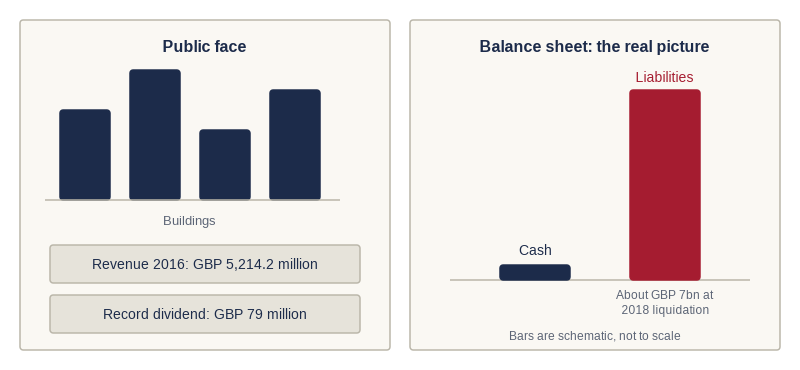
Carillion ek British construction aur facilities management company thi. Wo July 1999 mein Tarmac se demerger se bani aur UK ki second largest construction company ban gayi [1]. 2016 mein uski revenue £5,214.2 million thi aur lagbhag 43,000 employees the, jinmein 18,257 UK mein the [2].
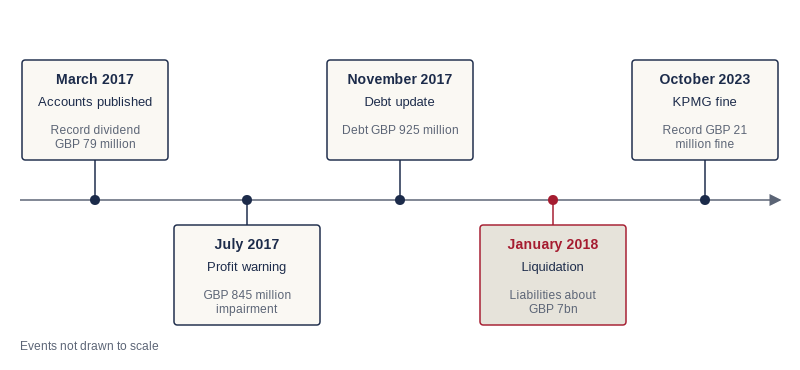
Company ne 1 March 2017 ko 2016 ke accounts publish kiye. Usi base par record dividend £79 million declare hua, jismein £55 million 10 June 2017 ko pay hua [3]. Chaar mahine baad, 10 July 2017 ko company ne construction contracts par £845 million ke impairment ki profit warning di [4]. September 2017 mein yeh badh kar £1,045 million ho gaya, jo pichhle saat saalon ke total profit ke barabar tha [3]. November 2017 mein company ne kaha ki debt £925 million tak pahunch raha hai; share price 18p tak gira aur poori company ki market value £73 million reh gayi [5].
15 January 2018 ko Carillion compulsory liquidation mein gayi, lagbhag £7 billion liabilities ke saath [6]. Us samay cash sirf £29 million tha [7]. April 2018 mein Official Receiver ne 27 liquidated UK companies ki total liabilities £6.9 billion anumanit ki, jo 2016 accounts mein dikhaye figure se teen guna se zyada thi [8]. National Audit Office ke anusaar £2.6 billion ki pension liabilities Pension Protection Fund par aayi, 13 schemes aur 27,000 members ke saath [9].
The audit failure
KPMG Carillion ka auditor 19 saal raha aur is kaam ke liye use £29 million mile. UK Parliament ke Business and Work and Pensions Committees ke report ke anusaar KPMG ne ek baar bhi apna audit opinion qualify nahi kiya [3]. Matlab, jab company £845 million ka impairment le rahi thi, tab tak pichhle accounts par clean opinion diya ja chuka tha.
Regulatory and legal outcome
Feb 2022 mein Official Receiver ne KPMG ke khilaf £1.3 billion ke audit negligence ka claim file kiya [10]. 12 October 2023 ko UK regulator FRC ne KPMG par Carillion audits ke liye record £21 million ka fine lagaya [11].
A further angle: reverse factoring and hidden debt
Reverse factoring (supply chain finance) mein bank supplier ko jaldi bhugtan karta hai aur company bank ko baad mein deti hai, aksar lambe terms par. Sawal yeh hai ki company ise trade payable dikhaye ya borrowings. Dono se balance sheet par dikhne wala debt alag ho jata hai. Classification terms ki prakriti par depend karta hai. Is chapter ke sources mein is vishay par koi specific accounting standard ya SA paragraph nahi liya gaya, isliye yahan koi standard reference nahi diya gaya.
Wikipedia ke anusaar UBS analyst Gregor Kuglitsch ne March 2015 mein Carillion ke extended supplier payment terms aur reverse factoring ke use par dhyan dilaya aur kaha ki company reported se zyada leveraged hai [12]. Wikipedia yeh bhi kehta hai ki June 2016 tak Carillion ke 20% se zyada shares hedge funds ko loan par the, jabki 2015 ki shuruat mein yeh 5% se kam tha [13]. Collapse ke samay Wikipedia ke anusaar company ke paas around £900M debt aur £580M pension deficit tha, aur £29M cash [14]. (Debt ke figures alag sources mein alag tareekh par hain: £925 million [5] aur around £900 million [14]. Yahan dono source ke anusaar diye gaye hain.)
Jab bahar ke analysts ya short-sellers ek hi cheez par sawal uthayen, to auditor ke paas teen kaam hone chahiye: supplier payment terms ki details saal bhar ke trend ke saath mangna; bank aur financing contracts padh kar accounting treatment ko terms se match karna; aur year end ke aas paas payables ke unusual movement ko test karna.
Lessons
- Contract assets ki valuation mukhya samasya thi. Long-term contracts mein revenue recognition estimates par chalti hai. Carillion ne aggressive estimates use kiye. Auditor ko inhe SA 540 ke tahat challenge karna tha, jo effectively nahi hua.
- Liabilities dramatically understate ho sakti hain. Actual liabilities 2016 ke figure se teen guna se zyada nikli. Completeness testing fail hui.
- Going concern ke red flags kai the: profit warnings, £925 million debt aur £29 million cash, phir bhi clean opinions diye gaye.
- Dividend profit ke saath cash par bhi tike. Record dividend us company ne diya jiske paas cash nahi tha. Balance sheet audit ko liquidity aur solvency dono dekhni chahiye.
- Auditor tenure aur familiarity risk. 19 saal ek hi auditor raha. Source ke anusaar India mein isi karan listed companies mein auditor rotation mandatory hai.
- Bahar ke sawal risk assessment ko update karne ka trigger hain. Short-seller ke aarop evidence nahi hain, par auditor ko unhe ek data point maan kar risk assessment update karna chahiye.
Critical discussion
Yeh case teen alag-alag layers dikhata hai: accounting estimates (contract valuation), disclosure (liabilities aur going concern), aur audit governance (tenure). Parliament report kya batati hai wo source mein sirf headline tak hai, isliye yeh nahi kaha ja sakta ki audit ke kaun se working paper fail hue. Jo kaha ja sakta hai wo yeh hai ki outcome (liquidation, claim, fine) un lessons se mel khata hai.
10.9 Short case studies
Olympus (Japan)
Olympus camera aur medical equipment company hai. October 2011 mein naye CEO Michael Woodford ko hataya gaya jab usne kuch acquisition payments par sawal uthaye. Wikipedia ke anusaar yeh baad mein ek bade scandal mein badla, jisme ¥117.7 billion ($1.5 billion) ke investment losses chhupane ka aarop tha [15]. Woodford ne 2008 ke $2.2 billion ke Gyrus Group acquisition par sawal uthaye; ek middleman ko $687 million success fee di gayi, jo purchase price ka 31% tha [16]. 8 November 2011 ko company ne maana ki paisa 1990s se chale aa rahe investment losses cover karne ke liye use hua aur accounting "not appropriate" thi [17].
Asset audit ka angle: goodwill aur intangibles ki carrying value, advisory fee ke unusual size ka business reason, aur investments ki independent price ya custodian confirmation. Exam angle: related party aur unusual transactions mein auditor business rationale samajhta hai, board approvals dekhta hai aur counterparty ki independence verify karta hai. Yeh SA 550 (Related Parties) ke bhaav ke anusaar hai [18]; paragraph number verify nahi kiya gaya.
Toshiba (Japan)
Toshiba ne May 2015 mein bataya ki wo accounting scandal ki jaanch kar raha hai. 21 July 2015 ko CEO Hisao Tanaka ne resign kiya. Wikipedia ke anusaar pichhle saat saal mein profits $1.2 billion se inflated the, aur aath aur senior officials ne bhi resign kiya [19]. Source mein exact mechanism aur auditor ka detail nahi hai, isliye yahan nahi diya gaya. Seekh: audit ek saal ka hota hai par pattern multi-year ho sakta hai, isliye pichhle saal ke estimates ka hindsight review zaroori hai.
Autonomy and HP
Wikipedia ke anusaar Hewlett-Packard ne October 2011 mein Autonomy ko $11.7 billion (£7.4 billion) mein kharida aur ek saal ke andar $8.8 billion ka write-off kiya. HP ne "serious accounting improprieties" ka aarop lagaya, jabki purane CEO Mike Lynch ne kaha ki samasya HP ke run karne mein thi [20]. Seekh: goodwill aur intangibles ke impairment testing mein assumptions (growth rates, discount rates) ka evidence sabse zaroori hai. Jab do parties ke bayan alag hon, to auditor dono ke assumptions ko independent data se test karta hai. Exam trap: "Goodwill ka impairment auditor test nahi karta" galat hai; auditor management ke impairment assumptions test karta hai.
Valeant and Philidor
21 October 2015 ko short-seller Citron Research ke Andrew Left ne aarop lagaya ki Valeant ne specialty pharmacy Philidor Rx Services ko jo sales dikhayi wo false thi, kyunki Valeant hi Philidor ko control karta tha [21]. Yeh Wikipedia dwara report kiya gaya aarop hai; source mein aage ke audit ya restatement ka outcome nahi hai, isliye wo yahan nahi likha gaya. Seekh: related ya controlled customers ko pehchaniye. Debtor confirmation tab kamzor hai jab debtor khud company ke control mein ho. Substance over form dekhiye: kya bikri asli third-party sale hai ya group ke andar ka transfer?
Kingfisher Airlines (India)
Wikipedia ke anusaar Kingfisher Airlines 20 October 2012 ko band hui, saalon ke continuous losses aur high debts ke baad [22]. Ek BSE disclosure mein company ne bade nuksan aur net worth erosion bataya, par financial statements going concern basis par tayyar kiye gaye [23]. July 2014 mein Kingfisher ka karz India ke state-owned banks ka top non-performing asset ban gaya, jahan ₹40 billion se zyada ka karz wapas nahi hua [24]. Seekh: jab net worth erode ho chuka ho, SA 570 ke anusaar management ke going concern plans (debt recast, fleet recovery) ke evidence ki gehri jaanch chahiye, sirf unke bayan par nahi.
10.10 Worked problems
Problem 1 (inventory valuation, kaalpanik). Ek company ke paas teen items hain. Item A: cost 50, NRV 70. Item B: cost 80, NRV 55. Item C: cost 30, NRV 30. Stock ka sahi value kya hoga? Solution. Har item ko cost aur NRV mein se kam par dikhaya jata hai. A: 50. B: 55. C: 30. Total = 135. Cost total 160 hota; write-down = 160 minus 135 = 25 (sirf Item B par). Journal entry: Stock write-down (loss) Dr 25, Inventory Cr 25. Item A ko 70 par nahi badhaya jata, kyunki yeh unrealised profit hoga (prudence).
Problem 2 (ageing and provision, kaalpanik). Debtors: 0 se 30 din mein 400; 30 se 90 din mein 300; 90 din se upar 100. Management 90 din se upar ke poore balance ka provision mangta hai. Audit adjustment kya hoga agar company ne koi provision nahi banaya? Solution. Provision = 100 (90 din se upar ke slab ka balance). Entry: Bad debts expense Dr 100, Provision for doubtful debts Cr 100. Net receivables = 800 minus 100 = 700. Auditor yeh bhi test karta hai ki 90 din se upar ke balance par management ka vasooli ka anumaan reasonable hai ya nahi.
Problem 3 (bank reconciliation, kaalpanik). Cash book ka balance 5,000 hai. Ek cheque 600 ka issue hua par bank mein present nahi hua. Ek deposit 400 ka bank ne abhi credit nahi kiya. Bank statement ka balance kitna hoga? Solution. Cash book balance 5,000 se shuru karen. Unpresented cheque ke karan bank balance cash book se zyada hoga: +600. Deposit in transit ke karan bank balance cash book se kam hoga: minus 400. Bank statement balance = 5,000 + 600 minus 400 = 5,200. Auditor ek-ek reconciling item ko baad ki bank statement aur supporting documents se match karta hai.
Problem 4 (completeness of liabilities, kaalpanik). 31 March ko creditors 1,000 dikhaye gaye. April mein ek supplier ko 150 ki payment hui, jiska invoice 28 March ka hai par books mein 31 March tak record nahi hua. Adjustment kya hogi? Solution. Yeh unrecorded liability hai jo 31 March ki hai. Entry: Purchases (ya relevant expense/asset) Dr 150, Creditors Cr 150. Creditors 1,150 ho jate hain. Yeh subsequent payments test ka seedha udaharan hai.
10.11 Chapter summary
Verification balance sheet ke assets aur liabilities ki jaanch hai, jabki vouching P&L ke transactions ki jaanch hai. Assets ke liye chaar test hain: existence, ownership, possession aur valuation. Liabilities ke liye mukhya test completeness hai, kyunki risk understatement ka hai. Fixed assets mein register se physical matching, title deeds, depreciation aur ROC charge search hota hai. Inventory mein SA 501 ke tahat count attendance, dono direction ki testing, cut-off aur lower of cost and NRV ka rule lagta hai. Receivables mein direct confirmation (SA 505) aur ageing se provision ka test hota hai. Liabilities mein subsequent payments, unrecorded liability search, board minutes aur legal letters upyogi hain. Contingent liabilities books mein nahi, notes mein disclose hoti hain. Going concern (SA 570) doubtful ho to valuation basis badal jata hai. Carillion mein contract valuation, liabilities ki completeness, going concern aur 19 saal ke auditor tenure, sab par sawal uthe, aur 2023 mein FRC ne £21 million ka record fine lagaya.
10.12 Review questions
Short answer
- Vouching aur verification ka farq spasht kijiye.
- Assets verification ke chaar pillars kya hain?
- Ghost asset kya hota hai aur use kaun sa test pakadta hai?
- Fixed assets par charge ki jaanch kaise hoti hai aur kyon?
- Floor-to-sheet aur sheet-to-floor testing mein kya farq hai?
- Stock valuation ka rule kya hai aur sade hue maal par kaise lagta hai?
- Debtors ki direct confirmation ka reply seedha auditor ko kyon aana chahiye?
- Unrecorded liabilities pakadne ke do tareeke batayiye.
- Contingent liability ka accounting treatment kya hai aur auditor legal confirmation kyon leta hai?
- Carillion ke case se auditor tenure aur going concern par kya seekh milti hai?
Multiple choice
Q1. Verification ka main uddeshya kya hai? (a) Transactions ki arithmetic check (b) Tax calculation (c) Assets aur liabilities ka existence, ownership aur valuation check karna (d) Sirf fraud pakadna
Answer: (c). Verification balance sheet items ki jaanch hai: wo exist karte hain, company ke hain, aur sahi value par hain.
Q2. Stock (inventory) kis value par dikhaya jata hai? (a) Cost price (b) Cost ya net realisable value, jo bhi kam ho (c) Market price (d) Selling price
Answer: (b). Lower of cost and NRV, prudence ke sidhant par.
Q3. Liabilities ki audit mein sabse bada risk kya hai? (a) Overstatement (b) Wrong classification (c) Typing mistakes (d) Understatement ya unrecorded liabilities
Answer: (d). Companies liabilities chhupane ya ghatane mein interested ho sakti hain, isliye completeness test zaroori hai.
Q4. Contingent liability ko kahan dikhaya jata hai? (a) Balance sheet ke liability side mein entry (b) Balance sheet ke notes mein disclosure (c) P&L account mein (d) Kahin nahi
Answer: (b). Possible liability par books mein entry nahi hoti, par notes mein disclose hoti hai.
Q5. Debtors ki verification ka sabse strong tareeka kya hai? (a) Ledger dekhna (b) Management se poochna (c) Sales register dekhna (d) Debtors se direct confirmation
Answer: (d). Direct external confirmation (SA 505), reply seedha auditor ko.
Q6. Count sheet se floor ki taraf test karne se kya pakda jata hai? (a) Existence (b) Completeness (c) Cut-off (d) Ownership
Answer: (a). Sheet mein likhi cheez floor par hai ya nahi, yeh existence ka test hai. Floor se sheet completeness ka test hai.
Q7. Capital aur revenue expenditure ka galat split kis fraud technique ka hissa hai? (a) Normal expenses ko capitalize karke profit badhana (b) Cash ka physical count (c) Bank confirmation (d) Debtor ageing
Answer: (a). Source ke anusaar WorldCom ne normal expenses capitalize kiye the.
Q8. Going concern ka standard kaun sa hai? (a) SA 501 (b) SA 505 (c) SA 570 (d) SA 540
Answer: (c). SA 570 agle 12 mahine ke look-ahead ka standard hai. SA 540 estimates ka, SA 505 confirmation ka, SA 501 inventory ka hai.
Q9. Carillion ka auditor kitne saal raha? (a) 9 (b) 12 (c) 15 (d) 19
Answer: (d). KPMG 19 saal auditor raha aur kabhi opinion qualify nahi kiya.
Q10. Subsequent payments ka review kis ke liye upyogi hai? (a) Existence of cash (b) Completeness of liabilities (c) Depreciation rate (d) Stock valuation
Answer: (b). Year end ke baad hui payments se pata chalta hai ki koi liability books mein chhut gayi thi.
Notes and references
[1] Wikipedia, "Carillion", en.wikipedia.org, accessed 2026-11-27, https://en.wikipedia.org/wiki/Carillion. Claim: created July 1999 by demerger from Tarmac; second largest UK construction company. [2] Wikipedia, "Carillion", accessed 2026-11-27, https://en.wikipedia.org/wiki/Carillion. Claim: revenue £5,214.2M and about 43,000 employees in 2016 (18,257 in UK). [3] UK Parliament, Business and Work and Pensions Committees report on Carillion, publications.parliament.uk, accessed 2026-11-27, https://publications.parliament.uk/pa/cm201719/cmselect/cmworpen/769/76903.htm. Claims: 2016 accounts published 1 March 2017; record dividend £79 million, £55 million paid 10 June 2017; impairment £1,045 million in September 2017 equal to previous seven years' profits; KPMG paid £29 million over 19 years and never qualified its opinion. [4] Wikipedia, "Carillion", accessed 2026-11-27, https://en.wikipedia.org/wiki/Carillion. Claim: £845M impairment charge announced 10 July 2017. [5] Wikipedia, "Carillion", accessed 2026-11-27, https://en.wikipedia.org/wiki/Carillion. Claim: debts up to £925M; share price 18p valuing business at £73M, November 2017. [6] Wikipedia, "Carillion", accessed 2026-11-27, https://en.wikipedia.org/wiki/Carillion. Claim: compulsory liquidation 15 January 2018, liabilities of almost £7 billion. [7] Wikipedia, "Carillion", accessed 2026-11-27, https://en.wikipedia.org/wiki/Carillion. Claim: just £29M in cash at collapse (the source text attributes the cash figure to the Financial Times). [8] Wikipedia, "Carillion", accessed 2026-11-27, https://en.wikipedia.org/wiki/Carillion. Claim: Official Receiver estimated £6.9 billion liabilities of 27 liquidated UK companies (April 2018), over three times the figure in 2016 accounts. [9] Wikipedia, "Carillion", accessed 2026-11-27, https://en.wikipedia.org/wiki/Carillion. Claim: £2.6bn pension liabilities to PPF; 13 schemes, 27,000 members (National Audit Office). [10] The Guardian, "KPMG being sued for £1.3bn over Carillion audit by UK official receiver", 3 February 2022, https://www.theguardian.com/business/2022/feb/03/kpmg-being-sued-for-13bn-over-carillion-audit-uk-official-receiver (accessed 2026-11-27). [11] Reuters, "KPMG fined record 21 million pounds over audits of UK builder Carillion", 12 October 2023, https://www.reuters.com/world/uk/kpmg-fined-record-21-million-pounds-audits-uk-builder-carillion-2023-10-12/ (accessed 2026-11-27). [12] Wikipedia, "Carillion", accessed 2026-11-27, https://en.wikipedia.org/wiki/Carillion. Claim: UBS analyst Gregor Kuglitsch, March 2015, highlighted extended supplier payment terms and reverse factoring, argued more leveraged than reported. [13] Wikipedia, "Carillion", accessed 2026-11-27, https://en.wikipedia.org/wiki/Carillion. Claim: over 20% of shares on loan to hedge funds by June 2016, from under 5% at start of 2015. [14] Wikipedia, "Carillion", accessed 2026-11-27, https://en.wikipedia.org/wiki/Carillion. Claim: £900M debts, £580M pension deficit, £29M cash at collapse. [15] Wikipedia, "Olympus Corporation", accessed 2026-11-27, https://en.wikipedia.org/wiki/Olympus_Corporation. Claim: Woodford fired for probing irregularities; concealment of more than ¥117.7 billion ($1.5 billion) investment losses. [16] Wikipedia, "Olympus Corporation", accessed 2026-11-27, https://en.wikipedia.org/wiki/Olympus_Corporation. Claim: $2.2 billion Gyrus acquisition in 2008; $687 million to a middleman, 31% of purchase price. [17] Wikipedia, "Olympus Corporation", accessed 2026-11-27, https://en.wikipedia.org/wiki/Olympus_Corporation. Claim: 8 November 2011 admission that money covered losses dating to the 1990s. [18] ICAI, "Auditing, Review and Other Standards (formerly AASs), complete text", https://www.icai.org/post/auditing-review-and-other-standards-formerly-known-as-aas-complete-text (accessed 2026-11-27). Claim: list includes SA 550, Related Parties; paragraph number not checked. [19] Wikipedia, "Toshiba", accessed 2026-11-27, https://en.wikipedia.org/wiki/Toshiba. Claim: May 2015 investigation; CEO Hisao Tanaka resigned 21 July 2015; profits inflated by $1.2 billion over seven years; eight other officials resigned. [20] Wikipedia, "Autonomy Corporation", accessed 2026-11-27, https://en.wikipedia.org/wiki/Autonomy_Corporation. Claim: HP acquired Autonomy October 2011 at $11.7 billion (£7.4 billion); wrote off $8.8 billion within a year; HP alleged accounting improprieties; Lynch blamed HP's running. [21] Wikipedia, "Valeant Pharmaceuticals", accessed 2026-11-27, https://en.wikipedia.org/wiki/Valeant_Pharmaceuticals. Claim: 21 October 2015 Citron Research claims that Valeant recorded false sales to Philidor, which Valeant controlled. [22] Wikipedia, "Kingfisher Airlines", accessed 2026-11-27, https://en.wikipedia.org/wiki/Kingfisher_Airlines. Claim: continuous losses, high debts, operations closed 20 October 2012. [23] Wikipedia, "Kingfisher Airlines", accessed 2026-11-27, https://en.wikipedia.org/wiki/Kingfisher_Airlines. Claim: disclosure to BSE of substantial losses and net worth erosion, statements prepared on going concern basis. [24] Wikipedia, "Kingfisher Airlines", accessed 2026-11-27, https://en.wikipedia.org/wiki/Kingfisher_Airlines. Claim: July 2014, top NPA of state-owned banks, loans over ₹40 billion unpaid.