Accounting Foundations and the Anatomy of Audit Failure
Abstract
Audit ek bane hue hisaab ki jaanch hai, isliye audit samajhne ke liye pehle hisaab ka banna samajhna padta hai. Is chapter mein accounting equation, double entry, golden rules, trial balance aur profit ki ganana ek worked example se samjhai gayi hai. Phir yeh dikhaya gaya hai ki trial balance ka barabar hona accounts ke sahi hone ka saboot kyun nahi hai. Chapter ke doosre hisse mein chaar real cases, yaani Enron, Satyam, Wirecard aur Carillion, ko fact aur allegation ka fark rakhte hue padha gaya hai. Ant mein worked problems, review questions aur sourced notes hain.
Learning objectives
Is chapter ko padhne ke baad aap:
- accounting equation ko define kar paayenge aur uska use ek chhote business par kar paayenge;
- personal, real aur nominal accounts ke golden rules ko apply karke journal entries bana paayenge;
- ek trial balance tayyar karke closing cash, COGS, gross profit aur net profit compute kar paayenge;
- trial balance ki seemaon ko evaluate kar paayenge aur unhe audit assertions se jod paayenge;
- accrual basis aur cash basis ka fark distinguish kar paayenge;
- Enron, Satyam, Wirecard aur Carillion mein audit ki kamzori ko fact aur allegation ke fark ke saath explain kar paayenge.
1. Introduction and research question
Canteen ka ek malik apni kitaab mein ek taraf "kya aaya" aur doosri taraf "kya gaya" likhta hai. Audit karne se pehle ye samajhna zaroori hai ki ye kitaab kaise likhi jaati hai. Bina accounting seekhe audit karna aisa hai jaise ginti seekhe bina ginti ki jaanch karna.
Is chapter ka research question hai: hisaab ki kaun si bunyadi sanrachna audit ke liye aadhar banti hai, aur jab ye sanrachna jhoothi jaankari se bhar di jaati hai, to audit kahan chook jaata hai? Pehle hisse (Section 1.1 se 1.5) mein sanrachna padhi jaayegi. Doosre hisse (Section 2) mein chaar cases se dekha jayega ki wo kahan tooti.
1.1 The accounting equation
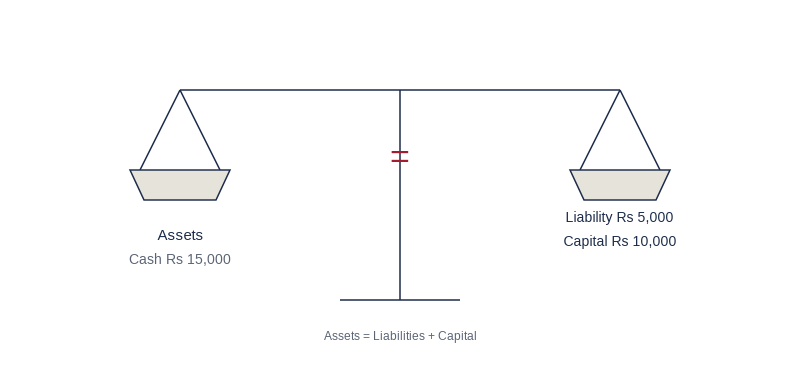
Accounting equation kehti hai: Assets = Liabilities + Capital. Assets wo hain jo business ke paas hain. Liabilities wo hain jo business ko doosron ko dene hain. Capital maalik ka hissa hai. Company mein share capital ko equity kehte hain.
Udaharan: maalik ne Rs 10,000 lagaye (Capital) aur Rs 5,000 udhaar liye (Liability). Business ke paas ab Rs 15,000 cash (Asset) hai. 15,000 = 5,000 + 10,000, yaani dono side barabar.
Critical discussion
Exam trap: capital maalik ka hissa hai, liability nahi. "Liabilities = Assets + Capital" jaisa option galat hai. Ye equation sirf tab sahi rehti hai jab har transaction ke dono pehlu likhe jaayein, aur yahi se double entry ka vichar aata hai.
1.2 Double entry and the golden rules
Double entry ka matlab hai ki har transaction ke do asar hote hain. Ek account debit hota hai aur doosra credit. Total debit total credit ke barabar hota hai. Auditor yahi match check karta hai. Dhyan rahe ki double entry ka matlab "do accounts ka asar" hai, "do entries" nahi.
Accounts teen type ke hote hain, aur har type ka ek golden rule hai.
Table 2.1. Golden rules of accounting
| Account type | Debit karo jab | Credit karo jab |
|---|---|---|
| Personal | Receiver (paane wala) | Giver (dene wala) |
| Real | Cheez aaye | Cheez jaaye |
| Nominal | Kharcha ya loss | Income ya gain |
Critical discussion
Sabse common galti rules ko mix karna hai. Pehle account ka type pehchaniye, phir rule lagaiye. Udaharan ke liye, Raju ko udhaar maal becha: Raju ek personal account hai aur wo receiver hai, isliye Raju ka account debit hoga, na ki Sales.
1.3 Accrual basis versus cash basis
Accrual basis par revenue aur expenses tab record hote hain jab wo hue, cash aane ya jaane par nahi. Cash basis mein entry cash ke aane-jaane par hoti hai. Accrual basis mein timing ke jhooth ka risk banta hai, jaise cut-off errors ya revenue ko jaldi record karna, aur audit mein inhi par sabse zyada dhyan hota hai. Frameworks ke naam Ind AS, IFRS aur US GAAP hain.
Exam trap. Cut-off galti accrual basis mein zyada hoti hai. Cash basis mein timing ka mudda alag hota hai, kyunki entry cash ke saath hoti hai.
1.4 Journal, ledger and trial balance: a worked illustration
Neeche diye gaye saare numbers kalpanik hain aur sirf seekhne ke liye hain. Ramesh ne apne dost Aman ke saath chai ka thela chalaya. Mahine ke transactions ye the:
- Ramesh ne Rs 10,000 cash lagakar thela shuru kiya.
- Aman se Rs 5,000 udhaar liye.
- Rs 6,000 ka saman (chai-patti, doodh, cheeni) cash mein khareeda.
- Rs 9,000 ka saman cash mein becha.
- Rs 1,200 kiraya cash mein diya.
- Rs 2,000 ka saman udhaar becha (customer Raju ko).
Table 2.2. Journal entries
| # | Debit | Credit | Rs |
|---|---|---|---|
| 1 | Cash A/c (Real) | Capital A/c (Personal) | 10,000 |
| 2 | Cash A/c (Real) | Aman's Loan A/c (Personal) | 5,000 |
| 3 | Purchases A/c (Nominal) | Cash A/c (Real) | 6,000 |
| 4 | Cash A/c (Real) | Sales A/c (Nominal) | 9,000 |
| 5 | Rent A/c (Nominal) | Cash A/c (Real) | 1,200 |
| 6 | Raju A/c (Personal, receiver) | Sales A/c (Nominal) | 2,000 |
Cash account ka balance. Cash mein aaya: 10,000 + 5,000 + 9,000 = Rs 24,000. Cash se gaya: 6,000 + 1,200 = Rs 7,200. Closing cash = 24,000 - 7,200 = Rs 16,800.
Table 2.3. Trial balance
| Account | Debit (Rs) | Credit (Rs) |
|---|---|---|
| Cash | 16,800 | |
| Purchases | 6,000 | |
| Rent | 1,200 | |
| Raju (debtor) | 2,000 | |
| Capital | 10,000 | |
| Aman's Loan | 5,000 | |
| Sales (9,000 + 2,000) | 11,000 | |
| Total | 26,000 | 26,000 |
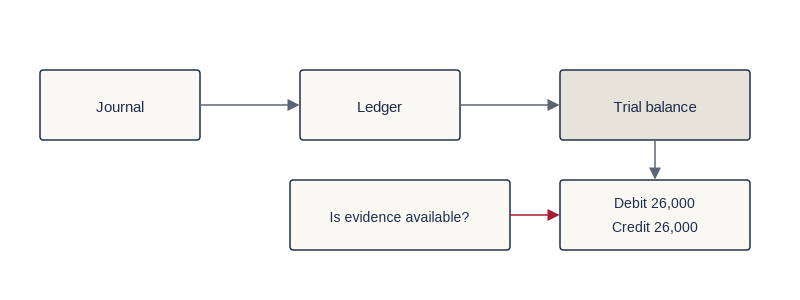
Debit aur credit dono 26,000 hain, isliye trial balance arithmetic ke hisaab se sahi hai.
Critical discussion: kya trial balance ka barabar hona kaafi hai?
Nahi. Trial balance sirf arithmetical accuracy ka test hai. Maan lijiye Aman ne Rs 6,000 ki purchase ke badle dono taraf Rs 600 likh diya. Total phir bhi barabar aayega, par entry galat hogi. Trial balance compensating errors, poori transaction ka chhoot jaana, ya galat account mein sahi amount ki entry pakad nahi paata. Isiliye auditor sirf trial balance nahi, saboot dekhta hai, aur audit assertions-based hota hai.
Exam trap. "Trial balance agree karta hai, isliye accounts bilkul sahi hain" galat hai.
1.5 Profit calculation and the audit angle
Maan lijiye mahine ke ant mein Rs 1,000 ka saman bacha (closing stock, opening stock zero).
- Cost of goods sold (COGS) = Purchases 6,000 - Closing stock 1,000 = Rs 5,000.
- Gross profit = Sales 11,000 - COGS 5,000 = Rs 6,000.
- Net profit = Gross profit 6,000 - Rent 1,200 = Rs 4,800.
Is profit mein Rs 2,000 Raju se abhi aana baaki hai. Accrual basis par ye income ginti jaati hai, cash basis par nahi.
Table 2.4. Assertion-linked audit questions on the example
| Auditor ka sawaal | Assertion ya technique |
|---|---|
| Raju sach mein hai aur usne Rs 2,000 ka maal liya? | Existence aur valuation |
| Closing stock Rs 1,000 ka shelf par hai? | Existence |
| Rent ki receipt hai? | Vouching (supporting document) |
| Aman ka loan kisi agreement ya message mein darj hai? | Completeness of liabilities |
Assertions (existence, completeness, valuation, cut-off) audit ke steps nahi hain. Ye management ke claims hain jinhe auditor verify karta hai. Existence poochta hai ki cheez sach mein hai ya nahi. Completeness poochta hai ki sab kuch likha gaya ya nahi. Valuation poochta hai ki keemat sahi hai ya nahi. Cut-off poochta hai ki entry sahi period mein hai ya nahi.
1.5.1 Preview of audit types
Audit ke types ka poora master table Chapter 3 mein hai. Yahan sirf ek jhalak di gayi hai.
Table 2.5. Preview: types of audit
| Type | Kaun karta hai | Kiske liye |
|---|---|---|
| Statutory audit | Chartered Accountant | Members (shareholders) |
| Internal audit | Company ka team ya bahari firm | Management aur audit committee |
| Cost audit | Cost accountant | Government aur management |
| Government audit | CAG | Parliament aur legislatures |
| Forensic audit | Forensic specialist | Court ya investigation ke liye |
Audit ke types ki pehchaan Wikipedia ke "Audit" page se[13] aur CAG ka role (Union aur State governments ki receipts aur expenditure ka audit) "CAG of India" page se[14] liya gaya hai.
2. Case studies: when the accounting foundation fails
Neeche ke chaar cases sirf introduction hain. Har case mein format hai: kya hua, audit ki kamzori kahan dikhi, sabak, exam angle. Fact aur allegation ka fark rakhna zaroori hai: "auditor guilty" aur "auditor par aarop" alag cheezein hain.
2.1 Enron and Arthur Andersen (USA, 2001)
What happened. Enron ek American energy company thi jo 1985 mein Kenneth Lay ke dwara Houston Natural Gas aur InterNorth ke vilay se bani.[1] Company ne special purpose entities (SPE) ka use karke apna karz books se bahar rakha; Wikipedia ke mutabik 2001 tak Enron ne hundreds of SPEs ka istemal kiya.[1] 16 October 2001 ko Enron ne 1997 se 2000 ke financials ka restatement announce kiya, jisne earnings $613 million (reported profit ka 23 percent) ghatayi aur 2000 ke ant ki equity $1.2 billion kam ki.[1] 2 December 2001 ko Enron ne Chapter 11 bankruptcy file ki, $63.4 billion assets ke saath.[1]
Audit failure. 2000 mein Arthur Andersen ko Enron se $25 million audit fees aur $27 million consulting fees mile, yaani consulting audit se zyada thi.[1] Wikipedia ke mutabik Andersen ka Houston office Chicago ke partner ki critical reviews ko override kar sakta tha, aur SEC investigation ki khabar ke baad Andersen ne kai tons documents shred kiye aur lagbhag 30,000 emails aur files delete ki.[1]
Lessons. Jab auditor ki kamai ka bada hissa client se consulting ke roop mein aata hai, to "nahi" kehna mushkil ho jaata hai. Ye self-interest threat hai. Baad mein Sarbanes-Oxley Act ke Title II ne auditing companies ko usi client ko consulting jaisi non-audit services dene par rok lagayi.[2]
Exam angle. Enron ka auditor Arthur Andersen tha. Auditor independence ke rules SOX ke baad sakht hue. Poora case Chapter 4 mein aayega.
2.2 Satyam and Price Waterhouse (India, 2009)
What happened. Satyam Computer Services Hyderabad ki IT company thi. 7 January 2009 ko chairman Byrraju Ramalinga Raju ne resign kiya aur maana ki accounts mein Rs 7,000 crore ka manipulation hua.[3] Accounts mein aise profit aur bank cash dikhaye gaye jo the hi nahi, aur ek jagah $3 million ki "salary payments" aise logon ko dikhayi gayi jo exist hi nahi karte the.[3] 22 January 2009 ko CID ne court ko bataya ki actual employees 40,000 the, 53,000 nahi, aur kathit taur par Raju un 13,000 non-existent employees ke naam par har mahine Rs 200 million nikaal raha tha. Ye aarop (allegation) hai.[3]
Audit failure. Satyam ka auditor Price Waterhouse (PwC ka Indian arm) tha. 14 January 2009 ko Price Waterhouse ne khud kaha ki management ki di hui potentially galat jankari par bharosa karne se uski audit reports "inaccurate and unreliable" ho sakti hain.[3] Baad mein US SEC ne PwC India par $6 million ka jurmana lagaya, aur 2018 mein SEBI ne Price Waterhouse ko listed companies ke audit se 2 saal ke liye roka.[3] ICAI ne bhi PwC ko show-cause notice diya aur 21 din mein jawab maanga.[3]
Court outcome. Hyderabad ki special court ne 9 April 2015 ko Raju aur 9 aur logon (kul 10) ko 7 saal ki saza di.[4][5]
Lessons. Bank balance aur receivables ka saboot company ke andar se nahi, bahar se mangna chahiye. Ghost employees aur fake cash jaise items bank confirmation, payroll check aur physical verification se pakde jaate hain.
Exam angle. Satyam ke auditor Price Waterhouse (PwC) the. NFRA ka vichar Satyam ke baad aaya.
2.3 Wirecard and EY (Germany, 2020)
What happened. Wirecard ek German payment processing company thi jo 1 January 1999 ko bani aur September 2018 se August 2020 tak DAX index mein rahi.[6] 2019 mein Financial Times ki investigations ke baad accounting malpractice ke aarop tez hue.[6] Wirecard ne KPMG ko ek independent special audit ke liye hire kiya, aur 28 April 2020 ko KPMG ne kaha ki use kuch aaropon ke liye kaafi documentation nahi mila; us par shares 26 percent gire.[6] June 2020 mein EUR 1.9 billion "missing" bataye gaye, jo do Philippines ke banks mein hone ka daava tha. Un banks ne kaha ki unke paas ye raashi na kabhi thi na hai.[6] 25 June 2020 ko Wirecard ne insolvency file ki.[6]
Audit failure. Wikipedia ke "Big Four" page ke mutabik June 2020 mein EY par aarop laga ki wo Wirecard ke EUR 1.9 billion cash ke missing hone ko pakad nahi paya.[7] Ye ek aarop hai aur is chapter mein final nirnay ki tarah nahi likha ja raha. EY ne khud kaha ki Wirecard ke ek trustee ne auditor ko "deceive" karne ki koshish ki.[6] Financial Times ke mutabik EY ne Wirecard ko pehli baar 2010 mein RP Richter ke saath audit kiya aur 2011 se wo akela auditor bana[8]; Wirecard ki 2009 ki annual report mein RP Richter aur Ernst & Young ka joint audit darj hai.[9] January 2026 mein ek Singapore court ne Citadelle Corporate Services se jude do logon ko Wirecard ke liye falsified confirmation letters ke case mein saza di; in letters mein EUR 1.1 billion accounts mein hone ka jhootha daava tha.[6]
Lessons. Jhoothi confirmation letters, yaani bahar se aayi dikhne wali par asal mein kisi aur ke control mein bani jaankari, auditor ko chhal sakti hain. Isliye professional scepticism chahiye: confirmation ka source aur channel khud check karna chahiye.
Exam angle. Wirecard ka missing amount EUR 1.9 billion tha, aur wo Philippines ke banks mein hona bataya gaya tha.
2.4 Carillion and KPMG (UK, 2018)
What happened. Carillion UK ki construction aur facilities management company thi jo July 1999 mein Tarmac se demerge hui.[10] 2016 mein uske lagbhag 43,000 employees the, jinme 18,257 UK mein the.[10] 10 July 2017 ke trading update mein GBP 845M ka impairment charge bataya gaya, jo mainly teen loss-making UK PFI projects aur Middle East projects se aaya.[10] 15 January 2018 ko Carillion compulsory liquidation mein gayi.[10] April 2018 mein Official Receiver ne 27 liquidated UK companies ke liabilities GBP 6.9 billion anumanit kiye, jo group ke 2016 accounts ke aankde se teen guna se zyada tha.[10]
Audit failure. Parliament ki Business aur Work and Pensions Select Committees ki May 2018 ki report ne collapse ko "recklessness, hubris and greed" ki kahani kaha.[10] 22 February 2018 ki hearing mein MPs ne external auditor KPMG aur Deloitte se sakht sawal kiye, aur committee ki chair Rachel Reeves ne kaha ki annual reports "worthless as a guide to the true financial health of the company" thi.[11] Ye MPs ki raay hai, kisi regulator ka final finding nahi. MPs ne KPMG se poochha ki usne 31 March 2017 ko 2016 ke accounts kyun sign off kiye.[12]
Lessons. Jahan company bahar se profit dikhaye par jiske paas cash na ho, wahan going concern ka sawaal sabse bada hota hai. Isse audit ka ek zaroori hissa maana jaata hai.
Exam angle. Carillion UK ki thi aur uska external auditor KPMG tha. Ye case going concern aur auditor ki expectation gap ke liye achha hai.
Table 2.6. Four cases at a glance
| Case | Country | Year | Auditor | Main issue |
|---|---|---|---|---|
| Enron | USA | 2001 | Arthur Andersen | SPEs, consulting fees, document shredding |
| Satyam | India | 2009 | Price Waterhouse (PwC) | Fake cash, non-existent employees |
| Wirecard | Germany | 2020 | EY (allegation) | EUR 1.9 billion missing cash |
| Carillion | UK | 2018 | KPMG | Going concern, liabilities gap |
Critical discussion
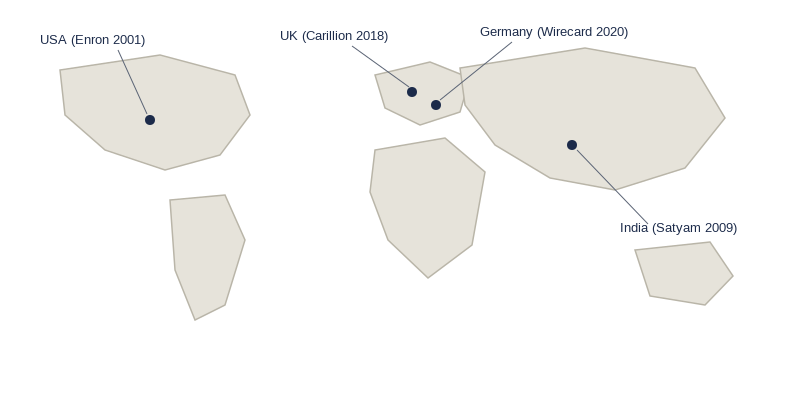
Chaaron cases mein ek hi sawaal baar-baar aata hai: kya audit evidence company ke control ke bahar se aaya? Enron mein independence toot gayi. Satyam aur Wirecard mein bank cash ka saboot jhootha nikla. Carillion mein sawaal tha ki annual reports company ki asli financial sehat dikhati thi ya nahi. Ye bhi yaad rakhna zaroori hai ki Wirecard mein EY par sirf aarop hai, aur Carillion mein MPs ki raay hai. In ko audit failure ka final nirnay maanna galat hoga.
3. Worked problems
Worked Problem 1: Journal entries
Problem. (a) Rs 10,000 cash lagakar business shuru hua. (b) Raju ko Rs 2,000 ka saman udhaar becha. (c) Rs 1,200 kiraya diya. Journal entries likhiye.
Solution. (a) Cash A/c Dr Rs 10,000, Capital A/c Cr Rs 10,000: cash (real) aaya to debit, capital (personal, giver) credit. (b) Raju A/c Dr Rs 2,000, Sales A/c Cr Rs 2,000: Raju receiver hai. (c) Rent A/c Dr Rs 1,200, Cash A/c Cr Rs 1,200: rent nominal kharcha hai.
Worked Problem 2: Profit
Problem. Sales Rs 11,000, purchases Rs 6,000, closing stock Rs 1,000, rent Rs 1,200, opening stock zero. Net profit nikaliye.
Solution. COGS = 6,000 - 1,000 = 5,000. Gross profit = 11,000 - 5,000 = 6,000. Net profit = 6,000 - 1,200 = Rs 4,800.
Worked Problem 3: Trial balance ki seema
Problem. Ek clerk ne Rs 6,000 ki purchase ke badle Rs 600 dono taraf (Purchases Dr aur Cash Cr) likh diya. Kya trial balance pakdega?
Solution. Nahi. Dono taraf Rs 600 likha gaya, isliye debit aur credit barabar rahenge. Ye ek amount ki galti hai jo trial balance se nahi, saboot (bill se match) se pakdi jaati hai.
Worked Problem 4: Accrual versus cash
Problem. Chai ke thele ki Rs 2,000 ki udhaar sale ka accrual basis aur cash basis par kya asar hoga?
Solution. Accrual basis par Rs 2,000 income ginti jaayegi kyunki sale ho chuki hai. Cash basis par ye tab income banegi jab Raju paisa dega. Is example mein Rs 4,800 ka net profit accrual basis ka hai, aur usme Rs 2,000 abhi Raju se aana baaki hai.
Worked Problem 5: Evidence plan
Problem. Satyam jaise case se seekhte hue, bank balance aur employee payroll ke liye kaun se bahari saboot maangne chahiye?
Solution. Bank balance ke liye bank se seedha confirmation. Payroll ke liye payroll check aur physical verification, taaki non-existent employees pakde ja sakein. Wirecard ke case ke aadhar par confirmation ka source aur channel bhi verify karna chahiye.
4. Chapter summary
Accounting equation kehti hai ki Assets = Liabilities + Capital. Double entry mein har transaction ke do asar hote hain, aur total debit total credit ke barabar hota hai. Teen type ke accounts, yaani personal, real aur nominal, ke golden rules alag hain, aur galti tab hoti hai jab type pehchane bina rule lagaya jaata hai. Accrual basis par income aur kharcha tab ginte jaate hain jab wo hue, isliye cut-off errors ka risk badhta hai. Trial balance sirf arithmetic accuracy dikhata hai, saboot nahi, isliye audit assertions par chalta hai. Chai ke thele ke example mein closing cash Rs 16,800 aur net profit Rs 4,800 nikla. Enron mein consulting fees audit fees se zyada thi aur documents shred kiye gaye. Satyam mein fake cash aur non-existent employees ka maamla tha. Wirecard mein EUR 1.9 billion cash ka saboot nahi mila aur EY par aarop hai. Carillion mein going concern aur liabilities ka bada gap saamne aaya. In sabse ek hi sabak nikalta hai: saboot jitna company ke bahar se aaye, utna bharosemand, aur fact aur allegation ka fark hamesha rakhna chahiye.
5. Review questions
Short answer questions
- Accounting equation likhiye aur ek numerical udaharan dijiye.
- Double entry ka matlab samjhaiye. "Do entries" kyun galat hai?
- Personal, real aur nominal accounts ke golden rules likhiye.
- Accrual basis aur cash basis ka fark ek udaharan se samjhaiye.
- Trial balance barabar hone par bhi accounts galat kaise ho sakte hain? Do udaharan dijiye.
- Assertions ko "audit ke steps" kyun nahi samjha jaata?
- Enron mein auditor independence par kaun sa threat tha?
- Satyam case mein Price Waterhouse ne January 2009 mein kya kaha?
- Wirecard mein "fact" aur "allegation" ka fark kaise dikhta hai?
- Carillion case mein going concern ka sawaal kyun mukhya tha?
Multiple choice questions
Har sawaal ka ek hi sahi option hai. Answer key aur ek line ki explanation har sawaal ke baad di gayi hai.
Q1. Accounting equation kya hai?
(a) Assets + Liabilities = Capital (b) Assets = Liabilities + Capital (c) Capital = Assets + Liabilities (d) Liabilities = Assets + Capital
Answer: (b). Business ke paas jo hai, wo maalik aur bahar walon ke hisse se barabar hota hai.
Q2. Rs 10,000 cash lagakar business shuru hua. Journal entry kya hogi?
(a) Capital Dr, Cash Cr (b) Cash Dr, Sales Cr (c) Purchases Dr, Cash Cr (d) Cash Dr, Capital Cr
Answer: (d). Cash (real) aaya to debit, capital (personal, giver) credit.
Q3. Raju ko udhaar maal becha. Kaun sa account debit hoga?
(a) Raju's account (b) Sales (c) Cash (d) Purchases
Answer: (a). Receiver ka personal account debit hota hai.
Q4. Rent diya. Kaun sa account debit hoga?
(a) Cash (b) Capital (c) Rent (nominal) (d) Purchases
Answer: (c). Kharcha nominal account hai aur debit hota hai.
Q5. Nominal account ka golden rule kya hai?
(a) Receiver debit (b) Jo aaye wo debit (c) Kharcha debit, income credit (d) Giver debit
Answer: (c). Nominal accounts mein kharcha aur loss debit, income aur gain credit hote hain.
Q6. Trial balance kya check karta hai?
(a) Debit total = Credit total (b) Profit (c) Saboot ki sachchai (d) Fraud
Answer: (a). Ye sirf arithmetic accuracy ka test hai.
Q7. Kaun si galti trial balance mein pakdi nahi jaati?
(a) Ek taraf ki entry bhool jaana (b) Addition ki galti (c) Posting ki galti (d) Galat account mein sahi amount
Answer: (d). Is galti mein debit aur credit barabar rehte hain. (Ek taraf ki entry chhootne par total barabar nahi aata.)
Q8. Closing stock Rs 1,000 aur purchases Rs 6,000 hain (opening stock zero). COGS kitna hai?
(a) Rs 6,000 (b) Rs 5,000 (c) Rs 7,000 (d) Rs 1,000
Answer: (b). COGS = 6,000 - 1,000 = 5,000.
Q9. Sales Rs 11,000 aur COGS Rs 5,000 hain. Gross profit kitna hai?
(a) Rs 6,000 (b) Rs 5,000 (c) Rs 11,000 (d) Rs 4,800
Answer: (a). Gross profit = 11,000 - 5,000 = 6,000.
Q10. Accrual basis par income kab ginti jaati hai?
(a) Jab cash aaye (b) Saal ke ant mein (c) Jab wo kamayi hui ho (d) Jab tax bhare
Answer: (c). Raju se Rs 2,000 abhi baaki hai, par accrual basis par wo income ginti jaati hai.
Q11. "Cut-off" assertion kis se judi hai?
(a) Maujoodgi (b) Sahi accounting period (c) Keemat (d) Poorta
Answer: (b). Cut-off ka sawaal hai ki entry sahi period mein hui ya nahi.
Q12. Enron ne bankruptcy kab file ki?
(a) 7 January 2009 (b) 25 June 2020 (c) 15 January 2018 (d) 2 December 2001
Answer: (d). Bankruptcy 2 December 2001 ko file hui.[1]
Q13. Enron ke 2001 ke restatement ne 2000 ke ant ki equity kitni kam ki?
(a) $613 million (b) $63.4 billion (c) $25 million (d) $1.2 billion
Answer: (d). $613 million earnings ki katauti thi, equity ki $1.2 billion.[1]
Q14. 2000 mein Andersen ki Enron se audit fees kitni thi?
(a) $27 million (b) $25 million (c) $52 million (d) $63 million
Answer: (b). Audit fees $25 million thi aur consulting $27 million.[1]
Q15. Satyam ka confession kab hua?
(a) 25 June 2020 (b) 2 December 2001 (c) 7 January 2009 (d) 15 January 2018
Answer: (c). Raju ne 7 January 2009 ko resign kiya aur confession kiya.[3]
Q16. Satyam ke auditor ne January 2009 mein kya kaha?
(a) Management ki jankari par bharose se reports inaccurate ho sakti hain (b) Sab kuch sahi hai (c) Company band ho gayi (d) Auditor ne resign kar diya
Answer: (a). Price Waterhouse ne 14 January 2009 ko ye statement diya.[3]
Q17. SEBI ne Price Waterhouse ko listed company audit se kitne saal ke liye roka (2018)?
(a) 5 saal (b) 2 saal (c) 10 saal (d) 1 saal
Answer: (b). 2018 mein SEBI ne 2 saal ka bar lagaya.[3]
Q18. Wirecard ka "missing" cash kitna tha?
(a) EUR 100 million (b) EUR 3.2 billion (c) EUR 63.4 billion (d) EUR 1.9 billion
Answer: (d). EUR 3.2 billion uska debt tha.[6]
Q19. Wirecard ka missing cash kis desh ke banks mein hona bataya gaya?
(a) Philippines (b) India (c) UK (d) USA
Answer: (a). Un banks ne kaha ki unke paas ye raashi nahi thi.[6]
Q20. Carillion ki liquidation kab hui?
(a) 7 January 2009 (b) 25 June 2020 (c) 15 January 2018 (d) 30 July 2002
Answer: (c). Compulsory liquidation 15 January 2018 ko hui.[10]
Q21. Carillion ke liabilities ka Official Receiver ka anumaan kitna tha?
(a) GBP 845 million (b) GBP 72 million (c) GBP 6.9 billion (d) GBP 29 million
Answer: (c). April 2018 ka anumaan group ke 2016 accounts ke aankde se teen guna se zyada tha.[10]
Q22. Sahi pairing kaun si hai?
(a) Satyam: Price Waterhouse (b) Enron: KPMG (c) Carillion: Arthur Andersen (d) Wirecard: Deloitte
Answer: (a). Enron ka auditor Arthur Andersen tha, Carillion ka external auditor KPMG, aur Wirecard mein EY par aarop hai.
Notes and references
[1] Wikipedia, "Enron scandal", Wikipedia, accessed 27 Nov 2026, https://en.wikipedia.org/wiki/Enron_scandal. Supports: formed 1985 by Kenneth Lay through merger of Houston Natural Gas and InterNorth; hundreds of SPEs by 2001; 16 Oct 2001 restatement ($613 million, 23 percent of reported profits; equity down $1.2 billion); bankruptcy 2 Dec 2001 with $63.4 billion assets; Andersen fees of $25 million audit and $27 million consulting in 2000; Houston office could overrule Chicago partner; shredding of several tons of documents and deletion of nearly 30,000 emails and files.
[2] Wikipedia, "Sarbanes-Oxley Act", Wikipedia, accessed 27 Nov 2026, https://en.wikipedia.org/wiki/Sarbanes%E2%80%93Oxley_Act. Supports: Title II restricts auditing companies from providing non-audit services such as consulting to the same clients.
[3] Wikipedia, "Satyam scandal", Wikipedia, accessed 27 Nov 2026, https://en.wikipedia.org/wiki/Satyam_scandal. Supports: 7 Jan 2009 resignation and confession (Rs 7,000 crore); profits and bank cash that never existed; $3 million salary to non-existent people; CID statement of 22 Jan 2009 (allegation); Price Waterhouse statement of 14 Jan 2009; SEC fine of $6 million; SEBI 2018 two-year bar; ICAI show-cause notice with 21 days to reply.
[4] Associated Press, report on the Satyam sentencing, apnews.com, accessed 27 Nov 2026, https://apnews.com/general-news-3aa5fdd7765546bbb86912da293c1125. Supports: court sentenced the founder and nine others to seven years each.
[5] Hindustan Times, "Satyam case: Ramalinga Raju, all other accused sentenced to 7 years", hindustantimes.com, 9 Apr 2015, accessed 27 Nov 2026, https://www.hindustantimes.com/business/satyam-case-ramalinga-raju-all-other-accused-sentenced-to-7-years/story-ikDcqjJh6RWqbGR2aU9pLL.html.
[6] Wikipedia, "Wirecard", Wikipedia, accessed 27 Nov 2026, https://en.wikipedia.org/wiki/Wirecard. Supports: founded 1 Jan 1999; DAX member Sep 2018 to Aug 2020; allegations peaking in 2019 after Financial Times investigations; KPMG special audit and 28 Apr 2020 statement, shares down 26 percent; EUR 1.9 billion missing, two Philippine banks denied holding the sum, EUR 3.2 billion debt; insolvency 25 Jun 2020; EY statement about a trustee trying to deceive the auditor; January 2026 Singapore sentences for false confirmation letters claiming EUR 1.1 billion.
[7] Wikipedia, "Big Four accounting firms", Wikipedia, accessed 27 Nov 2026, https://en.wikipedia.org/wiki/Big_Four_accounting_firms. Supports: in June 2020 EY was accused of poor auditing for failing to discover that EUR 1.9 billion cash was missing at Wirecard.
[8] Financial Times, article on EY and Wirecard audits, ft.com, accessed 27 Nov 2026, https://www.ft.com/content/bcadbdcb-5cd7-487e-afdd-1e926831e9b7. Supports: EY first audited Wirecard in 2010 with RP Richter; EY sole auditor from 2011.
[9] Wirecard AG, Annual Report 2009, via ftalphaville-cdn.ft.com, accessed 27 Nov 2026, https://ftalphaville-cdn.ft.com/wp-content/uploads/2015/04/Wirecard-AR-09-FP.pdf. Supports: RP Richter and Ernst & Young jointly audited.
[10] Wikipedia, "Carillion", Wikipedia, accessed 27 Nov 2026, https://en.wikipedia.org/wiki/Carillion. Supports: July 1999 demerger from Tarmac; 43,000 employees, 18,257 in UK (2016); 10 Jul 2017 trading update with GBP 845M impairment; compulsory liquidation 15 Jan 2018; April 2018 Official Receiver estimate of GBP 6.9 billion; May 2018 committee report ("recklessness, hubris and greed").
[11] The Independent, "Carillion collapse: KPMG, Deloitte grilled by MPs", independent.co.uk, 22 Feb 2018, accessed 27 Nov 2026, https://www.independent.co.uk/news/business/news/carillion-collapse-kpmg-deloitte-mps-worthless-accounts-business-committee-rachel-reeves-a8223626.html. Supports: Rachel Reeves said annual reports were worthless as a guide to the true financial health of the company.
[12] Accountancy Age, "Carillion inquiry: missed red lights, aggressive accounting, pension deficit", accountancyage.com, 26 Feb 2018, accessed 27 Nov 2026, https://accountancyage.com/2018/02/26/carillion-inquiry-missed-red-lights-aggressive-accounting-pension-deficit/. Supports: KPMG questioned over signing off the 2016 accounts on 31 March 2017.
[13] Wikipedia, "Audit", Wikipedia, accessed 27 Nov 2026, https://en.wikipedia.org/wiki/Audit. Supports: external or statutory, cost, secretarial, internal and government auditors described as distinct types.
[14] Wikipedia, "Comptroller and Auditor General of India", Wikipedia, accessed 27 Nov 2026, https://en.wikipedia.org/wiki/Comptroller_and_Auditor_General_of_India. Supports: CAG audits receipts and expenditure of Union and State governments.