Tax Audit and GST Audit
Abstract
Bharat mein "audit" shabd ke peeche kai alag kaam chhupe hain. Income Tax Act, 1961 ki Section 44AB ke tahat tax audit ek Chartered Accountant karta hai, jab turnover ya receipts ek tay limit se upar jaayein. GST mein CA se mandatory audit 1 August 2021 se khatam ho chuka hai; ab taxpayer GSTR-9 annual return aur Rs 5 crore se upar GSTR-9C reconciliation statement khud certify karta hai, aur GST department Section 65 (departmental audit) aur Section 66 (special audit) ke tahat jaanch kar sakta hai. Naye Income-tax Act, 2025 mein Section 44AB ki jagah Section 63 aur Forms 3CA, 3CB, 3CD ki jagah Form 26 aata hai, jo tax year 2026-27 se laagu hai. Yeh chapter limits, forms, due dates, procedural timelines aur reconciliation ko worked examples ke saath samjhata hai, aur har limit ke saath uska source aur tithi batata hai, kyunki is kshetra mein kanoon tezi se badalta hai.
Learning objectives
Is chapter ke baad reader yeh kar sakega:
- Section 44AB ke tahat tax audit ki applicability ko limits aur 5 percent cash test ke saath compute karna.
- Form 3CA-3CD, 3CB-3CD aur naye Form 26 ko distinguish karna.
- GST audit ke teen roop (GSTR-9C self-certification, Section 65, Section 66) ko define aur compare karna.
- Section 65 ki timeline (notice, commencement, completion, findings) ek diye gaye scenario par compute karna.
- GSTR-9C reconciliation aur ITC ke books, GSTR-3B aur GSTR-2B ke beech ke difference ko classify karna.
- Evaluate karna ki 2021 ke badlav ne GST audit ki zimmedari CA se taxpayer par kaise shift ki.
Introduction and research question
Maan lijiye ek kirana dukandaar ko uska CA kehta hai ki is saal tax audit karwana padega. Dukandaar poochta hai ki audit kya hai aur kya ye paisa chheen lega. Jawab hai ki audit chheenta nahi, check karta hai: ek CA books dekhta hai aur sarkar ko likhkar deta hai ki tax ke liye di gayi detail sahi hai. GST ka audit isse alag cheez hai. Yeh chapter is confusion ka jawab deta hai: Bharat mein tax aur GST ke naam par kaun-kaun se audit hote hain, kis trigger par, kaun karta hai, aur unka output kya hai?
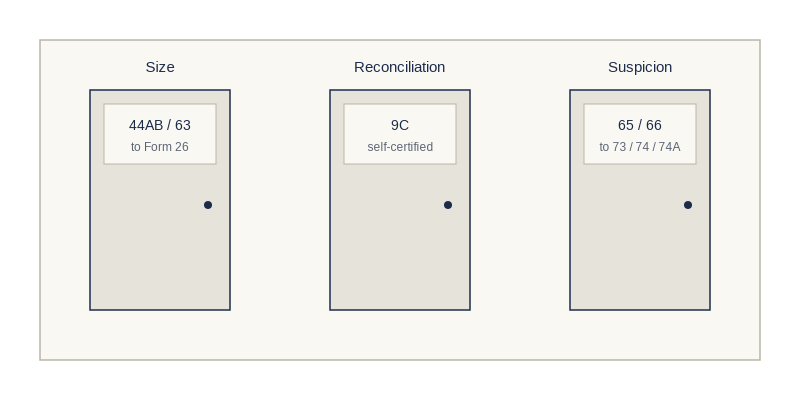
Ek yaad rakhne ka hook hai: size par self-audit, suspicion par state-audit. Tax audit (44AB ya Section 63) size se trigger hota hai aur CA se karwana padta hai. GSTR-9C bhi size (Rs 5 crore se upar) se trigger hota hai aur self-certified hai. GST audits (Sections 65 aur 66) department ki choice ya shak se trigger hote hain.
| Tax audit (44AB / 63) | GSTR-9C | GST audit (65 / 66) | |
|---|---|---|---|
| Trigger | Size (turnover ya receipts) | Size (Rs 5 crore se upar) | Department ki choice ya shak |
| Kaun karta hai | Accountant (CA), taxpayer engage karta hai | Taxpayer khud (self-certified) | GST officers (65) ya nominated CA/CMA (66) |
| Output | Form 3CA/3CB/3CD ya Form 26 | Reconciliation statement | Findings aur Section 73/74/74A action |
| Due date | Return due date se ek mahina pehle | Agle financial year ka 31 December | Notice ke baad, 3 mahine plus 6 mahine tak |
| Late ya default | Section 271B penalty ya Section 428(c) fee | Section 47(2) late fee | Tax, interest aur penalty proceedings |
15.1 Tax audit under the Income Tax Act
15.1.1 Section 44AB: scope and limits
Tax audit Income Tax Act, 1961 ki Section 44AB mein hai. Ise Finance Act 1984 ne dala, jo Assessment Year 1985-86 se laagu hua. Maksad tax chori aur avoidance rokna hai: auditor assessee ki di hui factual detail par opinion deta hai. Business ke liye normal limit turnover Rs 1 crore se upar hai. Profession ke liye gross receipts Rs 50 lakh se upar hone chahiye. Agar cash receipts aur cash payments dono apne-apne total ke 5 percent se zyada na hon, to business ki limit Rs 10 crore ho jaati hai, jo 1 April 2021 se laagu hai. Account payee na hone wala cheque ya draft cash maana jaata hai. Audit CA karta hai aur report portal par upload karta hai.[1][2]
Current official position (AY 2026-27), Income Tax Department ke threshold page ke anusaar:[17]
| Case | Limit |
|---|---|
| Business, normal | Rs 1 crore se upar (44AB(1)) |
| Business, cash receipts aur payments dono 5% tak | Rs 10 crore tak audit nahi chahiye |
| Profession | Rs 50 lakh se upar (44AB(2)) |
| 44AD presumptive opt karne wala | 44AB nahi, jab turnover Rs 2 crore se upar na ho |
Cash test. Do alag tests hain. Cash receipts (sales, turnover aur gross receipts samet) total receipts ke 5% se zyada nahi, aur cash payments (expenditure samet) total payments ke 5% se zyada nahi. Dono pass hone zaroori hain; ek bhi fail ho to Rs 10 crore wali limit nahi milti aur normal Rs 1 crore lagta hai.[2]
History of limits. Neeche ki table ek secondary source (TaxGuru) se hai aur official Act text se match nahi hui; ise "indicative" samjhiye.[16]
| Financial Year | Business turnover limit | Profession gross receipts limit |
|---|---|---|
| 1985-86 (44AB shuru) | Rs 40 lakh | Rs 10 lakh |
| 2011-12 | Rs 60 lakh | Rs 15 lakh |
| 2013-14 | Rs 1 crore | Rs 25 lakh |
| 2017-18 | Rs 1 crore | Rs 50 lakh |
| 2021-22 | Rs 5 crore (cash 5% condition ke saath) | Rs 50 lakh |
| 2022-23 onwards | Rs 10 crore (cash 5% condition ke saath) | Rs 50 lakh |
Worked example. Ek business ka turnover Rs 9.8 crore hai. Cash receipts 4 percent hain aur cash payments 6 percent. Payments ki shart fail hai, isliye Rs 10 crore ki limit nahi milegi. Normal Rs 1 crore lagega aur tax audit zaroori hai. Ek percentage point ka khel hai, isliye cash test dono taraf napna chahiye.
Critical discussion. Rs 10 crore wala proviso digital payments ko incentive deta hai. Exam trap: profession limit kabhi Rs 40 lakh nahi thi; Rs 40 lakh sirf 1985 ki business limit thi. Aur 2021-22 mein cash-tested limit Rs 5 crore thi, Rs 10 crore nahi.
15.1.2 Tax audit forms: 3CA, 3CB and 3CD
Report do jodiyon mein jaati hai. Form 3CA-3CD tab jab accounts kisi aur law ke under pehle se audited hon (jaise company ka Companies Act audit). Form 3CB-3CD tab jab kisi aur law ke tahat audit zaroori nahi, jaise chhoti proprietorship. Form 3CD deductions, compliance aur doosri particulars ki lambi list hai jo 3CA ya 3CB ke saath jaati hai. Rule 6G ke tahat ek taxpayer ko dono jodiyon mein se sirf ek bharni hoti hai.[3]
| Form | Kab | Kya hai |
|---|---|---|
| 3CA | Accounts kisi aur law ke under audited | Chhota audit report jo statutory audit par rely karta hai |
| 3CB | Kisi aur law ka audit nahi | Poora tax audit report |
| 3CD | Dono ke saath | Particulars ki lambi list |
15.1.3 Presumptive taxation and the audit gate
Normal rule: 44AD opt kiya aur turnover Rs 2 crore se upar nahi, to 44AB audit nahi chahiye.[17] Form 26 FAQ 3 ke anusaar audit do situations mein phir bhi aata hai. Pehli: presumptive scheme (sections 58(2) ya 61(2)) mein hote hue taxpayer ne income deemed income se kam declare ki. Doosri: taxpayer paanch saal ke lock-in period ke beech presumptive scheme se opt out kare aur uski income basic exemption limit se upar ho.[4]
Worked example. Ek freelancer ne FY 2024-25 mein presumptive scheme mein return bhari. FY 2026-27 mein usne kaha ki wo actual books se bharega, kyunki uski asli income deemed se kam hai. Uski income Rs 12 lakh hai, jo basic exemption se upar hai. Yeh lock-in ke andar opt-out hai, isliye tax audit zaroori hoga (Form 26 ke saath). Exam trap: "presumptive scheme mein audit kabhi nahi" galat hai. Sahi: presumptive opt kiya aur deemed se kam income nahi dikhayi, to audit nahi.
15.1.4 Form 26 and the new Income-tax Act, 2025
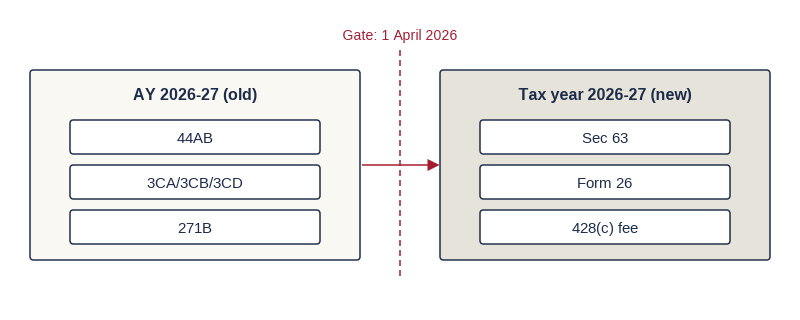
Naye Income-tax Act, 2025 ka Section 63 aur Income-tax Rules, 2026 ka Rule 47 purani Section 44AB aur Rule 6G ki jagah lete hain, aur Forms 3CA, 3CB, 3CD ki jagah ek Form 26 aata hai. Yeh tax years commencing on or after 1 April 2026 par laagu hai. FY 2025-26 (AY 2026-27) ka audit abhi bhi 3CA/3CB/3CD mein hota hai.[4]
Form 26 ke chaar parts hain: Part A (assessee ke particulars), Part B (Section 63 ke tahat statement of particulars), Part C (audit report jab accounts kisi aur law ke under audited hain, purane 3CA ki situation), aur Part D (audit report jab kisi aur law ka audit nahi, purane 3CB ki situation). Ise ek "Accountant" sign karta hai, jaisa Income-tax Act 2025 ke Section 515(3)(b) mein defined hai. UDIN mandatory hai, aur firm ke naam par audit ho to FRN bhi likhna hota hai. Process: accountant portal par form bharta hai, UDIN quote karta hai, DSC se sign karke upload karta hai, aur aakhri step mein assessee electronically accept karta hai. Part B ke schedules trigger-based hain: jis clause ka jawab "Yes" ho, usi ka schedule bharna hota hai, aur har clause ka Yes ya No dena mandatory hai. Part B ke saare schedules audit report ka integral part hain.[4]
Form 26 ke kuch naye pehlu (official FAQs ke anusaar):[4]
- Auditor ke observations teen categories mein jaate hain: test-check with materiality, management representation par adharit, ya unable to verify.
- Statutory audit ke qualifications, adverse remarks aur disclaimers ka profit, loss ya book profit par impact batana hota hai.
- TDS aur TCS reporting mein reported aur not reported dono transactions ki count aur amount deni hoti hai.
- Rule 46 ke tahat electronic books India mein accessible rehni chahiye, aur accounting software ka IP address, server ka country aur India backup server ka address dena hota hai.
- Form 26 ka Clause 36 purane 3CD ke Clause 18 se milta hai (depreciation aur brought forward losses), jisme 180 din ke upar aur neeche ke use ki segregation explicit hai.
- Clause 43 sirf un foreign remittances tak simit hai jo Form 145 (purana Form 15CA) ke Part-D mein actually report hui. Clause 53 (quantitative details) sirf trading ya manufacturing concern par laagu hai.
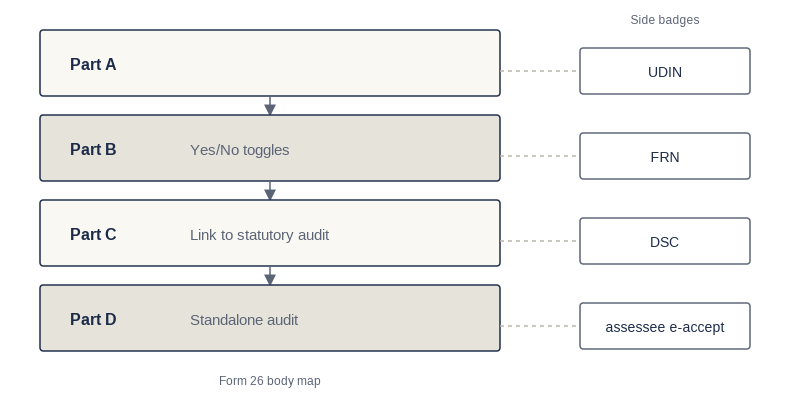
Exam trap. Form 26 mein assessee ka e-accept aakhri step hai; sirf accountant ke upload se filing complete nahi hoti. UDIN optional nahi, mandatory hai. Mapping yaad rakhiye: 44AB se 63; Rule 6G se Rule 47; 3CA/3CB/3CD se Form 26.
15.1.5 Due dates, penalty and fee
Form 26 ki due date return of income ki due date se ek mahina pehle hai (Section 263(1) ke tahat return due date ka reference). Return 31 October ko due ho to audit report 30 September ko; return 30 November ko due ho to report 31 October ko.[4] AY 2026-27 ke liye CBDT Circular 07/2026 (28 September 2026) ne ITR ki due date 31 October 2026 se badhakar 21 November 2026 ki aur audit report ki specified date 30 September 2026 se badhakar 21 October 2026 kar di.[5] Exam mein "normally" wali date likhiye aur saal diya ho to extension check kijiye.
| Cheez | Purana system (IT Act 1961) | Naya system (IT Act 2025) |
|---|---|---|
| Provision | Section 271B (penalty) | Section 428(c) (fee) |
| Amount | Turnover ka 0.5 percent, adhiktam Rs 1.5 lakh | Ek mahine tak delay: Rs 75,000; usse zyada: Rs 1,50,000 |
| Kab se | 44AB ke saath | Tax year 2026-27 se |
Section 428(c) ke amounts ka source secondary hai aur Act text se match nahi hua; ise soft figure maniye.[6]
Worked example. Gupta Traders ka FY 2025-26 (AY 2026-27) ka tax audit 30 November 2026 ko file hua; turnover Rs 3 crore maan lijiye. AY 2026-27 purane Act ka saal hai, isliye Section 271B lagega. 0.5 percent of Rs 3 crore = Rs 1.5 lakh, jo cap ke barabar hai. Circular 07/2026 ke baad specified date 21 October 2026 thi, isliye 30 November ko file karna late hai. Agar yahi deri tax year 2026-27 mein hoti, to fixed fee lagti (ek mahine tak Rs 75,000, usse zyada Rs 1,50,000), jo turnover se nahi badhti.
15.2 GST audit: from CA audit to self-certification
15.2.1 What GST audit means
GST audit registered person ke records, returns aur documents ki jaanch hai ki turnover, tax, refund aur ITC sahi hain ya nahi; ise CGST Act ki Section 2(13) se jodkar samjhaya jaata hai.[9] Pehle Section 35(5) ke anusaar prescribed limit se upar turnover wale registered persons ko apne accounts CA ya Cost Accountant se audit karwane padte the. Finance Act 2021 (Section 110) ne Section 35(5) hata diya; yeh 1 August 2021 se laagu hua (Notification 29/2021-Central Tax, 30 July 2021).[7] Purane Rule 80(3) mein aggregate turnover Rs 2 crore se upar audited accounts aur certified GSTR-9C dena padta tha; FY 2018-19 aur 2019-20 ke liye ek proviso ne limit Rs 5 crore ki thi. Rule 80(3) Notification 30/2021-CT (30 July 2021) se substitute hua.[8]
| Date | Event |
|---|---|
| 1 July 2017 | GST laagu hua (101st Amendment) |
| 1 August 2021 | Section 35(5) omitted; CA GST audit mandatory nahi raha |
| 17 September 2025 | Notification 15/2025-Central Tax: Rs 2 crore tak GSTR-9 optional |
GST ke baare mein Wikipedia ke anusaar tax 1 July 2017 ko laagu hua, shuruaati slabs 0%, 5%, 12%, 18% aur 28% the, aur us din lagbhag 1,211 items classified hue.[15]
15.2.2 GSTR-9, GSTR-9C and aggregate turnover
GSTR-9 annual return hai, jo Section 44 aur Rule 80(1) ke tahat agle financial year ke 31 December tak bharna hota hai. GSTR-9C reconciliation statement hai jisme audited financial statements ke figures GST returns se match kiye jaate hain; Rule 80(3) ke anusaar aggregate turnover Rs 5 crore se upar ho to yeh bharna padta hai aur ab self-certified hai.[8] Rs 2 crore tak aggregate turnover wale registered person ko GSTR-9 file karna optional hai (Notification 15/2025-Central Tax, 17 September 2025, FY 2024-25 se aage). Rs 2 crore se Rs 5 crore ke beech GSTR-9 mandatory hai; Rs 5 crore se upar GSTR-9 ke saath self-certified GSTR-9C bhi chahiye.[11][9] Rule 80 ke anusaar composition taxpayer GSTR-9A (Rule 80(1) ka proviso) deta hai, aur e-commerce operator jo Section 52 ke tahat TCS collect karta hai GSTR-9B (Rule 80(2)).[8]
Aggregate turnover ek hi PAN ke saare registrations ka all-India total hai: taxable supplies, exempt supplies, exports aur inter-State supplies. Isme GST khud nahi jodte. Isliye ek bade group ki chhoti units bhi limit cross kar sakti hain.[11]
Worked example. Ek client ke teen States mein GSTIN hain, har jagah turnover Rs 1.8 crore. PAN-wise all-India total = 1.8 x 3 = Rs 5.4 crore. Rs 5 crore cross hua, isliye har GSTIN ko GSTR-9 ke saath self-certified GSTR-9C dena padega.
15.2.3 Annual return time bar and late fee
Finance Act 2023 ne Section 44 mein sub-section (2) joda, jo 1 October 2023 se laagu hua (Notification 28/2023-CT, 31 July 2023): annual return due date se teen saal ke baad file nahi ho sakti, jab tak Government notification se kisi ko allow na kare. Udaharan ke liye FY 2023-24 ki GSTR-9 ki due date 31 December 2024 thi, isliye 31 December 2027 ke baad portal par file nahi hogi. Section 44 ka second proviso un Central ya State government departments aur local authorities par yeh Section laagu nahi karta jinki books CAG ya local authority auditor audit karta hai. Yahan Chapter 14 se link banta hai: CAG jahan audit karta hai, wahan GST annual return ki zaroorat nahi.[10]
Section 47(2) ke anusaar GSTR-9 ki late fee due date ke baad har din Rs 100 hai, adhiktam us State ya UT ke turnover ka 0.25 percent. Section 47(1) ke anusaar Section 37, 39, 45 aur 52 ke returns par Rs 100 per day, adhiktam Rs 5,000.[14]
15.2.4 Records under Section 35
Section 35(1) ke tahat registered person ko yeh records rakhne hote hain: production ya manufacture of goods, inward aur outward supply, stock, ITC availed, output tax payable aur paid, aur prescribed particulars. Records principal place of business par rakhe jaate hain aur electronic form allowed hai. Section 35(2) warehouse owners aur transporters ko, registered ho ya na ho, goods ke details maintain karne ko kehta hai. Section 35(6) ke tahat jo goods ya services account nahi hue, proper officer un par tax determine karta hai jaise wo supply ho gayi ho, aur Sections 73/74/74A lagu hote hain.[7]
15.3 Departmental and special audit under the CGST Act
15.3.1 Section 65: departmental audit
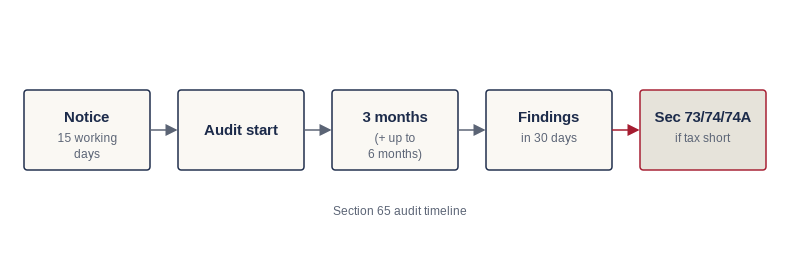
Section 65 ke anusaar Commissioner ya uska authorised officer kisi bhi registered person ka audit kar sakta hai, aur koi turnover limit nahi hai. Audit registered person ke place of business par ya department ke office mein ho sakta hai (Section 65(2)). Kam se kam 15 working days ka notice dena hota hai (65(3)). Audit commencement se 3 mahine ke andar complete hona chahiye; Commissioner likhit reasons ke saath adhiktam 6 mahine aur badha sakta hai (65(4)). Commencement wo din hai jis din records available hue ya audit asal mein shuru hua, jo baad mein ho. Registered person ko facility deni hoti hai, books verify karane deni hoti hain aur information deni hoti hai (65(5)). Audit khatam hone ke 30 din ke andar findings, rights, obligations aur reasons batane hote hain (65(6)). Tax kam ya galat ITC mile to Section 73, 74 ya 74A ke tahat action ho sakta hai (65(7)).[12]
Worked example. Notice 1 March 2027 ko mila. Records 5 April 2027 ko diye gaye, par officer 12 April 2027 ko dukaan aaya. Commencement baad wali date, yaani 12 April 2027, hai. Normal deadline: 12 July 2027 (3 mahine). Commissioner ke extension ke saath adhiktam samay 3 + 6 = 9 mahine, yaani 12 January 2028 tak. Findings audit conclude hone ke 30 din ke andar. Ek advisor ko department ka 5 working days ka notice mile to wo Section 65(3) ke 15 working days ke floor ka hawala dekar procedural objection record par rakh sakta hai.
15.3.2 Section 66: special audit
Special audit tab hota hai jab scrutiny, inquiry, investigation ya kisi proceeding ke dauran officer ko lage ki value sahi declare nahi hui ya credit normal limits mein nahi hai. Order Assistant Commissioner se kam rank ka officer nahi de sakta, aur Commissioner ki prior approval chahiye; audit CA ya Cost Accountant karta hai jise Commissioner nominate karta hai (66(1)). Report 90 din ke andar deni hoti hai, jo ek baar aur 90 din badh sakti hai (66(2)). Accounts pehle audited hon, tab bhi special audit ho sakta hai (66(3)). Special audit se mile material ko proceedings mein use karna ho to registered person ko being heard ka mauka milta hai (66(4)). Kharcha, CA/CMA ki fees samet, Commissioner determine karke pay karta hai aur determination final hai (66(5)). Action Sections 73/74/74A ke tahat (66(6)).[13]
Exam trap. Section 65 ka extension "up to six months" hai, 6 mahine standard nahi. Section 66 ka report 90 aur 90 din hai, 3 mahine nahi. Dono ke numbers paper mein aapas mein badal diye jaate hain.
15.3.3 Voluntary GST health check
Teesra roop voluntary hai: kanoon nahi maangta, par samajhdaar company CA se GST health check karwati hai (2B aur books ka match, exemption claims, e-invoice coverage, refund claims). Section 65 audit kabhi bhi aa sakta hai, aur tab readiness hi bachav hai. Yeh report kisi ko deni nahi hoti, isliye internal hoti hai.[9]
15.4 GSTR-9C reconciliation in practice
Worked example A: books versus returns. Sharma Electronics (ek State, ek GSTIN, FY 2025-26; teaching numbers, koi real company nahi):
- Audited financial statements mein total revenue: Rs 6.20 crore
- Isme non-GST income (interest on FD): Rs 10 lakh
- Isme exempt supplies: Rs 20 lakh
- GSTR-1 mein declared taxable supplies: Rs 5.75 crore
- March 2026 ki ek supply Rs 15 lakh books mein March mein, par GSTR-1 mein April 2026 mein gayi (timing difference)
Audited revenue                         6.20 cr
Less: non-GST income (interest)        (0.10 cr)
Less: exempt supplies                  (0.20 cr)
Books ka GST-relevant turnover          5.90 cr
Less: March supply April mein file hui  (0.15 cr)
Returns mein expected                   5.75 cr
GSTR-1 mein declared                    5.75 cr
Difference                              0
Exempt supplies GST returns mein alag column mein bhi declare hoti hain; yeh simplified example hai. Reconciliation ka matlab "bilkul match" nahi, balki "jo na mile uska hisaab" hai. Har difference ek dabbe mein jaata hai: timing, non-GST, exempt, ya error. Pehle teen legitimate hain; chautha (error) hi audit ka asli vishay hai. Unexplained difference rahe to GSTR-9C mein additional tax liability aa sakti hai, aur kyunki 9C self-certified hai, jhooth pakda gaya to zimmedari taxpayer ki hai.
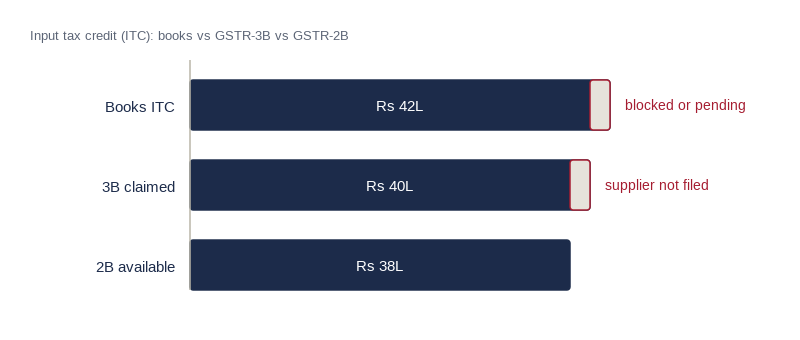
Worked example B: ITC reconciliation. Mehta Traders, FY 2025-26 (teaching numbers): books mein ITC Rs 42 lakh, GSTR-3B mein claimed Rs 40 lakh, GSTR-2B (suppliers ki filings se auto-drafted) mein available Rs 38 lakh. Books (42) aur 3B (40) ka Rs 2 lakh ka antar: books mein booked, par claim nahi hua; blocked credit ya baaki claim ho sakta hai, reason likhna hoga. 3B (40) aur 2B (38) ka Rs 2 lakh ka antar jokhim ka kshetra hai: ya to supplier ne file nahi ki ya invoice fake ya duplicate hai. Audit sawal: "ITC books, 3B aur 2B teeno mein match karta hai?" GSTR-2B batata hai ki suppliers ki filings ke aadhar par kitna ITC liya ja sakta hai. Isliye GST audit sirf apni books ka nahi, suppliers ki compliance ka bhi hai.
Exam trap. GSTR-9C reconciliation statement hai, audit report nahi. Option "GSTR-9C is certified by a CA" aaj galat hai, purane saal ke question mein sahi tha.
Case study: how audit duties shift with the law
Case A: the 2021 change in GST audit
GST ke shuru (1 July 2017) se Section 35(5) CA ya Cost Accountant se audit maangta tha, aur Rule 80(3) ke purane version mein Rs 2 crore se upar certified GSTR-9C dena padta tha. Finance Act 2021 ne Section 35(5) hata diya aur Notification 30/2021-CT ne Rule 80(3) badal diya: Rs 5 crore se upar "self-certified" reconciliation statement.[7][8] Yeh failure nahi, deliberate design change tha: compliance burden ghata aur zimmedari taxpayer par aayi. CA community ka ek poora practice area (certified GSTR-9C) ek hi tithi se samapt hua, aur uski jagah self-certification aur departmental audit (Section 65) aaye.
Lessons. Audit mandate kanoon par chalta hai, parampara par nahi. Self-certification ka matlab accountability ka shift hai: jhoothi reconciliation ka bojh seedha taxpayer par aata hai. Department ab data matching (2B aur 3B) aur Section 65 audits par zyada nirbhar hai. Purane notes mein "Rs 2 crore par GST audit zaroori" ya "CA certified 9C" ab galat hain.
Case B: Form 26 as a process redesign
Income-tax Act, 2025 ke saath Form 26 ne teen purane forms ko ek single form mein badla. Purane 3CD ki samasya lambi narrative list aur ITR se mismatch thi. Form 26 ka jawab hai structured Yes/No, trigger-based schedules aur ITR ke saath alignment (FAQ 37 ke anusaar data ITR mein populate ho sake, jisse Section 270(1) ke adjustments kam hon).[4] Lesson: audit design narrative se structured data ki taraf ja raha hai, taaki machine-readable risk assessment ho.
Case C: CAG audits the tax administration
2020 mein Direct Tax Vivad se Vishwas Scheme laayi gayi. 2026 mein CAG ne is par Subject Specific Compliance Audit kiya: Report No. 8 of 2026, Union Government, Department of Revenue (Direct Taxes), 12 August 2026 ko tabled. Ek aur report, Report No. 32 of 2026, "Taxation of Unexplained Transactions" par hai; uski tabling date source mein do jagah alag hai (detail page par 12 August 2026, listing entry par 3 September 2026), isliye yahan date nahi di gayi.[18] Yahan Chapter 14 aur 15 milte hain: CA taxpayer ki books ka tax audit karta hai, jabki CAG tax department ki working ka compliance audit karta hai. Do alag directions hain.
Worked problems
Problem 1: tax audit applicability. Ek business ka turnover Rs 8 crore hai, cash receipts 3 percent aur cash payments 4 percent hain. Kya Section 44AB lagega? Solution. Dono cash tests 5 percent ke andar hain, isliye Rs 10 crore ki limit milti hai. Rs 8 crore Rs 10 crore se kam hai, isliye tax audit zaroori nahi.
Problem 2: limit by year. FY 2021-22 mein cash condition ke saath business limit kya thi, aur FY 2022-23 se kya hai? Solution. FY 2021-22: Rs 5 crore. FY 2022-23 se: Rs 10 crore (secondary source ki table ke anusaar, indicative).
Problem 3: aggregate turnover. Ek PAN ke teen States mein registrations hain, har jagah Rs 2 crore turnover. Kya GSTR-9C bharna hoga? Solution. Aggregate turnover PAN-wise all-India hota hai: 3 x 2 = Rs 6 crore, jo Rs 5 crore se upar hai. Har GSTIN ko GSTR-9 ke saath self-certified GSTR-9C dena hoga.
Problem 4: Section 65 timeline. Audit commencement 12 April 2027 hai. Normal completion kab tak, aur extension ke saath adhiktam kab tak? Solution. Normal: 3 mahine, yaani 12 July 2027. Extension ke saath adhiktam 3 + 6 = 9 mahine, yaani 12 January 2028. Findings conclusion ke 30 din ke andar.
Problem 5: Section 66 timeline. Special audit report ke liye kitna samay milta hai? Solution. 90 din, aur ek baar 90 din ka extension ho sakta hai, yaani adhiktam 180 din.
Problem 6: classify the difference. Ek supply Rs 15 lakh ki books mein March mein hai par GSTR-1 mein April mein gayi. GSTR-9C mein ise kis category mein rakhenge? Solution. Timing difference. Yeh GSTR-9C mein explain hoga, lekin tax point of supply ke hisaab se March mein hi due tha, isliye late deposit par interest ka sawal uthega aur sahi disclosure zaroori hai.
Problem 7: ITC gap. Books ITC Rs 42 lakh, 3B Rs 40 lakh, 2B Rs 38 lakh. Kaun sa gap zyada jokhim wala hai? Solution. 3B aur 2B ka Rs 2 lakh ka gap. Yeh aisa claim hai jo suppliers ki filings mein nahi dikhta: supplier ne file nahi ki ya invoice fake ya duplicate hai. Books aur 3B ka gap usi ka reason (blocked credit ya baaki claim) likhkar samjhaya ja sakta hai.
Chapter summary
Tax audit Income Tax Act ki Section 44AB mein hai, jo Finance Act 1984 se AY 1985-86 mein aayi. Business ke liye limit Rs 1 crore hai (Rs 10 crore agar cash receipts aur payments dono 5 percent tak hon) aur profession ke liye Rs 50 lakh. Report Form 3CA-3CD ya 3CB-3CD mein jaati hai, aur tax year 2026-27 se Section 63 aur Rule 47 ke tahat ek Form 26 aayega. Report ki due date return due date se ek mahina pehle hoti hai; AY 2026-27 ke liye Circular 07/2026 ne audit report ki date 21 October 2026 kar di. Late hone par purana Section 271B penalty hai aur naya Section 428(c) fee. GST mein CA se mandatory audit 1 August 2021 se samapt hua. GSTR-9 annual return hai aur GSTR-9C Rs 5 crore se upar self-certified reconciliation statement. Section 65 ke tahat department 15 working days ke notice par audit kar sakta hai, jo 3 mahine mein (adhiktam 6 mahine ke extension ke saath) poora hota hai aur 30 din mein findings deta hai. Section 66 ka special audit nominated CA ya CMA karta hai, 90 aur 90 din ke samay mein. Aggregate turnover PAN-wise gina jaata hai. Reconciliation mein har difference timing, non-GST, exempt ya error mein baanta jaata hai, aur ITC books, 3B aur 2B teeno mein match hona chahiye.
Review questions
Short answer
- Section 44AB kab aur kis Finance Act se aayi?
- Business aur profession ke liye tax audit limits kya hain, aur Rs 10 crore ki limit kab milti hai?
- Cash test ke do hisse kya hain, aur dono kyun zaroori hain?
- Form 3CA aur 3CB mein kya antar hai?
- Form 26 ke chaar parts aur uski applicability batayiye.
- Tax audit report ki due date ka formula kya hai?
- GST mein Section 35(5) kab hata aur iska kya asar hua?
- GSTR-9C kab bharna padta hai aur ab use kaun certify karta hai?
- Section 65 audit ki timeline (notice se findings tak) batayiye.
- Section 65 aur Section 66 ke audit mein antar batayiye.
Multiple choice
Q1. Income Tax Act mein tax audit kaun si section batati hai? (a) 44AA (b) 80C (c) 44AB (d) 139 Key: (c). Section 44AB, Finance Act 1984 se.
Q2. Profession ke liye tax audit tab zaroori hai jab gross receipts kitne se upar hon? (a) Rs 25 lakh (b) Rs 1 crore (c) Rs 2 crore (d) Rs 50 lakh Key: (d). Profession ki limit Rs 50 lakh hai.
Q3. GST mein departmental audit kaun si section ke tahat hota hai? (a) Section 35 (b) Section 65 (c) Section 66 (d) Section 73 Key: (b). Section 66 special audit hai aur Section 44 annual return.
Q4. GST mein CA se mandatory audit (Section 35(5)) kab se hata? (a) 1 July 2017 (b) 1 April 2020 (c) 1 January 2023 (d) 1 August 2021 Key: (d). Finance Act 2021, Notification 29/2021-CT.
Q5. Form 26 kab se laagu hai? (a) 1 April 2025 (b) 1 July 2017 (c) tax years commencing on or after 1 April 2026 (d) 1 January 2027 Key: (c). AY 2026-27 tak 3CA/3CB/3CD hi chalte hain.
Q6. Section 65 audit ke findings kitne din mein batane hote hain? (a) 7 din (b) 15 din (c) 30 din (d) 90 din Key: (c). Audit khatam hone ke 30 din ke andar.
Q7. GST ka aggregate turnover kaise gina jaata hai? (a) sirf ek GSTIN ka (b) PAN-wise all-India, sab registrations milakar (c) sirf taxable sales (d) sirf exports Key: (b). Isme GST khud nahi jodte.
Q8. Section 44(2) ke anusaar annual return due date se kitne saal baad file nahi ho sakti? (a) 1 saal (b) 2 saal (c) 5 saal (d) 3 saal Key: (d). Finance Act 2023, 1 October 2023 se.
Q9. Special audit (Section 66) ki report kitne din mein deni hoti hai? (a) 30 din (b) 90 din, ek baar aur 90 din badh sakte hain (c) 6 mahine flat (d) 1 saal Key: (b). Section 66(2).
Q10. Audit mein tax short pay ya galat ITC mile to action kin sections ke tahat hota hai? (a) 139 aur 143 (b) 269SS aur 269ST (c) 73, 74 ya 74A (d) 80C aur 80D Key: (c). Sections 65(7) aur 66(6) yahi kehte hain.
Notes and references
[1] Income Tax Department, webinar PPT on Forms 3CA-3CD and 3CB-3CD, 13 September 2024, incometax.gov.in. https://www.incometax.gov.in/iec/foportal/sites/default/files/2024-09/Webinar%20PPT%20for%203CA-3CD_3CB-3CD_13.09.2024.pdf. Supports: Section 44AB, Finance Act 1984, AY 1985-86; business turnover Rs 1 crore; profession Rs 50 lakh; Rs 10 crore agar cash receipts aur payments 5 percent se zyada na hon, 1 April 2021 se.
[2] Income Tax Department, "Important terms or provisions which a taxpayer needs to know to comply with the income tax law", incometaxindia.gov.in, accessed 27 November 2026. https://www.incometaxindia.gov.in/w/5.-important-terms-or-provisions-which-a-taxpayer-needs-to-know-to-comply-with-the-income-tax-law. Supports: Rs 50 lakh profession; Rs 10 crore cash 5 percent ke saath; Rs 1 crore; non-account-payee cheque ya draft cash; cash receipts aur cash payments ke dono tests.
[3] Income Tax Department, "Form 3CB-3CD FAQ", incometax.gov.in. https://www.incometax.gov.in/iec/foportal/help/all-topics/e-filing-services/form%203cb-3cd-faq. Supports: Form 3CA-3CD aur 3CB-3CD ki applicability; Rule 6G; dono mein se sirf ek.
[4] Income Tax Department, "Form 26 FAQs", incometaxindia.gov.in, accessed 27 November 2026. https://www.incometaxindia.gov.in/documents/d/guest/form-26-faqs. Supports: Form 26, Section 63 aur Rule 47; tax years on or after 1 April 2026; 3CA/3CB/3CD AY 2026-27 tak; FAQ 3 (presumptive cases); FAQ 5 (due date); Parts A to D; Section 515(3)(b); UDIN, FRN, process flow; trigger-based schedules; mandatory Yes/No; observations ki teen categories; statutory audit qualifications ka impact; TDS/TCS; Rule 46; Clause 36, 43, 53; FAQ 37.
[5] CBDT, Circular No. 07/2026, F. No. 225/128/2026/ITA-II, 28 September 2026, incometaxindia.gov.in. https://www.incometaxindia.gov.in/documents/d/guest/circular-7-2026-pdf. Supports: AY 2026-27 ke liye ITR date 31 October 2026 se 21 November 2026, audit report date 30 September 2026 se 21 October 2026; Section 119 IT Act 1961 aur Section 536 IT Act 2025.
[6] TaxGuru, "Form 26 tax audit report tax year 2026-27: key due dates and default fees". https://taxguru.in/income-tax/form-26-tax-audit-report-tax-year-2026-27-key-due-dates-default-fees.html. Supports: Section 428(c) fee Rs 75,000 aur Rs 1,50,000; Section 271B penalty 0.5 percent turnover, adhiktam Rs 1.5 lakh. Secondary source, Act text se match nahi hua.
[7] CBIC, CGST Act, Section 35, taxinformation.cbic.gov.in, accessed 27 November 2026. https://taxinformation.cbic.gov.in/content/html/tax_repository/gst/acts/2017_CGST_act/active/chapter8/section35_v1.00.html. Supports: Section 35(5) omitted w.e.f. 1 August 2021 (s.110 Finance Act 2021, Notification 29/2021-CT, 30 July 2021); Section 35(1), (2), (6).
[8] CBIC, CGST Rules, Rule 80, taxinformation.cbic.gov.in. https://taxinformation.cbic.gov.in/content/html/tax_repository/gst/rules/cgst_rules/active/chapter8/rule80_v1.00.html. Supports: Rule 80(1) GSTR-9 by 31 December; Rule 80(1) proviso GSTR-9A; Rule 80(2) GSTR-9B; Rule 80(3) Rs 5 crore self-certified GSTR-9C; purana Rs 2 crore; Notification 30/2021-CT dated 30.07.2021.
[9] HSAG, "GST audit". https://www.hsag.in/feeds/blog/gst-audit. Supports: GST audit definition, Section 2(13); Notification 15/2025-Central Tax dated 17 September 2025; voluntary review; special audit Section 66; Section 65, 66 aur voluntary teen roop.
[10] CBIC, CGST Act, Section 44, taxinformation.cbic.gov.in. https://taxinformation.cbic.gov.in/content/html/tax_repository/gst/acts/2017_CGST_act/active/chapter9/section44_v1.00.html. Supports: Section 44(2) (Finance Act 2023, w.e.f. 1 October 2023, Notification 28/2023-CT, 31 July 2023); teen saal ki seema; second proviso.
[11] Regitom, "GST audit limit, GSTR-9C applicability FY 2025-26". https://www.regitom.com/gst-audit-limit-gstr-9c-applicability-fy-2025-26. Supports: Rs 2 crore tak GSTR-9 optional; Rs 2 se 5 crore mandatory; Rs 5 crore se upar GSTR-9C; PAN-wise aggregate turnover.
[12] CBIC, CGST Act, Section 65, taxinformation.cbic.gov.in. https://taxinformation.cbic.gov.in/content/html/tax_repository/gst/acts/2017_CGST_act/active/chapter13/section65_v1.00.html. Supports: Section 65(1) se (7).
[13] CBIC, CGST Act, Section 66, taxinformation.cbic.gov.in. https://taxinformation.cbic.gov.in/content/html/tax_repository/gst/acts/2017_CGST_act/active/chapter13/section66_v1.00.html. Supports: Section 66(1) se (6).
[14] CBIC, CGST Act, Section 47, taxinformation.cbic.gov.in. https://taxinformation.cbic.gov.in/content/html/tax_repository/gst/acts/2017_CGST_act/active/chapter9/section47_v1.00.html. Supports: Section 47(1) Rs 100 per day, adhiktam Rs 5,000; Section 47(2) annual return, adhiktam 0.25 percent.
[15] "Goods and Services Tax (India)", Wikipedia, accessed 27 November 2026. https://en.wikipedia.org/wiki/Goods_and_Services_Tax_(India). Supports: 1 July 2017, 101st Amendment, slabs 0, 5, 12, 18, 28 percent, lagbhag 1,211 items.
[16] TaxGuru, "Liable to tax audit under Income Tax Act 2025". https://taxguru.in/income-tax/liable-tax-audit-income-tax-act-2025.html. Supports: 44AB limits ki history table. Secondary source, official text se match nahi hui.
[17] Income Tax Department, "Threshold limits under Income Tax Act", incometaxindia.gov.in. https://www.incometaxindia.gov.in/w/threshold-limits-under-income-tax-act. Supports: 44AB current limits, Finance Act 2026, AY 2026-27; 44AD note, Rs 2 crore.
[18] CAG of India, "Audit Report" listing, cag.gov.in. https://cag.gov.in/en/audit-report. Supports: Report No. 8 of 2026 (Vivad se Vishwas SSCA, 12 August 2026) aur Report No. 32 of 2026.