Vouching and Verification
Abstract
Yeh chapter auditing ke do sabse buniyadi procedures, vouching aur verification, ka systematic adhyayan hai. Vouching mein auditor books of account ki har transaction ko uske documentary evidence (voucher) se milata hai; verification mein woh balance sheet date par assets aur liabilities ka existence, ownership, possession aur charge-free status establish karta hai. Chapter in dono procedures ko financial statement assertions aur Standards on Auditing (SA 500, 501, 505, 240, 540) ke framework se jodta hai, cash book, purchases, sales, wages jaise areas ki vouching ka item-wise vishleshan deta hai, aur teeming and lading, window dressing aur cut-off manipulation jaise classic fraud patterns samjhata hai. Wirecard, Luckin Coffee, Toshiba aur Satyam ke case studies dikhate hain ki verification mein shortcut lena audit opinion ko kaise collapse kar deta hai.
Learning Objectives
Is chapter ko padhne ke baad vidhyarthi saksham hoga:
- Define vouching, verification aur valuation ko, aur teeno ke beech ka antar batana;
- Distinguish primary aur secondary vouchers, aur internal aur external evidence ki reliability ko SA 500 ke principles se;
- Evaluate cash book, purchases, sales aur special items ki vouching ke liye aavashyak documents aur red flags;
- Compute petty cash imprest equation, bank reconciliation aur asset disposal ke gain/loss ko audit drishti se;
- Apply SA 505 ke external confirmation requirements ko bank balances, debtors aur loans par;
- Distinguish capital aur revenue expenditure ko aur is classification ke manipulation se profit par hone wale asar ko;
- Evaluate Wirecard, Luckin Coffee, Toshiba aur Satyam case studies mein audit failures ko aur unse nikalne wale procedural lessons ko.
Introduction and Research Question
Auditing ka poora dhancha ek seedhe se sawaal par tika hai: likha gaya hai, uska saboot kya hai? Jis din auditor yeh sawaal poochna chhod deta hai, us din audit ek formality ban jaata hai. Is chapter ka research question yeh hai: auditor kaise establish karta hai ki books of account mein recorded transactions sach mein hui hain, aur balance sheet mein dikhayi gayi assets aur liabilities sach mein exist karti hain? Jawab do procedures mein milta hai. Pehla, vouching, jo poore saal ki transactions ko vouchers se milati hai. Doosra, verification, jo year-end ki position ko independent evidence se confirm karti hai. Chapter aage in dono ki theory, statute aur standard se judi technique, item-wise application, aur un situations ka analysis karta hai jahan yeh procedures fail ho gayi, jisse poora audit structure dharaashayi ho gaya.
7.1 The Concept of Vouching
Vouching woh process hai jisme auditor books of account mein recorded har transaction ko uske documentary evidence se mila kar dekhta hai. Us document ko voucher kehte hain: bill, invoice, rasid, cash memo, agreement, bank statement, yeh sab voucher hain. Indian audit textbooks ki ek prasiddh line hai: "Vouching is the backbone of auditing", yaani vouching audit ki reedh ki haddi hai; vouching ke bina baaki sab kaam aadhar-viheen hai.
Vouching mein auditor paanch baatein check karta hai. Ek, transaction hui sach mein? Do, woh business ke liye hui, personal nahin? Teen, sahi amount record hua? Chaar, sahi account mein record hua? Paanch, kisi authorised vyakti ne transaction approve ki thi? Jo entry bina voucher ke hai, woh auditor ke liye ek red flag hai: auditor management se explanation maangta hai, aur jawab santoshjanak na ho to audit report mein disclose kar sakta hai. Vouching sirf expenses ki nahin hoti; income, assets ki khareed, loan lena, jahan bhi paisa aaya ya gaya, wahan vouching hoti hai.
Worked example. Ek kirana dukaan ki cash register mein ek din 18,400 rupaye hone chahiye the, par ginti par 16,900 nikle. Entry-wise checking mein 12 tarikh ki 800 rupaye ki sale ka bill mil gaya, par 14 tarikh ki 2,000 rupaye ki payment entry ka koi voucher nahin mila, sirf ek haath se likhi chitthi mili. Yeh do paristhitiyan vouching ke do possible outcomes dikhati hain: pehli entry vouched ho gayi, doosri unvouched rahi aur red flag ban gayi.
Critical discussion. Vouching substantive procedures ka ek hissa hai, SA 500 (Audit Evidence) ke framework mein "inspection of records and documents". Auditor documentary evidence ki reliability assess karta hai: external documents (vendor invoice) internal documents (internal memo) se zyada reliable maane jaate hain, aur originals photocopies se zyada. Vouching primarily transactions ke liye "occurrence" aur "accuracy" assertions ko address karti hai. Ek chhota missing voucher chhota ho to chal sakta hai, par missing vouchers ka pattern internal control ki kamzori ya fraud ka signal hai. Exam mein ek common trap: "vouching sirf expense checking hai" galat hai; receipts aur income ki vouching utni hi zaroori hai, aur asal mein fraud-prone zyada hoti hai.
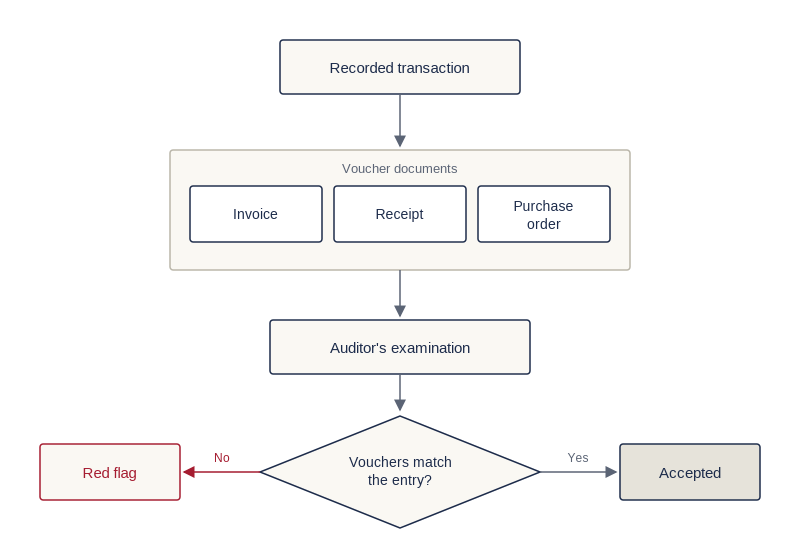
7.2 Types of Vouchers and the Reliability of Evidence
Vouchers ke do bade prakaar hain. Primary voucher woh document hai jo transaction ka seedha saboot hai, jaise supplier ka bill. Secondary ya collateral voucher woh document hai jo primary voucher ki kami ko poora karta hai, jaise bill kho jaane par supplier ka duplicate ya certified copy. Ek aur categorisation hai: internal vouchers company ke andar bante hain, jaise material requisition slip; external vouchers bahar se aate hain, jaise bank statement. External voucher hamesha zyada bharosemand hota hai, kyunki woh client ke control ke bahar bana hai.
Missing voucher ki sthiti mein auditor teen kaam karta hai. Pehla, duplicate ya written confirmation maangta hai. Doosra, dekhta hai ki entry ka nature business se match karta hai ya nahin. Teesra, agar saboot phir bhi na mile, to amount ko "unvouched" mark karke report mein disclose kar sakta hai.
Critical discussion. SA 500 ka application material reliability ke general principles deta hai: external source ka evidence internal se zyada, direct knowledge (observation, inspection) indirect se zyada, documentary evidence oral se zyada, aur original documents photocopy se zyada reliable maane jaate hain. Yeh koi fixed ranking nahin hai; circumstances par depend karta hai. Missing voucher auditor ko "limitation on scope" ki taraf le ja sakta hai, jo SA 705 ke under qualified opinion (effect material par pervasive nahin) ya disclaimer of opinion (effect material aur pervasive) tak ja sakta hai. Isliye ek missing voucher chhota ho to theek, par pattern ban jaaye to auditor samajh jaata hai: internal control kamzor hai, ya koi fraud chhupa raha hai.
7.3 Vouching, Verification and Valuation: A Distinction
Teen shabdon, vouching, verification aur valuation, ka antar ek mahatvapurna exam question hai. Vouching transactions ke liye hoti hai, poore saal ki entries ke liye. Verification balance sheet items ke liye hoti hai, saal ke aakhri din ki position ke liye: asset exist karti hai, ownership company ke paas hai, possession kiske paas hai, aur koi charge ya pledge to nahin. Valuation un items ki sahi keemat tay karti hai.
Worked example. Company ne ek machine kharidi. Us entry ko supplier ke bill se milana vouching hai. Balance sheet date par factory mein jaakar dekhna ki machine maujood hai, company ki hai, aur kaam kar rahi hai, yeh verification hai. Machine ko cost par dikhana ya depreciation kaat kar dikhana, yeh valuation hai.
Critical discussion. Financial statement assertions (SA 315 framework) se mapping karein to: vouching occurrence, accuracy aur cut-off assertions se judti hai; verification existence, rights and obligations, aur completeness se; valuation valuation and allocation se. Verification of assets mein auditor physical inspection, external confirmation aur title documents ka combination use karta hai; valuation mein woh management ke accounting estimates ko SA 540 ke under test karta hai. Kaun pehle hota hai? Vouching saal bhar chalti hai transactions par; verification aam taur par year-end mein hoti hai balance sheet items par. Dono mil kar auditor ko assurance dete hain ki financial statements sach hain.
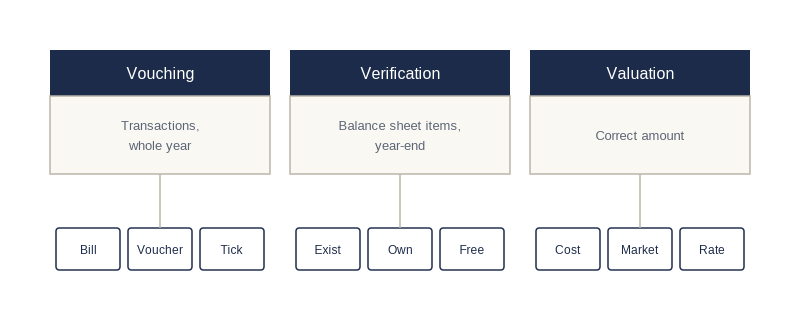
7.4 Vouching of the Cash Book and Teeming and Lading
Sabse zyada fraud cash mein hota hai, isliye cash book ki vouching sabse careful hoti hai. Cash book ke do sides hain: receipts side (paisa aaya) aur payments side (paisa gaya), aur dono alag tarike se check hote hain.
Receipts side ka saboot milna mushkil hota hai, kyunki paisa dene wala vyakti rasid maangta hai aur rasid dene wali company sirf counterfoil rakhti hai. Auditor counterfoils, receipts ki carbon copies, bank paying-in slips aur cash memos se milata hai. Yahan sabse important baat yeh hai ki internal check strong hona chahiye, nahin to cashier chori kar sakta hai. Isi ka classic roop hai teeming and lading, jise "lapping" bhi kehte hain: cashier customer A se mile 5,000 rupaye pocket mein daal leta hai aur entry nahin karta; jab B se 5,000 aate hain to unhe A ke naam entry kar deta hai; phir C ke paise se B ki entry. Yeh chakra tab tak ghoomta rehta hai jab tak cashier chhutti par nahin jaata ya surprise cash check nahin hoti. Isliye auditor: (1) surprise cash count karta hai, (2) receipts ko daily bank deposits se milata hai, (3) debtors se direct confirmation maangta hai ki unhone kab kitna bhara.
Payments side ka saboot strong hota hai: payee ki signed rasid, invoice, approval. Auditor check karta hai ki rasid company ke naam par hai, amount sahi hai, date saal ke andar hai, aur payment business purpose ka hai. Ek trick hai fake ya duplicate rasid se double payment nikaalna; auditor same amount aur same payee ki do rasid dhundhta hai.
Critical discussion. Teeming and lading detection ke liye auditor cut-off testing karta hai: year-end ke aas-paas ki receipts ko bank statement se match karke dekhta hai ki koi receipt agle period mein daali to nahin gayi. Debtor confirmations (SA 505) lapping ko expose karte hain kyunki debtor apni payment ka record rakhta hai. Strong internal control ke elements hain: cashier aur record-keeper alag vyakti (segregation of duties), serial numbered receipts, daily bank deposit, aur cashier ki periodic rotation. Exam trap: "lapping stock se juda fraud hai" galat; yeh cash receipts se juda hai.
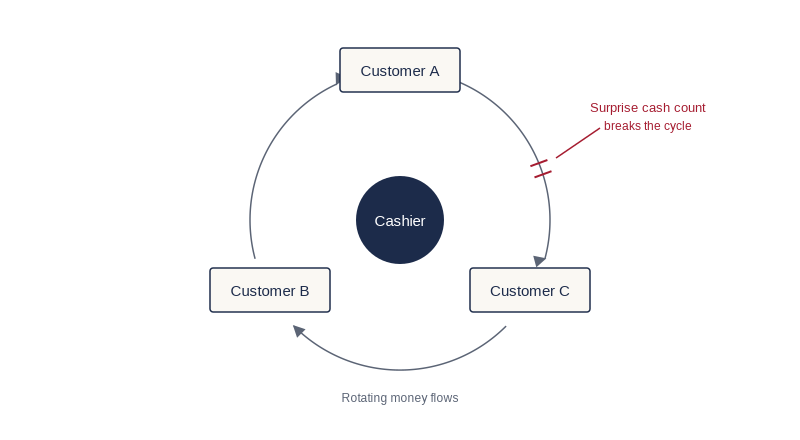
7.5 Vouching of Purchases and Sales
Purchase entry ke teen saathi documents hote hain: purchase order (humne order kiya), goods received note ya GRN (maal aaya), aur supplier invoice (bill). In teeno ko milana three-way match kehlata hai. Phir auditor dekhta hai: rate sahi, quantity sahi, discount kata gaya, aur goods business ke liye hain. Credit purchases mein ek extra check hai: supplier ki statement se balance milaya jaata hai. Purchases returns (debit notes) alag se check hote hain, kyunki wahan se paisa wapas aata hai, jo fraud ka ek raasta hai.
Sales ki vouching sales invoices, dispatch documents, transporter receipts (L/R ya bilty) aur customer orders se hoti hai. Auditor yahan cut-off test karta hai: 31 March se pehle dispatch hua maal is saal ki sale hai, baad ka agle saal ki. Sales side ke do classic frauds hain. Fictitious sales: jhooti sale entries dikhana taaki profit phoola lage. Goods sent on approval ko sale likhna: customer ne abhi approve hi nahin kiya, par sale book kar di gayi. Dono se profit inflate hota hai.
Critical discussion. Revenue recognition ke cut-off tests audit ke sabse sensitive tests hain, kyunki revenue financial statements ka sabse bada aur sabse aasani se manipulate hone wala hissa maana jaata hai. SA 240 ke under auditor revenue mein fraud risk presume karta hai ("presumed fraud risk in revenue recognition"), jab tak woh usse rebut na kare. Isliye invoice ka hona zaroori hai par kaafi nahin; auditor ko sales ki occurrence independently check karni hoti hai.
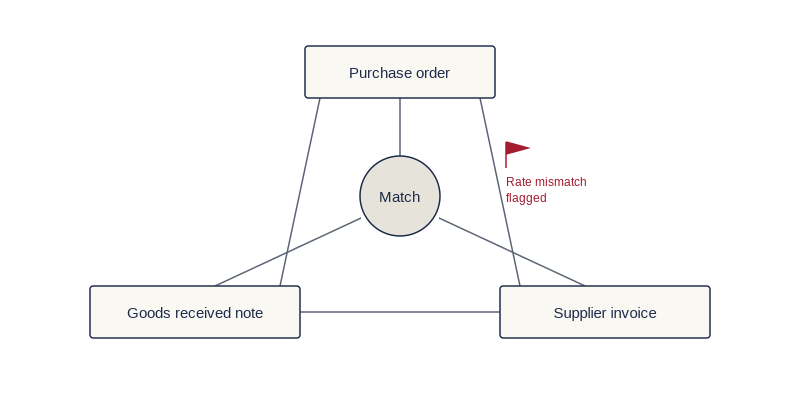
7.6 Vouching of Special Items
Exam mein "vouching of ..." karke alag-alag items poochhe jaate hain. Har item ke liye chaar sawaal kaam aate hain: (1) kaunsa document hai, (2) kisne authorise kiya, (3) business se juda hai ya nahin, (4) koi law ka limit to nahin lagta. Neeche mukhya items ka saransh hai.
| Item | Primary documents | Typical red flag |
|---|---|---|
| Wages | Wages sheet, muster roll, signatures/thumb impressions | Dummy workers (bhoote mazdoor) |
| Petty cash | Serial-numbered petty vouchers, imprest records | IOU slips, unapproved vouchers |
| Rent paid | Rent agreement, receipts, TDS deduction | Agreement se zyada payment |
| Rent received | Agreement, rent register, counterfoils | Unexplained vacancy, rate mismatch |
| Capital expenditure | Board resolution, quotations, invoice, installation certificate | Revenue expense ko capital banana |
| Directors' fees and commission | Articles of association, board resolution, Companies Act limits | Limit se zyada payment |
| Travelling expenses | Tour programme, tickets, hotel bills | Personal bills business mein |
| Sale of investments | Broker's contract note, bank credit | Price related party ko kam |
| Bad debts recovered | Earlier write-off entry, recovery proof | Recovery book hi nahin ki |
| Insurance claim received | Surveyor report, insurer's letter | Claim received, asset bhi books mein |
Wages mein auditor wages sheet, muster roll, signatures ya thumb impressions aur casual workers ke naam verify karta hai; fraud ka roop hai dummy workers, aur check yeh hai ki kuch workers se personally mulaqat ki jaye. Petty cash mein imprest system check hota hai: fixed float, vouchers serial se, har voucher approved, aur badi rakam ke vouchers ko extra dhyan. Capital expenditure mein board resolution, quotation comparison, invoice aur installation certificate maange jaate hain; revenue kharch ko capital likhna profit phoolata hai, yeh classic manipulation hai. Directors' fees aur commission mein articles of association, board resolution aur Companies Act ki limits check hoti hain.
Critical discussion. In items ka common funda yeh hai ki har item ka apna "saboot ka pata" hota hai; auditor ko pata hona chahiye kaunsi cheez ka saboot kahan milta hai. Exam trap: cash sales ke liye "sales invoice" likhna galat hai; cash sales mein cash memo/counterfoil, credit sales mein invoice.
7.7 The Concept of Verification
Verification ka matlab hai balance sheet mein dikhayi gayi assets aur liabilities ka existence, ownership, possession aur sahi disclosure check karna. Chaar sawaal: (1) asset hai sach mein? (2) company ki hai? (3) company ke control mein hai ya kisi aur ke paas padi hai? (4) koi loan ka girvi (charge) to nahin jiska disclosure nahin hua? Verification ke paanch objectives hain: existence yaani asset physically maujood; ownership yaani title company ke naam; possession yaani asset company ke kabze mein; charge-free status; aur proper valuation ke saath disclosure.
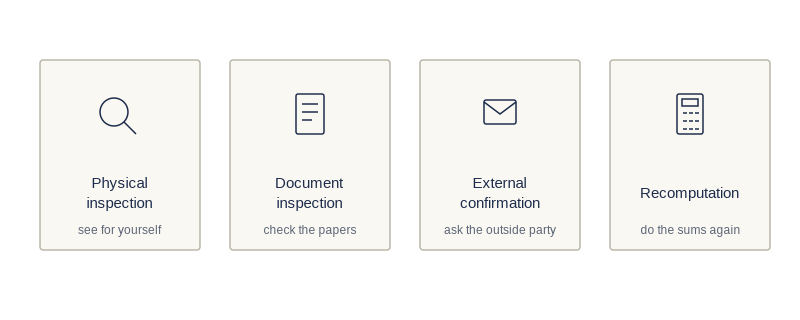
Verification mein auditor chaar main techniques use karta hai: physical inspection (jaakar dekhna), document inspection (title deeds, registration), external confirmation (bank, debtor, creditor se seedha letter), aur recomputation (depreciation khud calculate karna). Sabse strong technique situation par depend karti hai: cash ke liye physical count, bank balance ke liye bank se direct confirmation, building ke liye title deed plus physical visit, debtors ke liye confirmation letters. Ek technique sab par fit nahin hoti.
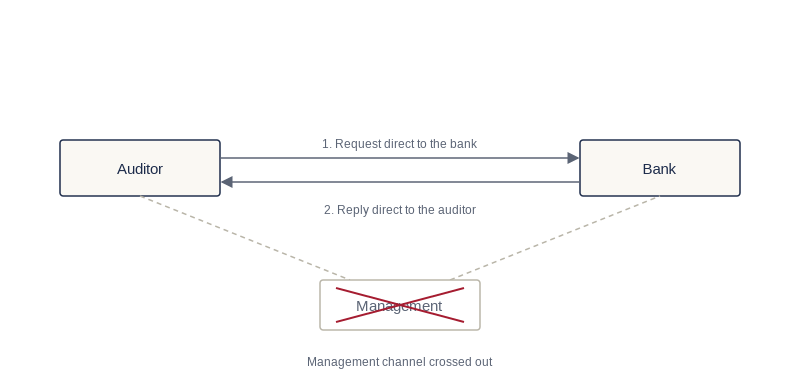
Critical discussion. SA 501 (Audit Evidence, Specific Considerations for Selected Items) inventory aur litigation ke liye specific procedures deta hai: inventory material ho to auditor ko physical count mein attend karna chahiye aur count procedures evaluate karne chahiye. SA 505 external confirmations ko regulate karta hai: auditor ko confirmation process ka control maintain karna chahiye, requests khud bhejni chahiye, replies seedha auditor ke paas aani chahiye. Management ka confirmation rokna ek scope limitation ho sakta hai.
7.8 Verification of Specific Assets and Liabilities
Item-wise verification ka seedha saransh:
- Cash in hand: physical count, surprise basis par; saare locations ka cash ek saath count karo taaki ek jagah ka cash doosri jagah dikhaya na jaye.
- Cash at bank: bank reconciliation statement banao aur bank se seedha confirmation letter lo. Yeh sabse zaroori step hai; aage Wirecard case dikhayega ki is step ko na karne par kya hota hai.
- Investments: share certificates physically dekho ya depository (NSDL/CDSL) statement lo; shares bank ke paas girvi hain to bank se confirm karo.
- Stock in trade: physical stock count mein auditor khud haazir hota hai; cut-off check karo (jo maal 31 March ko andar hai woh stock mein, jo bech diya woh bahar); obsolete ya sada hua maal mark karo.
- Sundry debtors: debtor confirmation letters bhejo (positive ya negative); bad debts provide karo; credit sales real hain ya related party ko dikhayi hain, yeh dekho.
- Fixed assets: fixed asset register se physical assets milao; naye additions ki vouching; disposals ka proof; depreciation rate check.
- Goodwill aur intangible assets: purchase agreement, consideration ka proof, aur impairment review. Yeh sabse mushkil verification hai kyunki inhe chhoo kar nahin dekha ja sakta.
- Liabilities side: creditors se statements; loans ke liye loan agreement aur lender se confirmation; outstanding expenses ke liye next year ke payments check; contingent liabilities ke liye lawyer letters aur board minutes.
Contingent liability woh liability hai jo ho bhi sakti hai aur nahin bhi, ek future event par depend karti hai, jaise chal raha court case. Ise balance sheet ke footnote mein dikhana padta hai; auditor court papers aur legal advisors se verify karta hai.
7.9 Window Dressing
Window dressing ka matlab hai balance sheet ko saja-savar kar dikhana, jaise dukaan wala Diwali par dukaan sajaata hai. Company year-end par temporary tricks karti hai: loan lekar cash dikhana (jo 2 April ko wapas kar de), debtors se advance recover karke cash badhana, ya expenses ko agle saal dhakelna. Agar entries jhooti hain to fraud hai; agar entries asli hain par sirf dikhawe ke liye ki gayi hain, to presentation misleading hai, aur auditor ko iska dhyan rakhna chahiye.
Detection: year-end ke aas-paas ki unusual transactions check karo, aur just-after-year-end reversals dekho. Window dressing presentation ki chaal hai, fraud jhoothi recording hai; dono galat hain, par fraud criminal hai.
Critical discussion. Window dressing aur fraud ki boundary exam mein poochhi jaati hai. Dono ka antar intent aur recording ki sachchai par hai. Auditor ka tool dono ke liye ek hi hai: period boundary ke dono taraf ki targeted testing, yaani cut-off work.
7.10 Cut-off Testing: The Period Boundary
Cut-off sirf sales aur purchases ka nahin hai; yeh har jagah lagta hai jahan period badalta hai. Paanch jagah yaad rakho:
- Sales cut-off: dispatch date vs invoice date. Dispatch 31 March se pehle = is saal ki sale.
- Purchases cut-off: receipt date (GRN) vs invoice date. Maal 31 March tak aa gaya = is saal ka purchase aur stock dono.
- Stock cut-off: count ke din last GRN aur last dispatch numbers freeze karo; count ke baad movement mix ho gayi to count bekaar.
- Expenses cut-off: March ki electricity ka bill April mein aaya, to outstanding expense is saal mein book hoga; accrual concept yahi maangta hai.
- Receipts cut-off: 31 March ko mila cheque kab record hua, kab deposit hua; yeh teeming-lading ka favourite playground hai.
Principle ek hai: period boundary ke dono taraf ke documents uthao aur entry ki date se milao. Documents hamesha boundary ke around ke chune jaate hain, random nahin. Cut-off testing sampling ki woh jagah hai jahan targeted selection random selection se behtar kaam karti hai.
7.11 The Auditor's Responsibility: Watchdog, Not Bloodhound
Ek kathin sawaal: agar auditor ne normal care se vouching ki aur phir bhi fraud chhoot gaya, to kya woh zimmedar hai? Law aur profession ka general principle yeh hai ki auditor watchdog hai, bloodhound nahin: uska kaam reasonable care aur skill se checking hai, har fraud ko pakadne ki guarantee nahin. Agar documents itne ache forged the ki reasonable professional dhoka kha jaye, auditor ki liability limited hai.
Par kab bloodhound banna padta hai? Jab red flags dikhen. Jab circumstances suspicious hon, missing vouchers ka pattern, month-end spikes, management ka confirmation rokna, tab normal care ka matlab badh jaata hai. Suspicion ke baad bhi surface checking karna negligence hai. Isliye Satyam aur Wirecard ke auditors safe nahin the: flags saalon se lehera rahe the. Formula: normal circumstances mein reasonable care; suspicious circumstances mein probing inquiry. Auditor ki file hi uska defense hai: jo red flag tumne dekha aur file mein nahin likha, woh court ke saamne dekha hi nahin gaya.
7.12 The Management Representation Letter
Kuch cheezon ka evidence sirf management hi de sakti hai, jaise "iske siwa koi contingent liability nahin hai". Wahan auditor management representation letter maangta hai: ek signed document jisme management likh kar deti hai ki usne saari liabilities, saare records aur saare frauds auditor ko bata diye hain.
Yeh letter kabhi kaafi nahin hota. Representation letter supplementary evidence hai, substitute nahin. Jo cheez independently verify ho sakti hai, uske liye letter bahana nahin. Aur agar letter books se contradict kare, to auditor investigate karta hai, letter par rely nahin karta. Management letter dene se mana kar de to yeh scope limitation hai aur opinion par asar padta hai. Satyam mein PwC ka sabse bada lesson yahi tha: management ki di potentially false information par reliance se unki audit reports "inaccurate and unreliable" ho sakti thin, unke apne shabdon mein.[19]
7.13 The Standards Map: Which SA Applies Where
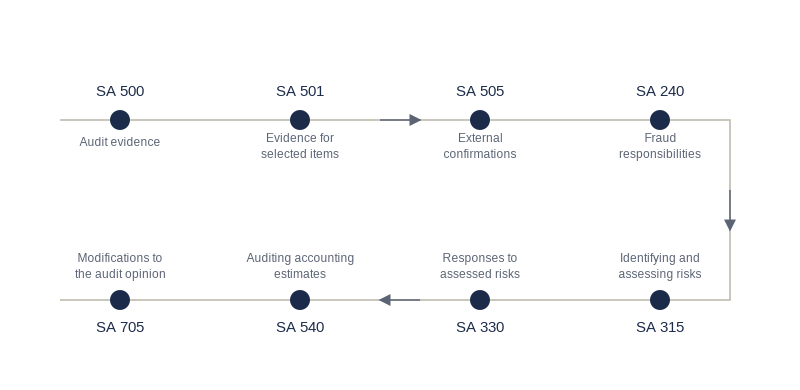
Is chapter se judne wale Standards on Auditing ka seedha map:
- SA 500 (Audit Evidence): sabka aadhar. Evidence sufficient (quantity) aur appropriate (quality) ho. Reliability principles: external > internal, direct > indirect, documentary > oral, original > photocopy. Vouching iska inspection procedure hai.
- SA 501 (Specific Considerations): inventory aur litigation jaise khaas items; inventory material ho to count mein attend karo aur count procedures evaluate karo.
- SA 505 (External Confirmations): auditor confirmation process ka control rakhe; khud request bheje, reply seedha uske paas aaye; management ke rokne ko scope limitation samjhe.
- SA 240 (Fraud): fraud pakadna auditor ka primary kaam nahin, par reasonable assurance ke liye fraud risk assess karna hai; revenue mein fraud risk presume hota hai.
- SA 315 (Risk Assessment): entity aur uske environment ko samajhna, assertions identify karna; vouching/verification ko assertions se jodta hai.
- SA 330 (Responses to Assessed Risks): risk jo mila, uske hisaab se procedures design karo; controls weak nikle to substantive badhao.
- SA 540 (Accounting Estimates): estimates ki reasonableness; Toshiba case isi se juda hai.
- SA 705 (Modifications to Opinion): evidence na mile to qualified opinion (material, not pervasive) ya disclaimer (material aur pervasive).
Critical discussion. Exam mein standard ka number yaad na rahe to concept likhna behtar hai, galat number likhne se. Par yeh aath yaad rakhna vyavaharik hai: 500, 501, 505, 240, 315, 330, 540, 705.
7.14 Case Study: Wirecard, the Cash That Never Existed
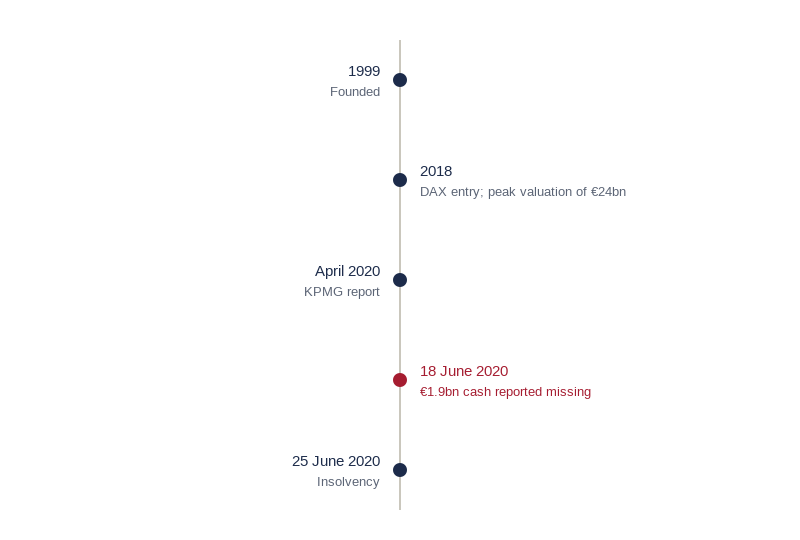
Background. Wirecard AG, Munich ke paas ki payment processing company, kabhi Germany ka fintech star tha. Company 1999 mein bani, 2002 se Markus Braun CEO the, 2018 se yeh Germany ke prestigious DAX index mein thi, aur 2018 mein uski peak valuation 24 billion euro thi.[1]
Red flags pehle se the. 2008 se hi balance sheet par sawaal uthte rahe. 2019 mein Financial Times ki investigations aur whistleblower complaints ke baad Wirecard ne KPMG se special audit karwaya. KPMG 2016 se 2018 ke zyadatar profits verify nahin kar payi, kyunki Wirecard aur uske partners ne documents nahin diye. April 2020 mein yeh announcement aayi to shares 26% gir gaye.[6][7]
Crash. 18 June 2020 ko Wirecard ne bataya ki EY ke audit ke baad 1.9 billion euro cash gayab hai; EY ke mutabik ek trustee ne auditor ko dhokha dene ki koshish ki thi, aur 2019 ke results release nahin ho paaye. Do din mein stock 72% gir gaya.[2] Kuch din baad management board ne kaha ki 1.9 billion euro ka cash "likely did not exist". Philippines ke dono banks ne kaha ki unke paas yeh paisa kabhi tha hi nahin; Financial Times ki report ke mutabik Philippine central bank governor ne bhi kaha ki paisa desh ke financial system mein aaya hi nahin.[3] CEO Markus Braun resign karke arrest ho gaya (19 June resign, 22 June arrest); COO Jan Marsalek bhaag gaya aur Europe's Most Wanted list mein aa gaya. 25 June 2020 ko company ne insolvency file kar di.[4]
Auditor ki galti kya thi? EY 2008 ke special audit ke baad Wirecard ka main auditor bana aur company ke ant tak raha. KPMG ke special audit ke mutabik EY cash reserves ka existence verify nahin kar paya, aur jin bank statements par woh tika tha woh fraudulent dikhti thin. Singapore mein Citadelle naam ki trustee company ne jhoothe confirmation letters diye ki uske paas Wirecard ka 1.1 billion euro hai; January 2026 mein Singapore court ne is jhooth ke liye do vyaktiyon ko 10 saal aur saade 6 saal ki saza sunayi.[5]
Lessons. Pehla, bank balance ki verification ka gold standard hai auditor ka khud bank se direct confirmation lena (SA 505); management se mili photocopy ya trustee ka letter sufficient evidence nahin hai. Doosra, confirmation tabhi evidence hai jab source independent ho aur channel auditor ke haath mein ho; jo confirmation management arrange karke de, woh evidence nahin, dhokhe ka invitation hai. Teesra, whistleblower aur press reports ko seriously lena: saalon se red flags uth rahe the, aur KPMG ke special audit ne 2016-2018 ke zyadatar profits verify nahin kar paaye.[6] Jo auditor cash verify karna bhool jaaye, woh poora audit kho deta hai.
7.15 Case Study: Luckin Coffee, Fabricated Sales of RMB 2.2 Billion
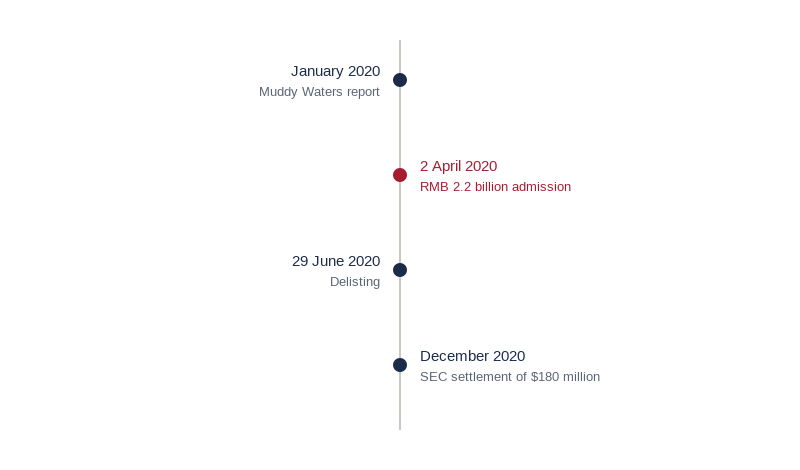
What happened. Luckin Coffee China ka coffee chain tha jo Starbucks ko takkar de raha tha; 2019 mein yeh America ke Nasdaq par 17 dollar ke share se list hua.[8] 31 January 2020 ko short-seller Carson Block ki firm Muddy Waters ne ek anonymous 89-page report publish ki, jisme dawa kiya gaya ki Luckin ne apne per-store sales figures inflate kiye, 2019 ki third quarter mein kam se kam 69% aur fourth quarter mein 88% tak; is dawe ke peeche 11,200 ghante ki video footage thi.[9] Company ne pehle sab kuch deny kiya. Phir 2 April 2020 ko company ne khud bataya ki internal investigation mein paya gaya ki COO Jian Liu ne 2019 ki sales "around RMB 2.2 billion" (lagbhag 310 million dollars) fabricate ki thi.[10] April mahine mein stock 80% se zyada gira; 15 May ko Nasdaq ka delisting notice aaya aur 29 June 2020 ko delisting ho gayi.[11] 16 December 2020 ko US SEC ke saath accounting fraud case mein 180 million dollar ka settlement hua,[12] aur February 2021 mein company ne US mein Chapter 15 bankruptcy file ki.[13]
Audit failure kahan thi? Jhooti sales ka matlab hai aise invoices jo kabhi hue hi nahin. Vouching ke nazariye se yeh fictitious sales ka textbook case hai. Agar sales entries real dikhne wale documents (fake invoices, fake orders) ke saath bhi banayi gayi thin, to document dekhna kaafi nahin tha: auditor ko sales ki occurrence independently check karni thi. Muddy Waters ne wahi kiya jo auditor ko karna chahiye tha: store level par actual activity observe ki (video footage) aur recorded numbers se milaya. Observation aur external data, sirf management ke records nahin: yahi SA 500 ke reliability principles ka lesson hai.
Lessons aur exam angle. Sales ki vouching mein invoice ka hona zaroori hai par kaafi nahin. Jab revenue hi fraud ka target ho (SA 240 revenue mein fraud risk presume karta hai), auditor ko independent data chahiye: store footfall, delivery records, payment processor data. UPSSSC-style sawaal "fictitious sales pakadne ke liye auditor kya kare?" ka jawab: cut-off testing, debtor confirmations, dispatch documents ko invoices se milana, aur unusual month-end sales spikes ki enquiry.
7.16 Case Study: Toshiba, Seven Years of Inflated Profits
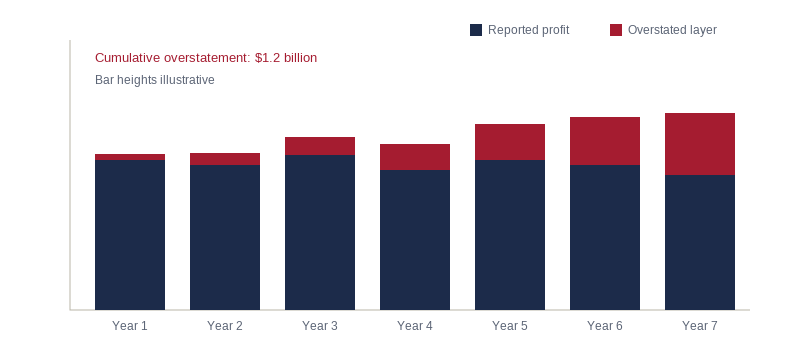
What happened. Japan ki electronics company Toshiba ne May 2015 mein announce kiya ki woh ek accounting scandal ki internal investigation kar rahi hai aur pichhle teen saalon ke profits revise karne pad sakte hain.[14] 21 July 2015 ko CEO Hisao Tanaka ne resign kiya; unhone is scandal ko company ke 140 saal ke itihaas ka "most damaging event" kaha. Investigation mein paya gaya ki profits pichhle saat saalon mein lagbhag 1.2 billion dollar inflate kiye gaye the.[15] Tanaka ke saath 8 aur senior officials gaye, jinmein do former CEOs shamil the.[16]
Audit angle: verification of estimates. Toshiba ka fraud sales invoice ka jhooth nahin tha; yeh estimates aur judgments ka khel tha: long-term projects mein kitna profit abhi book karna hai, kitna loss dikhana hai, kab dikhana hai. Jab top management hi pressure daale ki target poora karna hi hai, to neeche ke accountants estimates ko dheere-dheere, saal-dar-saal dhakelte hain. Har saal thoda, saat saal mein 1.2 billion dollar.
Verification ka lesson. Estimates ko verify karna assets chhoone jitna seedha nahin hota. Auditor ko karna padta hai: (1) management ke assumptions ko independent data se milana; (2) pichhle saal ke estimates ka is saal ke actual se comparison (hindsight review); (3) unusual top-side adjustments aur journal entries ka test, kyunki top-down fraud hamesha entries ke zariye aata hai. SA 540 accounting estimates ke audit ke liye hi hai. Do former CEOs ka jaana dikhata hai ki yeh ek vyakti ka fraud nahin tha, yeh culture tha: jab tone at the top galat ho, to internal controls kagaz par reh jaate hain.
Exam angle. "Verification of provisions and estimates is difficult because..." ka jawab: yeh future events par based hain, management judgment lagta hai, aur auditor ko assumptions ki reasonableness test karni padti hai. Toshiba iska sabse bada praman hai.
7.17 Case Study: Satyam, India's Own Wirecard
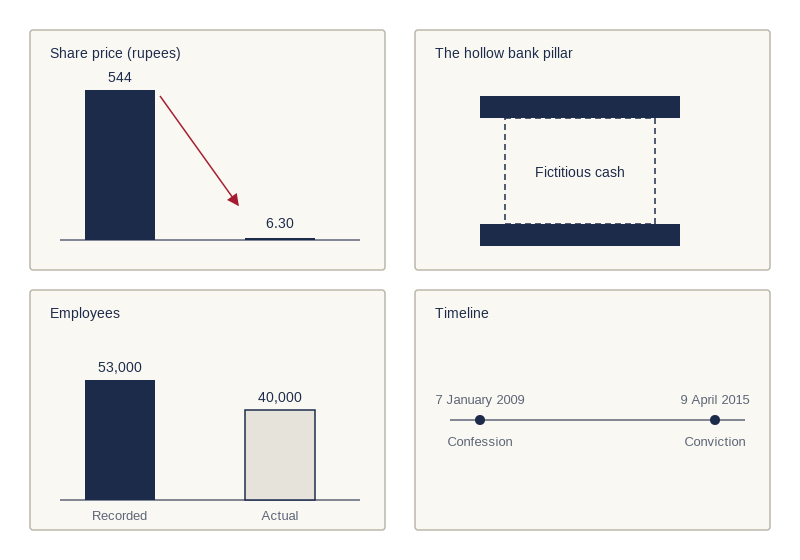
What happened. Satyam Computer Services India ki IT giant thi. 7 January 2009 ko chairman B. Ramalinga Raju ne resign karte hue confess kiya ki usne company ke accounts ko lagbhag 7,000 crore rupaye manipulate kiya tha.[17] Confession ki sabse chonkane wali baat yeh thi ki balance sheet mein dikhaya gaya bank balance ka ek bada hissa exist hi nahin karta tha.[18] Shares, jo 2008 mein 544 rupaye ke high par the, 9 January 2009 ko 6.30 rupaye par aa girre.[20] Fake cash ke alawa books mein profits dikhaye gaye jo kabhi hue hi nahin, fake invoices bane, aur company ke records mein 53,000 employees dikhaye gaye jabki actual lagbhag 40,000 the; 13,000 non-existent employees ki "salaries" ke naam par Raju allegedly har mahine lagbhag 200 million rupaye nikaal rahe the.[21]
Regulatory outcome. Satyam ke auditors PricewaterhouseCoopers ke affiliates the. US SEC ne PwC ki Indian arm par 6 million dollars ka fine lagaya auditing standards na manne par.[22] 2018 mein SEBI ne Price Waterhouse ko 2 saal ke liye India ki kisi bhi listed company ka audit karne se roka aur 13 crore rupaye se zyada ka disgorgement order diya.[23] PwC ne khud 14 January 2009 ko kaha ki management ki di potentially false information par reliance se unki audit reports "inaccurate and unreliable" ho sakti hain.[19] Raju aur 9 anya ko 9 April 2015 ko Hyderabad court ne 7 saal ki saza sunayi.[24]
Vouching aur verification ke aaine mein. Satyam mein teeno failures ek saath thin: (1) bank balance verification fail, kyunki agar auditor ne har bank se direct, independently controlled confirmations li hote, fake cash ki deewar pehle saal hi gir jaati; (2) revenue vouching fail, kyunki fake invoices ko debtor confirmations aur payment trails se nahin milaya gaya; (3) payroll vouching fail, kyunki 13,000 dummy employees dummy worker fraud ka corporate mega version the, jo ek physical presence test ya PF/ESI records se match karne par pakda ja sakta tha.
Lesson. Satyam aur Wirecard ek hi sikke ke do pahlu hain: dono mein cash ka verification management ke kagaz se kiya gaya, independent source se nahin, aur dono mein auditors ne saalon tak clean reports din. Niyam: bank balance, debtors, aur payroll, teen jagah auditor ka apna, seedha, unmediated evidence. In teen par shortcut lena audit par jua hai.
7.18 Worked Problems with Full Solutions
Har problem ka format: Scenario, Journal Entry, Vouching (kaunse kagaz), Verification/Checks, Red flag aur lesson.
Problem 1: Vouching of Cash Sales
Scenario. Gupta Electronics ki 14 March ko cash sales 48,500 rupaye; cashier ne cash book mein entry ki.
| Account | Dr (Rs) | Cr (Rs) |
|---|---|---|
| Cash A/c Dr | 48,500 | |
| To Sales A/c | 48,500 |
Solution. Vouching ke kagaz: cash memos ke counterfoils ya carbon copies, salesman ke daily summary sheets, cash register ka till roll, aur agle din ka bank paying-in slip. Auditor: (1) counterfoils ke serial numbers check kare (1201 se 1280 tak), koi number missing ya cancelled to nahin, cancelled memo ki dono copies file par honi chahiye; (2) counterfoils ka total cash book se milaye; (3) dekhe ki 48,500 agle din bank mein deposit hue, kyunki delay ka matlab cashier ke paas paisa pada raha, teeming-lading ka darwaza; (4) kuch memos ke rate aur quantity ki calculation check kare.
Red flag. Counterfoil 1247 missing hai; cashier kehta hai "galat likh diya tha, phenk diya". Phenkna allowed nahin hai, cancelled memo bhi file par rehta hai. Yeh possible cash chori ka rasta hai: customer ko memo diya, counterfoil phenka, paisa pocket mein. Exam trap: cash sales ke liye "sales invoices" mat likho; credit sales mein invoice, cash sales mein cash memo/counterfoil.
Problem 2: Credit Purchases and the Three-Way Match
Scenario. 10 January ko Sharma Traders se maal 1,20,000 rupaye plus 18% GST (21,600) udaar kharida.
| Account | Dr (Rs) | Cr (Rs) |
|---|---|---|
| Purchases A/c Dr | 1,20,000 | |
| Input GST A/c Dr | 21,600 | |
| To Sharma Traders A/c | 1,41,600 |
Solution. Vouching ke kagaz: purchase order (PO) ki copy, GRN, supplier ka invoice, purchase register. Three-way match: (1) PO par rate 1,15,000 tha, invoice 1,20,000 ka hai; 5,000 ka fark ya to approved price change hai ya billing error, approval note maange; (2) GRN se quantity milaye, short receipt ka hisaab alag chahiye; (3) invoice ki math check kare: 1,20,000 ka 18% = 21,600, sahi; (4) invoice par company ka naam, GST number, date check kare; (5) purchase register se ledger posting tak trace kare. Verification angle: supplier se period-end statement maang kar balance milaye, yeh external evidence hai.
Red flag. Invoice par GRN reference hi nahin: maal aaya ya nahin, koi proof nahin. Aise entries se "jhooti khareed" banti hai jisse profit ghata kar tax bachaya jaata hai.
Problem 3: Wages and Dummy Workers
Scenario. Ek construction company ne March ki wages 3,60,000 rupaye di, 40 workers ko.
| Account | Dr (Rs) | Cr (Rs) |
|---|---|---|
| Wages A/c Dr | 3,60,000 | |
| To Cash A/c | 3,60,000 |
Solution. Vouching ke kagaz: wages sheet, muster roll, workers ke signatures ya thumb impressions, overtime approval slips. Auditor: (1) muster roll se wages sheet milaye (naam, din, rate); (2) signatures dekhe, do alag workers ke sign ek jaisi likhawat mein to nahin; (3) surprise test: wages payment ke din khud haazir rahe, paanch random workers ko bulaye aur unka naam muster roll se poochhe; (4) casual workers ke liye appointment ya contractor agreement dekhe.
Red flag. Ek "Ramesh Kumar" teen mahine se har sheet par hai par site supervisor use pehchanta nahin; contractor har mahine uska 9,000 rupaye khud sign karke le jaata hai. Classic dummy worker (bhoota mazdoor) fraud. Exam trap: dummy worker pakadne ka sabse seedha test payment ke din surprise physical presence hai; sirf muster roll check karna aadha jawab hai.
Problem 4: Machine Purchase, Capital or Revenue?
Scenario. 5 August ko company ne machine kharidi: basic price 8,00,000, transport 20,000, installation 30,000. Saath purani machine ki repair ka 40,000 ka bill aaya, aur accountant ne dono ko Machinery account mein daal diya.
Correct journal entries:
| Account | Dr (Rs) | Cr (Rs) |
|---|---|---|
| Machinery A/c Dr (8,00,000 + 20,000 + 30,000) | 8,50,000 | |
| To Bank A/c | 8,50,000 | |
| Repairs A/c Dr | 40,000 | |
| To Bank A/c | 40,000 |
Solution. Vouching ke kagaz: supplier invoice, transport bilty, installation certificate, quotation comparison sheet, board ya purchase committee ka approval. Capital vs revenue check: transport aur installation machine ko working condition tak laane ka kharch hai, isliye cost mein judta hai; repair sirf purani machine chalane ka kharch hai, woh revenue expense hai, P&L mein jaayega. Accountant ki galti ka asar: 40,000 repair ko Machinery mein daalne se asset phool gaya aur is saal ka expense kam ho gaya, yaani profit 40,000 se zyada dikha (depreciation ka chhota asar alag). Correction entry: Repairs A/c Dr 40,000 / To Machinery A/c 40,000. Quotation comparison dekhe; agar maalik ke rishtedaar ki firm se kharida to related party disclosure ka sawaal.
Verification angle. Machine physically factory mein dekhe, serial number invoice se milaye, depreciation recompute kare. Exam trap: installation charges Machinery ki cost mein; major overhaul jo life badha de capital; routine repair revenue.
Problem 5: Vouching of Rent Received
Scenario. Seth ji ne teen dukaanein 15,000 rupaye mahine ke kiraye par di hain; books mein saal ka rent received 5,25,000 dikhta hai.
Solution. Agreement se rate confirm kare: 3 x 15,000 x 12 = 5,40,000 hona chahiye; books mein 5,25,000 hai, 15,000 kam kyun? Rent register mein July ka ek dukaan ka rent missing hai. Tenant se confirmation: tenant kehta hai usne July ka rent cash mein Seth ji ke bete ko diya. Auditor ke liye yeh rent in arrears hai jo books mein dikhna chahiye. Khali dukaan ka dawa ho to vacancy ka proof maange: zero electricity bill, local enquiry.
Red flag. Tenant confirmation mein tenant kehta hai usne 18,000 mahina diya, books mein 15,000 likha hai; 3,000 har mahine kahin aur ja raha hai. Rent receipts ke counterfoil check karo.
Problem 6: Verification of a Bank Loan
Scenario. Company ne 1 October ko bank se 25,00,000 ka term loan liya, factory building girvi rakh kar.
| Account | Dr (Rs) | Cr (Rs) |
|---|---|---|
| Bank A/c Dr | 25,00,000 | |
| To Term Loan A/c | 25,00,000 |
Solution. Vouching ke kagaz: loan sanction letter, loan agreement, bank statement mein credit, board resolution. Verification steps: (1) direct confirmation: auditor khud bank ko letter likhe, 31 March ko outstanding, interest rate, security; reply seedha auditor ke paas aana chahiye (SA 505); (2) charge check: building girvi hai, to charge register hua ya nahin dekhe; balance sheet mein loan "secured" tabhi dikhaya jaa sakta hai jab charge ka proof ho; (3) interest accrual: 6 mahine ka interest recompute kare: 25,00,000 x 10% x 6/12 = 1,25,000; books mein outstanding interest se milaye; (4) purpose check: loan factory ke liye tha; paisa sach mein factory mein laga, bank statement se bade payments trace kare.
Red flag. Management kehti hai "bank se hum confirm karwa denge, aap mat likhiye". Confirmation ka control management ke haath mein gaya to evidence kamzor ho gaya. Wirecard yaad rakho.
Problem 7: Debtor Confirmation Mismatch
Scenario. Books mein debtor Mehta & Co ka balance 2,45,000 hai. Auditor ne direct confirmation bheji; Mehta & Co ka reply: "Hamara balance sirf 1,95,000 hai. 50,000 ka cheque humne 29 March ko post kiya tha."
Solution. Teen possibilities. Pehli: cheque 29 March ko bheja gaya, company ko 2 April ko mila; yeh cheque in transit hai. Agle saal ki cash book dekho: 2 April ko 50,000 ki receipt entry hai to koi galti nahin, sirf timing, yeh reconciliation item hai, adjustment nahin. Doosri: cheque kabhi aaya hi nahin, ya cashier ne pocket mein daala aur receipt entry hi nahin ki; yeh teeming-lading ka signal hai. Teesri: Mehta & Co jhooth bol raha hai apni liability kam dikhane ke liye; cheque number aur bank clearing ka proof maango. Agar cashier ne churaya, to entries: Mehta & Co Dr 50,000 / To Cash 50,000 (receipt record), aur phir recovery ka alag raasta.
Red flag. Aisa mismatch paanch aur debtors mein mile, sab "cheque post kiya tha" wale. Pattern ka matlab cashier receipts rok raha hai. Debtor confirmations lapping pakadne ka sabse sasta tool hai.
Problem 8: Stock Verification and Cut-off
Scenario. Books ke hisaab se 31 March ko stock 4,200 units @ 250 = 10,50,000. Auditor ne physical count kiya: 4,050 units. Saath dekha: 60,000 ka maal 2 April ko dispatch hua, par sale 31 March ki books mein likhi gayi.
Solution. (1) Shortage: 150 units x 250 = 37,500 ka stock gayab; wajah chori, damage ya counting error. Entry: Stock Shortage (P&L) Dr 37,500 / To Trading A/c 37,500. (2) Cut-off error: maal 2 April ko gaya to sale agle saal ki hai. Reversal: Sales A/c Dr 60,000 / To Debtor A/c 60,000; aur woh maal is saal ke stock mein wapas judega (cost par). (3) Goods in transit: supplier ne maal 30 March ko bheja, 2 April ko pahuncha; agar ownership 30 March ko transfer ho gayi thi (FOB shipping point), to yeh "goods in transit" ke roop mein hamara stock hai.
Red flag. Management count ke baad kehti hai "woh 150 units doosre godown mein hain". Auditor ka response: turant physically verify karo. Exam trap: goods sent on approval stock mein judega (cost par); goods sold but not dispatched stock se hat jayega.
Problem 9: Investments, Certificates Present but Pledged
Scenario. Company ke paas X Ltd ke 10,000 shares hain, cost 120 per share = 12,00,000. Company ne certificates dikha diye.
Solution. (1) Certificates physically dekhe: company ke naam par? Serial numbers investment register se milte hain? (2) Pledge check: certificates par "pledged" ka stamp? Bank se direct confirmation maange; bank confirm karta hai ki 10,000 shares overdraft ke against lien mein hain. (3) Disclosure: pledged shares ka disclosure balance sheet mein chahiye; books mein koi note nahin to yeh incomplete disclosure hai. (4) Income trace: X Ltd ne is saal dividend diya? Dividend warrant ya bank credit se income verify kare; shares hain par dividend kabhi nahin aaya to poochho kyun.
| Account | Dr (Rs) | Cr (Rs) |
|---|---|---|
| Bank A/c Dr | 30,000 | |
| To Dividend Received A/c | 30,000 |
Red flag. Certificates original nahin, photocopies hain; "original bank mein hain". Bank se confirm karo; bank kehta hai koi shares nahin hain uske paas. Ab poora investment doubtful hai.
Problem 10: Sale of a Fixed Asset
Scenario. Company ne ek machine bechi: cost 5,00,000, accumulated depreciation 2,00,000, sale price 2,60,000.
| Account | Dr (Rs) | Cr (Rs) |
|---|---|---|
| Bank A/c Dr | 2,60,000 | |
| Accumulated Depreciation A/c Dr | 2,00,000 | |
| Loss on Sale A/c Dr | 40,000 | |
| To Machinery A/c | 5,00,000 |
(WDV = 5,00,000 - 2,00,000 = 3,00,000; sale 2,60,000; loss 40,000.)
Solution. Vouching ke kagaz: sale agreement ya delivery challan, board approval, bank mein paisa aane ka proof. Auditor: (1) approval dekhe, articles ya board minutes mein authority; (2) price reasonable tha, ya related party ko sasta bech diya; do independent quotations ya valuation maange; (3) calculation recompute kare: WDV, loss; (4) asset register update hua ya machine ab bhi register mein hai.
Red flag. Machine maalik ke damaad ki firm ko 2,60,000 mein bechi gayi jabki scrap dealer 3,10,000 de raha tha: related party aur undervaluation dono ka sawaal.
Problem 11: Petty Cash Surprise Count
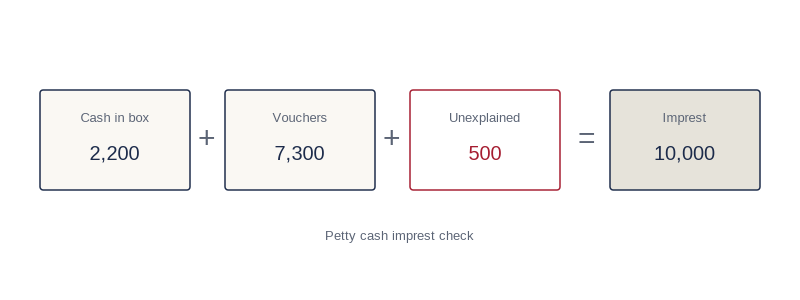
Scenario. Imprest amount 10,000. Auditor ne bina bataye petty cash box khulwaya. Vouchers ka total 7,300; cash hona chahiye 2,700; actual cash 2,200.
Solution. Equation: Imprest amount = cash in box + approved vouchers + unexplained shortage. Yahan 10,000 = 2,200 + 7,300 + 500 shortage. Pehle poochho: koi voucher likha jo register mein entry nahin hua? Koi IOU padi hai box mein? IOU allowed nahin hoti. Ek 800 ka voucher hai jis par approval signature nahin: unapproved voucher = unvouched payment. Ek voucher "office decoration 1,500" ka hai par bill nahin, sirf haath se likhi chitthi: secondary evidence maango ya unvouched mark karo.
Red flag. Petty cashier kehta hai "500 maine apni jeb se peon ko advance diye the". Petty cash se personal loan teeming-lading ka nanha roop hai. Exam trap: petty cash check ka sahi tareeqa surprise count hai, appointment lekar nahin.
Problem 12: Travelling Expenses, Business or Personal?
Scenario. Director ke travelling expenses 85,000 claim hue, Europe tour; bills attached hain.
Solution. Vouching ke kagaz: tour programme, tickets, boarding passes, hotel bills, board approval for foreign travel, daily allowance policy. Tour programme se tickets milaye: director ke saath do aur tickets hain, Mrs. Director aur bete ki, 32,000 rupaye; yeh personal expense hai. Hotel bill mein family room ka charge. Board approval mein kya likha tha, "director akela" ya "family allowed"? Personal hissa recover hona chahiye: Director's A/c Dr 32,000 / To Travelling Expenses A/c 32,000.
Red flag. Bills mein ek jeweller ka bill bhi hai, "client gift" likha hua; client ka naam aur business purpose maango. Directors ke expenses mein auditor ki skepticism sabse tez honi chahiye kyunki approval karne wala khud beneficiary hai.
Problem 13: Goods on Approval Recorded as Sale
Scenario. 28 March ko company ne 1,00,000 ka maal customer ko "sale or return" basis par bheja, approval period 15 din. Accountant ne sale book kar di: Debtor Dr 1,00,000 / To Sales 1,00,000. Maal ki cost 80,000.
Solution. 31 March ko customer ne approve nahin kiya, matlab yeh sale nahin hai; yeh hamara stock hai, customer ke paas pada hua. Profit par asar: sale 1,00,000 aur cost 80,000 dono books mein chale gaye, profit 20,000 phool gaya. Correction entries: (1) Sales A/c Dr 1,00,000 / To Debtor A/c 1,00,000; (2) Stock with Customer on Approval Dr 80,000 / To Trading A/c 80,000. Verification: customer se confirm karo ki 31 March tak approve kiya tha ya nahin; 5 April ki approval ka matlab sale agle saal ki.
Exam trap. Sale or return hamesha cost par stock mein aata hai, sale price par nahin.
Problem 14: Bank Reconciliation and Confirmation
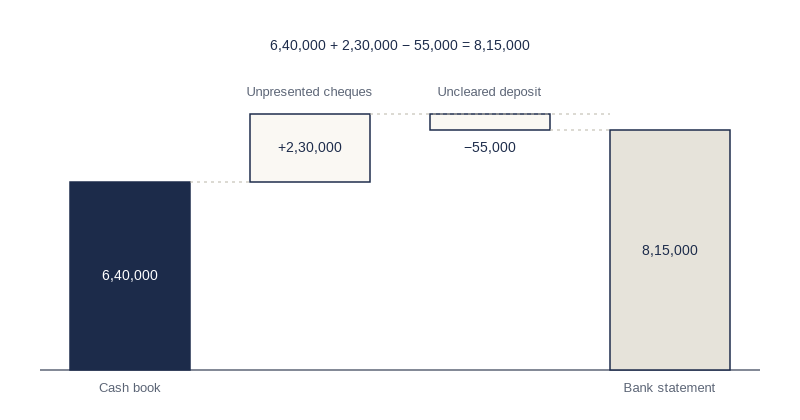
Scenario. 31 March ko cash book mein bank balance 6,40,000; bank statement mein 8,15,000.
Solution. Reconciliation: cheques issued par present nahin hue +2,30,000; cheque deposited par clear nahin hua -55,000. Cash book 6,40,000 + 2,30,000 - 55,000 = 8,15,000 = bank statement. Auditor: (1) har reconciling item trace kare: 2,30,000 ke cheques April mein present hue? (2) 55,000 ka deposit April ke pehle hafte clear hua? (3) direct confirmation bank se: balance, koi lien, koi guarantee; statement ki photocopy management se mat lo; (4) old outstanding cheques dekhe: 6 mahine se present na hua cheque stale hai, wapas likhna chahiye.
Red flag. Ek reconciling item "cheque issued not presented 90,000" teen mahine purana hai; payee se confirm kiya, payee kehta hai use kabhi cheque mila hi nahin. Matlab cheque nikala gaya, kisi aur ne cash karaya, aur "not presented" dikhakar baitha diya gaya. Bank figure ko management ke kagaz se maan lena Wirecard wali duniya ka darwaza hai.
Problem 15: Verification of a Contingent Liability
Scenario. Company par ek customer ka case chal raha hai: 12,00,000 ka claim, court mein pending.
Solution. (1) Court papers dekhe: plaint copy, claim amount, status. (2) Company ke lawyer se direct letter maange: haarne ka chance? Lawyer kehta hai "possible but not probable". (3) Board minutes dekhe: case ka zikr, provision ki baat? (4) Treatment: "possible, not probable" hai to koi journal entry nahin, sirf footnote disclosure: "Contingent liability: customer claim 12,00,000, company is contesting the case." (5) Agar lawyer kehta "probable hai, 10 lakh dena padega", to provision: P&L A/c Dr 10,00,000 / To Provision for Claim 10,00,000.
Red flag. Management kehti hai "case purana hai, footnote ki zaroorat nahin". Purana hona liability khatam nahin karta; jab tak court se disposal order nahin, disclosure chahiye. Exam trap: contingent liability ki books mein entry nahin hoti; provision tab banta hai jab outflow probable ho aur amount reliably estimate ho sake.
Problem 16: Window Dressing with Numbers
Scenario. Ek company ki 31 March ki position: cash 2,00,000, debtors 18,00,000, creditors 15,00,000. 28 March ko management ne creditors ko 6,00,000 ka payment rok diya aur debtors se 4,00,000 jaldi vasool liye, sirf isliye ki balance sheet par cash achha dikhe. 5 April ko creditors ko payment chala gaya.
Solution. 31 March ko cash dikhta hai 8,00,000 (2,00,000 + 4,00,000 + 6,00,000 jo roka gaya). Current ratio ka hisaab: current assets badhe, current liabilities waise hi, to ratio healthy lagta hai. Par yeh position sirf ek hafte ki acting hai. Auditor ka test: (1) year-end ke aas-paas ke cash book ke bade receipts aur payments ko agle saal ke cash book se match karo; 5 April ka 6,00,000 payment turant dikhega; (2) debtors se poochho ki unse early payment ki request gayi thi kya; (3) subsequent events review karo. Red flag. Year-end ke thik pehle collections ka spike aur thik baad payments ka spike, yeh window dressing ka classic pattern hai. Exam trap: window dressing mein entries jhooti nahin hotin, timing hoti hai; isliye yeh vouching se nahin, cut-off aur subsequent events ke analysis se pakda jaata hai.
Problem 17: Teeming and Lading, Ek Hafte Ka Reconstruction
Scenario. Ek cashier ke paas teen customers A, B, C se cash aata hai. 2 March: A se 50,000 aaye, cashier ne pocket mein daal liye, cash book mein entry nahin. 5 March: B se 50,000 aaye, cashier ne unhe A ke naam laga diye. 9 March: C se 50,000 aaye, unhe B ke naam. C ka balance ab bhi khula dikhta hai.
Solution. Yeh teeming and lading hai: ek ke paise se doosre ka hisaab band karna, aur ghapla aakhri customer par chhod dena. Pakadne ke tests: (1) receipt books ke counterfoils ki dates ko bank paying-in slips aur cash book ki dates se match karo; receipt 2 March ki, deposit 5 March ka, yeh gap hi saboot hai; (2) remittance advices dekho: B ne apna 50,000 apne bill ke against bheja tha, A ke against credit kaise hua? (3) customers ko confirmation bhejo; A ka account to band dikhega par B aur C mismatch karenge; (4) dekho ki ek hi cashier receipt, entry aur deposit teeno karta hai ya nahin, duties ka separation hai ya nahin. Lesson. Teeming and lading ka engine "time gap" hai: cash aane aur bank jaane ke beech ka fasla. Roz ka deposit (daily banking, intact) is fraud ka sabse sasta ilaaj hai.
Problem 18: Vouching of Royalty Income
Scenario. Ek author company ko do publishers se royalty milti hai. Agreement: Publisher X 10% royalty deta hai MRP par, minimum 1,00,000 saal ka; Publisher Y 12% net sales par, koi minimum nahin. Saal mein company ke books mein royalty income: X se 1,00,000, Y se 86,400. X ne saal mein 8,000 copies bechin, MRP 120. Y ne 6,000 copies bechin, MRP 150, par 4% returns.
Solution. Vouching ka base document agreement hai, sirf bank credit nahin. X ka hisaab: 8,000 x 120 x 10% = 96,000; minimum guarantee 1,00,000 zyada hai, to 1,00,000 sahi booked. Y ka hisaab: gross sales 6,000 x 150 = 9,00,000; returns 4% = 36,000; net 8,64,000; royalty 12% = 1,03,680. Books mein 86,400 hai, matlab 17,280 kam booked. Fark ka karan? Ho sakta hai publisher ne returns zyada kaati hon ya copies ka figure alag ho. Auditor: (1) dono publishers se royalty statements maange aur apne hisaab se milaye; (2) copies sold ka external corroboration dekhe (publishers ki statements hi yahan main source hain); (3) agreement ke clauses check kare: MRP par ya net par, minimum, returns ki definition; (4) 17,280 ka fark management se poochhe aur unresolved rahe to qualification ka vichaar kare. Red flag. Publisher Y ka statement 1,03,680 dikhata hai par company 86,400 maan rahi hai: ho sakta hai baaki paisa kisi aur account mein gaya ho. Exam trap. Royalty vouching mein agreement clause hi computation ka adhar hai; "bank mein jitna aaya utna sahi" galat approach hai.
7.19 Verification of Goodwill and Intangible Assets
Goodwill aur intangibles verification ke sabse mushkil items hain, kyunki inhe chhoo kar nahin dekha ja sakta. Teen rules.
Pehla, paid goodwill hi books mein aati hai: jab business kharida aur net assets se zyada daam diya, woh extra goodwill hai; purchase agreement aur consideration ka proof uski vouching hai. Apni banayi (self-generated) goodwill khud se books mein daalna allowed nahin. Doosra, impairment review: har saal management ko dekhna chahiye ki goodwill ki value ab bhi utni hai ya business kharab ho gaya; auditor management ke assumptions test karta hai, future cash flows, discount rates, growth. Toshiba yaad karo: estimates hi fraud ka playground hain. Teesra, amortisation ya write-off policy consistent ho: ek saal "goodwill 10 saal mein amortise", agle saal "kabhi amortise nahin", bina reason ke, yeh manipulation ka signal hai; policy change ka justification aur disclosure maango.
Patents aur trademarks ke liye registration certificates dekho, renewal fees ke receipts, aur unse aane wali income ka reasonable link. Jo patent kabhi renew hi nahin hua, woh enforceable asset kehlana sandigdh hai.
7.20 Practice Drills
Drill A: Rapid Vouching Reference (25 Items)
Har item ke saath pehla voucher, ek extra document, aur ek red flag diya gaya hai.
| Item | First voucher | Extra document | Red flag |
|---|---|---|---|
| Legal fees | Vakil ki fee note, case file | Court receipt | Case company ka ya director ka personal? |
| Commission to agent | Agency agreement, commission statement | Agent ka PAN/TDS | Commission sales ke proportion se zyada |
| Freight inward | Transporter ka bilty (L/R), freight bill | GRN se link | Freight hai par goods received ka record nahin |
| Advertisement | Newspaper clipping, invoice | Contract | Ek chhote publication ko bahut bade payments |
| Repairs to building | Contractor bill, completion certificate | Engineer approval | Bill mein naye construction ka material (capital hona chahiye) |
| Insurance premium | Policy, premium receipt | Asset list se cover match | Premium diya par policy expire ho chuki |
| Dividend received | Dividend warrant ya bank advice | Investment register | Shares books mein hain par dividend kabhi nahin aaya |
| Interest on loan paid | Bank interest debit advice | Loan agreement se rate recompute | Books ka interest bank calculation se kam |
| Sale of scrap | Scrap sale note, weighbridge slip | Gate pass | Scrap sale cash mein, entry hi nahin |
| Custom duty paid | Bill of entry, duty challan | Import invoice se link | Duty stock cost mein nahin daala |
| Bonus to staff | Bonus agreement, payment sheet | Payment of Bonus calculations | Ineligible employees ko bonus |
| Electricity expenses | Electricity board bill | Meter reading register | Bill flat, production double |
| Stationery purchase | Supplier bill, store issue slips | Stationery stock register | Bill hai, issue register mein kuch nahin |
| Bank charges | Bank statement | Charges schedule | Unusual "commission" entries |
| Loan to employee | Loan application, approval | Salary deduction schedule | Loan diya, deduction shuru nahin hui |
| Advance to supplier | Advance agreement, payment proof | Baad mein GRN se adjustment | Advance saalon se outstanding, supply nahin aayi |
| Donation paid | Donee ki receipt, approval | Donee ka registration | Donation maalik ke apne trust ko |
| Royalty paid | Royalty agreement, calculation | Production data | Royalty fixed, sales variable |
| Hire purchase asset | HP agreement, installment schedule | Asset possession | Poora HP price asset mein, interest alag nahin |
| Income tax refund | Assessment order, refund advice | Earlier tax payments | Refund aaya, interest on refund missing |
| Sales return | Credit note, goods inward note | Maal ki condition | Saal ke baad ke returns is saal se adjust |
| Purchase return | Debit note, outward gate pass | Supplier acknowledgement | Debit note bana, maal gaya nahin |
| Carriage outward | Transporter receipts, freight register | Sales invoices se link | Carriage zyada, dispatches kam |
| Share certificate printing | Printer bill, board approval | Certificates stock register | Count register se zyada print |
| Preliminary expenses | Registration fee receipts, MOA/AOA filing | ROC receipts | Ek saal mein expense ya hamesha ka asset |
Drill B: Banking Transactions (10 Items)
Banking transactions ka apna grammar hai; bank se seedha confirm karna default hai, exception nahin.
- Fixed deposit: FD receipt original dekho; bank se FD aur koi lien ki direct confirmation; red flag: photocopy receipt, "original locker mein".
- Bills discounted: bill ka usance, drawee, discounting charges; drawee se confirmation; red flag: record bills receivable register se mismatch.
- Letter of credit: LC application, bank ki LC copy, margin money; red flag: LC khuli, maal kabhi nahin aaya, liability chhupi hui.
- Bank guarantee: guarantee copy, commission debit, beneficiary aur expiry date; red flag: guarantee chal rahi hai par contingent liability note se gayab.
- Interest on FD: bank advice; rate aur period se recompute; red flag: interest rate se zyada (fake income?) ya kam (siphoning?).
- Cheque dishonoured: bank return memo, customer account mein reversal entry; red flag: dishonour hua par amount debtors se hata diya bina follow-up.
- Cash credit/overdraft: bank statement, direct confirmation, security documents (hypothecation deed, stock statements); red flag: bank ko diye stock statement aur books ke stock mein farak.
- Locker rent: bank receipt, locker register entry; red flag: doosra locker bhi rent par hai jiska mention hi nahin.
- Dividend warrant received: warrant counterfoil ya bank credit; investment register se match; red flag: warrant encash hua, books mein nahin.
- Foreign remittance received: bank advice, FIRC (foreign inward remittance certificate); invoice se link aur conversion rate; red flag: remittance hai par koi sale/export record nahin.
Drill C: Capital versus Revenue Classification (12 Items)
Har transaction ko capital ya revenue classify karo, phir answers se milao.
- Purani building ki annual whitewash, 35,000. Revenue: Repairs A/c Dr; routine maintenance.
- Nayi machine ka erection aur trial run, 60,000. Capital: Machinery A/c Dr; working condition tak ka kharch.
- Legal fees for acquiring land, 25,000. Capital: Land A/c Dr; acquisition se juda cost asset mein.
- Legal fees for defending a suit, 15,000. Revenue: Legal Expenses Dr; defence cost asset create nahin karti.
- Import duty on raw material, 40,000. Revenue (stock cost): raw material ki cost ka hissa.
- Import duty on machinery, 90,000. Capital: Machinery A/c Dr; asset laane ka duty cost mein.
- Major engine overhaul jo truck ki life 5 saal badha de, 1,20,000. Capital: Truck A/c Dr; benefit future periods tak.
- Painting of newly purchased second-hand machine before use, 8,000. Capital: pehli baar use ke liye zaroori.
- Registration fees for new shop purchase, 50,000. Capital: acquisition cost.
- Fire insurance premium for stock, 12,000. Revenue: routine protection.
- Shifting machinery to a better site, 45,000. Revenue: na naya asset, na life improvement.
- Employee training for new software, 30,000. Revenue: training asset nahin banti.
Exam trap. Land acquire karne ki legal fees capital, par usi land par case defend karne ki legal fees revenue. Dono "legal fees" hain; context padho, keyword par mat koodo.
Drill D: Cash Book Walkthrough (10 Entries, One Surprise)
Gupta ji ki March ki cash book ke 10 items diye gaye hain; har item ke liye voucher aur check likho, aur aakhir mein woh "surprise" dhundo jo auditor ko dikhna chahiye.
| Date | Item | Voucher | Check |
|---|---|---|---|
| 2 March | Cash sales 32,000 | Cash memo counterfoils | Total milao; bank deposit next day? |
| 4 March | Rent paid 15,000 | Rent agreement, landlord receipt | TDS angle, agar threshold lagta ho |
| 7 March | Cash purchase 48,000 | Supplier cash memo | Rate/quantity; GRN/stock register |
| 10 March | Received from Sharma 25,000 | Receipt counterfoil | Ledger credit; debtor confirmation |
| 12 March | Salary paid 60,000 | Salary sheet, signatures | PF/ESI records se headcount match |
| 15 March | Cash sales 28,500 | Counterfoils | Serial continuity |
| 18 March | Electricity 4,200 | Board receipt | Meter reading |
| 21 March | Cash sales 31,000 | Counterfoils | Serial continuity |
| 25 March | Drawings 20,000 | Capital account posting | Business cash se personal nikaas ka pattern? |
| 31 March | Cash sales 47,000 | Counterfoils | Cut-off: next day bank gayi? |
The surprise. 2, 15 aur 21 March ki sales 32,000 / 28,500 / 31,000 hain, par 31 March ko achanak 47,000. Month-end spike window dressing ya fictitious sale ka signal ho sakta hai. Auditor 31 March ke counterfoils specially check karega: customers real hain, maal dispatch hua, paisa sach mein aaya? Ek month-end spike kabhi ignore mat karo.
Drill E: Fraud Signals Dictionary (15 Signals)
- Month-end sales spike: aakhri hafte sales double; cut-off test lagao.
- Missing serial numbers: invoices/receipts mein gaps; cancelled documents maango.
- Too many round figures: 50,000, 1,00,000 jaise gol amounts; asli duniya mein amounts tedhe hote hain.
- Manual entries at top level: senior officers ki seedhi journal entries; top-side entries hamesha test karo.
- Related party payments without disclosure: maalik ke rishtedaar ki firms; ownership chain trace karo.
- Photocopies instead of originals: "original bank mein hai" sabse purana bahana; bank se confirm karo.
- Staff never on leave: cashier saalon se chhutti nahin leta; lapping ka cover.
- Lifestyle beyond salary: cashier ki nayi gaadi; direct evidence nahin, par enquiry ka point.
- Slow bank deposits: receipt aaj, deposit paanch din baad; teeming-lading ka raasta.
- Frequent adjusting entries: har mahine "rectification"; system weak ya fraud.
- Unusual year-end reversals: 31 March ko entry, 2 April ko reverse; window dressing.
- Suppliers with no physical address: invoice par address incomplete; fictitious vendor check.
- Same handwriting signatures: alag workers ke sign ek jaisi likhawat; dummy records.
- Stock shortage explained by "doosra godown": turant physically verify karo.
- Management avoiding confirmations: "bank se hum pooch lenge"; confirmation ka control auditor ke haath mein rakho.
Ek signal investigation maangta hai; teen signal ek saath audit plan badalte hain; paanch signal ek saath to auditor ko apni fees se zyada apni report ki fikr honi chahiye.
7.21 Chapter Summary
Vouching woh buniyadi audit procedure hai jisme har recorded transaction ko uske voucher, yaani documentary evidence, se milaya jaata hai, aur isliye ise audit ki backbone kaha jaata hai. Vouchers primary (asli bill, rasid) aur secondary (duplicate, collateral) hote hain, aur external evidence internal se zyada reliable maana jaata hai. Vouching transactions par poore saal chalti hai, jabki verification year-end par balance sheet items ke existence, ownership, possession aur charge-free status ko establish karti hai, aur valuation unki sahi keemat tay karti hai. Cash receipts side sabse fraud-prone hai, jahan teeming and lading (lapping) ka classic fraud surprise cash counts, daily deposit matching aur debtor confirmations se pakda jaata hai. Purchases mein three-way match (PO, GRN, invoice) aur sales mein cut-off testing core controls hain, aur SA 240 revenue mein fraud risk presume karta hai. Capital-revenue misclassification, dummy workers, pledged investments aur sale-or-return ko sale likhna classic manipulation techniques hain jinhe auditor item-wise procedures se todta hai. Wirecard aur Satyam ne dikhaya ki bank balance ko management ke kagaz se verify karna audit failure ka seedha raasta hai; direct, auditor-controlled confirmation (SA 505) hi gold standard hai. Luckin Coffee ne dikhaya ki invoice ka hona kaafi nahin, occurrence ko independent data se check karna zaroori hai, aur Toshiba ne dikhaya ki estimates ka audit hindsight review aur top-side journal entry testing maangta hai. Auditor watchdog hai, bloodhound nahin, par red flags dikhne par probing inquiry uski zimmedari ban jaati hai. Ant mein, management representation letter supplementary evidence hai, substitute nahin, aur auditor ki apni documentation hi court ke saamne uska defense hai.
7.22 Review Questions
Part A: Short-Answer Questions (10)
- Vouching ki definition likho aur batao auditor isme kaunse paanch tatva check karta hai.
- Primary aur secondary voucher mein antar likho; missing voucher ki sthiti mein auditor ke teen steps kya hain?
- Vouching, verification aur valuation mein antar ek machine kharid ke example se samjhao.
- Teeming and lading kya hai? Iska mechanism aur iske detection ke teen tests likho.
- Verification ke chaar pillars kaunse hain? Har pillar ka ek-example do.
- Window dressing aur fraud mein antar likho; window dressing ke do detection techniques batao.
- Contingent liability kya hai, kahan dikhayi jaati hai, aur provision kab banta hai?
- "Auditor is a watchdog, not a bloodhound" ka matlab likho; kab probing inquiry zaroori ho jaati hai?
- Management representation letter kya hai? Yeh kab sufficient evidence nahin hota?
- Wirecard case se bank balance verification ka ek-paragraph lesson likho, SA 505 ka zikr karke.
Part B: Multiple-Choice Questions (10)
Q1. "Vouching is the backbone of auditing" yeh statement kis concept ko batata hai? (a) Verification (b) Valuation (c) Vouching (d) Investigation Answer: (c). Vouching audit ka aadhar hai; bina documentary evidence ke koi transaction accept nahin ki jaati.
Q2. Teeming and lading kis se juda fraud hai? (a) Cash receipts (b) Stock (c) Fixed assets (d) Purchases Answer: (a). Cashier ek customer ka paisa pocket mein daal kar doosre ke paisa se pehle ki entry karta hai; detection surprise cash count aur debtor confirmations se hota hai.
Q3. Balance sheet date par assets ka existence aur ownership check karna kehlata hai: (a) Vouching (b) Routine checking (c) Test checking (d) Verification Answer: (d). Verification year-end ki position ko establish karti hai; vouching transactions se judti hai.
Q4. Bank balance verify karne ka sabse reliable tareeqa: (a) Cash book dekhna (b) Bank se direct confirmation letter (c) Pass book ki photocopy (d) Management se poochna Answer: (b). Direct external confirmation sabse strong evidence hai; Wirecard mein cash ka saboot fake nikla kyunki yeh step toota tha.[2]
Q5. Three-way match mein kaunsa document shamil nahin hota? (a) Purchase order (b) Goods received note (c) Supplier invoice (d) Bank passbook Answer: (d). Three-way match PO + GRN + invoice ka hota hai; passbook payment stage par aata hai.
Q6. Goods sent on sale-or-return, customer ne year-end tak approve nahin kiya. Treatment: (a) Sale likho (b) Bad debt likho (c) Stock mein cost par dikhao (d) Sale likho par profit mat lo Answer: (c). Approval tak ownership transfer nahin hoti; maal hamara stock hai, cost par.
Q7. Dummy worker fraud ka sabse seedha detection test: (a) Trial balance milana (b) Wages payment ke din surprise physical presence (c) Stock count (d) Depreciation recheck Answer: (b). Physical presence se naam aur chehra milte hain; kagaz ki checking aadhi hai.
Q8. Revenue kharch ko capital dikhane se: (a) Profit zyada dikhta hai (b) Profit kam dikhta hai (c) Koi asar nahin (d) Cash badh jaata hai Answer: (a). Expense P&L se hat kar balance sheet mein chala jaata hai, isliye profit phool jaata hai.
Q9. Confirmation process ka control kiske haath mein hona chahiye? (a) Client ke (b) Bank manager ke (c) Kisi ke bhi (d) Auditor ke Answer: (d). SA 505 ke under auditor khud requests bhejta hai aur replies seedha paata hai.
Q10. Machine ki installation charges ka treatment: (a) Repairs mein (b) P&L mein direct (c) Machinery ki cost mein (d) Prepaid expenses Answer: (c). Machine ko working condition tak laane ka har kharch cost ka hissa hai.
Part C: Practice MCQ Bank (35)
Q11. Cash sales ka primary voucher hai: (a) Sales invoice (b) Cash memo ka counterfoil (c) Delivery challan (d) Purchase order. Answer: (b). Credit sales mein invoice, cash sales mein cash memo/counterfoil.
Q12. Teeming and lading pakadne ka best test: (a) Trial balance milana (b) Debtors se direct confirmation (c) Stock count (d) Depreciation recheck. Answer: (b). Debtor khud batata hai kab kitna bhara; ghoomti entries expose ho jaati hain.
Q13. Petty cash mein imprest system ka matlab: (a) Jitna chaho nikalo (b) Fixed amount, kharch ke vouchers se reimbursement (c) Sirf online payment (d) Mahine mein ek baar count. Answer: (b). Cash + vouchers = imprest amount, yeh equation check hoti hai.
Q14. IOU slip petty cash box mein mile to: (a) Theek hai (b) Irregularity hai, personal loan petty cash se allowed nahin (c) Receipt maano (d) Ignore karo. Answer: (b). IOU ka matlab bina expense ke paisa nikla; shortage hai jab tak wapas na aaye.
Q15. Contingent liability kahan dikhai jaati hai? (a) Trial balance (b) Balance sheet footnote/disclosure (c) Cash book (d) Sales register. Answer: (b). Future event par depend karne wali liability sirf disclosure maangti hai.
Q16. Debtor confirmation ka reply seedha kiske paas aana chahiye? (a) Accountant (b) Cashier (c) Auditor (d) Director. Answer: (c). Management ke haath se guzra evidence kamzor ho jaata hai.
Q17. Missing voucher ke case mein auditor pehle kya maangega? (a) Resignation (b) Duplicate copy ya written confirmation (c) Police complaint (d) Naya accountant. Answer: (b). Pehla step duplicate/collateral evidence hai.
Q18. Fixed assets ki verification mein auditor kya nahin karta? (a) Physical inspection (b) Title deeds check (c) Sirf management ki list par sign (d) Additions ki vouching. Answer: (c). Sirf list par sign karna verification nahin hai.
Q19. Window dressing pakadne ka tareeqa: (a) Year-end ke aas-paas ke reversals dekhna (b) Sirf trial balance (c) Staff se poochna (d) Kuch nahin. Answer: (a). Cut-off testing isi ka tool hai.
Q20. Verification ke chaar pillars: (a) Sales, purchase, cash, stock (b) Existence, ownership, possession, charge-free disclosure (c) Debit, credit, balance, trial (d) Bill, voucher, receipt, invoice. Answer: (b). Har asset ke liye yeh chaar sawaal evidence ke saath poochhe jaate hain.
Q21. External voucher internal se zyada reliable kyun? (a) Lamba hota hai (b) Bahar ki independent party ne banaya hota hai (c) Mehenga hota hai (d) Computer se banta hai. Answer: (b). Client ke control ke bahar bana document manipulate karna mushkil hai.
Q22. Rent received ki vouching mein vacancy ka proof: (a) Malik ka kahna (b) Zero electricity bill aur local enquiry (c) Sirf agreement (d) Kuch nahin. Answer: (b). Fake vacancy dikhakar rent pocket mein daala ja sakta hai.
Q23. Investments girvi hone par kya chahiye? (a) Kuch nahin (b) Pledge ka disclosure aur lender se confirmation (c) Shares bech do (d) Dividend rok do. Answer: (b). Chhupana incomplete disclosure hai.
Q24. Cut-off test kis assertion ko check karta hai? (a) Sahi period mein transaction record hui (b) Sahi handwriting (c) Sahi file (d) Sahi staff. Answer: (a). Boundary ke dono taraf ki entries sahi saal mein gayi, yahi test hai.
Q25. Luckin Coffee fraud ka center kya tha? (a) Stock chori (b) Fabricated sales (c) Fake purchase (d) Loan default. Answer: (b). 2019 ki sales ko RMB 2.2 billion tak fabricate kiya gaya tha.[10]
Q26. Muddy Waters ne Luckin ke khilaf sabse strong evidence kya use kiya? (a) Gossip (b) Store-level video footage (c) Tarot (d) Old newspapers. Answer: (b). 11,200 ghante ki footage se per-store actual sales count ki gayi thi.[9]
Q27. Toshiba scandal mein profits kitne saal tak inflate hue? (a) 1 saal (b) 3 saal (c) Lagbhag 7 saal (d) 20 saal. Answer: (c). Lagbhag 1.2 billion dollar pichhle saat saalon mein.[15]
Q28. Toshiba jaise estimate-based frauds mein auditor ka key tool: (a) Sirf invoice dekhna (b) Pichhle estimates ka actual se comparison aur top-side journal entries ka test (c) Staff party (d) Trial balance. Answer: (b). Document tick karne se estimate fraud nahin pakda jaata.
Q29. WDV 3,00,000 ki machine 2,60,000 mein bechi to: (a) Profit 40,000 (b) Loss 40,000 (c) Profit 2,60,000 (d) Koi asar nahin. Answer: (b). Sale price WDV se kam, to loss on sale P&L mein.
Q30. Surprise cash count kyun kiya jaata hai? (a) Staff ko darane ke liye (b) Taaki shortage cover karne ka time na mile (c) Time pass (d) Rule book ke liye. Answer: (b). Pehle se bata doge to shortage temporarily poori kar di jaayegi.
Q31. Satyam mein 13,000 fake employees ka fraud kis test se pakda ja sakta tha? (a) Stock count (b) Payroll records ko PF/ESI se match aur surprise presence (c) Bank reconciliation (d) Trial balance. Answer: (b). Records mein 53,000 dikhaye gaye, actual lagbhag 40,000 the.[21]
Q32. Satyam aur Wirecard ka common audit failure: (a) Stock count (b) Bank balance ka independent verification na karna (c) Depreciation (d) Tax audit. Answer: (b). Dono mein fake cash dikhaya gaya aur auditors ne management-arranged evidence par rely kiya.[18]
Q33. Purchased goodwill ki vouching ka document: (a) Board minute only (b) Purchase agreement aur consideration ka proof (c) Advertisement bill (d) Staff list. Answer: (b). Self-generated goodwill books mein nahin aati.
Q34. SEBI ne 2018 mein Price Waterhouse par kya action liya? (a) Warning letter (b) 2 saal listed company audits se ban aur 13 crore se zyada disgorgement (c) Kuch nahin (d) License permanent cancel. Answer: (b).[23]
Q35. Month-end sales spike ka pehla audit response: (a) Ignore (b) Counterfoils, dispatch proof aur cash trail ka cut-off test (c) Client ko daantna (d) Fees badhana. Answer: (b). Spike ka matlab fake ya pulled-forward sales ho sakti hain.
Q36. Drawings ki vouching mein auditor kya dekhta hai? (a) Board authorization (b) Capital account posting aur personal vs business separation (c) Employee approval (d) Bank loan. Answer: (b). Owner ke nikaas ka posting sahi ho aur fraud ka pattern na chhupa raha ho.
Q37. Impairment review kis asset ke liye sabse relevant? (a) Cash (b) Goodwill (c) Stock (d) Debtors. Answer: (b). Goodwill ki value future expectations par tiki hai.
Q38. Salary vouching mein PF/ESI records ka role: (a) Koi nahin (b) External corroboration of actual headcount (c) Tax saving (d) Attendance decoration. Answer: (b). Government records mein jo employee hai hi nahin, woh fake hai.
Q39. Bills discounted ki vouching mein sabse important check: (a) Bill ka rang (b) Drawee se confirmation aur register se match (c) Bank ka naam (d) Kuch nahin. Answer: (b). Drawee ke na chukane par bill wapas aata hai.
Q40. Management representation letter kab sufficient evidence hota hai? (a) Hamesha (b) Kabhi nahin, yeh supplementary hai (c) Chhote amounts ke liye (d) Sirf Sunday ko. Answer: (b). Jo independently verify ho sakta hai uske liye letter substitute nahin.
Q41. "Watchdog, not bloodhound" ka matlab: (a) Auditor kuch nahin karta (b) Reasonable care expected, guarantee nahin; suspicion par probing inquiry zaroori (c) Auditor police hai (d) Auditor judge hai. Answer: (b). Dono halves milkar poora jawab banta hai.
Q42. Cash credit balance verify karte waqt auditor bank se kya confirm karega? (a) Sirf balance (b) Balance, security, aur bank ko diye stock statements (c) Sirf interest (d) Kuch nahin. Answer: (b). Stock statements ka books se mismatch hypothecation fraud dikhata hai.
Q43. Cut-off testing mein items kaise chune jaate hain? (a) Random (b) Period boundary ke dono taraf ke targeted documents (c) Sabse bade (d) Sabse purane. Answer: (b). Cut-off ka test boundary par hota hai.
Q44. Ek auditor ko creditor statement mili jo company ke records se zyada payable dikhati hai. Pehla step: (a) Statement phenk do (b) Reconciliation: in-transit payments, unrecorded invoices, disputes (c) Report mein seedha likh do (d) Client ko daanto. Answer: (b). Difference ko decompose karna pehla kaam hai.
Q45. Vouching ka final output kya hota hai? (a) Nayi entries (b) Har tested transaction par evidence-based assurance ya exception (c) Client ki fees (d) Naya ledger. Answer: (b). Vouching entries banati nahin, unhe todti ya mazboot karti hai.
7.23 Master Recap Table
| Fraud/failure pattern | Worked problem / case | Detection tool |
|---|---|---|
| Cash receipt chori | Problems 1, 11 | Surprise count, counterfoil serials |
| Teeming-lading | Problems 7, 14 | Debtor confirmations, deposit matching |
| Dummy workers | Problem 3; Satyam case | Physical presence, PF/ESI match |
| Capital-revenue manipulation | Problem 4 | Nature test: life badhi ya nahin |
| Fictitious purchases | Problem 2 | Three-way match, supplier statement |
| Personal expense in business | Problem 12 | Tour programme vs bills |
| Premature sale booking | Problems 8, 13 | Cut-off testing |
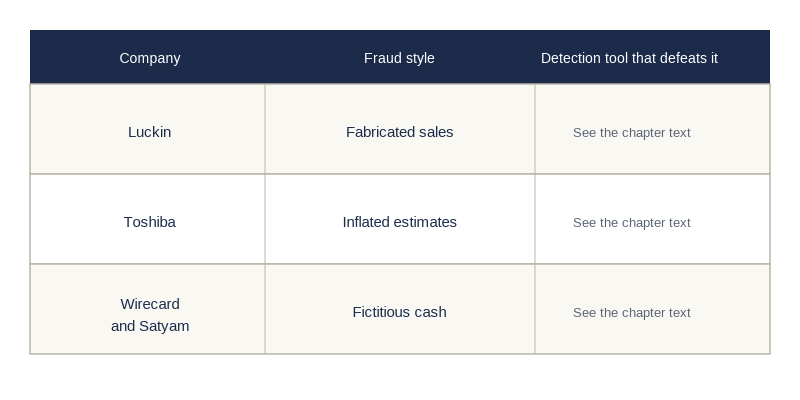
| Fictitious cash | Problem 14; Wirecard; Satyam | Direct bank confirmation |
| Fabricated sales | Luckin case | Independent data (footfall, deliveries) |
| Inflated estimates | Toshiba case | Hindsight review, top-side entry testing |
| Hidden pledge | Problem 9 | Lender confirmation, disclosure check |
| Undisclosed liability | Problem 15 | Legal letters, board minutes |
Notes and References
[1] Wikipedia, "Wirecard scandal", Wikimedia Foundation, accessed 27 November 2026, https://en.wikipedia.org/wiki/Wirecard_scandal. (Founded 1999; DAX member since 2018; peak valuation €24 billion in 2018.) [2] Wikipedia, "Wirecard", Wikimedia Foundation, accessed 27 November 2026, https://en.wikipedia.org/wiki/Wirecard. (€1.9 billion reported missing 18 June 2020 after EY audit; stock fell 72% over two days.) [3] Wikipedia, "Wirecard", Wikimedia Foundation, accessed 27 November 2026, https://en.wikipedia.org/wiki/Wirecard. (Board said the €1.9 billion "likely did not exist"; two Philippine banks denied holding it.) [4] Wikipedia, "Wirecard scandal", Wikimedia Foundation, accessed 27 November 2026, https://en.wikipedia.org/wiki/Wirecard_scandal. (Insolvency filed 25 June 2020; Braun arrested; Marsalek fugitive.) [5] Wikipedia, "Wirecard scandal", Wikimedia Foundation, accessed 27 November 2026, https://en.wikipedia.org/wiki/Wirecard_scandal. (Singapore court sentenced two men in January 2026, to 10 years and 6.5 years, for false Citadelle confirmation letters claiming €1.1 billion held for Wirecard.) [6] Wikipedia, "Wirecard scandal", Wikimedia Foundation, accessed 27 November 2026, https://en.wikipedia.org/wiki/Wirecard_scandal. (KPMG special audit could not verify the majority of 2016-2018 profits.) [7] Wikipedia, "Wirecard", Wikimedia Foundation, accessed 27 November 2026, https://en.wikipedia.org/wiki/Wirecard. (Shares tumbled 26% on 28 April 2020 on the KPMG announcement.) [8] Wikipedia, "Luckin Coffee", Wikimedia Foundation, accessed 27 November 2026, https://en.wikipedia.org/wiki/Luckin_Coffee. (Nasdaq listing at $17 a share in 2019.) [9] Wikipedia, "Luckin Coffee", Wikimedia Foundation, accessed 27 November 2026, https://en.wikipedia.org/wiki/Luckin_Coffee. (Muddy Waters report of 31 January 2020: items per store inflated 69% in Q3 and 88% in Q4 2019, backed by 11,200 hours of video footage.) [10] Wikipedia, "Luckin Coffee", Wikimedia Foundation, accessed 27 November 2026, https://en.wikipedia.org/wiki/Luckin_Coffee. (2 April 2020 announcement: COO Jian Liu fabricated 2019 sales by around RMB 2.2 billion, about US$310 million.) [11] Wikipedia, "Luckin Coffee", Wikimedia Foundation, accessed 27 November 2026, https://en.wikipedia.org/wiki/Luckin_Coffee. (Stock fell over 80% in April 2020; Nasdaq delisting notice 15 May; delisted 29 June 2020.) [12] Wikipedia, "Luckin Coffee", Wikimedia Foundation, accessed 27 November 2026, https://en.wikipedia.org/wiki/Luckin_Coffee. (SEC settled the accounting fraud case for $180 million on 16 December 2020.) [13] Wikipedia, "Luckin Coffee", Wikimedia Foundation, accessed 27 November 2026, https://en.wikipedia.org/wiki/Luckin_Coffee. (Chapter 15 bankruptcy filed 5 February 2021.) [14] Wikipedia, "Toshiba", Wikimedia Foundation, accessed 27 November 2026, https://en.wikipedia.org/wiki/Toshiba. (May 2015: Toshiba announced an accounting investigation; profits might need revision.) [15] Wikipedia, "Toshiba", Wikimedia Foundation, accessed 27 November 2026, https://en.wikipedia.org/wiki/Toshiba. (CEO Hisao Tanaka resigned 21 July 2015; profits inflated by $1.2 billion over the previous seven years.) [16] Wikipedia, "Toshiba", Wikimedia Foundation, accessed 27 November 2026, https://en.wikipedia.org/wiki/Toshiba. (Eight other senior officials resigned, including two previous CEOs.) [17] Wikipedia, "Satyam scandal", Wikimedia Foundation, accessed 27 November 2026, https://en.wikipedia.org/wiki/Satyam_scandal. (7 January 2009: Raju resigned, confessing manipulation of accounts of Rs 7,000 crore.) [18] Wikipedia, "Satyam scandal", Wikimedia Foundation, accessed 27 November 2026, https://en.wikipedia.org/wiki/Satyam_scandal. (Accounts showed cash at bank that did not exist.) [19] Wikipedia, "Satyam scandal", Wikimedia Foundation, accessed 27 November 2026, https://en.wikipedia.org/wiki/Satyam_scandal. (PwC statement of 14 January 2009: reliance on potentially false information may have rendered its audit reports "inaccurate and unreliable".) [20] Wikipedia, "Satyam scandal", Wikimedia Foundation, accessed 27 November 2026, https://en.wikipedia.org/wiki/Satyam_scandal. (Shares fell to Rs 6.30 on 9 January 2009, from a 2008 high of Rs 544.) [21] Wikipedia, "Satyam scandal", Wikimedia Foundation, accessed 27 November 2026, https://en.wikipedia.org/wiki/Satyam_scandal. (Actual employees 40,000, not 53,000; alleged monthly withdrawal of Rs 200 million for 13,000 non-existent employees.) [22] Wikipedia, "Satyam scandal", Wikimedia Foundation, accessed 27 November 2026, https://en.wikipedia.org/wiki/Satyam_scandal. (PwC India arm fined $6 million by the US SEC.) [23] Wikipedia, "Satyam scandal", Wikimedia Foundation, accessed 27 November 2026, https://en.wikipedia.org/wiki/Satyam_scandal. (2018: SEBI barred Price Waterhouse from auditing listed companies for 2 years and ordered disgorgement of over Rs 13 crore.) [24] Wikipedia, "Satyam scandal", Wikimedia Foundation, accessed 27 November 2026, https://en.wikipedia.org/wiki/Satyam_scandal. (9 April 2015: Raju and nine others sentenced to seven years.)