Government Audit: CAG, GFR and PAC
Abstract
Company ka audit shareholders ke liye hota hai. Sarkari paise ka audit janta ke liye hota hai, aur is kaam ko Constitution ne ek alag office ko diya hai: Comptroller and Auditor General of India (CAG). Is chapter mein teen stambh padhe gaye hain. Pehla, CAG, jiski niyukti, tenure, removal aur salary Constitution ke Articles 148 se 151 aur CAG (Duties, Powers and Conditions of Service) Act, 1971 se surakshit hain. Doosra, Public Accounts Committee (PAC), jo CAG reports par sarkar se jawab maangti hai. Teesra, General Financial Rules (GFR) 2017, jo wo rulebook hai jiske against officer ke kharch ko check kiya jaata hai. Chapter DPC Act ke sections, CAG reports ke prakar aur anatomy, GFR ke procurement aur propriety rules, aur 2G, coal, fodder jaise real cases ko exam aur practice dono ke nazariye se samjhata hai.
Learning objectives
Is chapter ke baad reader yeh kar sakega:
- CAG ki niyukti, tenure, removal aur independence ke safeguards define karna.
- DPC Act, 1971 ke Sections 13 se 24 ki audit powers aur duties ko distinguish karna.
- Section 14 ke "substantially financed" test ko numbers par compute karna.
- CAG report ka path (audit se PAC aur Action Taken Note tak) trace karna aur PAC, COPU aur Estimates Committee ko alag karna.
- GFR 2017 ke Rules 21, 22, 30, 33, 144, 170, 171 aur procurement ladder ko ek diye gaye scenario par apply karna.
- Ek audit paragraph ko Criteria, Condition, Cause, Effect format mein evaluate karke likhna.
Introduction and research question
Maan lijiye ek gaon ki sadak ke liye paanch crore ka budget paas hota hai. Do saal baad sadak ki jagah gaddhe hain aur thekedaar ja chuka hai. Yeh paisa sarkar ka tha, yaani janta ka. Sawal yeh hai: kaun check karta hai ki kharch sahi hua ya nahi, aur us check ka kya hota hai?
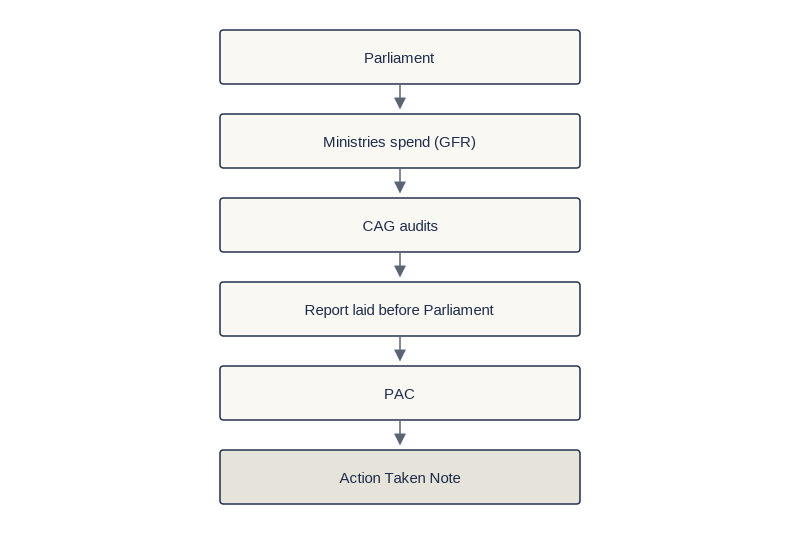
Is chapter ka research question yahi hai: Bharat mein sarkari kharch ka independent audit kaun karta hai, uski report ka kya hota hai, aur kharch ko kis rulebook ke against napa jaata hai? Jawab teen hisson mein aata hai. CAG audit karta hai aur report banata hai (Constitution, Articles 148 se 151). PAC (aur PSUs ke liye COPU) us report par bahas karti hai aur sarkar se jawab maangti hai. GFR wo rulebook hai jiske against officer ka kharch napa jaata hai. Ek simple flow yeh hai:
Budget paas (Parliament) -> Kharch (Ministry, GFR ke rules se)
   -> Audit (CAG) -> Report Parliament mein -> PAC jaanch
   -> Action Taken Note (Ministry ka jawab)
14.1 The CAG: constitutional position and independence
Concept
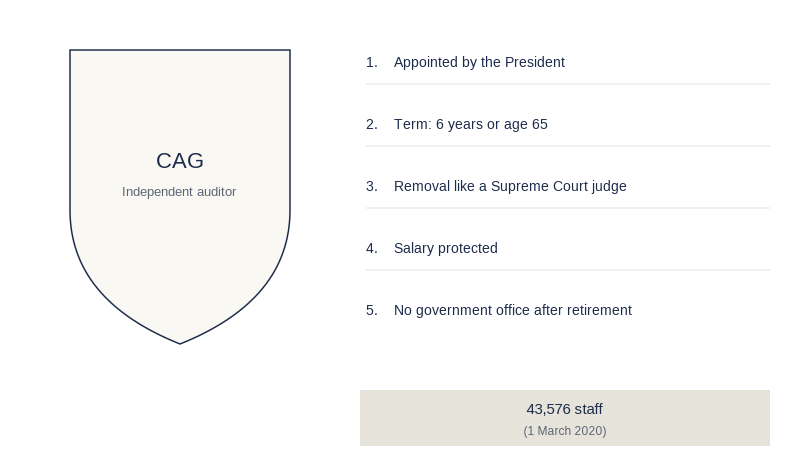
CAG yaani Comptroller and Auditor General of India, Bharat ki Supreme Audit Institution (SAI) hai, yaani sabse upar ka external auditor. Constitution ke Articles 148 se 151 CAG ke baare mein hain.[3] Article 148(1) ke anusaar CAG ko President apne warrant se appoint karta hai. CAG ko hatane ka tareeka wahi hai jo Supreme Court ke judge ko hatane ka hai: Parliament ke dono houses ke address se, proved misbehaviour ya incapacity par. Article 148(3) ke tahat salary Parliament ke law se tay hoti hai aur appointment ke baad uske nuksan mein nahi badli ja sakti. Article 148(4) ke anusaar CAG office chhodne ke baad Government of India ya kisi State government ke adheen koi aur office lene ke liye eligible nahi hota.[1]
Tenure ka rule Constitution mein nahi, DPC Act, 1971 mein hai. Section 4 ke anusaar term chhe saal hai, aur CAG 65 saal ki umar paane par office khaali karta hai. Section 3 ke anusaar salary Supreme Court ke judge ke barabar hai.[2]
Article 149 CAG ke duties aur powers Parliament ke law par chhodta hai (aur law banne tak wahi jo pehle Auditor-General of India ke the). Article 150 kehta hai ki Union aur States ke accounts us form mein rakhe jaate hain jo President CAG ki salah par tay kare. Article 151(1) ke anusaar Union accounts par CAG ki reports President ko submit hoti hain, jo unhe Parliament ke har House ke saamne rakhwate hain. Article 151(2) ke anusaar State accounts ki reports Governor ko jaati hain, jo unhe State Legislature ke saamne rakhwate hain.[1]
| Safeguard | Source |
|---|---|
| Niyukti President ke warrant se | Article 148(1) |
| Removal Supreme Court judge ki tarah | Article 148(1) |
| Salary Parliament ke law se, nuksan mein nahi badalti | Article 148(3) |
| Retirement ke baad government office nahi | Article 148(4) |
| Term 6 saal ya 65 saal ki umar, jo pehle ho | DPC Act s.4 |
| Salary Supreme Court judge ke barabar | DPC Act s.3 |
Scope of audit
Wikipedia ke anusaar CAG teen bade dabbe audit karta hai: Consolidated Fund of India aur har State ka kharch aur aamdani, government companies aur corporations, aur wo bodies jinhe sarkar se bahut paisa milta hai (substantially financed). Government ke loans aur grants bhi iske dayre mein aate hain. 1 March 2020 tak Indian Audit and Accounts Department mein 43,576 employees the. 1976 se CAG ko accounting ke kaam se mukt kar diya gaya; ab wo sirf audit par kendrit hai.[3] Order of precedence mein CAG ka sthan 9th hai, jo Supreme Court ke sitting judge ke barabar hai.[3]
Worked example
Ek sarkar CAG ko hataana chahti hai kyunki uski report asuvidhajanak hai. Article 148(1) ke anusaar sarkar akeli ye nahi kar sakti. Process Supreme Court ke judge ko hatane jaisi hai, jisme dono houses ka address chahiye. Isi tarah, sarkar salary badhaakar ya ghatakar CAG par dabaav nahi daal sakti, kyunki Article 148(3) nuksan mein badlav roakta hai.
Critical discussion
CAG ka model "Westminster style" kaha jaata hai: auditor Legislature ko report karta hai aur Legislature ki committee (PAC) follow-up karti hai. Is model mein CAG executive ka hissa nahi hai. Independence ke safeguards (fixed term, judge jaisa removal, protected salary, retirement ke baad office par rok) INTOSAI-P 10 Mexico Declaration ke SAI independence ke principles se milte hain, jisme SAI head ka security of tenure, information tak unrestricted access aur financial aur managerial autonomy shamil hain.[6]
Teen limits dhyan dene yogya hain. Pehla, CAG policy ke merit par sawaal nahi uthata; wo uska financial impact dekhta hai. Wikipedia mein ek Supreme Court bench observation quote hai ki CAG "munimji" nahi hai, balki economy, effectiveness aur efficiency dekhne wala constitutional authority hai.[3] Doosra, Wikipedia ke anusaar Supreme Court ne kaha ki CAG un private firms ko audit kar sakta hai jo government ke saath revenue-share deal mein hain; wahi page ek estimate deta hai ki 2013 tak sarkari kharch ka lagbhag 60 percent CAG ki nazar se bahar tha (yeh estimate Wikipedia ka hai, verified figure nahi).[3] Teesra, Panchayati Raj Institutions aur Urban Local Bodies ka audit Technical Guidance and Support (TGS) ke tahat entrusted audit ke roop mein hota hai.[3]
14.2 The DPC Act, 1971: section by section
CAG (Duties, Powers and Conditions of Service) Act, 1971, jise DPC Act kehte hain, audit ke provisions Sections 13 se 21, 23 aur 24 mein rakhta hai.[3] Neeche har section ka sar hai, jo CAG ki website par diye gaye Act ke text par adharit hai.[2]
| Section | Subject |
|---|---|
| 10 | Union aur States ke accounts compile karna; President (aur State ke liye Governor) CAG ko is zimmedari se relief de sakta hai |
| 11 | Annual accounts (aur appropriation accounts) taiyaar karke submit karna; relief ka proviso yahan bhi |
| 12 | Information dena aur governments ko annual financial statements banane mein reasonable assistance dena |
| 13 | Consolidated Fund, Contingency Fund aur Public Account ka audit; departmental commercial accounts ka audit; har case mein report |
| 14 | Substantially financed bodies ka audit |
| 15 | Specific-purpose grants aur loans ki sanctioning procedures ka scrutiny; notice dekar books tak access |
| 16 | Receipts ka audit: assessment, collection aur allocation par effective check |
| 17 | Stores aur stock ka audit |
| 18 | Offices (treasuries samet) ka inspection; documents mangwana; sawaal poochna |
| 19 | Government companies ka audit Companies Act ke hisaab se; corporations ka audit unke apne law ke hisaab se |
| 20 | Government company ya corporation ki reports ko Parliament ya State Legislature ke saamne rakhna |
| 21 | Delegation; President ya Governor ko report CAG hi submit karega, jab tak CAG leave par ya absent na ho |
| 23 | Audit ke scope aur extent ke liye regulations; government accounting ke general principles |
| 24 | Circumstances dekhkar detailed audit ka koi hissa chhodna aur limited check lagana |
Section 19 ke Act text mein Companies Act, 1956 ka naam hai; aaj yeh Companies Act, 2013 ke framework se chalta hai. Act chaar baar amend hua: 1976, 1984, 1987 aur 1994.[2]
14.2.1 Section 13 aur teen funds
Section 13(a) CAG ko Consolidated Fund of India, har State aur har legislature wale Union Territory ke saare kharch ka audit karne ko kehta hai, aur yeh dekhne ko ki paisa legally us kaam ke liye available tha jis par laga. Section 13(b) Contingency Fund aur Public Account ki saari transactions ka audit karta hai. Section 13(c) departmental commercial accounts ka audit karta hai.[2] Appropriation accounts (Section 2(b)) wo accounts hain jo ek financial year mein book hue expenditure ko appropriation law ke items se jodte hain; CAG ka appropriation audit isi ko check karta hai ki kharch grant ke scope ke andar raha ya nahi.[2][4]
14.2.2 Section 14: the "substantially financed" test
Section 14(1) ka Explanation kehta hai ki kisi body ko ek financial year mein Consolidated Fund se mila grant ya loan agar kam se kam Rs 25 lakh ho aur body ke total expenditure ka kam se kam 75 percent ho, to wo body "substantially financed" maani jaati hai, aur CAG uske receipts aur expenditure ka audit karta hai. Section 14(2) ke tahat grant ya loan Rs 1 crore se kam na ho to CAG President, Governor ya UT Administrator ki previous approval se audit kar sakta hai, chahe 75 percent wali condition poori na ho. Section 14(3) ke anusaar audit shuru hone ke baad CAG agle do saal tak audit karta rehta hai, chahe un saalon mein conditions poori na hon.[2]
Worked example. Ek NGO ko sarkar se saal mein Rs 30 lakh mile. NGO ka total kharch Rs 38 lakh hai. 30 / 38 = 78.9 percent, jo 75 percent se upar hai, aur Rs 30 lakh Rs 25 lakh se upar hai. Dono conditions poori: CAG audit karega.
Critical discussion. Exam trap yeh hai ki limit Rs 25 lakh hai, Rs 25 crore nahi, aur percentage 75 hai, 51 nahi. 51 percent government companies ka test hai (Companies Act), jabki 75 percent substantially financed bodies ka test hai. Paper aksar dono ko mila kar options banata hai.
14.2.3 Section 18 aur Section 24
Section 18 CAG ko offices ka inspection karne, documents apne bataye place par mangwane aur in-charge se sawaal poochkar observations dene aur information maangne ka adhikar deta hai.[2] Section 24 detailed audit ke hisse ko chhodne aur limited check lagane ki permission deta hai. Isi liye CAG test audit karta hai, har voucher nahi dekhta; reports mein isiliye "instances noticed in test audit" likha hota hai.[2][17]
14.3 CAG reports: types, anatomy and the road to Parliament
Report types
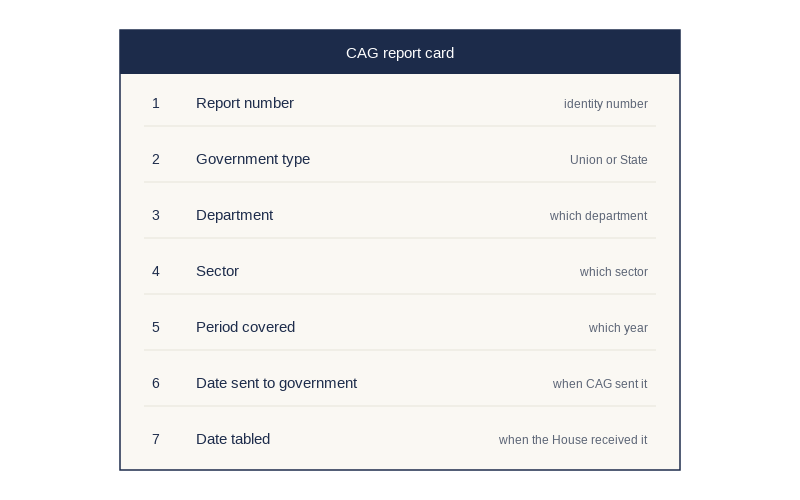
CAG ki website par reports teen tags ke saath listed hain: Compliance, Financial aur Performance. Financial audit dekhta hai ki accounts sahi bane ya nahi. Compliance audit dekhta hai ki rules aur kanoon maane gaye ya nahi. Performance audit dekhta hai ki kaam saste (Economy), kushalta se (Efficiency) aur asar ke saath (Effectiveness) hua ya nahi; ise 3E kehte hain. Reports "Report No. X of 2026" jaise format mein numbered hoti hain aur har report ke saath government type (Union ya State), department, sector aur tabling date likhi hoti hai.[14] Wikipedia aur PAC page ke anusaar CAG audit ke prakar ginaye jaate hain: accountancy audit, regularity audit, appropriation audit, discretionary audit aur efficiency-cum-performance audit.[3][4]
Recent reports (2026)
| Report | Type | Subject | Tabled |
|---|---|---|---|
| Report No. 6 of 2026, Accounts of the Union Government 2024-25 | Financial audit | Union Government ke accounts, Ministry of Finance | 2 April 2026 |
| Report No. 32 of 2026, Taxation of Unexplained Transactions under Income Tax Act, 1961 | Compliance audit | Department of Revenue (Direct Taxes) | 12 August 2026 |
| Report No. 8 of 2026, Direct Tax Vivad se Vishwas Scheme, 2020 | Subject Specific Compliance Audit | Union Government, Department of Revenue (Direct Taxes) | 12 August 2026 |
| Report No. 5 of 2026, Jal Jeevan Mission in Madhya Pradesh | Performance audit | 2019-20 se 2023-24, Governor ko Article 151 ke tahat | 22 July 2026 |
| Report No. 5 of 2026, Rajasthan State Finances 2024-25 | Financial audit | State finances ka analytical review | page par date nahi di |
| Report No. 3 of 2026, Assam Social, Economic and General Sectors | Mixed | MGNREGA par ek Performance Audit, IFMS par ek IT Audit, chaar chapters | 29 July 2026 |
| Report No. 4 of 2026, Kerala Local Self-Government Institutions | Compliance | March 2024 tak ka period, saat chapters | listing par |
| Report No. 01 of 2026, West Bengal Compliance Audit | Compliance | 31 March 2024 ko khatam saal | 25 July 2026 |
| Report No. 2 of 2026, Nagaland State Finances 2024-25 | Financial audit | Fiscal position ka independent assessment | 3 September 2026 |
Sources: cag.gov.in ke listing aur detail pages.[14][15][16][17] Press release page ke anusaar 23 November 2026 ko CAG ne PSUs ke management se cyber aur IT security ko core business risk ki tarah lene ko kaha, aur 16 June 2026 ko State Finances 2024-25 publication release ki.[18]
Anatomy of a report: the JJM example
Jal Jeevan Mission (Madhya Pradesh) report ka overview batata hai ki report 31 March 2024 ko khatam saal ke liye hai, performance audit 2019-20 se 2023-24 ka period cover karti hai, aur report Governor ko Article 151 ke tahat submit hui taaki State Legislature ke saamne rakhi ja sake. Overview yeh bhi kehta hai ki report mein diye instances test audit mein dhyan mein aaye the, aur audit CAG ke issue kiye Auditing Standards ke anusaar kiya gaya. Report Government ko 7 May 2026 ko bheji gayi aur 22 July 2026 ko tabled hui.[17]
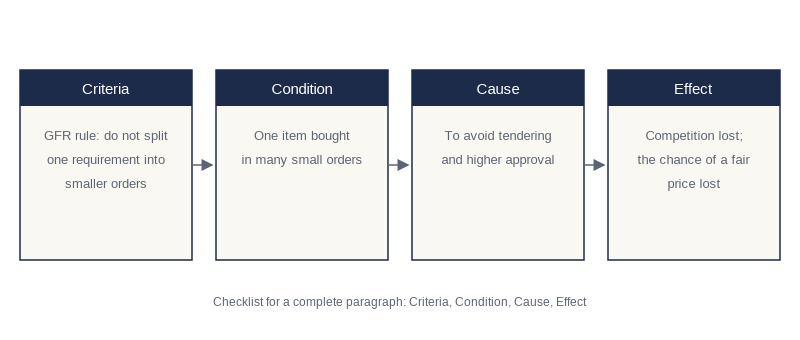
Ek report ke andar aam taur par yeh hota hai: header (number, saal, government type, department, sector), period covered, method note (test audit aur standards), findings, aur auditee ka reply. Har finding ke chaar ang hain: Criteria (kaun sa rule), Condition (kya hua), Cause (kyun) aur Effect (asar).
The road to Parliament and PAC
- Audit: Field offices (Accountants General) departments ka audit karte hain.
- Draft paragraphs: Auditee ko draft paragraph bheji jaati hai aur reply maangi jaati hai.
- Report: CAG report President ya Governor ko deta hai, jo use Parliament ya Legislature ke saamne rakhwate hain (Article 151).[1]
- PAC selection: Har saal term ke shuru mein PAC in-depth examination ke liye audit paragraphs chunti hai.
- Hearing: CAG PAC ki jaanch mein madad karta hai.
- PAC report: Sifarishen sarkar ko jaati hain.
- ATN: Ministry Action Taken Note deti hai; ek PAC sub-committee ATN ke samay par submission ka follow-up karti hai.[4]
Exam trap. CAG report "release" nahi hoti, wo Parliament ya Legislature mein "laid" (tabled) hoti hai. Aur report pehle President ya Governor ko jaati hai, seedha Parliament mein nahi.
14.4 The Public Accounts Committee and its companions
Composition and procedure
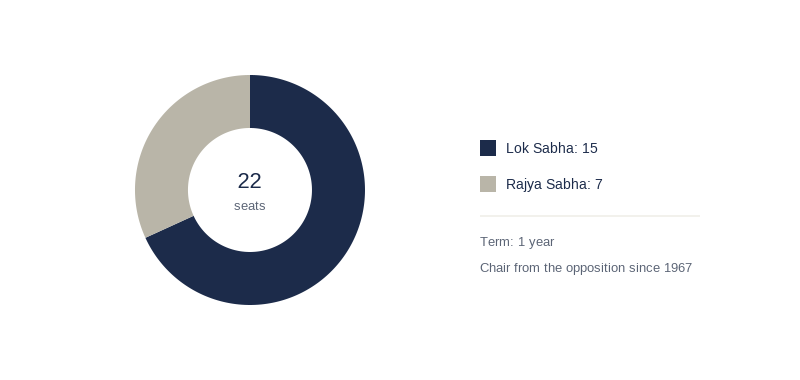
PAC Parliament ki ek financial committee hai. Wikipedia ke anusaar isme adhiktam 22 members hote hain: Lok Sabha ke 15 aur Rajya Sabha ke adhiktam 7. Members har saal proportional representation aur single transferable vote se chune jaate hain, term ek saal ka hai. Chairperson ko Lok Sabha Speaker appoint karta hai; 1967 ke baad se chairperson opposition se hota hai. Koi minister PAC ka member nahi ho sakta.[4] PAC 1921 mein conceive hui, 1950 mein parliamentary committee bani, aur 1954-55 se Rajya Sabha ke 7 members jode gaye.[4]
Lok Sabha ke Rules of Procedure mein Rules 308 aur 309 PAC se sambandhit hain. Chaar mukhya sub-committees hain: (1) non-selected audit paragraphs aur excess expenditure par Action Taken Notes (ATN) ke time par submission ka non-compliance, (2) Direct and Indirect Taxes, (3) Implementation of Recommendations of PAC, aur (4) Railways. 1950 se April 2018 tak PAC ne kul 1596 reports di.[4]
Excess expenditure and the role of CAG
PAC dekhti hai ki Parliament ne jo paisa diya wo demand ke scope ke andar kharch hua ya nahi. Jahan department ne budget se zyada kharch kiya, wahan PAC jaanch karti hai ki zyada kharch kyun hua. CAG PAC ke paas apni audit team nahi hai; CAG hi jaanch ke dauran committee ki madad karta hai, aur appropriation audit mein check karta hai ki kharch grant ke scope mein raha ya nahi.[4]
Roughly kaha jaaye to CAG evidence laata hai, PAC us par sunwai karti hai aur sifarish deti hai, aur final action sarkar karti hai, jise wo ATN mein batati hai.
PAC, Estimates Committee and COPU
PAC, Estimates Committee (EC) aur Committee on Public Undertakings (COPU) Parliament ki teen financial standing committees hain.[4] CAG ki reports PACs aur COPUs dono mein discuss hoti hain.[3] Ek line mein farq: PAC peeche ka hisaab dekhti hai (CAG reports ke zariye), EC aage ke budget estimates dekhti hai, aur COPU public undertakings ka kaam. Government companies ki CAG reports ka natural forum COPU hai. In committees ki official pages is chapter ke sources mein nahi kholi gayi, isliye inki detail yahan nahi di gayi.
Critical discussion
PAC ka focus system par hota hai, vyakti par nahi. Hearing mein PAC civil servants (secretaries) ko bulati hai, ministers ko nahi, kyunki minister PAC ka member bhi nahi ban sakta.[4] PAC ek post-mortem committee hai, jo ho chuke kharch ka hisaab theek karti hai. Iske vipreet Joint Parliamentary Committee (JPC) ek ad-hoc body hai, jabki PAC permanent standing committee hai.
14.5 The General Financial Rules (GFR) 2017
Concept
General Financial Rules Ministry of Finance ke Department of Expenditure ne banaye. Pehli baar 1947 mein issue hue, phir GFR 1963, GFR 2005 aur GFR 2017 aaye. GFR 2017 ka preface 11 February 2017 ka hai. GFR Parliament ka Act nahi hai; ye executive instructions hain, jinhe sarkari officers ko maanna padta hai. Rule 1 ke anusaar ye autonomous bodies par bhi laagu hote hain, jab tak unke apne bye-laws alag na bolen.[5] GFR 2017 ke 12 chapters hain: Introduction, General System of Financial Management, Budget, Government Accounts, Works, Procurement of Goods and Services, Inventory Management, Contract Management, Grants-in-aid and Loans, Externally Aided Projects, Government Guarantees, aur Miscellaneous.[5]
Audit mein sawaal yeh poochha jaata hai: GFR ka kaun sa rule tod kar paisa kharch hua? Do shabd yahan important hain. Regularity poochti hai: kharch rule ke andar hua? Propriety poochti hai: rule ke andar hone par bhi kharch wise tha? CAG dono dekhta hai.
14.5.1 Financial propriety and sanction (Rules 21, 22, 23, 29, 30, 33)
Rule 21 kehta hai ki public money kharch karne wala officer high standards of financial propriety rakhe. Iske chaar principles hain: officer sarkari paise par utni vigilance rakhe jitni ek samajhdaar aadmi apne paise par rakhta; kharch occasion ki demand se prima facie zyada na ho; koi authority aisa sanction na de jisse use khud fayda ho; aur kharch kisi khaas aadmi ya section ke fayde ke liye na ho, jab tak koi enforceable claim ya recognised policy ya custom na ho.[5]
Worked example. Ek officer ne Rs 45,000 ki imported coffee machine kharidi, jabki Rs 8,000 wali mashine kaam kar rahi thi. Yeh kharch Rule 154 ki seema ke andar hai aur quotation bhi zaroori nahi tha. Fir bhi audit ise Rule 21 ke dusre principle se pakdega: kharch occasion ki demand se zyada hai. Isse propriety aur regularity ka antar samajh aata hai.
Rule 22: competent authority ke sanction ke bina koi kharch ya liability nahi ho sakti. Rule 23: financial powers Delegation of Financial Powers Rules se subordinate authorities ko di gayi hain; jo powers delegate nahi hui wo Finance Ministry ke paas rehti hain.[5]
Worked example. Ek section officer ne sanction aane se pehle Rs 3 lakh ka repair karwa liya. Yeh Rule 22 ka seedha violation hai. Agar officer ke paas wo power delegate hi nahi hui thi, to Rule 23 ke tahat uska sanction ultra vires, yaani invalid hoga.
Rule 29: har financial sanction Audit Officer aur Accounts Officer ko communicate kiya jaata hai. Rule 30: fresh charge ka sanction lapse ho jaata hai agar issue hone ke 12 mahine ke andar uske against poora ya partial payment na hua ho, jab tak renew na kiya jaaye.[5]
Worked example. March 2025 mein Rs 2 lakh ke furniture ka sanction nikla, par payment nahi hui. May 2026 mein supplier ka bill aaya. 12 mahine beet chuke aur payment zero rahi, isliye sanction lapse ho gaya. Payment se pehle sanction renew karwana hoga. Auditor sanction aur payment ki dates aur renewal order dekhega.
Rule 33(1): public money, revenue, stamps, stores ya property ka koi bhi loss ya shortage turant next higher authority, Statutory Audit Officer aur Principal Accounts Officer ko report karna hai, chahe wo party ne make good kar diya ho.[5] Wajah yeh hai ki audit ko pattern dikhna chahiye: chori recover ho jaaye, lekin security ki kamzori wahi rahti hai.
14.5.2 Procurement: Rules 144, 149, 154, 155, 161, 162, 166
Rule 144 har procuring authority ko efficiency, economy aur transparency laane, suppliers ke saath fair aur equitable behaviour karne aur competition badhane ki zimmedari deta hai. Description objective, functional, generic aur measurable honi chahiye; kisi khaas trade mark, trade name ya brand ki requirement nahi likhni chahiye. Specifications mein superfluous features nahi hone chahiye, aur requirement se zyada quantity nahi kharidni chahiye. Har stage par procurement decision ke peeche ke considerations record par precise shabdon mein likhe jaate hain.[5]
Worked example. Ek tender mein likha gaya "sirf Brand X ke compatible parts". Yeh Rule 144 ka violation hai. Agar wahi brand zaroori hai to uski wajah record par likhni hogi.
Procurement ladder (Goods, GeM ke bahar) Department of Expenditure ke O.M. No. F.1/3/2024-PPD dated 10 July 2024 ke baad:
| Tareeka | Rule | Current limit (10 July 2024 O.M. ke baad) | Pehle ka limit |
|---|---|---|---|
| Bina quotation khareed, certificate ke saath | 154 | Rs 50,000 tak | Rs 25,000 tak |
| Local Purchase Committee (3 members) | 155 | Rs 50,000 se Rs 5 lakh | Rs 25,000 se Rs 2.5 lakh |
| Limited Tender Enquiry | 162 | Rs 50 lakh tak | Rs 25 lakh tak |
| Open / Advertised Tender | 161 | Rs 50 lakh aur upar | Rs 25 lakh se upar |
| Single Tender | 166 | Khaas cases | Khaas cases |
| GeM (jahan item GeM par ho) | 149 | Mandatory | Mandatory |
Sources: [10][11][12]. Limits amend hote rehte hain; exam question kis saal ka hai, yeh dekhkar jawab dena chahiye.
Rule 149 ke GeM limits bhi badle. O.M. se pehle: Rs 25,000 tak seedha, Rs 25,000 se Rs 5 lakh ke beech teen alag manufacturers ke sellers mein se lowest price, Rs 5 lakh se upar bidding ya reverse auction. O.M. ke baad: Rs 50,000 tak seedha, Rs 50,000 se Rs 10 lakh tak teen manufacturers mein se lowest, Rs 10 lakh se upar bidding ya reverse auction.[10]
Red flags. (1) Splitting: bade kharch ko tukdon mein todna taaki limit ke neeche rahe. Rule 149 ka clause (viii) kehta hai ki goods ki demand ko chhote quantities mein baant kar piecemeal purchase nahi karna chahiye.[13] (2) Bina reason ke single tender. (3) LPC mein teen members ka joint certificate missing. (4) GeM par item hone ke bawajood bahar se khareed.
14.5.3 Works, security and grants (Rules 136, 170, 171, 229, 230, 238)
Rule 136(1): works shuru karne se pehle administrative approval, expenditure sanction, sanctioned design, Schedule of Rates par adharit detailed estimates, funds ka provision, rules ke anusaar tenders aur Work Order hone chahiye. Rule 136(2): urgency mein officer apne judgement aur zimmedari par kaam shuru kara sakta hai, lekin saath hi competent authority se approval maangni shuru kare aur Accounts Officer ko soochit kare.[19]
Rule 170 (bid security): aam taur par estimated value ka 2 se 5 percent. Yeh final bid validity period se 45 din aage tak valid honi chahiye. Haarne wale bidders ki security contract award ke baad 30ve din tak wapas honi chahiye. Bid security ki jagah "Bid Securing Declaration" bhi li ja sakti hai, jisme bidder bid withdraw karne par ya contract sign na karne par suspension maanta hai. Rule 171 (performance security): goods, consultancy aur non-consultancy services mein contract value ka 3 se 5 percent (1 January 2024 ke O.M. ke baad); works mein performance security aur retention money milakar 3 se 10 percent. Yeh contract ke saare obligations poore hone ke 60 din baad tak valid rehti hai.[20]
Grants (Rules 229, 230, 238): grant maangne wali institution ko bye-laws aur audited accounts dene hote hain, aur certify karna hota hai ki usne usi purpose ke liye kisi aur Ministry, Department, Government of India ya State Government se grant nahi li ya maangi. Rule 229(xi) ke anusaar jis organisation ko saal mein Rs 5 crore se zyada budgetary support milta hai use Administrative Ministry ke saath Memorandum of Understanding sign karna chahiye jisme performance parameters aur measurable output targets hon. Rule 238 Utilization Certificates (UC) ka hai.[19]
14.6 Writing an audit paragraph: Criteria, Condition, Cause, Effect
Har CAG audit paragraph chaar angon par chalta hai.
Practice paragraph 1 (splitting).
- Criteria: GFR Rule 149(viii), demand ko chhote tukdon mein baant kar piecemeal purchase mana hai.[13]
- Condition: Ek department ne ek hi supplier se ek hafte mein Rs 49,000 ke 8 bills banwaye, total Rs 3.92 lakh.
- Cause: LPC ya tender ki limit se bachne ki ichha, ya procedure ki anabhigyata.
- Effect: Competition aur price reasonableness ka check bypass hua; excess payment ka risk.
- Recommendation: LPC ya tender route follow ho aur zimmedar officer se explanation li jaaye.
Practice paragraph 2 (UC missing).
- Criteria: GFR Rule 238, grant-in-aid ke against Utilization Certificate dena zaroori.
- Condition: Ek NGO ko Rs 40 lakh diye gaye, do saal se UC pending, teesri instalment bhi release ho gayi.
- Cause: Sanctioning authority ne release se pehle UC status check nahi kiya.
- Effect: Paisa purpose mein laga ya nahi, verification absent; misuse ka risk khula.
- Recommendation: UC ke bina aage ki release roki jaaye; pichhli grants ki physical verification ho.
Case study: CAG reports, PAC and public money
Case 1: The 2G spectrum report
2008 mein 2G licences diye gaye. CAG ne dekha ki licences bina auction ke diye gaye aur sarkar ko "presumptive loss" hua, yaani "agar doosra tareeka hota to itna aa sakta tha". Yeh asli nuksan nahi, anumaan hai. Wikipedia ke anusaar CAG ka presumptive loss estimate Rs 1,76,600 crore tha; CBI chargesheet (2 April 2011) mein loss Rs 31,000 crore bataya gaya; Supreme Court ne 2 February 2012 ko 122 licences cancel kiye; 3 August 2012 ko naya reserve price Rs 14,000 crore tay hua; aur 21 December 2017 ko special court ne sab accused acquit kiye.[3] Telegraph ne bhi likha ki CAG ne 2G report mein alag parameters aur methodologies se teen alag notional loss estimates diye the.[7]
PAC ne 4 April 2011 ko Ratan Tata aur Niira Radia ko summon kiya; tab PAC chairperson Murli Manohar Joshi the. 2G allocation par opposition ne PAC ke saath Joint Parliamentary Committee ki bhi maang ki, aur 2010 ka winter session lagbhag deadlock mein raha.[4] Ek hi maamle mein CAG ki report, PAC ki jaanch aur CBI ki machinery, teeno chali.
Lessons. Ek hi report ke teen alag numbers ho sakte hain kyunki method alag hai. CAG ka figure "presumptive" tha, aur court ne wo number prove nahi kiya. PAC ka process political accountability ke liye hai, criminal guilt ke liye nahi. Audit report, criminal investigation aur court verdict teen alag cheezein hain; ek ka result doosre ko decide nahi karta.
Case 2: The coal block allocation report (2012)
CAG ne dekha ki coal blocks competitive bidding se nahi, screening committee ki sifarish se baante gaye. Draft report (March 2012) mein windfall gain Rs 10,67,300 crore bataya gaya; final report (17 August 2012 ko tabled) mein Rs 1,85,591.34 crore, 31 March 2011 tak, jo headline mein Rs 1.86 lakh crore aaya.[3][8] Telegraph ke anusaar finding 57 blocks par thi jo May 2005 se July 2009 ke beech allot hue. CAG ne Coal India (2010-11) ka average cost Rs 583.01 per tonne aur additional financing cost Rs 150 per tonne, aur average sale price Rs 1,028.42 per tonne liya, jisse net gain Rs 295.41 per tonne aaya.[7]
Formula yeh hai: Gain per tonne = Sale price - (Cost + Financing) = 1,028.42 - (583.01 + 150) = 295.41. Phir ise har block ke extractable reserves se guna karke total banta hai. Sarkar ne is calculation ko galat kaha; Coal Minister ne kaha ki Coal India ke average se naye mines ka cost compare karna sahi nahi.[7] Lesson: auditee ka reply report ka hissa hota hai, aur dono taraf ki baat padhni chahiye.
Case 3: The Commonwealth Games (2010)
Games ke baad sarkar ne ek special committee banayi jiski head pichhle CAG V. K. Shunglu the. Wikipedia ke anusaar ek Swiss company ko 700 million rupees se zyada ka contract mila tha. Shunglu committee ke findings par CBI ne 23 August 2012 ko FIR darj ki.[9] Yeh jaanch Shunglu committee ki thi, CAG ki nahi; exam mein dono ko mix nahi karna chahiye.
Case 4: The Bihar fodder scam
December 1995 ki CAG report ne Bihar ke animal husbandry department mein lagbhag Rs 950 crore ke fraudulent withdrawal ka zikr kiya, aise supplies ke naam par jo exist nahi karti thi: chaara aur dawaiyan. Patna High Court ke orders par CBI ne jaanch ki aur 63 cases register kiye; kai accused convict hue aur kai cases trial mein rahe.[3] Case dikhata hai ki treasury system ka audit kyun zaroori hai: withdrawals treasury se hue aur records mein fake suppliers dikhaye gaye. CAG investigate nahi karta, report karta hai; jaanch CBI jaisi agencies karti hain aur court faisla karta hai.
Case 5: KG-D6 gas and the Adarsh Society
Krishna-Godavari basin ka D6 block Reliance Industries ke paas production-sharing contract ke tahat tha, jisme cost pehle recover hota hai aur profit baad mein baanta jaata hai. Wikipedia ke anusaar CAG ke 2011 ke audit ke baad oil ministry ne company par Rs 7,000 crore ka fine lagaya. Report mein aaya ki KG D-6 receipts ka lagbhag 90 percent expenditure ke roop mein book ho chuka tha, aur baaki 10 percent mein se sirf 1 percent government ko aur 9 percent operator ko mila. Company ne audit ko ek saal stall kiya aur April mein ja kar audit shuru hone diya.[3] Lesson: cost recovery model mein cost hi vivaad ka maidan hai, aur revenue-share contracts mein audit rights contract mein likhe hone chahiye.
2011 ki ek CAG report ne Mumbai ke Adarsh Co-operative Housing Society ka maamla uthaya. PAC page par quoted report ke anusaar episode dikhata hai ki "a group of select officials, placed in key posts" ne rules aur regulations ko subvert kiya, taaki prime government land personal benefit ke liye grab ho sake.[4] Yahan CAG ne sirf "rules toote" nahi kaha; usne mechanism bataya.
Worked problems
Problem 1: Section 14 test. Ek body ko sarkar se Rs 90 lakh grant mili. Uska total annual kharch Rs 1.5 crore hai. Kya CAG Section 14(1) ke tahat audit kar sakta hai? Solution. Rs 90 lakh Rs 25 lakh se upar hai. Share = 90 / 150 = 60 percent, jo 75 percent se kam hai, isliye Section 14(1) fail. Section 14(2) ke liye grant Rs 1 crore ya zyada chahiye, jo Rs 90 lakh nahi hai. Isliye normal substantially financed audit nahi chalega. Agar grant specific purpose ke liye thi, to Section 15 ke tahat CAG sanctioning authority ki procedure scrutinise kar sakta hai.
Problem 2: splitting. Ek hi supplier ke 8 bills, har ek Rs 49,000 ka, ek hi hafte mein. Total kitna hai, aur kaun sa route lagna chahiye tha? Solution. 8 x 49,000 = Rs 3,92,000, yaani Rs 3.92 lakh. Yeh Rs 50,000 se upar aur Rs 5 lakh se neeche hai, isliye Local Purchase Committee route (Rule 155) lagna chahiye tha, bina quotation wale Rule 154 ka nahi. Ek ek bill Rule 154 ke andar tha, jo splitting ka sanket hai (Rule 149(viii)).
Problem 3: coal gain per tonne. Sale price Rs 1,028.42, cost Rs 583.01 aur financing Rs 150 per tonne ho to net gain nikaliye. Solution. Cost + Financing = 583.01 + 150 = 733.01. Gain = 1,028.42 - 733.01 = Rs 295.41 per tonne. Block ka total gain is figure ko us block ke extractable reserves se guna karke aata hai.
Problem 4: sanction expiry. Sanction 10 March 2025 ko issue hua. 9 March 2026 tak koi payment nahi hui. 15 April 2026 ko payment karni hai. Kya sanction valid hai? Solution. Rule 30 ke anusaar issue ke 12 mahine ke andar koi payment na ho to sanction lapse ho jaata hai. 12 mahine 10 March 2026 ko poore hue aur tab tak koi payment nahi thi, isliye 15 April 2026 ko sanction lapse ho chuka hai. Payment se pehle sanction renew karna hoga.
Problem 5: performance security. Rs 40 lakh ke goods supply contract mein bid document mein performance security 5 percent likhi hai. Kitni leni chahiye, aur contractor ne Rs 50,000 di to kya hoga? Solution. 5 percent of 40 lakh = Rs 2 lakh (Rule 171). Rs 50,000 lena Rule 171 ke against hai; audit ise contractor ko undue favour ke roop mein likhega. Isse department ko risk bhi hai agar contractor perform na kare.
Problem 6: Rule 21 vs Rule 154. Rs 45,000 ki coffee machine ka kharch Rule 154 ke andar hai. Phir bhi objection kyun uthega? Solution. Procurement limit regularity ka test hai. Rule 21 propriety ka test hai: kharch occasion ki demand se zyada hai, jabki Rs 8,000 wali mashine kaam kar rahi thi. Isliye rule ke andar hote hue bhi propriety ka objection banta hai.
Chapter summary
CAG Bharat ki Supreme Audit Institution hai, jiski sthapna Article 148 se hai aur jiske duties DPC Act, 1971 mein hain. Niyukti President karta hai, term 6 saal ya 65 saal ki umar tak hai, removal Supreme Court judge jaisa hai, salary Supreme Court judge ke barabar hai aur protected hai, aur retirement ke baad government office nahi li ja sakti. DPC Act ke Sections 13 se 24 audit scope, powers aur limits dete hain; Section 14 mein Rs 25 lakh aur 75 percent ka test, aur Rs 1 crore ka alternative hai. 1976 se CAG sirf audit karta hai, accounts nahi banata. CAG ki reports Compliance, Financial aur Performance tags mein hoti hain aur President ya Governor ke zariye Parliament ya Legislature ke saamne rakhi jaati hain, test audit ki seemaon ke saath. PAC mein adhiktam 22 members hote hain, chairperson 1967 ke baad se opposition se hota hai, aur CAG PAC ki madad karta hai. GFR 2017 executive instructions hain jo propriety (Rule 21), sanction (Rules 22 aur 30), loss reporting (Rule 33), procurement (Rules 144 aur 149 se 166), security (Rules 170 aur 171) aur grants (Rules 229, 230, 238) ko govern karte hain. 2G, coal, fodder aur KG-D6 ke cases dikhate hain ki CAG ke figures, PAC ki jaanch aur court ke faisle alag cheezein hain.
Review questions
Short answer
- Article 148 se 151 mein CAG ke baare mein kya provisions hain?
- CAG ki independence ke chaar safeguards batayiye.
- DPC Act ka Section 13 kin teen funds ya accounts ke audit ko cover karta hai?
- Section 14 ka "substantially financed" test samjhaiye, Rs 1 crore wale alternative ke saath.
- Test audit kya hai aur CAG reports mein "instances noticed in test audit" kyun likha hota hai?
- CAG report ka President ya Governor se Parliament tak ka path batayiye.
- PAC ki composition aur chairperson ki niyukti batayiye.
- PAC, Estimates Committee aur COPU mein antar batayiye.
- GFR Rule 21 ke chaar principles likhiye.
- Rule 149(viii) kya rokta hai, aur audit use kaise dekhta hai?
Multiple choice
Q1. CAG of India ko kaun appoint karta hai? (a) Prime Minister (b) Speaker (c) President (d) Chief Justice Key: (c). Article 148(1) ke anusaar President apne warrant se.
Q2. DPC Act ke tahat CAG ka term kya hai? (a) 5 saal (b) 6 saal ya 65 saal ki umar, jo pehle ho (c) 4 saal (d) 65 saal ki umar tak, koi saal limit nahi Key: (b). Section 4. Term ka rule Constitution mein nahi hai.
Q3. "Substantially financed" ke liye minimum grant ya loan aur share of expenditure kya hai? (a) Rs 25 crore aur 51 percent (b) Rs 10 lakh aur 75 percent (c) Rs 50 lakh aur 90 percent (d) Rs 25 lakh aur 75 percent Key: (d). Section 14(1) ka Explanation.
Q4. Union accounts par CAG reports President ko submit karne ka provision kis Article mein hai? (a) Article 149 (b) Article 150 (c) Article 151 (d) Article 148 Key: (c). Article 151(1).
Q5. PAC mein adhiktam kitne members hote hain? (a) 15 Lok Sabha aur 7 Rajya Sabha, kul 22 (b) 10 aur 10 (c) 20 aur 5 (d) 15 aur 5 Key: (a). Wikipedia ke anusaar adhiktam 22 members.
Q6. PAC ke chairperson ko kaun appoint karta hai? (a) President (b) Prime Minister (c) Rajya Sabha Chairman (d) Lok Sabha Speaker Key: (d). 1967 ke baad se chairperson opposition se hota hai.
Q7. Rule 30 ke anusaar fresh charge ka sanction kab lapse hota hai? (a) 6 mahine mein payment na ho (b) kabhi nahi (c) 12 mahine mein poora ya partial payment na ho (d) 5 saal mein Key: (c). Jab tak renew na kiya jaaye.
Q8. Rule 170 ke anusaar haarne wale bidders ki bid security kab tak wapas honi chahiye? (a) 1 saal baad (b) contract award ke baad 30ve din tak (c) 5 din mein (d) kabhi nahi Key: (b). Bid security final bid validity se 45 din aage tak valid rehti hai.
Q9. Bihar fodder scam par CAG report kab aayi? (a) January 2001 (b) July 2010 (c) March 2012 (d) December 1995 Key: (d). Report ne lagbhag Rs 950 crore ke fraudulent withdrawal ka zikr kiya.
Q10. Rule 144 tender documents mein kya likhne se rokta hai? (a) delivery date (b) quantity (c) particular trade mark, trade name ya brand (d) price Key: (c). Specifications objective, generic aur measurable honi chahiye.
Notes and references
[1] CAG of India, "Constitutional Provisions", cag.gov.in, accessed 27 November 2026. https://www.cag.gov.in/en/page-constitutional-provisions. Supports: Article 148(1) appointment by President aur removal Supreme Court judge ki tarah; 148(3) salary; 148(4) retirement ke baad office par rok; Articles 149, 150 aur 151(1), (2).
[2] CAG of India, "Duties, Power and Conditions of Services Act", cag.gov.in, accessed 27 November 2026. https://cag.gov.in/en/page-duties-power-and-conditions-of-services-act. Supports: DPC Act 1971 ke Sections 3, 4, 10 se 21, 23, 24, section 2(b), Section 14 ka Explanation aur sub-sections (2) aur (3); chaar amendments (1976, 1984, 1987, 1994).
[3] "Comptroller and Auditor General of India", Wikipedia, accessed 27 November 2026. https://en.wikipedia.org/wiki/Comptroller_and_Auditor_General_of_India. Supports: Articles 148-151; 43,576 employees (1 March 2020); 1976 mein accounting se mukti; audit scope; order of precedence 9th; Supreme Court ka private firms par ruling aur 60 percent estimate; TGS; 2G figures aur dates; coal draft aur final figures; fodder scam; KG-D6; Supreme Court bench "munimji" observation.
[4] "Public Accounts Committee (India)", Wikipedia, accessed 27 November 2026. https://en.wikipedia.org/wiki/Public_Accounts_Committee_(India). Supports: 22 members, election, chairperson, 1967, ministers excluded, tenure 1 year; 1921, 1950, 1954-55; Rules 308 aur 309; sub-committees; 1596 reports; CAG assists the committee; 4 April 2011 2G summons; Adarsh quote; financial standing committees.
[5] Department of Expenditure, General Financial Rules 2017, repmismoef.nic.in. http://www.repmismoef.nic.in/writereaddata/GFR%202017.pdf. Supports: GFR 1947, 1963, 2005, 2017; preface 11 February 2017; Rule 1; chapters 1 to 12; Rules 21, 22, 23, 29, 30, 33(1), 144.
[6] INTOSAI, "INTOSAI-P 10 Mexico Declaration on SAI Independence", issai.org. https://www.issai.org/pronouncements/intosai-p-10-mexico-declaration-on-sai-independence/. Supports: SAI independence ke aath core principles.
[7] The Telegraph (India), "CAG drags govt over coals". https://www.telegraphindia.com/india/cag-drags-govt-over-coals/cid/390110. Supports: 2G mein teen divergent loss estimates; 57 coal blocks (May 2005 se July 2009); Rs 583.01, Rs 150, Rs 1,028.42 aur Rs 295.41 per tonne.
[8] The Indian Express, "CAG reports point to Rs 3 lakh cr scam". https://indianexpress.com/article/news-archive/web/cag-reports-point-to-rs-3-lakh-cr-scam/. Supports: coal final report ka Rs 1,85,591.34 crore, 31 March 2011 tak.
[9] "Commonwealth Games scam", Wikipedia, accessed 27 November 2026. https://en.wikipedia.org/wiki/Commonwealth_Games_scam. Supports: V. K. Shunglu ki special committee; Swiss company contract 700 million rupees se zyada; CBI FIR 23 August 2012.
[10] Department of Expenditure, O.M. F.1/3/2024-PPD dated 10 July 2024. https://doe.gov.in/files/whats_new_documents/OM_1_3_2024_PPD_dated_10_07_2024.pdf. Supports: Rules 154, 155, 161, 162 aur 149(i), (ii), (iii) ke naye aur purane limits.
[11] CGE Corner, "GFR: Purchase of Goods". https://cgecorner.in/financial-rules/gfr-purchase-of-goods. Supports: Rules 154, 155, 161, 162 ke limits, DoE OM 10 July 2024 par adharit.
[12] Forest Research Institute (ICFRE), presentation on procurement. https://fri.icfre.gov.in/wp-content/uploads/2020/08/power-point-presentation.pdf. Supports: Open Tender Rule 161; Limited Tender Rule 162; Single Tender Rule 166.
[13] GeM, "Rule 149 of GFR 2017". https://assets-bg.gem.gov.in/resources/pdf/rule-149-of-GFR-2017.pdf. Supports: goods ki demand ko piecemeal purchase ke liye chhote quantities mein nahi baanta jayega.
[14] CAG of India, "Audit Report" listing, cag.gov.in, accessed 27 November 2026. https://cag.gov.in/en/audit-report. Supports: Compliance, Financial aur Performance categories; "Report No. X of 2026" format; Reports No. 8, 5 (Rajasthan, detail page https://www.cag.gov.in/en/audit-report/details/125847, tabling date nahi), 3 (Assam, https://cag.gov.in/en/audit-report/details/125845), 4, 01, 2 of 2026.
[15] CAG of India, Report No. 6 of 2026, Accounts of the Union Government 2024-25. https://cag.gov.in/en/audit-report/details/125152. Supports: Financial Audit, tabled 2 April 2026.
[16] CAG of India, Report No. 32 of 2026, Taxation of Unexplained Transactions. https://cag.gov.in/en/audit-report/details/125842. Supports: Compliance Audit, tabled 12 August 2026, Union, Direct Taxes.
[17] CAG of India, Report No. 5 of 2026, Jal Jeevan Mission in Madhya Pradesh. https://www.cag.gov.in/en/audit-report/details/125728. Supports: Governor ko Article 151 ke tahat submit; 2019-20 se 2023-24; test audit; CAG ke Auditing Standards; Government ko 7 May 2026, tabled 22 July 2026.
[18] CAG of India, "Press Release", cag.gov.in. https://cag.gov.in/en/press-release. Supports: 23 November 2026 aur 16 June 2026 ki press releases.
[19] KartavyaDesk, GFR rules 136, 229, 230, 238, kartavyadesk.com (https://kartavyadesk.com/rules/gfr/rule-136, https://kartavyadesk.com/rules/gfr/rule-229, https://kartavyadesk.com/rules/gfr/rule-230, https://kartavyadesk.com/rules/gfr/rule-238); text official instrument se compiled, GFR 2017 PDF [5] ke saath. Supports: Rule 136(1) aur (2); Rule 229(xi) Rs 5 crore par MoU; Rule 230(1) certificate; Rule 238 Utilization Certificates.
[20] IIT Kanpur, GFR 2017 as amended up to 31-07-2024. https://iitk.ac.in/centralstores/data/GFR_2017_Amended_upto_31-07-2024.pdf. Supports: Rule 170 aur Rule 171 ke figures, OM F.1/2/2023-PPD dated 01.01.2024.