Audit Evidence and Documentation
Abstract
Yeh chapter audit ke do jude hue foundations, audit evidence (saboot) aur documentation (likhit record), ka systematic adhyayan hai. Chapter samjhata hai ki auditor financial statements ko management ke claims maan kar unke saboot kaise maangta hai; evidence ko sufficiency (quantity) aur appropriateness (quality: relevance aur reliability) ke frame mein kaise tolta hai; aur SA 500 ke saat procedures, inspection, observation, external confirmation, recalculation, reperformance, analytical procedures aur inquiry, kaise lagata hai. Documentation ke khule mein SA 230, working papers ke formats (lead schedule, vouching sheet, confirmation control sheet), retention rules aur "not documented = not done" ka doctrine covered hai. Luckin Coffee, Parmalat, Wirecard, Satyam, Enron/Arthur Andersen aur Carillion ke case studies dikhate hain ki jab evidence ka raasta compromise hota hai ya records nasht hote hain, to audit profession ka aitbar kaise tootta hai. Cut-off testing ke worked examples aur management representation letter (SA 580) ka sahi sthan bhi samjhaya gaya hai.
Learning Objectives
Is chapter ko padhne ke baad vidhyarthi saksham hoga:
- Define audit evidence, sufficiency, appropriateness, relevance aur reliability ko SA 500 ke frame mein;
- Distinguish evidence ki reliability hierarchy ke levels ko aur unka audit design par asar;
- List and apply evidence collect karne ke saat procedures ko, aur har procedure ko uske test kiye gaye assertion se jodna;
- Evaluate external confirmations ki reliability ko confirmation process ke control ke aadhar par;
- Describe SA 230 ke documentation requirements, working papers ke types, property rules, aur retention periods ko;
- Compute cut-off errors ka revenue, stock aur debtors par net effect, adjustment entries samet;
- Evaluate case studies mein evidence failures ko aur unse nikalne wale procedural lessons ko.
Introduction and Research Question
Ek chai ki dukaan wali seedhi kahani se shuru karein. Dukaan ki maalik kehti hai, "is mahine humne 4,000 cup chai beche." Poochho: aapko kaise pata? Jawab: "mujhe lagta hai." Lagne se audit nahin hoti; saboot chahiye. Roz ki cash register, doodh wale ka bill, cheeni ke packet ka bill, jab inhe gin kar milaya gaya to register mein 3,100 cup nikle, yaad mein 4,000 the. Farq 900 cup: ya ginti bhool, ya kahi doosra record, ya free mein gaye cup. Is chapter ka research question yeh hai: auditor "mujhe lagta hai" se "dikhao, sabit karo, aur jo sabit kiya usko likh kar rakho" tak ka raasta kaise tay karta hai? Doosri taraf, documentation ka sawaal: jab koi regulator, court ya peer reviewer saalon baad pooche "tumne yeh opinion kis basis par di", to auditor kya dikhayega? Chapter evidence ki theory, procedures, working papers, aur un cases se jawab deta hai jahan yeh dono foundations toot gaye.
9.1 The Concept of Audit Evidence
Audit evidence woh saari information hai jo auditor apni conclusions tak pahunchne ke liye use karta hai, jin par uska audit opinion tikta hai. Yeh SA 500 (Audit Evidence) ka concept hai. Auditor company ke financial statements ko claims ka set maanta hai; company kehti hai "hamare paas 50 crore ka maal hai", auditor poochta hai "saboot kya hai?"
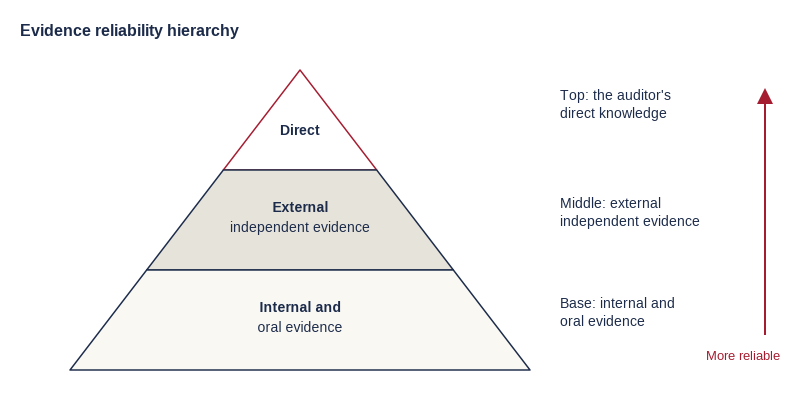
Evidence ke do bade sources hain. Ek, accounting records: books of account, vouchers, invoices, bank statements. Doosra, other information: management se baat, direct confirmations, physical inspection, industry data. Sirf books dekh lena kaafi nahin hai, kyunki books company khud banati hai aur biased ho sakti hain. Isliye evidence ki quality matter karti hai: company ke andar bana document (internal evidence) kam strong hai; bahar se aaya document (external evidence), jaise bank ka seedha confirmation, zyada strong hai; aur jo auditor ne khud haath se dekha ya gina (auditor's direct knowledge), woh sabse strong hai.
Critical discussion. Management har balance ke saath implicit assertions karti hai: existence, completeness, rights and obligations, valuation, presentation. Har audit procedure kisi assertion ko test karta hai; procedure-assertion mapping hi audit design ki core hai. Fraud cases mein spoofed documents ka risk hota hai, isliye auditor ko authenticity par alert rehna chahiye (SA 240) aur forged documents ke signs samajhne chahiye.
9.2 Sufficient and Appropriate: How Much and How Good
"Sufficient appropriate audit evidence" ke dono words alag maaine rakhte hain. Sufficiency ka matlab hai quantity, kitna evidence chahiye; appropriateness ka matlab hai quality, kaisa evidence chahiye. Quantity risk se decide hoti hai: jahan risk of material misstatement zyada, wahan zyada evidence; jahan control achha hai, wahan thoda kam chal jaata hai. Chhoti company ki petty cash ke liye 5 vouchers kaafi ho sakte hain; 10,000 crore ki inventory ke liye detailed counting aur testing chahiye.
Appropriateness mein do cheezein dekhi jaati hain. Relevance ka matlab evidence usi assertion se juda ho: agar hum check kar rahe hain ki maal exist karta hai, to maal ki photo relevant hai, uska purchase price relevant nahin. Reliability ka matlab source par bharosa: bank ka seedha aaya letter reliable hai; manager ka WhatsApp message kam reliable.
Critical discussion. Quality quantity se upar hai: 100 weak internal documents se achhe 5 strong external documents. Lekin ulta nahin chalta: bahut saara low-quality evidence se opinion nahin banta. Ek unreliable source ko do baar bulwa kar "do saboot" nahin banaya ja sakta; corroboration ke liye independent source chahiye. Jab auditor ko kisi source ki reliability par shaq ho, SA 500 ka principle hai ki additional procedures ya wording ke badlav par vichaar kare. Formula yaad rakhne layak: right amount of the right kind.
9.3 The Reliability Hierarchy
SA 500 ke hisaab se evidence ki reliability source, nature aur circumstances par depend karti hai. Neeche ek ladder hai jo in general principles ko teaching tool ke roop mein rakhti hai; yeh standard ki word-by-word list nahin hai.
| Level | Type of evidence | Example | Reliability |
|---|---|---|---|
| 1 (highest) | Auditor's own direct knowledge | Khud stock count karna, khud recalculation | Bahut zyada |
| 2 | External party se seedha auditor ko (original form) | Bank se direct confirmation letter | Zyada |
| 3 | External document, par company ke haath se guzra | Supplier ka invoice jo company ne rakha | Madhyam |
| 4 | Internal document, strong internal control ke saath | Controlled GRN, numbered sales invoices | Madhyam se kam |
| 5 | Internal document, weak control | Handwritten adjustment voucher bina approval | Kam |
| 6 (lowest) | Mainly oral statement | Manager ne bola "stock sahi hai" | Sabse kam |
Auditor saboot ko teen sawaal pooch kar tolta hai: kahan se aaya, andar se ya bahar se? Kya auditor ne use seedha pakda ya management ke raaste se aaya? Kya uske peeche internal control mazboot hai? Jitna zyada bahar, seedha aur controlled, utna reliable. Bekaar koi evidence nahin hota, par sab evidence barabar nahin hote.
Worked example (ranking exercise). Paanch items ko rank karo: (a) bank ka direct reply, (b) accountant ka email, (c) auditor ne khud godown mein ginti ki, (d) company ka internal sales register, (e) CEO ka bayan. Sahi order: (c) sabse upar, phir (a), phir (d) agar control achha ho, phir (b), sabse neeche (e). Bonus twist: agar (a) bank ka reply company ke haath se hokar aaya, to uski quality gir gayi, kyunki company ne beech mein badal diya ho sakta hai. Yahi Parmalat mein hua tha (section 9.10).
Exam trap. "Do alag management representations ek external confirmation ke barabar hote hain": galat. Management representation (SA 580) kabhi doosre appropriate evidence ki jagah nahin leti; sirf supportive hoti hai.
9.4 The Seven Procedures for Gathering Evidence
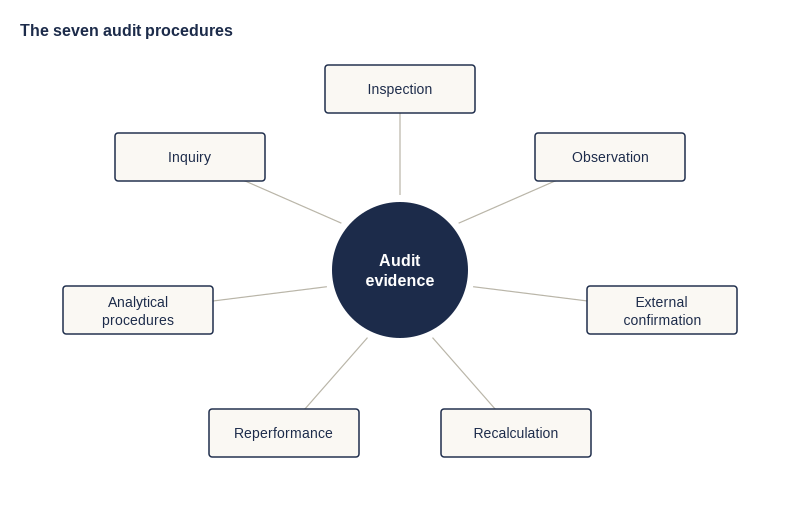
SA 500 ke under auditor saat tarah ke procedures use karta hai:
- Inspection: documents dekhna ya physical assets dekhna; invoice padhna, machine dekhna.
- Observation: koi process hote hue dekhna, jaise stock count.
- External confirmation: third party se seedha jawab maangna, jaise bank ya debtor ko letter bhejna (SA 505).
- Recalculation: khud math dobara karna, jaise depreciation check karna.
- Reperformance: company ka control khud dobara chala kar dekhna.
- Analytical procedures: numbers mein relationships aur trends dekhna (SA 520), jaise "sales 20% badhi to commission bhi badhna chahiye tha, badha kyun nahin?"
- Inquiry: logon se sawaal poochna, management aur staff se.
Inquiry sabse weak hai, kyunki log jhooth bol sakte hain; inquiry akeli kabhi kaafi nahin hoti, use aage verify karna padta hai. Agar manager bole "sab maal godown mein hai", to auditor godown jaakar dekhega; yeh professional scepticism hai. Procedures dono stages mein use hote hain: risk assessment procedures se auditor risk samajhta hai; phir further audit procedures: control testing aur substantive procedures (tests of details aur substantive analytical procedures).
Critical discussion. Evidence framework SA 500 aur uske companions se banta hai: SA 501 (specific items), SA 505 (external confirmations), SA 520 (analytical procedures), SA 530 (sampling). Har procedure kisi assertion ko test karta hai: inspection of tangible assets existence ko, recalculation accuracy ko, cutoff testing cutoff assertion ko. SA 315 (Revised 2019) ke classes of transactions ke assertions hain: occurrence, completeness, accuracy, cut-off, classification.[1]
9.5 Documentation: Why Working Papers Are the Spine of the Audit
Evidence ka kaam tab khatam nahin hota jab report sign ho jaati hai. Kal ko koi poochhe, court, regulator, ya peer reviewer, "tumne yeh opinion kis basis par di?", to auditor ko dikhana padega. Isliye SA 230 (Audit Documentation) kehta hai: audit documentation banao. Documentation mein sab kuch aata hai jo auditor ne kiya: audit plan, kaunse procedures kiye, kya mila, kaunse conclusions nikale, kisne kaam kiya, kisne review kiya, kab kiya. Inhe working papers kehte hain.
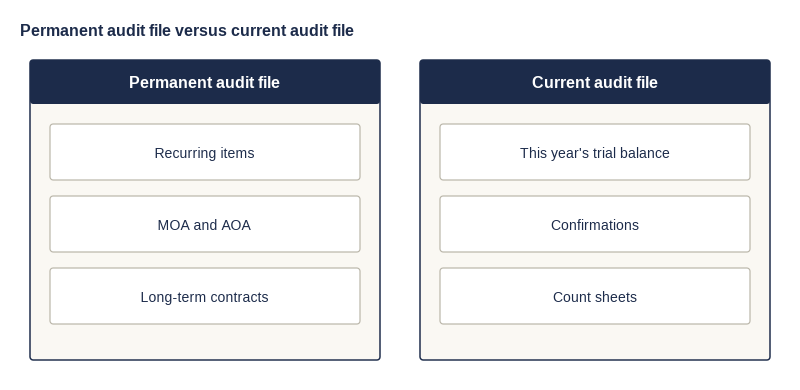
Working papers do type ke hote hain. Permanent audit file: woh cheezein jo har saal kaam aati hain, jaise company ka MOA/AOA, long-term contracts, loan agreements, internal control notes. Current audit file: sirf is saal ka kaam, jaise is saal ki trial balance, confirmations, stock count sheets. Files auditor ki property hain; company unhe maang nahin sakti, aur auditor unhe bina permission kisi ko nahin dikhata (client confidentiality), lekin regulator ya court process ke through access ho sakta hai.
ICAI ke SA 230 (aur SQC 1) ke hisaab se audit documentation ki retention period auditor ki report ki date se kam se kam 7 saal hai (international ISA 230 mein 5 saal; India mein ICAI ne purani 10 saal ki limit ko 7 saal kiya, SQC 1 ke amendment ke baad).[2][3] Final audit file assemble karne ka samay aam taur par report date ke baad 60 din se zyada nahin (SA 230 A21).[2][4] Exam ke liye: 7 saal retention, 60 din assembly.
Critical discussion. Documentation ke teen bade benefits hain: proof ki kaam hua; team supervision aur review easy; aur agle saal ke auditor ya future team ko samajh aata hai ki kya hua tha. Audit ka famous thumb rule: "jo document nahin hua, woh hua hi nahin." Not documented = not done. NFRA aur FRC actions mein sabse common deficiency insufficient audit documentation hoti hai; disciplinary aur litigation context mein yeh doctrine decisive hai.
9.6 Working Paper Formats
Standard koi fixed template nahin deta, par practice mein har firm ke paas common formats hote hain. Ek achhe working paper ko ek anjaan experienced auditor, jisne tumhare saath kaam nahin kiya, padh sake aur samjhe: kya kiya, kab kiya, kisne kiya, kya mila, kya conclusion nikla. Yeh SA 230 ka bhaav hai. Teen common formats neeche diye hain.
Format 1: Lead Schedule
Lead schedule ek line mein ek balance sheet item ka saar hota hai; peeche supporting schedules aur tests hote hain. Example (hypothetical): Nani ki Chai Dukaan Pvt Ltd, 31 March 2027.
| WP ref | Item | Opening (Rs) | Additions (Rs) | Deductions (Rs) | Closing per books (Rs) | Closing per audit (Rs) | Diff (Rs) | Status |
|---|---|---|---|---|---|---|---|---|
| C-1 | Cash in hand | 12,000 | 3,10,000 | 3,05,000 | 17,000 | 17,000 | 0 | Done |
| C-2 | Bank (SBI CA) | 1,40,000 | 8,00,000 | 7,60,000 | 1,80,000 | 1,80,000 | 0 | Confirmed |
| D-1 | Debtors | 60,000 | 2,10,000 | 1,95,000 | 75,000 | 70,000 | (5,000) | Query raised |
Teen baatein: har row ka WP reference (cross-referencing se reviewer seedha supporting work tak pahunchta hai); "per books" aur "per audit" alag columns (fark yahin dikhta hai); aur status column (kaam kitna baaki, ek nazar mein).
Format 2: Vouching / Testing Sheet with Tick Marks
Tick marks auditor ki short-hand hain; har firm ki legend alag hoti hai, par legend har sheet par honi chahiye, warna koi samjhega nahin. Legend (hypothetical): check mark = vouched to original invoice; G = GRN dekha; R = recalculated, sahi; B = bank statement se match; X = exception, alag note mein.
Example (hypothetical): purchases vouching, sample of 5.
| Sr | Date | Supplier | Invoice no. | Amount (Rs) | Invoice | GRN | Recalc | Bank | Remark |
|---|---|---|---|---|---|---|---|---|---|
| 1 | 04-Jan | Doodh Dairy | 1182 | 18,000 | Yes | G | R | B | OK |
| 2 | 09-Jan | Cheeni Mart | 0447 | 7,500 | Yes | G | R | B | OK |
| 3 | 14-Jan | Patti Traders | 0991 | 12,400 | Yes | G | X | B | Total galat jodha, Rs 400 zyada |
| 4 | 20-Jan | Cup House | 2290 | 5,000 | Yes | - | R | B | GRN nahi mila, query |
| 5 | 28-Jan | Gas Agency | 7731 | 3,600 | Yes | G | R | B | OK |
Sheet ke neeche conclusion likhna zaroori hai: "Sample size 5 mein 3 items par koi exception nahin. 2 exceptions: Sr 3 (Rs 400 over-charge, supplier ko return note), Sr 4 (GRN missing, stock register se cross-check). Management ko letter mein mention kiya. Conclusion: purchases occurrence assertion ke liye reasonable assurance, subject to Sr 4 ke follow-up ke." Bina conclusion ke working paper aadha hai: saboot hai, par usse kya nikla, woh likha nahin.
Format 3: External Confirmation Control Sheet
Is sheet mein confirmation ka poora safar track hota hai.
| Ref | Party | Type | Balance asked (Rs) | Sent on | Sent by | Reply on | Balance replied (Rs) | Diff | Resolution |
|---|---|---|---|---|---|---|---|---|---|
| B-1 | SBI Branch A | Bank | 1,80,000 | 10-Apr | Auditor | 18-Apr | 1,80,000 | 0 | None |
| D-1a | Customer P | Debtor | 40,000 | 10-Apr | Auditor | 22-Apr | 35,000 | 5,000 | Timing, cheque in transit |
| D-1b | Customer Q | Debtor | 20,000 | 10-Apr | Auditor | No reply | - | - | Alternative procedure: subsequent receipt |
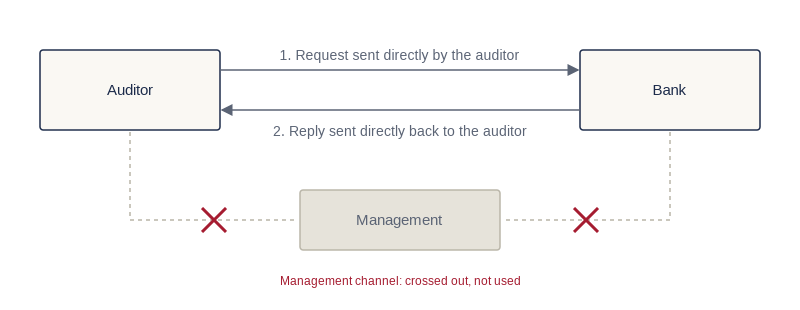
Control sheet ke teen sawaal: request kaun bhej raha hai (auditor, management nahin)? Reply kahan aa raha hai (auditor ke paas, management ke raaste nahin)? Address kisne diya aur kisne verify kiya? Exam trap: "Debtor confirmation ka address list company deti hai to auditor ko verify karne ki zaroorat nahin": galat. Address aur identity auditor ko independent source se verify karni chahiye.
Working Paper Review
Ek review sign-off sirf "dekha" nahin hota. Reviewer ke standard sawaal:
| Question | Why |
|---|---|
| Kya objective likha hai? | Test kis assertion ke liye hai |
| Kya sample ka basis likha hai? | Reviewer samjhe kyun itne items |
| Kya exceptions ka resolution likha hai? | Khula exception sabse bada red flag |
| Kya conclusion saboot se milta hai? | Kabhi kabhi conclusion jaldi likh diya jaata hai |
| Preparer aur reviewer ke naam aur date? | Accountability |
Jab kuch galat hota hai, log pehle yeh poochte hain: "tumne kya likha tha?" Yaad nahin, likha hua. Aur agar kuch likha hi nahin, to maana jaata hai ki kiya hi nahin.
9.7 The Management Representation Letter
Auditor management se ek management representation letter maangta hai: management likh kar deti hai ki usne saari information di hai, sab transactions record ho gaye, aur uski responsibilities poori hui hain. SA 580 (Written Representations) isse cover karta hai.
Yeh letter kabhi audit ka foundation nahin hai. Agar auditor ke paas doosra evidence hai jo letter se takrata hai, to auditor ko investigate karna padega; letter sirf ek additional piece hai, substitute nahin. Aur agar management letter dene se mana kar de, to yeh red flag hai: auditor ko management ki integrity par dobara sochna padega, aur serious case mein opinion par asar padta hai.
9.8 Cut-off Testing: The Game of the Date Line
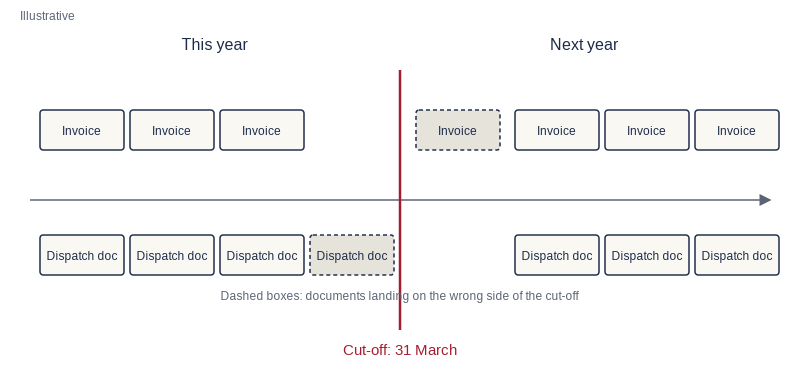
Cut-off test check karta hai ki transactions sahi accounting period mein record hue. Sales aur purchases ke liye yeh do taraf ka test hai: period ke ant ke aas-paas ke transactions dekho, aur dekho ki goods ki movement (dispatch ya receipt) ka din aur invoice ki date sahi period mein aayi. Cut-off SA 315 ke classes of transactions ka ek alag assertion hai.[1] Revenue recognition ka timing relevant framework par depend karta hai, par audit test seedha hai: shipping documents aur invoice ko period-end ke dono taraf match karo. SA 240 mein revenue recognition par presumed fraud risk hota hai, isliye cut-off ke tests ko gehra rakha jaata hai.
Worked Problem 1: Sales Cut-off
Example (hypothetical): Nani ki Chai Dukaan Pvt Ltd ka year-end 31 March 2027. Auditor 31 March ke 3 din pehle aur 3 din baad ke sales invoices test karta hai.
| Invoice | Invoice date | Dispatch date | Amount (Rs) | Booked in | Correct period | Result |
|---|---|---|---|---|---|---|
| S-901 | 29-Mar | 29-Mar | 30,000 | FY 26-27 | FY 26-27 | OK |
| S-902 | 31-Mar | 02-Apr | 50,000 | FY 26-27 | FY 27-28 | Cut-off error: overstated |
| S-903 | 01-Apr | 30-Mar | 20,000 | FY 27-28 | FY 26-27 | Cut-off error: understated |
| S-904 | 02-Apr | 02-Apr | 10,000 | FY 27-28 | FY 27-28 | OK |
Steps: (1) period-end ke aas-paas ke sales invoices list karo; (2) har invoice ke saath dispatch document dekho; (3) jahan dono ki dates alag periods mein hain, error pakdo; (4) net effect nikalo. Net effect on FY 26-27 revenue: S-902 se overstated 50,000, S-903 se understated 20,000; net overstated 30,000.
Proposed adjustment entries (hypothetical): S-902 ko agle saal shift karne ke liye, Sales A/c Dr 50,000 / To Debtors A/c 50,000; S-903 ko is saal laane ke liye, Debtors A/c Dr 20,000 / To Sales A/c 20,000. (Stock ke COGS adjustments alag se honge; yahan sirf revenue side dikhayi gayi.) Exam trap: cut-off error ka effect sirf profit par nahin, closing stock aur debtors par bhi padta hai.
Worked Problem 2: Purchases Cut-off
Example (hypothetical): goods 30 March ko pahunche, supplier ka invoice 3 April ko aaya, company ne purchase 3 April ko record kiya.
| Item | Details |
|---|---|
| Goods received | 30-Mar, Rs 80,000 |
| Invoice date | 03-Apr |
| Booked in | FY 27-28 |
| Correct period | FY 26-27 (goods ka control company ke paas aa gaya) |
| Effect | Purchases aur payables dono Rs 80,000 understated |
Adjustment: Purchases (ya Inventory) A/c Dr 80,000 / To Creditors A/c 80,000. Liabilities ko aksar kam dikhane ka lalach hota hai, isliye purchases cut-off mein understatement ka khatra zyada hai. Jab tak receipt ka documentary saboot (GRN) na dekho, invoice date par bharosa mat karo.
Cut-off Red Flags
| Red flag | Meaning |
|---|---|
| Quarter/year ke aakhri hafte mein bada sales spike | Revenue pulled forward ho sakta hai |
| Period ke turant baad bade credit notes | Sales return jo pehle sale ban gaye |
| Round-number bade journal entries period ke ant mein | Management override ka sanket |
| Invoice date aur dispatch date alag periods mein | Seedha cut-off error |
9.9 Case Study: Luckin Coffee, When the Evidence Itself Was Fabricated
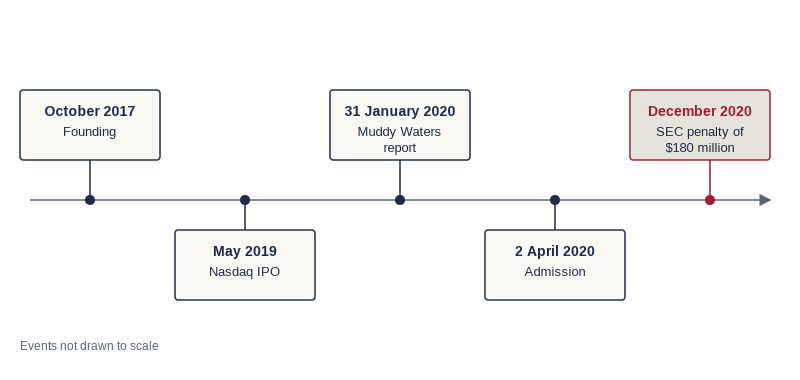
Background. Luckin Coffee ek Chinese coffee chain thi, October 2017 mein Beijing mein shuru hui.[5] Company ka model tha: app se order, chhote kiosks, Starbucks se sasta. Growth itni tez thi ki 2019 tak China mein Starbucks se zyada stores ho gaye. May 2019 mein company Nasdaq par list hui, shares $17 par price hue, aur IPO mein $561 million raise kiye.[6]
Muddy Waters report: outsider ne saboot ikattha kiya. 31 January 2020 ko short-seller firm Muddy Waters ne ek anonymous 89-page report publish ki,[7] jisme dawa tha ki Luckin apni per-store sales inflate kar rahi hai: Q3 2019 mein kam se kam 69% aur Q4 2019 mein 88% tak,[8] aur iske peeche lagbhag 11,200 ghante ki store video footage thi.[9] Irony dekho: yahan external evidence itna strong tha ki company ki internal records ki authenticity par direct sawaal khada ho gaya. Video footage matlab direct observation, jo evidence hierarchy mein sabse upar hai. Luckin ne pehle sab deny kiya.
Internal investigation. 2 April 2020 ko Luckin ne khud disclose kiya: internal investigation mein paya gaya ki COO Jian Liu aur uski reporting employees ne 2019 ki sales ko lagbhag 2.2 billion yuan (kareeb $310 million) se fabricate kiya tha.[10] Us din stock premarket mein 80% se zyada gira, aur kareeb $5 billion market value mitti mein mil gayi.[11]
SEC complaint: nakli evidence ka poora mechanism. December 2020 mein SEC ne bataya fraud kaise kaam kiya tha:[12] April 2019 se January 2020 tak Luckin ne $300 million se zyada ki fake retail sales banayi, related parties ko use karke teen alag purchasing schemes ke through; fraud chhupane ke liye employees ne expenses ko $190 million se zyada inflate kiya, ek fake operations database banaya, aur accounting aur bank records alter kiye taaki fake sales match karein. Public financial statements mein revenue June 2019 quarter mein lagbhag 28% aur September 2019 quarter mein 45% tak overstate kiya gaya. Fraud ke dauran company ne investors se $864 million se zyada debt aur equity mein raise kiye. Aakhirkar fraud tab pakra gaya jab annual external audit chal raha tha.[13] Company ne SEC ke saath cooperate kiya, logon ko terminate kiya, controls badhaye; settlement $180 million penalty.[13] Nasdaq ne company ko delist kar diya (Wikipedia ke mutabik 29 June 2020; SEC ke mutabik ADS Nasdaq par 13 July 2020 tak trade hue, isliye exact date source ke hisaab se alag hai).[14]
Audit lessons. (1) Internal evidence ko spoof kiya ja sakta hai: Luckin ne fake database banaya, records alter kiye; agar auditor sirf company ke system par bharosa kare, to fraud ko fraud hi lagta hai. (2) External, independent evidence ne fraud phoda: video footage aur audit ke dauran bank/third-party checks ne asli picture dikhayi. (3) Analytical procedures ne gaant kholi: sales badh rahi thi par expenses aur cash flows match nahin kar rahe the; relationships toot rahi thin. (4) Documentation matters: SEC case mein altered records khud evidence ban gaye; fraud prove karne mein audit trail hi base tha.
9.10 Case Study: Parmalat and the Forged Bank of America Letter
What happened. Parmalat Italy ka bada dairy group tha. 2003 mein company ek mutual fund Epicurum se jude lenden aur cash ki kami ke sawaalon mein phans gayi. Parmalat ki Cayman Islands ki subsidiary Bonlat ke baare mein Bank of America ne ek document ko forgery bataya, jo Parmalat ke bank account mein 3.95 billion euro dikhata tha.[15]
Parmalat ke founder Calisto Tanzi par fraud aur money laundering ke aarop lage. Tanzi ko 10 saal ki saza hui (Milan court, December 2008, market-rigging aur false accounting ke liye); baaki saat defendants (executives aur bankers) bari hue, aur aath ne September 2008 mein out-of-court settle kiya.[16][17] Baad mein December 2010 mein Parma ki court ne use fraudulent bankruptcy ke liye alag se 18 saal ki saza di.[18] Settlements bhi hue: Deloitte ne 2007 mein $149 million ka bhugtan kiya, Bank of America ne 2009 mein $100 million, aur Grant Thornton International ne $4.4 million mein settle kiya; naye management ne lagbhag $700 million recover kiye.[19]
Audit failure: evidence ladder ke hisaab se. Teen baatein. Pehli, ek document ka rank uske raaste se tay hota hai: bank letter agar bank se seedha auditor ke paas aaye to level 2 ka saboot hai; agar company ke haath se guzre to level 3 ya neeche, kyunki beech mein editing, scanning ya badalna sambhav hai. Doosri, ek bahut bade balance ka sirf ek letter: 3.95 billion euro ka balance ek document par tika tha. Jab ek hi saboot par bahut bada claim tika ho, auditor ko aur layers dhoondhni chahiye: bank statement ka seedha access, bank ke saath phone verification, transaction flow (interest income, usage). Teesri, Bonlat jaisi door ki entity: Cayman subsidiary jahan group auditor ka seedha kaam nahin hota, wahan component auditor par bharosa aur group auditor ka oversight (SA 600, Using the Work of Another Auditor, ka bhaav) dono zaroori hain.[20]
Lesson aur exam angle. Confirmation ka matlab sirf letter bhejna nahin; confirmation ka matlab hai poora raasta control mein rakhna: kisne bheja, kahan gaya, kahan se wapas aaya, aur kya letterhead, signature aur address asli hain. Exam sawaal "external confirmation ki reliability sabse zyada kab hai?" ka jawab: jab auditor khud request bheje aur reply seedha auditor ko aaye, management ke raaste nahin. Ek letter ko kabhi akela mat chhodo.
9.11 Case Study: Wirecard, When 1.9 Billion Euro of Cash Could Not Be Found
What happened. Wirecard Germany ki payments company thi. 18 June 2020 ko company ne bataya ki 1.9 billion euro cash uske accounts mein se gayab hai; 25 June 2020 ko insolvency file hui; CEO Markus Braun ne resign kiya aur arrest hua; former COO Jan Marsalek fugitive hai.[21] Jin do Philippines ke banks ke paas yeh paisa hona tha, unhone kaha ki unke paas yeh rakam kabhi thi hi nahin.[22] EY ke mutabik Wirecard ke ek trustee ne auditor ko deceive karne ki koshish ki thi, aur company 2019 ke results release nahin kar saki.[23] KPMG ne 2019 mein special audit kiya; 28 April 2020 ko KPMG ne kaha ki use sabhi aarop address karne ke liye sufficient documentation nahin mila, aur Wirecard ke shares 26% gire.[24] Press warnings purani thin: Financial Times ne 30 January 2019 ko aarop chhape, aur 2016 ki Zatarra report ne pehle hi fraud ke aarop lagaye the.[25]
Audit failure: evidence ke nazariye se. Sabse bada sabak: cash sabse safe asset maana jaata hai kyunki confirm karna aasan hai; par jab confirmation ka source hi (trustee, third-party partner) company ke control mein ho ya company ka dost ho, to aasan test bhi kamzor ho jaata hai. Teen red flags:
| Red flag | Why it matters |
|---|---|
| Cash ka bahut bada hissa third-party trustees ke paas | Auditor ka direct bank access nahin |
| Banks ne confirm kiya rakam hai hi nahin | Asli bank ka reply sabse strong evidence hai |
| Short-sellers aur press ke saalon ke sawaal | Scepticism trigger karna chahiye tha |
Lessons. (1) Cash confirmation mein "kaun confirm kar raha hai" utna important hai jitna "kitna confirm hua". (2) Jab third party control mein ho, direct bank access ki maang karo. (3) Press aur whistleblower complaints evidence nahin hain, par risk assessment (SA 315 ka bhaav) ko update karne ke liye trigger hain.
Applied scenario. Tum ek company ke auditor ho; company ke paas 50 crore rupaye cash ek third-party trustee ke paas hai; trustee ne email se confirm kiya. Kya karoge? Model answer: trustee ke email ko akela saboot nahin maanoge; underlying bank se direct confirmation maangoge, trustee ke contract aur bank statement inspect karoge, trustee ki independence aur existence verify karoge, aur access na mile to scope limitation ka vichaar karoge (SA 705 ka bhaav).
9.12 Case Study: Satyam, When the Bank Balance Did Not Exist
What happened. Satyam Computer Services India ki badi IT company thi. 7 January 2009 ko chairman B. Ramalinga Raju ne resign kiya aur maana ki unhone accounts mein hera-pheri ki thi, jiski raashi 7,000 crore rupaye thi.[26] Saalon tak Satyam ke accounts mein aisa munafa dikhta raha jo tha hi nahin, aur bank mein aisa cash dikhta raha jo tha hi nahin; accounts mein $3 million ki "salary" aise logon ke naam par thi jo exist hi nahin karte the.[27] US SEC ne PwC India par $6 million ka jurmana lagaya; 2018 mein SEBI ne Price Waterhouse ko do saal ke liye kisi bhi listed company ka audit karne se roka aur 13 crore rupaye se zyada ka disgorgement order diya.[28] 9 April 2015 ko Raju aur nau anya doshi paye gaye aur saat saal ki saza hui.[29] Raju ke 7 January 2009 ke letter (SEC filing) ke mutabik balance sheet mein 5,040 crore rupaye ka non-existent cash aur bank balance tha, jabki books mein 5,361 crore dikhaya gaya tha.[30]
Evidence ke nazariye se. Teen sabak. Pehla, existence assertion: bank se seedha confirmation sabse strong test hai; agar balance forged documents se dikhaya gaya, auditor ko bank ke saath alag channel se verify karna chahiye tha. Doosra, fictitious payroll ka test: employee names ka HR records ke saath physical verification, salary account details ka independent match. Teesra, auditor ki independence aur scepticism ka test court aur regulator karte hain, sirf company ka internal matter nahin hai.
Exam angle. "Fictitious employees ko pakadne ka best audit procedure?" Jawab: payroll ko HR records aur physical verification (ya salary bank accounts ke independent confirmation) se match karna. Jo vyakti kabhi office aaya hi nahin, uska saboot kahin nahin milega: badge records, system logs, kisi mein nahin.
9.13 Case Study: Enron and Arthur Andersen, When Documentation Became the Evidence
What happened. Enron ka scandal October 2001 mein saamne aaya. Company ne 2 December 2001 ko Chapter 11 bankruptcy file ki; uska $63.4 billion ka asset base us samay US ki sabse badi corporate bankruptcy thi.[31] Auditor Arthur Andersen ko SEC investigation se judi documents ko gair-kanooni tareeke se nasht karne ka doshi paya gaya, jisse uska public companies ka audit license khatam ho gaya. Supreme Court mein faisla baad mein palta gaya, par tab tak firm apne zyadatar clients kho chuki thi.[32]
Documentation ka sabak. Working papers aur documents sirf internal kaam nahin hote; yeh legal evidence ban jaate hain. Do baatein: (1) documents ko retention policy ke mutabik rakhna zaroori hai; India mein SA 230 ke para A23 mein ICAI ne report ki date se 7 saal ki retention batayi hai;[3] (2) investigation chalu hone par, ya uske andeshe par, documents ko nasht ya badalna sabse khatarnak galti hai.
Exam trap. "Audit file ka assembly report date ke 6 mahine baad bhi complete kiya ja sakta hai": galat. SA 230 (A21) mein file assembly ka general limit 60 din hai.[4]
9.14 Case Study: Carillion, When Estimates Replaced Evidence
What happened. Carillion ne 10 July 2017 ko ek trading update mein 845 million pounds ki impairment charge batayi, jo mainly teen loss-making UK PFI projects aur Middle East ke kharchon se judi thi.[33] UK Parliament ki joint report ke mutabik KPMG ko 19 saal ke audit ke 29 million pounds mile aur usne ek baar bhi apna opinion qualify nahin kiya; report ke shabdon mein KPMG ne accounting judgements ke prati professional scepticism nahin dikhayi.[34]
Estimates ka evidence. Construction contracts mein revenue aur profit ka bada hissa estimates par tika hota hai: project kitna poora hua, aage kitna kharcha, kitna claim milega. Yeh evidence ki duniya ki sabse "soft" cheez hai, kyunki yeh management ka judgement hai. Auditor ko teen layers chahiye: (1) past estimates ka track record, pichhle projects mein estimates aur actuals mein kitna fark tha (hindsight review); (2) independent expert ya technical input, engineer ya quantity surveyor ka assessment; (3) contract documents aur client correspondence, claims ka asli saboot, sirf internal projection nahin. Yeh approach SA 540 (accounting estimates) ke bhaav se milti hai.
Lesson. Jab revenue ya profit bahut zyada judgement par tika ho, evidence ka bhaar management ke bayan par nahin, bahari data par shift karna chahiye. Aur agar saalon tak estimates upar ki taraf hi jhukte rahen, to woh bias ka sanket hai.
9.15 Worked Problems with Full Solutions
Har problem ka format: Scenario, phir step-by-step solution, aur ant mein red flag ya exam trap.
Problem 1: Cut-off, Ek Invoice Do Saalon Mein
Scenario. Year end 31 March. Goods 30 March ko dispatch hue, customer tak 2 April ko pahunche. Invoice S-902, 1,00,000 rupaye, accountant ne 2 April ki date se agle saal ki sales mein daal diya. Goods ki cost 60,000 rupaye hai.
Solution. Step 1: control aur risk aur reward ka transfer kab hua? Goods 30 March ko dispatch hue, matlab sale is saal ki hai; invoice ki date 2 April sirf kaagaz ki date hai, transaction ki date nahin. Step 2: effect batao. Is saal ki revenue 1,00,000 se understated; COGS 60,000 se understated; profit 40,000 se understated; closing stock 60,000 se overstated (maal gaya par books mein abhi bhi baitha hai). Step 3: agle saal ka asar: wahan revenue 1,00,000 zyada aur profit 40,000 zyada dikhega, jo sahi saal ka profit hai. Step 4: correction: sales aur COGS ko is saal mein le aao, stock se 60,000 hatao. Exam trap: cut-off test mein dispatch document (goods outward note, transport receipt) hi asli saboot hai; invoice date par mat jao. Aur yaad rakho, yeh shift profit ke saath-saath stock ki existence aur completeness assertions ko bhi chhoota hai.
Problem 2: Evidence Ko Reliability Ke Order Mein Lagao
Scenario. Ek hi balance, closing stock 25,00,000 rupaye, ke liye auditor ke paas yeh cheezein hain: (a) auditor ne khud 31 March ki raat stock gina; (b) warehouse keeper ne kaha "sab theek hai"; (c) store department ka internal stock sheet, jis par store incharge ke sign hain; (d) ek photocopied supplier invoice; (e) bank se seedha aaya confirmation letter (loan ke against stock pledge ka); (f) company ke accountant ka memo.
Solution. Order sabse reliable se sabse kam: (a) auditor ki apni ginti, direct personal knowledge, level 1; (e) bank ka direct confirmation, independent external source, auditor ke paas seedha aaya, level 2; (d) external document (supplier invoice) par photocopy, original se kam reliable, level 3; (c) internal document par kam se kam authorization ke sign hain, level 4; (f) internal memo bina cross-check ke, level 5; (b) oral statement, sabse kam, level 6. Lesson: auditor (a) aur (e) par jyaada bharosa karega; (b) aur (f) sirf corroboration ke liye. Agar (a) aur (c) mein fark ho, to (a) ko tarjeeh do aur fark ka karan likho.
Problem 3: Confirmation Process Mein Paanch Khoon Dhoondho
Scenario. Ek audit team ne debtors confirmation ka process yun chalaya: (1) management ne bataya kin 10 debtors ko letter bhejna hai; (2) company ke accountant ne letters taiyar kiye; (3) letters company ke courier se gaye; (4) debtors ko kaha gaya reply company ke email par bhejein; (5) jo reply nahin aaye, unhe "sahi maan liya gaya".
Solution. Har kadam ki kami: (1) selection auditor ka kaam hai; management choose karegi to woh sirf "saaf" accounts chunegi; auditor khud population se select kare, kuch random, kuch bade balances. (2) Letters auditor ko taiyar karne ya kam se kam check karne chahiye, warna accountant galat balance likh sakta hai. (3) Posting auditor ke control mein honi chahiye; company ke courier se jaane par letters beech mein badle ja sakte hain. (4) Reply seedha auditor ke paas aana chahiye; company ke email ka matlab reply company ke haath se guzra, reliability gir gayi, Parmalat ka wahi darwaza. (5) Non-response ka matlab "sahi" kabhi nahin hota; alternative procedures (subsequent receipts, invoices, dispatch) chahiye, aur agar woh bhi na chalein to scope limitation ka vichaar. Lesson: confirmation ki taakat uske control mein hai; process management ke haath mein ho to confirmation ka matlab hi nahin bachta.
Problem 4: Permanent Ya Current File?
Scenario. In items ko permanent file ya current file mein classify karo: (a) company ka Memorandum of Association; (b) is saal ke debtors ki confirmation replies; (c) loan agreement jo agle 8 saal chalega; (d) is saal ka bank reconciliation; (e) internal controls ka notes jo auditor ne 3 saal pehle banaye aur abhi bhi valid hain; (f) is saal ka management representation letter; (g) fixed assets ka register jo har saal update hota hai; (h) is saal ke stock count ki sheets.
Solution. Permanent file: (a), (c), (e), (g). Ye sab lambe samay tak kaam ke hain aur har saal dobara banane ki zaroorat nahin; bas update hote hain. Current file: (b), (d), (f), (h). Ye is saal ke audit ke specific evidence hain. Exam trap: fixed asset register permanent file mein jaata hai bhale hi har saal badle; is saal ke additions ki vouching working papers current file mein jaate hain. Register ka "frame" permanent, us par is saal ka "kaam" current.
Problem 5: Sufficiency Kami Hai Ya Appropriateness?
Scenario. Char situations: (a) auditor ne 500 vouchers check kiye, sab internal memos the; (b) auditor ne sirf 2 debtors confirm kiye, population mein 4,000 hain; (c) auditor ne manager se 20 sawaal pooche aur har jawab note kar liya, koi document nahin dekha; (d) auditor ne 100 invoices check kin, par sab ek hi din, 15 March, ki thin, jabki cut-off 31 March hai.
Solution. (a) Appropriateness ki kami: quantity bahut hai par quality weak, internal memos low reliability ke hain; quantity se yeh kami poori nahin hogi. (b) Sufficiency ki kami: procedure (confirmation) sahi hai par sample bahut chhota. (c) Appropriateness ki kami: inquiry ka jawab mila par corroboration nahin; SA 500 ka bhaav hai inquiry akeli sufficient nahin hoti. (d) Dono taraf ki samasya: cut-off assertion ke liye 15 March ki invoices irrelevant (relevance, yani appropriateness, ki kami), aur period-end ke aas-paas ka coverage bhi nahin (sufficiency bhi kamzor). Lesson: pehle sawaal yeh poochho ki sahi saboot hai ya nahin (appropriateness), phir yeh ki kaafi hai ya nahin (sufficiency).
Problem 6: Working Paper Ka Review
Scenario. Senior ne ek junior ka working paper dekha. Usmein likha tha: "Debtors checked. OK." Na preparer ka sign, na date, na koi tick mark ki legend, na yeh ki kaunse debtors check hue, na yeh ki kya saboot dekha gaya. Ek jagah likha tha "difference of 42,000" par aage kuch nahin.
Solution. Kami ki list: (1) kisne kaam kiya, kab kiya, yeh nahin; SA 230 ka bhaav hai ki kaam, karne wala aur date record ho. (2) Kaam ka scope likha nahin: kin debtors, kitne, kyun. (3) Saboot ka zikr nahin: kya dekha, confirmation, subsequent receipts, invoices? (4) Conclusion nahin: "OK" ka matlab kya, kya basis par? (5) Tick marks hain to unki legend chahiye. (6) 42,000 ka difference ek open exception hai: iska resolution ya to likhna tha ya senior ko escalate karna tha; khula exception sabse bada red flag hai. (7) Reviewer ka sign bhi chahiye. Lesson: court ya regulator ke saamne yeh paper "kaam hua" ka saboot nahin banega. Not documented, not done.
Problem 7: Rep Letter Ki Jagah Kya Lega?
Scenario. Management ne likh ke diya: "Hamara inventory poora aur sahi hai, aur iska ham poora zimma lete hain." Auditor ne kaha, "ab stock count ki zaroorat nahin, rep letter mil gaya."
Solution. Auditor galat hai. SA 580 ke bhaav mein written representation doosre evidence ka supplement hai, substitute nahin. Rep letter se do kaam hote hain: management ki responsibility confirm hoti hai, aur auditor ke saath ki gayi baaton ka written record banta hai. Par inventory ki existence aur valuation ka saboot count, observation aur valuation testing se hi aata hai. Agar rep letter aur auditor ka apna saboot takrayein, to auditor apne saboot par tikta hai aur mismatch investigate karta hai. Aur agar management rep letter dene se hi mana kar de, to yeh scope limitation hai jiska opinion par asar pad sakta hai. Exam trap: "rep letter mil gaya to procedure chhoda ja sakta hai" hamesha galat option hai.
Problem 8: Analytical Procedure as Evidence
Scenario. Company ki credit sales is saal 12,00,00,000 rupaye. Debtors ka book balance 2,40,00,000. Pichhle saal sales 10,00,00,000 aur debtors 1,60,00,000 the. Auditor ne ek analytical expectation banayi.
Solution. Step 1: expectation banao. Pichhle saal ka DSO (days sales outstanding) = 1,60,00,000 / 10,00,00,000 x 360 = 57.6 din. Is saal wahi pattern chale to expected debtors = 12,00,00,000 x 57.6 / 360 = 1,92,00,000. Step 2: compare karo. Books mein 2,40,00,000, fark 48,00,000, yaani DSO badh kar 72 din. Step 3: fark ka karan poochho aur corroborate karo: kya credit policy badli? Kya year-end ke paas sales spike hui (phir cut-off check)? Kya kuch debtors ne payment roka (dispute ya fake sales ka sanket)? Kya koi bada debtor cash flow mein phansa hai? Step 4: har explanation ka independent saboot maango: policy change ka board approval, year-end sales ke dispatch documents, disputed debtors ki correspondence. Step 5: jo fark explain na ho, us par detailed testing badhao. Lesson. Analytical procedure ek direction deti hai, final saboot nahin; expectation auditor ki apni honi chahiye, management ke diye figures se nahin, warna circular ho jaata hai. Exam trap. Analytical procedure ko sirf "ratio nikala, theek hai" tak mat simto; investigation of significant differences hi asli kaam hai.
Problem 9: Observation at the Stock Count
Scenario. Auditor 31 March ko client ke warehouse mein physical stock count attend karne gaya. Count client ke staff ne kiya, auditor ne observe kiya.
Solution. Observation ke dauraan auditor kya note karta hai: (1) count ke written instructions sab teams ke paas hain ya nahin, aur staff unhe follow kar raha hai ya nahin; (2) count tags ya sheets ke serial numbers, taki baad mein koi sheet add ya remove na ho; (3) kaun sa maal count hua aur kaun sa nahin, damaged ya obsolete stock alag mark hua ya nahin; (4) cut-off ke liye sabse zaroori: din ka aakhri goods received note (GRN) number aur aakhri dispatch note number likh lo; yahi do numbers baad mein purchases aur sales cut-off test ke anchor bante hain; (5) auditor khud kuch test counts kare: sheet se floor tak (existence) aur floor se sheet tak (completeness), dono disha mein; (6) third party ke paas pada maal (job work, consignment) alag se confirm hoga, count se nahin. Lesson. Observation ka saboot sirf us din aur us process ka hota hai: auditor ne dekha ki count sahi hua, yeh kabhi nahin ki 31 March ko stock tha hi kitna, iske liye count ka record aur cut-off ke anchor numbers milkar kaam karte hain. Exam trap. "Auditor ne count kiya" galat; count management karta hai, auditor observe aur test count karta hai.
Problem 10: Documentation Ka Timeline, Dates Ka Hisaab
Scenario. Auditor ka report date 10 August 2026 hai. Batao: (a) final audit file ka assembly kab tak complete hona chahiye; (b) working papers kam se kam kab tak sambhal kar rakhne hain; (c) 15 September 2026 ko management ne ek purana paper badalne ko kaha, auditor kya kare?
Solution. (a) SA 230 para A21: assembly ordinarily report date ke 60 din ke andar, yaani takreeban 9 October 2026 tak.[2][4] Assembly ka matlab file ko final roop dena, naya audit kaam nahin. (b) SA 230 para A23 aur ICAI note: retention ordinarily report date se kam se kam 7 saal, yaani kam se kam 10 August 2033 tak; ISA mein 5 saal, India mein ICAI ne 7 bataya hai.[2][3] (c) Assembly ke baad file mein koi bhi badlav ya deletion niyamon ke daayre mein hai: auditor ko badlav ka karan, kisne kiya, kab kiya, yeh sab document karna hoga; management ke kehne par purana paper mitaana ya badalna bilkul nahin. Agar naya fact saamne aaya ho jo report ke baad aaya, to uska apna alag process hai (subsequent facts), purane paper ko chhedna nahin. Lesson. Documentation ke do clocks hain: 60 din assembly ka, 7 saal retention ka. Dono alag hain, dono likhe hone chahiye.
9.16 Common Errors in Evidence and Documentation
Auditor aur students jo galtiyaan sabse zyada karte hain, unka saar:
Error 1: Inquiry ko saboot samajh lena. Manager ne keh diya, likh liya, kaam khatam. Inquiry ka jawab ek lead hai, saboot nahin; har jawab ka corroboration dhoondo.
Error 2: Photocopy ko original samajh lena. Photocopy aur scanned copy badli ja sakti hain. Jahan risk zyada ho, original maango. Parmalat mein forged document ka drama isi par tika tha.
Error 3: Confirmation ka raasta management ke haath dena. Letter company bheje, reply company ko aaye: yeh confirmation ka naqli roop hai. Request auditor bheje, reply auditor ko aaye.
Error 4: Date peeche likhna. Kaam baad mein hua, date purani likh di. Yeh documentation ki integrity todta hai; baad mein add hua to waisa hi likho, actual date ke saath.
Error 5: Chhoti exception ko "immaterial" bol kar phenk dena. Rakam chhoti ho sakti hai, nature bada. Ek fraud-type exception ka pattern dekho; qualitative materiality bhi hoti hai.
Error 6: Hindsight bhool jaana. Estimates ko sirf us waqt ki nazar se mat dekho; purane estimates ko actuals se compare karo, management ka bias dikhega. Carillion mein yahi kami thi.
Error 7: Ek hi source ko do baar dekh kar "corroboration" samajhna. Doosri baar dekhna corroboration nahin; independent doosra source chahiye. Wirecard mein trustee ke statements par tike rehna yahi bhool thi.
Error 8: "Client achha aadmi hai" ko evidence maan lena. Familiarity threat. Saboot saboot hota hai, rishta nahin. Professional scepticism ka matlab shak karna nahin, verify karna hai.
Error 9: Assembly ko audit samajhna. Report ke baad ke 60 din sirf file ko final roop dene ke hain, naya kaam karne ke nahin. Is window mein bada naya testing karna ya papers ko chhedna, dono galat. Kaam report se pehle, safai report ke baad.
9.17 Applied Scenarios: What Would You Do?
Scenario 1: Late working paper. Tumhare senior ne 3 hafte baad kaha, "us din ke test ka paper abhi banao, date wahi likh dena." Model answer: date badalna ya purani date likhna galat hai. Working paper mein actual date likho aur noting karo ki yeh baad mein add hua hai. SA 230 ka bhaav yahi hai ki kaam, kisne kiya aur kab, yeh record ho. Senior ke kehne par bhi yeh niyam nahin badalta; galat date likhne se paper ka poora timeline hi jhoota ho jaata hai, aur regulator ya court ke saamne firm ka bachav mushkil.
Scenario 2: Management ne rep letter par sign karne se mana kiya. Model answer: SA 580 ke bhaav mein yeh serious hai. Management ki integrity par vichaar karo, alternative evidence dekho, aur opinion par asar ka vichaar karo.
Scenario 3: Debtor ne confirmation ka reply nahin diya. Model answer: alternative procedures: subsequent receipts, invoices aur dispatch documents ka match, customer ke saath communication ka record. Likh do ki confirmation kyun nahin mila aur kya alternative kiya. Yaad rakho, non-response ka matlab kabhi "sahi maan lo" nahin hota; agar alternative procedures bhi na chalein to yeh scope limitation ban jaata hai.
Scenario 4: Bank confirmation ka reply company ke office par aaya. Model answer: is reply ki reliability kam hai kyunki yeh company ke control se guzra. Bank se seedha dobara maango, auditor ke address par. Parmalat ka sabak yahi tha.
Scenario 5: Client ne bola "documents server crash mein gaye". Model answer: scope limitation ho sakta hai. Alternative saboot dhoondho (bank, third parties). Phir bhi kaafi saboot na mile to opinion par asar (qualification ya disclaimer) ka vichaar karo, aur those charged with governance se communicate karo (SA 705 ka bhaav).
Scenario 6: Ek hi saboot par bada balance. 40 crore rupaye ka balance sirf ek third-party letter par tika hai. Model answer: corroboration dhoondho: statement, transaction flow, income, contract. Wirecard aur Parmalat dono ka common sabak. Letter bhejne wala kaun hai, reply kis raaste aa raha hai, aur us raaste par management ka haath hai ya nahin, yeh teen sawaal har third-party evidence par lagao.
Scenario 7: Chhoti exception ko "immaterial" bol kar chhod dena. Model answer: ek exception chhoti ho sakti hai, par uska pattern aur nature dekho. Ek fraud-type exception chhoti rakam ki hone par bhi serious ho sakti hai, kyunki fraud ki materiality qualitative bhi hoti hai.
Scenario 8: Management ka bayan aur document alag. Manager ne kaha stock 10 lakh, count sheet mein 8 lakh. Model answer: khud ki ginti (level 1) ko tarjeeh do. Fark ka karan dhoondho, management se poochho, bayan likh lo par us par akela depend mat karo.
9.18 Chapter Summary
Audit evidence woh saari information hai jis par auditor apna opinion tikata hai, aur SA 500 use sufficiency (quantity) aur appropriateness (quality: relevance plus reliability) ke frame mein judge karta hai. Evidence ki reliability hierarchy kehti hai: auditor ki apni direct knowledge sabse upar, phir external independent source, phir internal controlled documents, aur sabse neeche oral statements; quality ki kami quantity se kabhi poori nahin hoti. Evidence collect karne ke saat procedures hain: inspection, observation, external confirmation, recalculation, reperformance, analytical procedures aur inquiry, aur inquiry akeli kabhi sufficient nahin hoti. Documentation SA 230 ka subject hai: working papers mein plan, procedures, findings aur conclusions likhe jaate hain, permanent aur current files alag hoti hain, working papers auditor ki property hain, retention 7 saal aur assembly 60 din ki limits ke saath. Management representation letter (SA 580) supplementary evidence hai, substitute kabhi nahin, aur sign karne se inkaar ek red flag hai. Cut-off testing check karti hai ki transactions sahi period mein record hue, aur iska effect revenue, stock aur debtors teeno par padta hai. Luckin Coffee ne dikhaya ki internal records fake ho sakte hain aur external, independent evidence hi fraud phodta hai; Parmalat aur Wirecard ne dikhaya ki confirmation ka raasta management ke haath se guzre to evidence bekaar ho jaata hai. Satyam ne existence assertion ki kiemt dikhayi, Enron/Andersen ne dikhaya ki documents nasht karna profession ko hi duba sakta hai, aur Carillion ne dikhaya ki estimates par scepticism chhodna audit failure hai. Ant mein, audit ka sabse sacha niyam: jo likha nahin, woh hua nahin.
9.19 Review Questions
Part A: Short-Answer Questions (10)
- Audit evidence ki SA 500 definition likho; iske do bade sources kaunse hain?
- Sufficiency aur appropriateness mein antar likho; relevance aur reliability alag-alag samjhao.
- Evidence ki reliability hierarchy ke 6 levels order mein likho, har level ka ek example do.
- Evidence collect karne ke saat procedures ke naam likho; inquiry akeli sufficient kyun nahin hoti?
- Permanent aur current audit file mein antar; har ek ke teen contents likho.
- Working papers kiski property hain? Confidentiality aur regulator access ka balance samjhao.
- SA 230 ki retention aur assembly limits likho; "not documented = not done" ka matlab batao.
- Management representation letter kya hai? Yeh kab sufficient evidence nahin hota?
- Sales cut-off test ke steps likho; S-902 jaise error ka revenue aur stock par effect batao.
- Luckin Coffee case se chaar audit lessons likho, evidence hierarchy ke frame mein.
Part B: Multiple-Choice Questions (10)
Q1. Audit evidence ki "sufficiency" kis cheez se judi hai? (a) Evidence ki quality (b) Evidence ka source (c) Evidence ki quantity (d) Evidence ka format Answer: (c). Sufficiency = quantity (kitna); appropriateness = quality (relevance + reliability).
Q2. Audit working papers kiski property hoti hain? (a) Client company (b) Shareholders (c) Registrar of Companies (d) Auditor Answer: (d). Working papers auditor ki property hain; confidentiality auditor ka duty bhi hai.
Q3. Sabse zyada reliable audit evidence kaunsa hai? (a) Management ka oral statement (b) Bank se seedha aaya written confirmation (c) Company ke accountant ki internal note (d) Sales team ka estimate Answer: (b). Independent external source se seedha aaya written evidence sabse strong hai.
Q4. Audit documentation ka main standard kaunsa hai? (a) SA 230 (b) SA 500 (c) SA 700 (d) SA 240 Answer: (a). SA 230 = Audit Documentation; SA 500 = Audit Evidence. Dono frequently confuse hote hain.
Q5. SA 230 ke para A23 mein ICAI ne retention period kitni batayi? (a) 5 saal (b) 3 saal (c) 7 saal (d) 10 saal Answer: (c). ICAI ne 10 se 7 saal kiya; ISA mein 5 saal hai, India mein 7.[2][3]
Q6. Confirmation ka reply seedha kiske paas aana chahiye? (a) Accountant (b) Company ke office (c) Auditor (d) Director Answer: (c). Beech mein management ka haath aaya to reliability gir jaati hai; Parmalat yaad rakho.
Q7. Management representation letter kya ho sakta hai? (a) Sufficient appropriate evidence ki jagah (b) Doosre evidence ka supplement (c) Auditor ka opinion (d) Tax return Answer: (b). Rep letter akela saboot nahin, sirf supportive.
Q8. Cut-off test ka maksad kya hai? (a) Staff kam karna (b) Transactions ka sahi period mein record hona check karna (c) Tax bachana (d) Fixed assets ginna Answer: (b). Cut-off period ke dono taraf ke transactions ki timing dekhta hai.
Q9. Enron mein Arthur Andersen ko kis kaaran doshi paya gaya? (a) Documents ko gair-kanooni tareeke se nasht karna (b) Late fees (c) Tax chori (d) Fake audit firm Answer: (a). Baad mein faisla Supreme Court mein palta, par firm tab tak clients kho chuki thi.[32]
Q10. Final audit file ka assembly kab complete hona chahiye (SA 230 A21)? (a) 1 saal ke baad (b) 6 mahine baad (c) Kabhi nahin (d) Report date ke 60 din ke andar Answer: (d). Assembly ordinarily 60 din; retention 7 saal, dono alag limits hain.[2][4]
Part C: Practice MCQ Bank (23)
Q11. Evidence hierarchy mein sabse upar kya hai? (a) Manager ka bayan (b) Auditor ki khud ki ginti (c) Internal memo (d) Staff ka email. Answer: (b). Direct observation/recalculation sabse strong.
Q12. Debtor confirmation ka reply nahi aaya. Kya karoge? (a) Balance sahi maan lo (b) Alternative procedures jaise subsequent receipts (c) Debtor hata do (d) Opinion do hi mat. Answer: (b). Non-response par alternative procedures, phir likhna.
Q13. Parmalat mein kis document ko forgery bataya gaya? (a) Audit report (b) Bank of America ka document jisme €3.95 billion dikhaya tha (c) Tax return (d) Board minutes. Answer: (b). Yeh Bonlat ke account se juda tha.[15]
Q14. Wirecard mein €1.9 billion ke baare mein sahi kaunsa? (a) Banks ne rakam hone ki baat maani (b) Banks ne kaha rakam kabhi thi hi nahi (c) Rakam wapas mil gayi (d) Koi missing rakam nahi thi. Answer: (b).[22]
Q15. "Corroboration" ka matlab? (a) Ek hi saboot do baar dekhna (b) Doosre independent saboot se pushti (c) Management se dobara poochna (d) Documents delete karna. Answer: (b). Ek hi source ko dohrana corroboration nahin.
Q16. Tick mark ki legend kyun zaroori? (a) Sundar dikhne ke liye (b) Reviewer samajh sake mark ka matlab (c) 10 marks ka rule (d) Client maangta hai. Answer: (b). Bina legend ke tick mark ka matlab nahin.
Q17. Lead schedule mein kya hota hai? (a) Ek balance sheet item ka saar aur supporting WP ka reference (b) Sirf signatures (c) Tax return (d) Legal notice. Answer: (a). Detail peechhe ke working papers mein hoti hai.
Q18. Goods 30 March ko pahunche, invoice 3 April ko aaya. FY March mein purchase record na ho to? (a) Sahi hai (b) Purchases aur payables understated (c) Sales overstated (d) Tax ghat jayega. Answer: (b). Goods ka control March mein aa gaya tha.
Q19. Satyam case mein PwC India par SEC ne kitna jurmana lagaya? (a) $1 million (b) $6 million (c) $60 million (d) $600 million. Answer: (b).[28]
Q20. Fictitious employees ka best test? (a) HR records aur physical verification se payroll match (b) Management se poochna (c) Sirf bank statement (d) Kuch nahi. Answer: (a). Payroll ko independent source se match karna chahiye.
Q21. Evidence ki quantity badhane se quality ki kami poori ho jaati hai? (a) Haan hamesha (b) Nahi, weak evidence ki kami zyada quantity se poori nahi hoti (c) Kabhi kabhi (d) Sirf bade clients mein. Answer: (b). SA 500 ka principle.
Q22. Sales cut-off test mein auditor kya match karta hai? (a) Invoice aur dispatch ki date (b) Invoice aur logo (c) Salary aur bonus (d) Bank aur tax. Answer: (a). Dispatch document se invoice ki date match hoti hai.
Q23. SA 500 ke 7 procedures mein kaunsa shamil nahin hai? (a) Inspection (b) Confirmation (c) Hearsay (d) Reperformance. Answer: (c). Saat procedures: inspection, observation, confirmation, recalculation, reperformance, analytical procedures, inquiry.
Q24. Working paper ka sabse bada red flag? (a) Khula exception jiska resolution nahin (b) Do tick marks (c) Date likhi hai (d) Reviewer sign hai. Answer: (a). Khula exception ka matlab audit adhoora.
Q25. Revenue recognition fraud risk ke liye kaunsa standard relevant hai? (a) SA 240 (b) SA 230 (c) SA 700 (d) SA 505. Answer: (a). Revenue par fraud risk ka presumption hota hai.
Q26. Third-party trustee ke email par bada cash balance tika hai. Pehla kadam? (a) Maan lo sahi hai (b) Underlying bank se direct confirmation maango (c) Client ko batao (d) Kuch nahi. Answer: (b). Wirecard jaisa risk.
Q27. Hindsight review of estimates kya hai? (a) Purane estimates ko actuals se compare karna (b) Naye estimates banana (c) Tax audit (d) Stock ginna. Answer: (a). Isse management bias ka pata chalta hai.
Q28. Confirmation control sheet mein sabse zaroori sawaal? (a) Reply kis raste aaya, kisne bheja (b) Font kaun sa (c) Kaun sa pen (d) Date format. Answer: (a). Raasta control mein hona confirmation ki jaan hai.
Q29. Carillion ke saath KPMG ke baare mein Parliament ki report ne kya kaha? (a) Ek baar qualify kiya (b) 19 saal mein ek baar bhi opinion qualify nahi kiya (c) Kabhi audit nahi kiya (d) Sirf 1 saal audit kiya. Answer: (b).[34]
Q30. "Observation" procedure ka example? (a) Stock count dekhna (b) Bank letter bhejna (c) Invoice dobara jodna (d) Manager se poochna. Answer: (a). Observation = process ko hota hua dekhna; dobara jodna recalculation hai.
Q31. Working paper mein kaam ki date galat likhna kaisa? (a) Theek (b) Documentation ki integrity ka ullanghan (c) Chhoti baat (d) Allowed agar senior bole. Answer: (b). Baad mein add hua to waisa hi likhna.
Q32. Wirecard case mein KPMG ne 28 April 2020 ko kya kaha? (a) Sab theek hai (b) Sufficient documentation nahi mila (c) Audit complete (d) Koi aarop nahi. Answer: (b). Shares us announcement par 26% gire the.[24]
Q33. Auditor ne ek chhoti exception paayi. Sahi kadam? (a) Ignore (b) Nature aur pattern dekhna, resolve karna (c) Client ko dhamkana (d) Report mein sabse upar likhna. Answer: (b). Chhoti rakam ka bhi fraud sanket ho sakta hai.
9.20 Master Recap Table
| Topic | One-line summary |
|---|---|
| Evidence ladder | Auditor ki khud ki dekhi > bahar se seedha > bahar ka document > andar ka controlled > andar ka weak > bayan |
| Working paper | Objective, kaam, saboot, conclusion, preparer, reviewer: sab likha ho |
| Retention | ICAI ne SA 230 A23 mein 7 saal bataya; assembly 60 din (A21) |
| Confirmation control | Request auditor bheje, reply auditor ko aaye |
| Cut-off | Period-end ke dono taraf test, dispatch ke saath invoice ka match |
| Parmalat | Forged bank document, €3.95bn |
| Wirecard | €1.9bn missing; Philippine banks ne kaha rakam kabhi thi hi nahi |
| Satyam | Cash aur payroll mein fictitious entries; Rs 5,040 crore non-existent cash |
| Enron/Andersen | Documents nasht karne ka crime aur firm ka patan |
| Carillion | Estimates ka bias aur scepticism ki kami |
Notes and References
[1] Finsrise, "Assertions and Audit Procedures", CA Intermediate Auditing and Ethics learning material, accessed 27 November 2026, https://finsrise.com/learn/ca-intermediate/auditing-and-ethics/audit-evidence/assertions-and-audit-procedures. (SA 315 (Revised 2019) classes of transactions: occurrence, completeness, accuracy, cut-off, classification.) [2] ICAI, "SA 230 Audit Documentation" (knowledge base PDF), ICAI, accessed 27 November 2026, https://kb.icai.org/pdfs/PDFFile5b3b4ec0607a15.03386623.pdf. (Para A21: assembly ordinarily not more than 60 days after the auditor's report; para A23 and ICAI note: retention no shorter than seven years from the date of the auditor's report.) [3] ICAI, "Announcement on amendment to SA 230: retention period for engagement documentation (working papers)", 28 May 2010, accessed 27 November 2026, https://www.icai.org/post/announcement-on-amendment-to-sa-230-retention-period-for-engagement-documentation-working-papers-28-05-2010. (Retention period of ten years in para A23 of SA 230 amended to seven years, consequential to the SQC 1 amendment.) [4] CAA Alley, "SA 230 Audit Documentation (standard text PDF)", accessed 27 November 2026, https://caalley.com/eqc/15372Link7_SA230-standard.pdf. (A21: assembly of the final audit file ordinarily not more than 60 days after the date of the auditor's report; A23: retention ordinarily no shorter than seven years.) [5] Wikipedia, "Luckin Coffee", Wikimedia Foundation, accessed 27 November 2026, https://en.wikipedia.org/wiki/Luckin_Coffee. (Founded October 2017, Beijing.) [6] CNBC, "Luckin Coffee stock plummets after investigation finds COO fabricated sales", 2 April 2020, accessed 27 November 2026, https://www.cnbc.com/2020/04/02/luckin-coffee-stock-plummets-after-investigation-finds-coo-fabricated-sales.html. (IPO raised $561 million at $17 per share, May 2019.) [7] Wikipedia, "Luckin Coffee", accessed 27 November 2026, https://en.wikipedia.org/wiki/Luckin_Coffee. (89-page investigative report published 31 January 2020.) [8] Wikipedia, "Luckin Coffee", accessed 27 November 2026, https://en.wikipedia.org/wiki/Luckin_Coffee. (Items per store inflated by at least 69% in Q3 and 88% in Q4 2019.) [9] Wikipedia, "Luckin Coffee", accessed 27 November 2026, https://en.wikipedia.org/wiki/Luckin_Coffee. (Report backed by 11,200 hours of video footage.) [10] CNBC, ibid., https://www.cnbc.com/2020/04/02/luckin-coffee-stock-plummets-after-investigation-finds-coo-fabricated-sales.html. (COO Jian Liu fabricated 2019 sales by about 2.2 billion yuan, about $310 million.) [11] CNBC, ibid., https://www.cnbc.com/2020/04/02/luckin-coffee-stock-plummets-after-investigation-finds-coo-fabricated-sales.html. (Shares cratered more than 80% in premarket; nearly $5 billion of market value wiped out.) [12] U.S. Securities and Exchange Commission, "Press Release 2020-319", 16 December 2020, accessed 27 November 2026, https://www.sec.gov/newsroom/press-releases/2020-319. (Over $300 million of fake retail sales through related-party schemes; expenses inflated by over $190 million; fake operations database; altered accounting and bank records; revenue overstated about 28% in Q2 2019 and 45% in Q3 2019; over $864 million raised during the fraud.) [13] U.S. Securities and Exchange Commission, ibid., https://www.sec.gov/newsroom/press-releases/2020-319. (Misconduct discovered in the course of the annual external audit; settlement included a $180 million penalty.) [14] Wikipedia, "Luckin Coffee", accessed 27 November 2026, https://en.wikipedia.org/wiki/Luckin_Coffee; SEC Press Release 2020-319, https://www.sec.gov/newsroom/press-releases/2020-319. (Wikipedia: delisted from Nasdaq 29 June 2020; SEC release: ADS traded on Nasdaq until 13 July 2020; dates differ by source.) [15] Wikipedia, "Parmalat", Wikimedia Foundation, accessed 27 November 2026, https://en.wikipedia.org/wiki/Parmalat. (Bank of America released that a document showing €3.95 billion in Parmalat's bank account was a forgery; Bonlat was a Cayman Islands subsidiary.) [16] Wikipedia, "Parmalat", accessed 27 November 2026, https://en.wikipedia.org/wiki/Parmalat. (Tanzi sentenced to 10 years; seven others acquitted; eight settled out of court in September 2008.) [17] The Guardian, "Parmalat" (business, 19 December 2008), accessed 27 November 2026, https://www.theguardian.com/business/2008/dec/19/parmalat-italy-market. (Tanzi given 10 years for market rigging in Milan, December 2008; seven acquitted, including former Bank of America staff.) [18] Associated Press, "Tanzi convicted of fraudulent bankruptcy", 9 December 2010, accessed 27 November 2026, https://apnews.com/article/business-europe-italy-5dc2edfdb925496c90067957ec2d4629. (Parma court convicted Tanzi of fraudulent bankruptcy, 18 years.) [19] Wikipedia, "Parmalat", accessed 27 November 2026, https://en.wikipedia.org/wiki/Parmalat. (Deloitte paid $149 million in 2007, Bank of America $100 million in 2009, Grant Thornton settled for $4.4 million; roughly $700 million recovered by new management.) [20] ICAI, "Auditing, Review and Other Standards (complete text list)", accessed 27 November 2026, https://www.icai.org/post/auditing-review-and-other-standards-formerly-known-as-aas-complete-text. (SA 600 is titled "Using the Work of Another Auditor".) [21] Wikipedia, "Wirecard", Wikimedia Foundation, accessed 27 November 2026, https://en.wikipedia.org/wiki/Wirecard. (€1.9 billion missing; insolvency filed 25 June 2020; Braun resigned and was arrested; Marsalek a fugitive.) [22] Wikipedia, "Wirecard", accessed 27 November 2026, https://en.wikipedia.org/wiki/Wirecard. (Two banks in the Philippines said they did not have the sum and never did.) [23] Wikipedia, "Wirecard", accessed 27 November 2026, https://en.wikipedia.org/wiki/Wirecard. (According to EY, a trustee of Wirecard tried to deceive the auditor; 2019 results could not be released.) [24] Wikipedia, "Wirecard", accessed 27 November 2026, https://en.wikipedia.org/wiki/Wirecard. (KPMG on 28 April 2020 said it had not received sufficient documentation; shares tumbled 26%.) [25] Wikipedia, "Wirecard", accessed 27 November 2026, https://en.wikipedia.org/wiki/Wirecard. (Financial Times reports of January 2019; Zatarra report of February 2016.) [26] Wikipedia, "Satyam scandal", Wikimedia Foundation, accessed 27 November 2026, https://en.wikipedia.org/wiki/Satyam_scandal. (Raju resigned 7 January 2009, confessing manipulation of accounts of Rs 7,000 crore.) [27] Wikipedia, "Satyam scandal", accessed 27 November 2026, https://en.wikipedia.org/wiki/Satyam_scandal. (Accounts showed profits and cash at bank that did not exist; $3 million of salary payments to non-existent people.) [28] Wikipedia, "Satyam scandal", accessed 27 November 2026, https://en.wikipedia.org/wiki/Satyam_scandal. (SEC fined PwC India $6 million; SEBI in 2018 barred Price Waterhouse for two years and ordered disgorgement of over Rs 13 crore.) [29] Wikipedia, "Satyam scandal", accessed 27 November 2026, https://en.wikipedia.org/wiki/Satyam_scandal. (Raju and nine others convicted 9 April 2015; seven years' imprisonment.) [30] U.S. Securities and Exchange Commission, "Satyam, Raju letter (SEC filing, exhibit 99.2)", SEC EDGAR, accessed 27 November 2026, https://www.sec.gov/Archives/edgar/data/1106056/000114554909000025/u00107exv99w2.htm. (Inflated, non-existent cash and bank balances of Rs 5,040 crore against Rs 5,361 crore shown in the books.) [31] Wikipedia, "Enron scandal", Wikimedia Foundation, accessed 27 November 2026, https://en.wikipedia.org/wiki/Enron_scandal. (Enron filed for Chapter 11 on 2 December 2001; $63.4 billion in assets, the largest US corporate bankruptcy at the time.) [32] Wikipedia, "Enron scandal", accessed 27 November 2026, https://en.wikipedia.org/wiki/Enron_scandal. (Arthur Andersen found guilty of illegally destroying documents relevant to the SEC investigation; conviction later overturned at the Supreme Court, but by then the firm had lost most clients.) [33] Wikipedia, "Carillion", Wikimedia Foundation, accessed 27 November 2026, https://en.wikipedia.org/wiki/Carillion. (10 July 2017 trading update: £845 million impairment charge, mainly three loss-making UK PFI projects and Middle East costs.) [34] UK Parliament, Work and Pensions and BEIS Committees, "Carillion: Second Joint Report" (76903), accessed 27 November 2026, https://publications.parliament.uk/pa/cm201719/cmselect/cmworpen/769/76903.htm. (KPMG paid £29 million over 19 years and never qualified its opinion; the report says KPMG failed to exercise professional scepticism.)