The Audit Report and Audit Opinions
Abstract
Audit report auditor ka final product hai: mahino ke procedures aur evidence ek document mein condense hote hain, jise investor, bank aur regulator padhte hain. Is chapter mein report ke elements (SA 700 Revised), chaar opinion types (unqualified, qualified, adverse, disclaimer) aur modification ka logic (SA 705) samjhaya gaya hai. Emphasis of Matter (SA 706), Key Audit Matters (SA 701), going concern ki material uncertainty (SA 570 Revised) aur Other Information (SA 720 Revised) bhi cover hote hain. India ke liye Companies Act 2013 ka Section 143, CARO aur SEBI LODR ki filing dekhi gayi hai. Case studies Lehman Brothers (Repo 105), Wirecard aur Carillion hain. Research question: ek report kya batati hai, kya nahi batati, aur ek reader ko clean opinion se kitna bharosa karna chahiye.
Learning objectives
Is chapter ke baad reader:
- Define karega audit report ke standard elements aur unka order.
- Distinguish karega unqualified, qualified, adverse aur disclaimer opinion ke beech, nature aur pervasiveness ke 2x2 se.
- Distinguish karega Emphasis of Matter, Other Matter, Key Audit Matters aur going concern section ke beech.
- Evaluate karega diye gaye scenario mein sahi opinion ya report paragraph.
- Explain karega India ki additional reporting: Section 143(3), Section 143(12), CARO, UDIN aur LODR filing.
- Analyse karega Lehman, Wirecard aur Carillion mein clean opinion ke baad bhi collapse kyon hua.
11.1 Introduction and research question
Report card ki tarah, audit report ko log aksar ek hi sawal ke liye padhte hain: "clean hai ya nahi?" Par report ka asli matlab opinion ke type, Emphasis of Matter, Key Audit Matters aur chhote notes mein hota hai, jahan auditor shant bhasha mein batata hai ki kahin dikkat hai.
Audit report auditor ka final product hai. Investor, bank, sarkar aur employee isi document ko padh kar tay karte hain ki company par bharosa karna hai ya nahi. Isliye is chapter ka research question yeh hai: audit report ka structure aur opinion ka logic kya hai, India mein usme kaun si extra reporting judti hai, aur Lehman, Wirecard aur Carillion jaise cases is report ki seemayen kaise dikhate hain?
11.2 Elements of the audit report (SA 700 Revised)
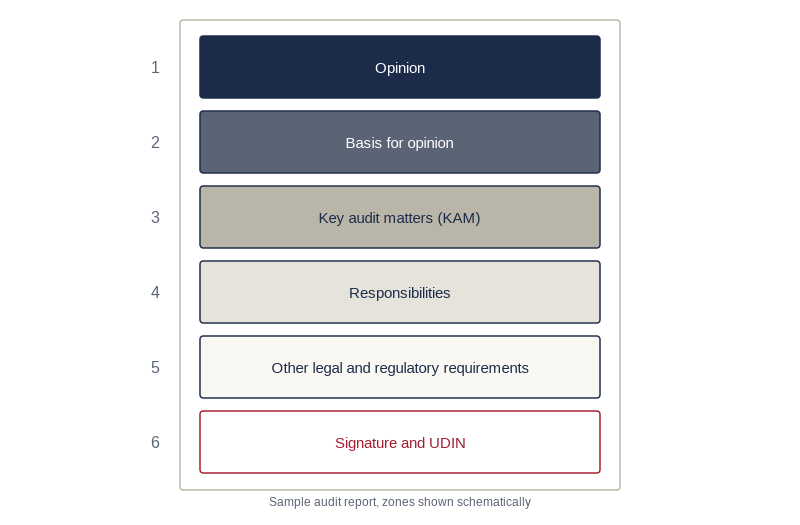
SA 700 (Revised) audit report ke standard elements deta hai. Revised format mein opinion sabse upar aata hai, kyunki reader ko sabse pehle conclusion chahiye. Purane format mein opinion end mein hota tha.
| Order | Element | Kaam |
|---|---|---|
| 1 | Title: "Independent Auditor's Report" | Report ki pehchaan; "Independent" shabd zaroori hai |
| 2 | Addressee | Report members (shareholders) ko address hoti hai, management ko nahi |
| 3 | Opinion | Auditor ka conclusion: kya audit kiya aur opinion kya hai |
| 4 | Basis for Opinion | Kaun se standards follow hue, independence declaration, evidence sufficient aur appropriate |
| 5 | Key Audit Matters (SA 701) | Listed entities mein, audit ke sabse significant matters |
| 6 | Responsibilities of management aur auditor | Zimmedari ka batwara; audit ki seema |
| 7 | Other legal and regulatory requirements | India mein Section 143(3) ke matters aur CARO |
| 8 | Signature, place, date, UDIN | Authentication |
UDIN (Unique Document Identification Number) ICAI ka system hai. Har audit report aur certificate par ek unique number banta hai, taaki fake reports pakdi ja sakein. Number udin.icai.org par verify hota hai.
A model report, read line by line
Neeche ek unlisted company ki clean report ka paraphrased model diya gaya hai. Exact legal wording ke liye hamesha SA text dekhiye. Structure SA 700 (Revised) ke illustrative reports ke anusaar hai [1][2].
Title and addressee. "Independent Auditor's Report. To the Members of ABC Company Limited." Report shareholders ke liye hai, isliye management ko address karna ek common exam trap hai.
Opinion. Auditor batata hai ki usne balance sheet, profit and loss, changes in equity, cash flow aur significant accounting policies ke notes audit kiye. Clean report mein opinion kehta hai ki statements Companies Act 2013 ki required information dete hain aur Indian accounting principles ke anusaar company ki sthiti, profit ya loss, aur cash flows ka true and fair view dete hain. Wording mein teen code words hain: "in our opinion" (yeh judgement hai, measurement nahi), "to the best of our information and according to the explanations given" (assurance ki seema), aur "true and fair view". Yeh phrase negligence se nahi bachati; yeh sirf audit ki seema batati hai.
Basis for Opinion. Audit Standards on Auditing ke anusaar hua, jo Section 143(10) ke tahat specified hain. Auditor ICAI Code of Ethics ke anusaar independent hai, baaki ethical responsibilities poori ki gayi hain, aur mila evidence opinion ke liye sufficient aur appropriate hai. Yeh section har type ki opinion mein aata hai.
Management ki responsibility. Management Companies Act ke anusaar statements prepare karne, true and fair view dene aur aise internal control ke liye zimmedar hai jisse fraud ya error se mukt statements ban sakein. Going concern ka assessment bhi management karta hai.
Auditor ki responsibility. Auditor ka objective reasonable assurance lena hai ki statements as a whole material misstatement se mukt hain. Reasonable assurance high level ka assurance hai, par guarantee nahi. Auditor professional judgement aur professional scepticism use karta hai, risks assess karta hai, procedures design karta hai, internal control samajhta hai, estimates evaluate karta hai, going concern par conclude karta hai, aur governance ke zimmedar logon se communicate karta hai. Yeh sabse lamba section hai aur expectation gap kam karne ke liye hai.
Other legal and regulatory requirements. Section 143(3) ke matters: zaroori information mili ya nahi, books of account sahi rakhe gaye ya nahi, balance sheet aur P&L books se match karte hain ya nahi, statements accounting standards ke anusaar hain ya nahi, directors Section 164(2) ke tahat disqualified hain ya nahi, aur internal financial controls (alag report mein) [3]. CARO ke matters bhi alag report mein [4].
Signature block. Partner sign karta hai (Section 141(2)). Firm registration number, partner ka membership number, place, date aur UDIN likhe jate hain.
Report date
Report ki date woh din hai jahan tak auditor subsequent events dekhta hai (SA 560). Auditor report ko us din se pehle date nahi kar sakta jab statements approve hue. Date auditor ki active responsibility ki seema hai.
Critical discussion
Report ka format standard hai, isliye ek reader ko ek hi report mein kuch tay shabdon ko dhoondhna sikhna chahiye: opinion ka type, Basis ka title, aur koi alag section (KAM, going concern, Emphasis of Matter). Yeh teen jagah wo hain jahan auditor bina opinion badle bhi risk ki taraf ishara kar sakta hai.
11.3 The four opinions and the modification logic (SA 705)
Unqualified opinion (clean opinion) kehta hai ki statements sab material respects mein true and fair view dete hain. Isme koi "except" nahi hota.
Qualified opinion kehta hai: sab theek hai, except for ek specific matter. Matter material hai par pervasive nahi.
Adverse opinion kehta hai ki statements true and fair view nahi dete. Misstatement material aur pervasive dono hai.
Disclaimer of opinion mein auditor koi opinion nahi deta, kyunki sufficient appropriate evidence nahi mila aur possible effects material aur pervasive ho sakte hain.
The 2x2
Opinion do sawalon se nikalti hai: (1) problem ka nature: kya misstatement hai ya evidence nahi mila; (2) pervasiveness: material par pervasive nahi, ya material aur pervasive.
| Material, not pervasive | Material and pervasive | |
|---|---|---|
| Misstatement | Qualified ("except for the effects of") | Adverse ("do not give a true and fair view") |
| Evidence not obtained | Qualified ("except for the possible effects of") | Disclaimer ("we do not express an opinion") |
Modified opinions (qualified, adverse, disclaimer) SA 705 ke tahat aate hain. Unqualified opinion SA 700 mein hai.
What "pervasive" means
SA 705 (para 5(a)) ke anusaar misstatement pervasive hai jab auditor ke judgement mein: (i) wo statements ke specific elements tak seemit nahi hai; ya (ii) seemit hone par bhi wo statements ka substantial proportion hai; ya (iii) disclosures ke maamle mein wo users ki understanding ke liye fundamental hai [5]. Ek sahi udaharan: ek debtor entry galat ho to material ho sakti hai par pervasive nahi; accounting system hi toota ho to pervasive hai.
Pervasiveness ke liye koi fixed percentage nahi hai. Isliye do competent auditors alag conclusion par pahunch sakte hain, aur modified opinions ke baad regulatory review aksar pervasiveness par hi sawal uthata hai. ICAI ki Practitioner's Guide on modified opinions bhi isi nature aur pervasiveness ke 2x2 ko apply karti hai [6].
Paraphrased sample paragraphs
Neeche ke paragraphs SA 700, SA 705, SA 570 aur SA 706 ke illustrative formats se apne shabdon mein paraphrase kiye gaye hain. Exact phrasing ke liye standard dekhiye.
| # | Paragraph | Signature phrase | Standard |
|---|---|---|---|
| P1 | Unmodified opinion | "true and fair view", no "except" | SA 700 (Revised) |
| P2 | Basis for Opinion | SAs under 143(10), independent, sufficient appropriate evidence | SA 700 (Revised) |
| P3 | Qualified opinion (misstatement) | "except for the effects of the matter described" | SA 705 para 17 |
| P4 | Basis for Qualified Opinion | matter aur uska quantified ya qualitative effect | SA 705 |
| P5 | Qualified opinion (evidence gap) | "except for the possible effects" | SA 705 para 17 |
| P6 | Adverse opinion | "because of the significance of the matter ... do not give a true and fair view" | SA 705 para 18 |
| P7 | Disclaimer | "we do not express an opinion" | SA 705 para 9 |
| P8 | Material uncertainty related to going concern | "opinion is not modified in respect of this matter" | SA 570 (Revised) |
| P9 | Emphasis of Matter | "we draw attention ... opinion is not modified" | SA 706 |
| P10 | Key Audit Matters | "most significant ... no separate opinion" | SA 701 |
Sources: SA 705 text aur illustrations [7]; ISA 700 illustration [2]; going concern wording [8]; Emphasis of Matter requirements [9].
P1 (unmodified). Auditor ne statements audit ki hain; unke opinion mein statements Companies Act 2013 ki required information dete hain aur Indian accounting principles ke anusaar sthiti, profit ya loss aur cash flows ka true and fair view dete hain [2].
P2 (Basis). Audit SAs ke anusaar hua; auditor independent hai; baaki ethical responsibilities poori hain; evidence sufficient aur appropriate hai. Agar yeh paragraph missing ho, to report adhoori hai [7].
P3 and P4 (qualified, misstatement). Opinion mein ek hi phrase badhta hai: "except for the effects of the matter described in the Basis for Qualified Opinion section" [7]. SA 705 ke Illustration 1 mein example hai: inventories sirf cost par dikhayi gayi, jabki lower of cost aur net realisable value par dikhani chahiye thi. Auditor effect quantify karta hai: cost of sales, tax, net income aur shareholders' funds par. Sirf "galat hai" likhna kaafi nahi hai [10].
P5 (qualified, evidence gap). Jab modification evidence na milne se aati hai, to wording badal kar "possible effects" ho jati hai. Kaaran: jab evidence hi nahi mila, auditor exact effect nahi bata sakta [11].
P6 (adverse). Illustration 2 mein group ne ek subsidiary ko consolidate nahi kiya aur effect pervasive tha. Auditor kehta hai ki matter ki significance ke karan statements true and fair view nahi dete [12].
P7 (disclaimer). Auditor kehta hai ki sufficient appropriate evidence nahi mila, isliye wo koi opinion express nahi karta. Disclaimer mein "except for" nahi aata, kyunki koi opinion hai hi nahi jise qualify kiya ja sake [13].
P8 (going concern). "Material Uncertainty Related to Going Concern" ab EOM mein nahi, apne alag section mein aati hai, Basis for Opinion ke theek baad. Auditor note ka reference deta hai (jaise net loss aur current liabilities total assets se zyada), batata hai ki material uncertainty maujood hai aur kehta hai ki opinion modify nahi hui [8].
P9 (EOM). SA 706 ke teen requirements: alag section jiske heading mein "Emphasis of Matter" ho; matter ka clear reference aur statements mein uski disclosure; aur yeh line ki opinion modify nahi hui. EOM sirf pehle se disclosed matter par hota hai [9].
P10 (KAM). Key Audit Matters woh matters hain jo auditor ke professional judgement mein audit ke sabse significant the. Format: matter kya hai, significant kyun hai, audit mein kaise address kiya. Udaharan: construction contracts mein percentage-of-completion revenue, jo cost estimates par nirbhar hai; auditor ne contract terms test kiye, cost-to-complete estimates ko past accuracy se compare kiya aur year-end milestones ka site evidence liya. Auditor in matters par alag opinion nahi deta [2].
Critical discussion
Teen exam traps. Pehla: revised SA 570 ke baad going concern ki material uncertainty EOM mein nahi jaati; uska apna section hai. Doosra: disclaimer mein "except for" nahi aata. Teesra: KAM opinion ka substitute nahi hai. Jo matter opinion modify karwata hai, wo Basis for Qualified ya Adverse Opinion mein jata hai, KAM mein nahi.
11.4 Emphasis of Matter, Other Matter, KAM and going concern
| Element | Kab | Opinion modify? |
|---|---|---|
| Emphasis of Matter (SA 706) | Statements mein pehle se disclosed matter, jaise major uncertainty ya court case | Nahi |
| Other Matter (SA 706) | Statements mein disclosed nahi, par audit ya report samajhne ke liye relevant; udaharan: pichhle saal ki statements predecessor auditor ne audit ki | Nahi |
| Key Audit Matters (SA 701) | Listed entities; audit ke sabse significant matters | Nahi |
| Material uncertainty related to going concern (SA 570 Revised) | Going concern par doubt, disclosure adequate | Nahi |
Test simple hai: matter statements mein disclosed hai to EOM; disclosed nahi par audit ya report samajhne ke liye relevant hai to Other Matter. Agar going concern disclosure inadequate hai, to yeh misstatement hai aur opinion qualified ya adverse banti hai [14].
Other Information (SA 720 Revised)
Annual report mein statements ke alawa jo kuch hai (directors' report, chairman ka message, management discussion) wo Other Information hai. Auditor ise padhta hai aur dekhta hai ki statements ke saath koi material inconsistency to nahi. Auditor is par opinion nahi deta. Agar directors' report kehti hai "record profits" aur statements mein loss hai, to auditor madhyam se correction mangta hai aur zaroorat par apni report mein respond karta hai [15]. Opinion sirf financial statements par hoti hai.
11.5 Reporting in India
Section 143 and fraud reporting
Companies Act 2013 ka Section 143 auditor ki reporting ka core hai. Auditor report karta hai ki usne accounts dekhe aur unke anusaar statements true and fair view dete hain ya nahi. Section 143(1) mein auditor ko kuch matters par inquiry karni hoti hai, jaise assets ke against loans aur personal expenses books mein to nahi. Section 143(3) mein report mein specific matters state hote hain [3].
Section 143(12): agar auditor ko audit ke dauran prescribed threshold se upar ka fraud pata chale, to use Central Government ko report karna hota hai (Rule 13; form ADT-4). Auditor chup nahi reh sakta.
CARO
CARO (Companies (Auditor's Report) Order) ek order hai jiske tahat auditor apni report mein extra matters par comment karta hai, jaise fixed assets, inventory, loans, statutory dues, fraud aur internal audit. Latest version CARO 2020 hai. CARO 2020 ka para 2 kehta hai ki Section 143 ke tahat har report mein paragraphs 3 aur 4 ke matters honge [4]. Internal financial controls par report listed aur prescribed companies ke liye Section 143(3)(i) ke tahat hoti hai.
SEBI LODR filing
Listed entity ke audited annual results SEBI LODR Regulation 33(3)(d) ke tahat financial year end ke 60 din ke andar audit report ke saath file hote hain. Modified opinion ho to saath mein Statement of Impact of Audit Qualifications file hota hai; unmodified ho to declaration. Agar standalone aur consolidated dono mein opinion modified hai to alag-alag statements lagte hain [16]. Is karan qualified opinion ab sirf report ka paragraph nahi, stock exchange filing ka headline bhi hai.
Auditor liability
Audit reasonable assurance hai, guarantee nahi. Agar auditor ne standards follow kiye, sahi evidence liya aur professional scepticism dikhayi, aur fraud collusion aur forgery ke karan phir bhi chhup gaya, to auditor ki defence strong hai. Par negligence ho (standards follow nahi hue, obvious red flags ignore hue), to civil liability (damages), professional liability (ICAI ya NFRA action) aur kabhi criminal liability bhi ho sakti hai. Documentation ki quality hi defence hai.
Critical discussion
Opinion negotiation ek studied phenomenon hai, kyunki ek qualification se company ki cost of capital badh sakti hai. Isliye management aur auditor ke beech pressure hota hai. Yeh sirf theory nahi; LODR ke impact statement ke karan qualification ki visibility badh gayi hai.
11.6 Case study: Lehman Brothers and Repo 105
What happened
Lehman Brothers ek 150 se zyada saal purani American investment bank thi. 15 September 2008 ko usne Chapter 11 bankruptcy file ki, jo US ki sabse badi thi: $639 billion assets, $613 billion bank debt aur $155 billion bond debt ke saath [17]. 2008 tak company ke $680 billion assets sirf $22.5 billion firm capital par tike the, yaani leverage bahut zyada tha [18].
Banks leverage ratio par judge hoti hain: kitna debt, kitna equity. Lehman ne ek trick use ki.
The mechanism
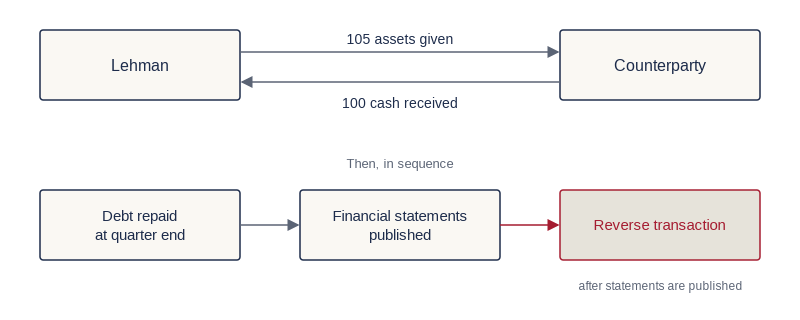
Normal repo (repurchase agreement) mein asset collateral deke short-term cash liya jata hai. Yeh technically ek loan hai: asset balance sheet par rehta hai aur liability badhti hai. Lehman ne kuch repo deals ko sale ki tarah treat kiya. Isse Repo 105 kaha gaya: 105 value ke assets dekar 100 cash lena (cost lagbhag 4.76%). Ek variant Repo 108 tha (108 dekar 100 lena, cost 7.41%) [19]. Kyunki ise sale mana gaya, assets balance sheet se hat jate the aur mili hui cash se Lehman apna debt chukata tha. Quarter-end par leverage kam dikhta tha.
Court-appointed examiner Anton Valukas ki 11 March 2010 ki report ke anusaar Lehman ne statements publish karne se theek pehle $50 billion ke assets temporarily cash mein badle [20]. Examiner ke anusaar yeh trick teen baar use hui [21].
The audit angle
Lehman ke auditor Ernst & Young the. Examiner ki report ke anusaar E&Y is classification se aware tha [22]. E&Y ne kabhi Lehman ke accounts qualify nahi kiye. Baad mein auditors ka stance raha ki transactions GAAP ke anusaar account kiye gaye the [23].
Regulatory outcome
December 2010 mein New York Attorney General Andrew Cuomo ne E&Y ke khilaf case kiya aur $150 million maange [24]. Case 2015 mein $10 million par settle hua, bina wrongdoing admit kiye [25].
Lessons
- Clean opinion ka matlab risk-free nahi. Lehman ki last reports clean thi.
- Substance over form. Repo 105 legally sale banayi gayi, par substance mein yeh window-dressing loan thi.
- Window dressing misstatement hai. Agar balance sheet sirf kuch din ke liye achhi dikhti hai, to wo true and fair nahi. Auditor period-end transactions ko specially test karta hai.
- Modified opinion ki shakti. Ek qualified ya adverse opinion pehle market ko jaga sakta tha. Ise use karne par client loss, fees aur relationship ka pressure hota hai.
- Expectation gap. Public audit ko guarantee samajhti hai; reality reasonable assurance hai.
Critical discussion
Yahan ek asli dispute hai: auditors kehte hain accounting GAAP ke anusaar thi; critics kehte hain legal form substance par haavi ho gaya. Yeh chapter is dispute ko tay nahi karta. Itna source ke anusaar kaha ja sakta hai ki examiner ne E&Y ko classification se aware paya aur 2015 ka settlement bina admission ke hua.
11.7 Case study: Wirecard
Wirecard Munich ka ek German payment processor tha aur 2018 se DAX index ka member tha. 2018 mein uski peak valuation €24 billion thi [26]. Financial Times ki investigations aur whistleblowers ke baad, 25 June 2020 ko Wirecard ne insolvency file ki jab pata chala ki €1.9 billion "missing" hai. CEO Markus Braun arrest hua [27].
KPMG ki special audit ne paya ki Ernst & Young cash reserves ka existence verify karne mein fail hua, jahan bank statements fraudulent lagti thi. KPMG 2016 se 2018 ke zyadatar profits cooperation na milne ke karan verify nahi kar payi [28]. Whistleblowers ke anusaar 2018 tak reported transaction volumes ka aadha hissa third-party acquirers se aata tha, aur trustee accounts ka cash Wirecard ki balance sheet mein gina jata tha [29]. January 2026 mein ek Singapore court ne do logon ko 10 aur 6.5 saal ki saza di, accounts falsify karne ke liye. Isme false confirmation letters shaamil the jo dikhate the ki Citadelle Wirecard ke liye €1.1 billion rakhti hai [30].
Lesson. Cash confirmation audit ka sabse basic procedure hai. Bank se direct confirmation auditor ko lena chahiye, client ke haath se nahi (SA 505). "Client ne diya hua document" par bharosa yahan toota. Agar evidence nahi milta aur effect material aur pervasive hai, to disclaimer ka rasta hai. Yeh chapter regulator ki bhoomika par detail nahi deta kyunki source mein uska verified detail nahi hai.
11.8 Case study: Carillion
Carillion UK ki second largest construction company thi, 2016 mein lagbhag 43,000 employees ke saath. 15 January 2018 ko wo compulsory liquidation mein gayi, lagbhag £7 billion liabilities ke saath [31]. KPMG ne 2014, 2015 aur 2016 ke saalon ke liye unqualified opinion diye; 2016 ka audit opinion 1 March 2017 ko date hua, yaani liquidation se lagbhag 10 mahine pehle [32]. Collapse ke waqt company ke paas sirf £29 million cash tha, jo 18 January 2018 tak khatam ho jata [33].
May 2018 ki parliamentary inquiry ne collapse ko "recklessness, hubris and greed" ki kahani kaha. Tin directors ko Financial Conduct Authority ne total £600,000 se zyada ke fines diye, aur do aur ko Financial Reporting Council ne £280,000 se zyada [34]. Committee ne suna ki Big Four firms ne Carillion se saalon mein £72 million fees collect ki thi. Committee chair Rachel Reeves ne kaha ki audits investors, workers aur public ko "false assurance" dene ke alawa kuch nahi lagte [35].
Lesson. Going concern assessment checklist nahi hai. Company debt aur pension deficit ke saath kam hoti cash par thi, phir bhi opinions clean rahe. SA 570 agle 12 mahine ka realistic assessment maangta hai, aur doubt ho to disclosure ya opinion modification. Chapter 10 mein Carillion ke audit failures ki detail hai. Auditor ki revenue client se aati hai; yeh conflict audit quality ko kaat sakta hai, isliye rotation aur oversight ke mudde (Chapters 12 aur 13) hain.
Comparative table
| Company | Country | Collapse | Auditor | Core audit issue |
|---|---|---|---|---|
| Lehman Brothers | USA | Chapter 11, 15 Sep 2008 | Ernst & Young | Repo 105 window dressing; $50bn at quarter-end; examiner: E&Y aware |
| Carillion | UK | Liquidation, 15 Jan 2018 | KPMG | Going concern judgements; £29m cash at collapse; MPs: "false assurance" |
| Wirecard | Germany | Insolvency, 25 Jun 2020 | Ernst & Young | €1.9bn cash missing; KPMG special audit: cash existence not verified |
Sources: [17][21][31][33][27][28].
Teenon cases mein report technically framework ke box tick karti dikhti thi, aur teenon mein substance form se haar gaya. Seekh yeh nahi ki "auditors corrupt hain"; seekh yeh hai ki audit ek judgement profession hai aur judgement pressure mein toot sakta hai. Reader ke liye clean opinion floor hai, ceiling nahi.
11.9 Worked problems
Har scenario mein pehle nature (misstatement ya evidence gap), phir pervasiveness, phir report element tay kijiye.
Problem 1. Ek bada machinery purchase expense kar diya gaya jabki capitalize hona chahiye tha. Amount profit ka 12% hai. Baaki sab theek hai. Solution. Misstatement hai, material hai, par ek item tak seemit hai. Qualified opinion ("except for the effects"), SA 705 ke anusaar.
Problem 2. Godown mein aag lagi aur saare records jal gaye. Debtors, creditors aur inventory, kisi ka evidence nahi hai. Solution. Evidence gap, har line item par. Material aur pervasive. Disclaimer of opinion.
Problem 3. Ek loss-making subsidiary ko consolidation se bahar rakha gaya, jo group size ka 40% hai. Solution. Misstatement. 40% substantial proportion hai, aur effect pervasive hai. Adverse opinion (SA 705 Illustration 2 jaisa).
Problem 4. Company ke khilaf bada court case chal raha hai. Note 19 mein poori disclosure hai aur accounting sahi hai. Solution. Misstatement nahi. Opinion modify nahi hogi. Emphasis of Matter paragraph, Note 19 ke reference ke saath.
Problem 5. Net loss hai, current liabilities assets se zyada hain, bank loan renew nahi ho raha. Management ne Note 6 mein poori going concern disclosure di hai. Solution. Disclosure adequate hai. Opinion clean rahegi, par alag Material Uncertainty Related to Going Concern section aayega, EOM nahi.
Problem 6. Wahi going concern problem, par management ne koi disclosure nahi di. Solution. Inadequate disclosure misstatement hai, users ki understanding ke liye fundamental hone se pervasive. Adverse opinion.
Problem 7. Auditor ko ek division ka access nahi mila. Division ka effect material hai par pervasive nahi. Solution. Evidence gap, not pervasive. Qualified opinion ("except for the possible effects").
Problem 8. Revenue recognition policy galat hai aur company ke saare segments mein wahi policy chalti hai. Solution. Misstatement, pervasive. Adverse opinion.
Problem 9. Directors' report mein profit Rs 100 crore likha hai, statements mein Rs 60 crore hai. Solution. Yeh Other Information mein material inconsistency hai. Auditor SA 720 ke tahat management se correction mangta hai; na ho to apni report mein respond karta hai. Opinion financial statements par rehti hai.
Problem 10. Pichhle saal ki statements doosre auditor ne audit ki thi. Solution. Other Matter paragraph (comparative information, predecessor auditor), kyunki matter statements mein disclosed nahi hai par report samajhne ke liye relevant hai.
11.10 Chapter summary
Audit report auditor ka final product hai, aur SA 700 (Revised) ke anusaar opinion sabse upar aati hai. Report mein title, addressee, opinion, Basis for Opinion, KAM, responsibilities, other legal requirements aur signature block hote hain. Chaar opinions hain: unqualified, qualified, adverse aur disclaimer. Inka logic nature (misstatement ya evidence gap) aur pervasiveness ka 2x2 hai, jo SA 705 deta hai. Emphasis of Matter, Other Matter, KAM aur going concern ka material uncertainty section opinion ko modify nahi karte. India mein Section 143, CARO, Section 143(12), UDIN aur LODR ki filing extra reporting deti hain. Audit reasonable assurance hai, guarantee nahi, par negligence par auditor ki liability banti hai. Lehman ka Repo 105 substance over form ka sabak deta hai. Wirecard ka sabak direct cash confirmation hai. Carillion ka sabak going concern ka realistic assessment hai. Clean opinion floor hai, ceiling nahi.
11.11 Review questions
Short answer
- Revised SA 700 mein opinion sabse upar kyon aati hai?
- Audit report kise address hoti hai aur kyon?
- Opinion ke chaar types aur unka 2x2 logic samjhaiye.
- SA 705 ke anusaar "pervasive" ki teen limbs batayiye.
- Qualified opinion mein "effects" aur "possible effects" ka farq kya hai?
- Emphasis of Matter aur Other Matter ka farq kya hai?
- Going concern ki material uncertainty ke liye alag section kyon hai, aur disclosure inadequate ho to kya hota hai?
- Section 143(12) ke tahat auditor ka kya kartavya hai?
- Modified opinion par listed entity ko LODR ke tahat kya file karna hota hai?
- Repo 105 mein auditor ke liye substance over form ka kya matlab tha?
Multiple choice
Q1. Jab misstatement material ho par pervasive na ho, to kaunsi opinion di jati hai? (a) Unqualified (b) Adverse (c) Qualified (d) Disclaimer
Answer: (c). Material but not pervasive misstatement qualified opinion ("except for") banata hai. Adverse tab hota hai jab effect pervasive bhi ho.
Q2. Disclaimer of opinion kab di jati hai? (a) Statements galat aur pervasive hon (b) Management ne fees nahi di (c) Auditor ko sufficient appropriate evidence nahi mila aur effect material aur pervasive ho sakta hai (d) Matter disclosed ho par important ho
Answer: (c). Disclaimer evidence ki kami par hai. Adverse misstatement ke proof par hai.
Q3. "Except for" wording kis opinion mein aati hai? (a) Adverse (b) Disclaimer (c) Unqualified (d) Qualified
Answer: (d). Qualified opinion ka signature phrase.
Q4. CARO ka full form? (a) Companies (Audit Report) Order (b) Company Accounts Review Order (c) Companies (Auditor's Report) Order (d) Corporate Audit Reporting Order
Answer: (c). Companies (Auditor's Report) Order; latest version 2020.
Q5. Fraud ko Central Government ko report karne ka Section kaun sa hai? (a) Section 139 (b) Section 143(12) (c) Section 141 (d) Section 147
Answer: (b). Section 143(12): prescribed threshold se upar ka fraud report karna zaroori hai.
Q6. Going concern ki material uncertainty (adequate disclosure) report mein kahan aati hai? (a) EOM ke andar (b) KAM ke andar (c) CARO mein (d) Basis for Opinion ke baad, alag heading mein
Answer: (d). Revised SA 570 ke anusaar alag section hai; opinion modify nahi hoti.
Q7. Records aag mein jal gaye aur koi evidence nahi, to opinion? (a) Qualified (b) Disclaimer (c) Adverse (d) Unqualified with EOM
Answer: (b). Evidence gap, material aur pervasive. Adverse nahi, kyunki misstatement ka proof nahi hai.
Q8. Directors' report ka profit figure statements se inconsistent ho to? (a) Auditor ignore kare (b) SA 720 ke tahat correction mange aur zaroorat par respond kare (c) Turant resign kare (d) Disclaimer de
Answer: (b). Auditor Other Information par opinion nahi deta, par material inconsistency par respond karta hai.
Q9. Lehman ke Repo 105 ka audit lesson? (a) Sampling badhao (b) Fees badhao (c) Rotation lagao (d) Period-end transactions test karo aur substance over form dekho
Answer: (d). Quarter-end window dressing cut-off aur period-end testing se pakdi jati hai.
Q10. Carillion ke external auditor aur collapse ki date? (a) EY, 15 Sep 2008 (b) KPMG, 15 Jan 2018 (c) KPMG, 25 Jun 2020 (d) EY, 15 Jan 2018
Answer: (b). KPMG external auditor tha; compulsory liquidation 15 January 2018. 15 Sep 2008 Lehman ki aur 25 Jun 2020 Wirecard ki date hai.
Notes and references
[1] IAASB/ICAI standards, SA 700 (Revised) structure as shown in SA 705 (Revised) illustrative reports, caalley.com, accessed 2026-11-27, https://caalley.com/eqc/44096aasb33841-sa705.pdf. Claim: SA 705 illustrative reports use the Indian opinion structure under SA 700 (Revised). [2] FICA, "Auditor's Opinion" (ISA 700 Revised Illustration 1), fica.org.fj, accessed 2026-11-27, https://fica.org.fj/wp-content/uploads/2023/02/Auditors-Opinion-New-1.pdf. Claims: unmodified opinion structure; KAM section structure and "no separate opinion" wording (paraphrased). [3] Companies Act 2013, Section 143, kanoonhq.in, accessed 2026-11-27, https://kanoonhq.in/laws/A2013-18/sections/143. Claim: Section 143(3)(a)-(j) matters. [4] "CARO 2020", taxguru.in, accessed 2026-11-27, https://taxguru.in/company-law/caro-2020.html. Claim: para 2, every report under section 143 shall contain matters in paragraphs 3 and 4. [5] SA 705 (Revised), caalley.com, accessed 2026-11-27, https://caalley.com/eqc/44096aasb33841-sa705.pdf. Claim: para 5(a) definition of pervasive, three limbs (paraphrased). [6] ICAI, "Practitioner's Guide on Modified Opinions", studycafe.in, accessed 2026-11-27, https://assets.studycafe.in/uploads/2026/02/GUIDE-FOR-MODIFIED-OPINIONS-ICAI-1.pdf. Claim: decision depends on nature of matter and pervasiveness. [7] SA 705 (Revised), caalley.com, accessed 2026-11-27, https://caalley.com/eqc/44096aasb33841-sa705.pdf. Claims: full text with paras 5-9, 17-18 and Illustrations 1-2; Basis wording; para 17(a) "except for the effects". [8] ICAI Kochi branch training material, kochiicai.org, accessed 2026-11-27, https://kochiicai.org/uploads/events/materials/EKM-ICAI--material-328193.pdf. Claim: material uncertainty related to going concern is a separate section after Basis for Opinion; formerly under EOM; qualified or adverse when disclosure inadequate (illustrative formats). [9] AccountingWEB, "Emphasis of matter paragraphs in the auditor's report", accessed 2026-11-27, https://www.accountingweb.co.uk/business/financial-reporting/emphasis-of-matter-paragraphs-in-the-auditors-report. Claim: ISA 706 EOM definition and para 9(a)-(c). [10] SA 705 (Revised) Illustration 1, https://caalley.com/eqc/44096aasb33841-sa705.pdf (accessed 2026-11-27). Claim: inventories at cost instead of lower of cost and NRV; effect quantified on cost of sales, tax, net income, shareholders' funds. [11] SA 705 (Revised) para 17, https://caalley.com/eqc/44096aasb33841-sa705.pdf (accessed 2026-11-27). Claim: evidence gap uses "possible effects". [12] SA 705 (Revised) para 18 and Illustration 2, https://caalley.com/eqc/44096aasb33841-sa705.pdf (accessed 2026-11-27). Claim: adverse wording; non-consolidation of subsidiary, effects pervasive and undetermined. [13] SA 705 (Revised) para 9, https://caalley.com/eqc/44096aasb33841-sa705.pdf (accessed 2026-11-27). Claim: disclaimer when sufficient appropriate evidence cannot be obtained and effects could be material and pervasive. [14] ICAI Kochi training material, https://kochiicai.org/uploads/events/materials/EKM-ICAI--material-328193.pdf (accessed 2026-11-27). Claim: material uncertainty section when disclosure adequate; qualified or adverse when inadequate. [15] SA 705 (Revised) illustrative reports, https://caalley.com/eqc/44096aasb33841-sa705.pdf (accessed 2026-11-27). Claim: reports reference an "Other Information" section per SA 720 (Revised). [16] SEBI, LODR FAQ (April 2025), sebi.gov.in, accessed 2026-11-27, https://www.sebi.gov.in/sebi_data/faqfiles/apr-2025/1745399101865.pdf. Claims: Reg 33(3)(d) 60-day audited results; statement on impact of audit qualifications for modified opinion, declaration for unmodified; separate statements for standalone and consolidated. [17] Wikipedia, "Lehman Brothers", accessed 2026-11-27, https://en.wikipedia.org/wiki/Lehman_Brothers. Claim: Chapter 11 filing 15 September 2008; $639 billion assets, $613 billion bank debt, $155 billion bond debt. [18] Wikipedia, "Lehman Brothers", https://en.wikipedia.org/wiki/Lehman_Brothers (accessed 2026-11-27). Claim: $680 billion assets supported by $22.5 billion of firm capital in 2008. [19] Wikipedia, "Repo 105", accessed 2026-11-27, https://en.wikipedia.org/wiki/Repo_105. Claim: Repo 105 costs 4.76%, Repo 108 costs 7.41% of assets exchanged. [20] Wikipedia, "Lehman Brothers", https://en.wikipedia.org/wiki/Lehman_Brothers (accessed 2026-11-27). Claim: Valukas report, 11 March 2010, Repo 105 used to temporarily exchange $50 billion of assets into cash before publishing statements. [21] Wikipedia, "Repo 105", https://en.wikipedia.org/wiki/Repo_105 (accessed 2026-11-27). Claim: used three times according to the March 2010 examiner report. [22] Wikipedia, "Repo 105", https://en.wikipedia.org/wiki/Repo_105 (accessed 2026-11-27). Claim: report stated Lehman's auditors Ernst & Young were aware of this classification. [23] Wikipedia, "Repo 105", https://en.wikipedia.org/wiki/Repo_105 (accessed 2026-11-27). Claim: auditors said transactions were accounted for in line with GAAP. [24] Wikipedia, "Repo 105", https://en.wikipedia.org/wiki/Repo_105 (accessed 2026-11-27). Claim: NY AG Andrew Cuomo filed charges December 2010 seeking $150 million. [25] Wikipedia, "Repo 105", https://en.wikipedia.org/wiki/Repo_105 (accessed 2026-11-27). Claim: settled in 2015 for $10 million without admitting wrongdoing. [26] Wikipedia, "Wirecard scandal", accessed 2026-11-27, https://en.wikipedia.org/wiki/Wirecard_scandal. Claim: Wirecard in DAX since 2018; peak valuation €24bn in 2018. [27] Wikipedia, "Wirecard scandal", https://en.wikipedia.org/wiki/Wirecard_scandal (accessed 2026-11-27). Claim: 25 June 2020 insolvency after €1.9 billion revealed missing; CEO Markus Braun arrested. [28] Wikipedia, "Wirecard scandal", https://en.wikipedia.org/wiki/Wirecard_scandal (accessed 2026-11-27). Claim: KPMG special audit: EY failed to verify existence of cash reserves; KPMG unable to verify majority of profits 2016-2018. [29] Wikipedia, "Wirecard scandal", https://en.wikipedia.org/wiki/Wirecard_scandal (accessed 2026-11-27). Claim: whistleblowers said third-party acquirers were half of 2018 global transaction volumes; trustee-account cash counted in Wirecard balance sheet. [30] Wikipedia, "Wirecard scandal", https://en.wikipedia.org/wiki/Wirecard_scandal (accessed 2026-11-27). Claim: January 2026 Singapore sentences of 10 and 6.5 years; false confirmations claiming Citadelle held €1.1 billion for Wirecard. [31] Wikipedia, "Carillion", accessed 2026-11-27, https://en.wikipedia.org/wiki/Carillion. Claim: second largest UK construction company; about 43,000 employees in 2016; compulsory liquidation 15 January 2018; liabilities almost £7 billion. [32] Financial Reporting Council, "Sanctions against KPMG LLP, KPMG Audit Plc and two former partners", 12 October 2023, https://www.frc.org.uk/news-and-events/news/2023/10/sanctions-against-kpmg-llp-kpmg-audit-plc-and-two-former-partners/ (accessed 2026-11-27). Claim: KPMG unqualified opinions FY2014-2016; 2016 opinion dated 1 March 2017. [33] Wikipedia, "Carillion", https://en.wikipedia.org/wiki/Carillion (accessed 2026-11-27). Claim: £29M in cash at collapse; would have run out by 18 January 2018. [34] Wikipedia, "Carillion", https://en.wikipedia.org/wiki/Carillion (accessed 2026-11-27). Claim: May 2018 select committee report "recklessness, hubris and greed"; FCA fines over £600,000 on three directors; FRC fines over £280,000 on two more. [35] Wikipedia, "Carillion", https://en.wikipedia.org/wiki/Carillion (accessed 2026-11-27). Claim: Big Four collected £72M fees from Carillion work; Rachel Reeves said audits appeared fit only to provide false assurance.