Standards on Auditing (SA), ICAI and NFRA
Abstract
Audit ki quality ke liye do cheezein chahiye: ek common rulebook, aur ek independent check ki rulebook follow hua ya nahi. Bharat mein rulebook Standards on Auditing (SA) hain, jinhe Companies Act, 2013 ki Section 143(9) har company auditor par binding banati hai. Institute of Chartered Accountants of India (ICAI) in standards ko recommend aur issue karta hai aur CA profession ko regulate karta hai. National Financial Reporting Authority (NFRA), jo 1 October 2018 ko Section 132 ke tahat bana, listed companies aur kuch bade unlisted companies ke audit quality ki nigrani karta hai. Is chapter mein teeno ka aapsi rishta samjhaya gaya hai, chaar standards (SA 240, SA 230, SA 505, SA 570) detail mein padhe gaye hain, Indian regulators ki US ke PCAOB se tulna ki gayi hai, aur NFRA tatha ICAI ke asli enforcement outcomes ka vishleshan kiya gaya hai.
Learning objectives
Is chapter ko padhne ke baad reader yeh kar sakega:
- Standard on Auditing ko define karna aur uski binding force ka legal source batana.
- ICAI (standard-setting aur professional discipline) aur NFRA (independent oversight aur enforcement) ke roles ko distinguish karna.
- SA series (200 se 800) ka subject aur sabse zyada puche jaane wale terah standards pehchanna.
- Ek auditor par ICAI, NFRA, MCA/ROC, SEBI, CAG aur US PCAOB ki powers ki tulna evaluate karna.
- Coffee Day Enterprises aur Zee Entertainment ke NFRA orders tatha ek ICAI Disciplinary Committee order ke audit failures ka evaluate karna.
- Regulatory orders mein diye gaye figures se combined penalty aur evidence gap compute karna.
Introduction and research question
Maan lijiye har auditor apna alag rulebook banata hai. Ek auditor halki jaanch ke baad "sab theek hai" likhta hai, doosra gehri jaanch ke baad wahi shabd likhta hai. Financial statements padhne wale dono reports ko compare nahi kar sakte. Common rulebook is samasya ko door karta hai. Lekin ek doosri samasya turant aati hai: jis rulebook ko koi check nahi karta, uski value kam hoti hai. Isliye is chapter ka research question do hisson mein hai: Bharat mein auditors ke liye rules kaun likhta hai, aur yeh kaun check karta hai ki rules follow hue?
Chapter teen charan mein jawab deta hai. Section 13.1 legal framework aur SA ka structure batata hai. Section 13.2 ICAI aur NFRA ko samjhata hai. Section 13.3 aur 13.4 chaar standards aur poore regulation map ko detail mein dekhte hain. Case study mein asli enforcement outcomes padhe jaate hain, taaki rules ko toot-te aur enforce hote dekha ja sake.
13.1 Standards on Auditing and the Companies Act, 2013
Concept
Standard on Auditing (SA) ek likhit professional standard hai jo batata hai ki audit kaise kiya jana chahiye. Companies Act, 2013 in standards ko binding banata hai. Section 143(9) ke anusaar har auditor ko auditing standards follow karne hote hain. Section 143(10) Central Government ko standards prescribe karne ki permission deta hai, ICAI ki recommendation par aur NFRA se consultation ke baad. Jab tak Government is tarah standards prescribe nahi karti, ICAI ke issue kiye hue standards hi auditing standards maane jaate hain.[1]
Act aur SA ka rishta seedha hai. Act kehta hai ki standards follow karo. SA batate hain ki kaise follow karna hai.
Non-compliance ke legal parinaam hain. Section 147(2) Section 143 ke contravention par penalty deti hai, jisme fine aur, jaanbujh kar ki gayi contravention mein, imprisonment bhi ho sakti hai.[5]
Structure of the SA series
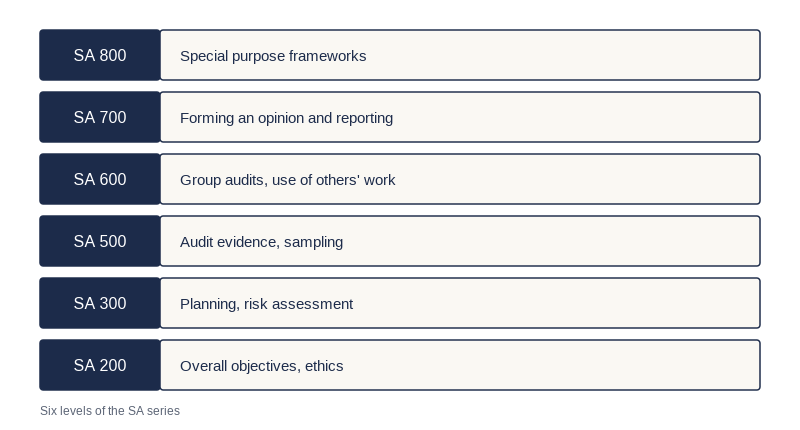
Clarity Project ke baad SAs numbered series mein hain. ICAI ki list ka header hai "New/Revised Standards (Auditing, Review and Others) issued under the Clarity Project". Clarity format mein har standard ke objectives, requirements aur application material alag likhe jaate hain. List SA 200 se SA 810 tak jaati hai aur review aur assurance engagements ke alag standards bhi deti hai, jaise SRE 2400, SRE 2410 aur SAE 3400.[2]
| Series | Subject area |
|---|---|
| 200-299 | General principles and responsibilities |
| 300-499 | Risk assessment and response |
| 500-599 | Audit evidence |
| 600-699 | Using the work of others |
| 700-799 | Conclusions and reporting |
| 800-899 | Special areas |
Sabse zyada puche jaane wale terah standards neeche hain.[2]
| Standard | Subject |
|---|---|
| SA 200 | Overall objectives of the independent auditor |
| SA 230 | Audit documentation |
| SA 240 | The auditor's responsibilities relating to fraud |
| SA 300 | Planning an audit |
| SA 315 | Identifying and assessing risks |
| SA 320 | Materiality |
| SA 500 | Audit evidence |
| SA 530 | Audit sampling |
| SA 570 (Revised) | Going concern [12] |
| SA 700 | Forming an opinion and reporting |
| SA 701 | Key audit matters |
| SA 705 | Modified opinions (qualified, adverse, disclaimer) |
| SA 706 | Emphasis of matter and other matter paragraphs |
Worked example
Ek student se poocha gaya ki audit mein fraud risk ka treatment kaun sa standard batata hai. Series table fraud ko general principles and responsibilities (200-299) mein rakhti hai, aur examined list mein SA 240 ka naam hai. Isi tarah materiality (SA 320) 300-499 risk series mein aur audit opinion (SA 700) 700-799 reporting series mein milte hain.
Critical discussion
Teen limits yaad rakhne yogya hain. Pehla, numbers ratna samajhna nahi hai. "Kaun sa standard?" wale sawal mein number chahiye, lekin descriptive sawal mein standard ka purpose aur statute se link chahiye. Doosra, SA 701, SA 705 aur SA 706 aasani se mix ho jaate hain. Key audit matters (SA 701) aam taur par listed entities ke liye relevant hain, modified opinion (SA 705) opinion ko hi badal deta hai, aur emphasis of matter paragraph (SA 706) opinion badle bina ek paragraph jodta hai. Har ki exact applicability standard text mein dekhni chahiye. Teesra, Section 143(10) ka deeming rule batata hai ki Government ke naye standards aane tak ICAI standards chalte hain. Iska matlab yeh nahi ki ICAI par koi oversight nahi, jaisa agla section dikhata hai.
13.2 ICAI and NFRA
Concept
ICAI yaani Institute of Chartered Accountants of India, 1 July 1949 ko Chartered Accountants Act, 1949 ke tahat bana. Yeh CA profession ko regulate karta hai. Sirf wahi ICAI member statutory auditor ban sakta hai jiske paas valid certificate of practice ho.[3]
NFRA yaani National Financial Reporting Authority, 1 October 2018 ko Companies Act, 2013 ki Section 132 ke tahat bana. Yeh auditing profession aur accounting standards ki nigrani karta hai. Yeh investigate kar sakta hai, penalty laga sakta hai aur auditor ko 10 saal tak debar kar sakta hai. Iska scope listed companies aur NFRA Rules, 2018 ke Rule 3 mein bataye gaye kuch bade unlisted public companies tak hai.[4] Independent audit regulator ka vichar Satyam ke baad Standing Committee on Finance se aaya, jiski charcha Chapter 12 mein hui hai.
| Body | Function | Established |
|---|---|---|
| ICAI | CA profession ko regulate karna, standards recommend karna, members par discipline | 1 July 1949 |
| NFRA | Bade companies ke auditors ki nigrani; investigation, penalty, debarment | 1 October 2018 |
Worked example
Ek listed company ke statutory auditor par aarop hai ki usne fraud indicator ko ignore kiya. Do bodies action le sakti hain. NFRA audit review karke Section 132 ke tahat penalty aur debarment laga sakta hai. ICAI alag se professional misconduct ko apni disciplinary machinery se dekh sakta hai (Section 13.4). Yaani ek hi engagement par auditor ko do alag frameworks mein proceedings jhelni pad sakti hain.
Critical discussion
Design ka kendriya bindu standard-setting aur enforcement ka alag hona hai. Section 143(10) standard-setting ki recommendation ICAI ko deta hai, lekin NFRA se consultation zaroori hai, jisse dono functions ke beech ek check bana rehta hai. NFRA par Wikipedia ka vivaran regulator ki profession se independence ko uske banne ka karan batata hai; yeh secondary source hai aur yahan sirf is general point ke liye li gayi hai.[4]
Sources mein do sawal khule rehte hain. Pehla, ek hi auditor par ICAI aur NFRA ke jurisdiction ka exact overlap latest NFRA Act, Rules aur Section 132 ke text mein dekhna chahiye. Doosra, Rule 3(2) aur 3(3) ke tahat auditor ko Form NFRA-1 se NFRA ko jaankari deni hoti hai; details ke liye rule text padhna chahiye.
13.3 Four standards in depth
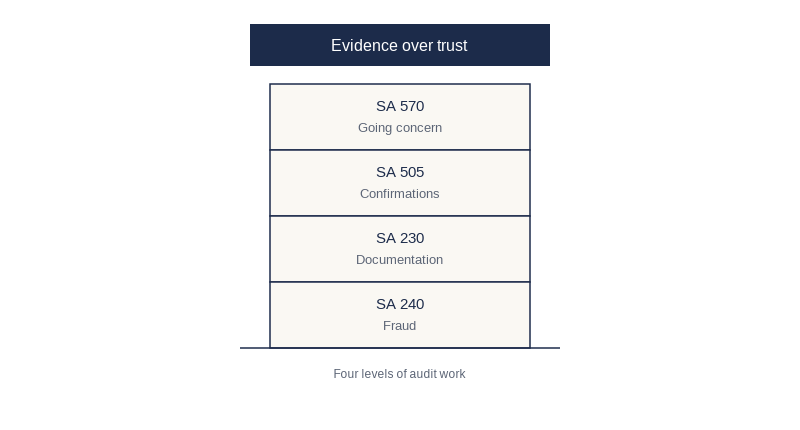
Yeh section chaar standards ko padhta hai jo enforcement orders mein baar baar aate hain.
13.3.1 SA 240: fraud
Poora title hai "The Auditor's Responsibilities Relating to Fraud in an Audit of Financial Statements".[2] Fraud rokne ki zimmedari management aur those charged with governance ki hai. Auditor ka kaam reasonable assurance (ek high lekin absolute nahi, level ka assurance) lena hai ki financial statements material misstatement se free hain, chahe wo fraud se ho ya error se. Auditor professional scepticism apnata hai, yaani yeh nahi maanta ki management beimaan hai, par conclusions evidence par banata hai.
Standard do prakar ke fraud maanta hai: fraudulent financial reporting (numbers ko jaanbujh kar bigaadna) aur misappropriation of assets (assets ki chori). Management override of controls ko hamesha fraud risk maana jaata hai. Isi karan auditor har audit mein journal entries test karta hai.
Critical discussion. Kyunki override risk pehle se maani jaati hai, auditor yeh tark nahi de sakta ki client ke controls mazboot dikhte hain isliye journal testing zaroori nahi. Yeh presumption ek aam exam trap hai.
13.3.2 SA 230: audit documentation
Title hai "Audit Documentation".[2] Auditor ko itni documentation banani hai ki ek experienced auditor, jiska is audit se koi sambandh nahi tha, samajh sake ki kaunse procedures kiye gaye, kaisa evidence mila aur kaunse conclusions nikle. File ko report date ke baad ek time limit ke andar assemble karna hota hai. Baad mein reasons ke saath cheezein jodi ja sakti hain, lekin hataayi nahi ja sakti.
Regulatory proceedings mein pehli maang aam taur par file ki hoti hai. Kaam ka siddhant yeh hai ki jo document nahi hua, use kiya hua nahi maana jaata.
13.3.3 SA 505: external confirmations
External confirmation ek likhit jawab hai jo seedha kisi third party se milta hai. Standard do request types alag karta hai.[13]
| Request type | Response required |
|---|---|
| Positive request | Har case mein reply, chahe recipient agree kare ya disagree |
| Negative request | Reply sirf tab jab recipient disagree kare |
Negative request kam persuasive hota hai. Ise kisi assertion ka akela procedure tabhi banana chahiye jab risk low ho, population bada aur homogeneous ho, aur exceptions ki dar kam rehne ki ummeed ho. Auditor ko requests par control rakhna hota hai: kya confirm karna hai, kisse poochna hai, aur replies seedha auditor ko aayen. Agar management auditor ko request bhejne se mana kare, to auditor wajah poochta hai, alternative procedures karta hai, aur refusal unreasonable ho to SA 705 ke tahat opinion par asar sochta hai. Non-response par alternative procedures chahiye. Exceptions ki jaanch zaroori hai.
SA 505 ka paragraph 10 kehta hai ki response ki reliability par shak ho to aur evidence lena chahiye.[13] Yeh Wirecard case se judta hai, jahan bank confirmations jhooti bataayi gayi thi. Confirmation tabhi persuasive hai jab wo direct aur reliable source se aaye.
13.3.4 SA 570 (Revised): going concern
Standard auditor se kehta hai ki wo evaluate kare ki management ka going concern basis ka upyog sahi hai ya nahi.[2] Kathinai ke aam sanket hain: losses, negative working capital, loan renewals mein deri, aur key suppliers ka credit rok dena. Jahan material uncertainty hai aur disclosure adequate hai, wahan report mein "Material Uncertainty Related to Going Concern" naam ka alag section aata hai. Jahan disclosure inadequate hai, wahan opinion qualified ya adverse hota hai. Auditor future ki bhavishyavani nahi karta. Wo management ke assessment ko available evidence ke against test karta hai.
13.4 The regulation map: who regulates whom
Students aksar ICAI, NFRA, MCA, SEBI aur CAG ko mix kar dete hain. Neeche ki table inhe jurisdiction aur power ke hisaab se alag karti hai.
| Regulator | Nature | Jurisdiction | Powers | Link to audit |
|---|---|---|---|---|
| ICAI | Statutory body (CA Act, 1949) | Sabhi CA members aur firms | Disciplinary Committee: reprimand, name removal, fines | Standards issue karta hai; certificate of practice deta hai |
| NFRA | Independent audit regulator (Companies Act, s.132, 2018) | Listed companies aur Rule 3 ke bade unlisted public companies ke auditors | Investigate, penalty, 10 saal tak debar | Audit quality oversight; standards par consult kiya jaata hai |
| MCA / ROC | Ministry aur Registrar offices | Sabhi companies | Prosecution, penalties, strike-off | Companies Act ss.139-148 enforce karna; ADT forms |
| SEBI (LODR) | Securities market regulator (SEBI Act, 1992) | Listed entities | Fines, market debarment, prosecution | Audit committee, results aur audit report filing |
| CAG | Constitutional auditor (Article 148) | Government aur government companies (51% ya adhik) | Parliament ko report; penalty power nahi | s.139(5) aur (7) ke tahat auditor appoint; supplementary audit |
| PCAOB (USA) | Sarbanes-Oxley, 2002 ke tahat audit regulator | US-listed companies ke auditors | Inspect, fine $100,000 tak (individual) aur $2 million tak (firm), registration revoke | Registration, inspection, standards aur enforcement |
Table ke sources: ICAI [3]; NFRA [4]; MCA [14]; SEBI, jiski executive establishment 12 April 1988 ko aur statutory status 30 January 1992 ko SEBI Act, 1992 se aayi [15], aur Listing Obligations and Disclosure Requirements (LODR) Regulations, 2015, jo 14 July 2026 ko last amend hui, Regulation 18 (audit committee) aur Regulation 33 (audit report ke saath financial results) [16]; CAG [17]; aur PCAOB, jo Sarbanes-Oxley Act se bana aur 30 July 2002 ko founded hua, jiske chaar functions (registration, inspection, standard-setting, enforcement) hain, aur jo 100 se zyada issuer clients wali firms ki annual aur chhoti firms ki triennial inspection karta hai [18].
How many overseers watch one listed-company auditor?
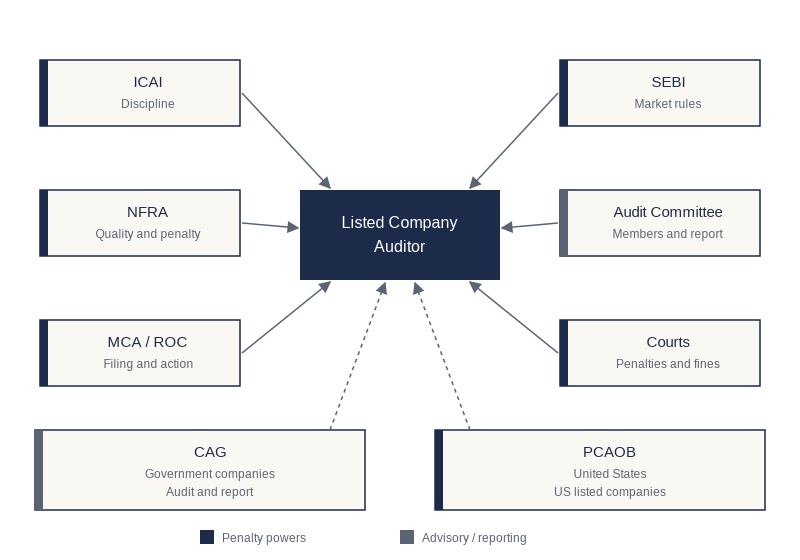
Ek listed company ke statutory auditor ko dekhne wale nigraani karta ye hain.
- Company ke members, jo auditor ko appoint aur remove karte hain (Sections 139 aur 140).
- Audit Committee, Section 177 ke tahat, jo auditor se internal control systems, audit ke scope aur observations par comments maang sakti hai.[19]
- SEBI, kyunki company listed hai. LODR Regulation 33 ke tahat audited annual results audit report ke saath 60 din mein file hone chahiye, aur modified opinion ho to Statement on Impact of Audit Qualifications zaroori hai.[20]
- NFRA, audit quality review aur investigation ke liye.
- ICAI, professional misconduct ke liye.
- MCA/ROC, Companies Act ke violations ke liye.
- Courts, jahan fraud ka aarop ho, Section 447 tak.
Government company mein CAG bhi judta hai. CAG Section 139(5) aur (7) ke tahat auditor appoint karta hai aur supplementary audit kar sakta hai. CAG ki reports Parliament ke saamne rakhi jaati hain aur Public Accounts Committee tatha Committees on Public Undertakings unhe uthate hain. CAG report karta hai, penalty nahi lagata; action report par sarkar leti hai.[17]
Comparison with the United States
NFRA aur PCAOB dono scandal ke jawab mein bane. PCAOB 2002 mein un restatements aur scandals ke jawab mein bana jinme WorldCom aur Enron shamil the, jinka audit Arthur Andersen ne kiya tha, aur profession pehle AICPA ke zariye self-regulated thi.[18] NFRA 2018 mein Satyam ke baad Standing Committee ki sifarish se bana. Dono ne pure self-regulation ko khatam kiya. Tareeka alag hai: PCAOB registered firms ki routine inspection karta hai (saalana ya teen saal mein), jabki NFRA mukhya roop se investigations aur orders ke zariye kaam karta hai. Sanctions ka roop bhi alag hai: PCAOB ke dollar caps hain, jabki NFRA ke paas Section 132 ke tahat penalty aur debarment dono hain.
Critical discussion
Layered oversight ka badhna ek pattern dikhata hai: jab bhi koi audit failure public hota hai, ek naya overseer jod diya jaata hai. "Auditors ko kaun audit kare" sawal ka jawab ab kai overlapping bodies hain. Iski keemat overlap hai: ek engagement par NFRA, ICAI aur SEBI ki processes chal sakti hain. Sources yeh nahi batate ki in overlaps ko kaise suljhaya jaata hai; students ko kisi priority order ko maanne ke bajaye Act aur Rules dekhne chahiye.
Case study: enforcement outcomes under NFRA and ICAI
NFRA orders: what the official page shows
NFRA apne orders publish karta hai. Official orders page, 27 November 2026 ko dekhi gayi, neeche ke recent matters list karti hai.[10]
| Order matter | Date |
|---|---|
| Religare Finvest Limited against CA Neeraj Bansal (FY 2017-18) | 31/01/2025 |
| Zee Entertainment Enterprises Limited (FY 2018-19, 2019-20), Errata | 23/12/2024 |
| DB Realty Limited (FY 2015-16) against CA Chetan Desai and CA Rakesh Rathi | 23/12/2024 |
| Ushdev International Limited (FY 2017-18) against CA Chirag Doshi | 21/10/2024 |
| Coffee Day Enterprises Limited (FY 2019-20) against M/s Venkatesh & Co., CA Dasaraty, CA Desikan G. | 10/10/2024 |
| Sanwaria Consumer Limited against CA Santosh Deshmukh (FY 2017-18) | 10/09/2024 |
| Mysore Amalgamated Coffee Estates Limited (MACEL) against M/s Lavitha & Associates and EP | 09/09/2024 |
| Coffee Day Enterprises Ltd (FY 2018-19) against BSR & Associates LLP, CA Aravind Maiya, CA Amit Somani | 19/08/2024 |
| Vikas Proppant and Granite Limited (FY 2018-19 to 2019-20) against CA Yogesh Mahipal | 05/07/2024 |
| Vikas Proppant and Granite Limited (FY 2020-21) against M/s Singh Ajay & Co. and CA Priyank Mittal | 05/07/2024 |
| DHFL Branch Audit against CA Kashinath Chaturvedi | 21/06/2024 |
| DHFL Branch Audit against CA Krishna Bihari Chaturvedi | 21/06/2024 |
Har order apne aap mein ek case study hai: wo dikhata hai ki kaun sa standard toota, kaun sa evidence missing tha aur kaun si documentation nahi thi. Descriptive answer mein ek ya do order names quote karna dikhata hai ki candidate ne asli enforcement padha hai.
Case A: Coffee Day Enterprises (CDEL) and BSR & Associates LLP, August 2024
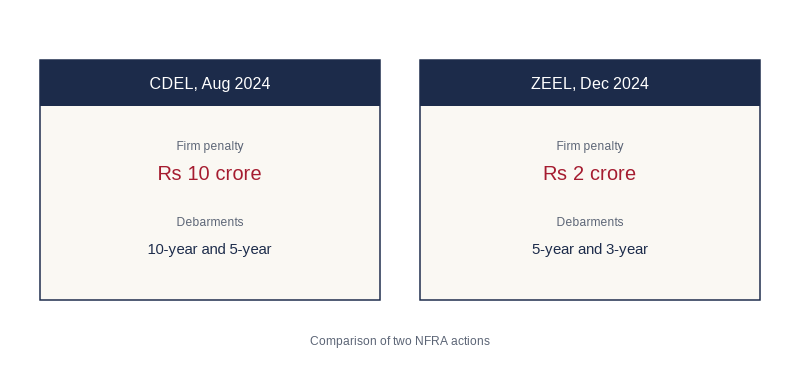
What happened. NFRA ne Coffee Day Enterprises Limited ke FY 2018-19 audit ka review kiya. 19 August 2024 ke order no. 020/2024 se, jo Section 132(4)(c) ke tahat jaari hua, NFRA ne BSR & Associates LLP par Rs 10 crore ki penalty lagayi. Engagement partner CA Aravind Maiya par Rs 50 lakh ka penalty aur 10 saal ka debarment lagaya gaya. Engagement quality control review (EQCR) partner CA Amit Somani par Rs 25 lakh ka penalty aur 5 saal ka debarment lagaya gaya.[6][7] Order ke executive summary mein ek SEBI report ka zikr hai jisne group companies mein funds ka diversion Rs 3,535 crore bataya.[6]
Audit failure. NFRA ka kehna tha ki auditors ne funds ke diversion ko report nahi kiya.[6] Order ke anusaar firm aur partners ne un consolidated statements ke liye zaroori additional audit procedures nahi kiye jahan financial information ka bada hissa doosre auditors ne audit kiya tha (group audit standard, SA 600). Order ne yeh bhi paya ki MACEL, ek related party, se milne wali receivable ki recoverability aur impairment ko grossly negligent tareeke se evaluate kiya gaya, aur fund diversion ke risk ko fraud risk ke roop mein evaluate nahi kiya gaya.[7]
Regulatory outcome. Section 132(4)(c) ke tahat penalty aur debarment. Dono individual debarment periods (10 saal aur 5 saal) alag hain, aur penalties bhi alag hain.
Lessons. Teen logon par teen levels par sanction lagi: firm (system), engagement partner (execution) aur EQCR partner (aakhri gatekeeper). EQCR partner ek doosra partner hota hai jo engagement ka review karta hai, aur yeh order dikhata hai ki is role ke saath personal liability judi hai. Case SA 240 (fraud) ko Section 143(12) ke reporting duty se jodta hai. Group audits mein component balances par kaam ek core requirement hai.
Case B: Zee Entertainment (ZEEL) and Deloitte Haskins & Sells LLP, December 2024
What happened. 23 December 2024 ke order mein NFRA ne Deloitte Haskins & Sells LLP par Rs 2 crore ki penalty lagayi. Engagement partner (A B Jani) par Rs 10 lakh ka penalty aur 5 saal ka debarment tha. EQCR partner (Rakesh Sharma) par Rs 5 lakh aur 3 saal ka debarment tha.[8][11] Mint ke anusaar maamla Yes Bank mein rakhi Rs 200 crore ki fixed deposit se juda tha, jise bank ne July 2019 mein promoter se jude entities ke dues chukane mein board ya shareholder approval ke bina use kiya. Yeh NFRA ka apne order mein kiya gaya finding hai.[8] Business Standard ne bhi Rs 2 crore ke penalty ki report ki.[9]
Lessons. Case bank confirmation (SA 505) aur documentation (SA 230) ke mahatva ko dikhata hai. Tathya order ke anusaar "alleged" roop mein likhe gaye hain. Firm ne kaha tha ki wo order ka review karegi, aur penalties ke khilaf appeal ho sakti hai. Current status NFRA ke pages (nfra.gov.in/debar aur nfra.gov.in/document-category/orders) par dekhna chahiye.
ICAI Disciplinary Committee: system and cases
Chartered Accountants Act, 1949 ke tahat misconduct do schedules mein baanta gaya hai. Jahan Director (Discipline) First Schedule ke tahat misconduct paata hai, wahan matter Board of Discipline ke paas jaata hai. Jahan Second Schedule, ya dono schedules, shamil hon, wahan matter Disciplinary Committee ke paas jaata hai, jo zyada gambhir route hai. Second Schedule ke Part I ke do clauses orders mein baar baar aate hain. Clause (7) due diligence na karne ya professional duties mein gross negligence ko cover karta hai. Clause (8) opinion dene ke liye zaroori sufficient information na lene ko cover karta hai. Section 21B(3) ke tahat punishments hain: reprimand, Register of Members se name removal (fixed period ya permanent) aur fine.[21]
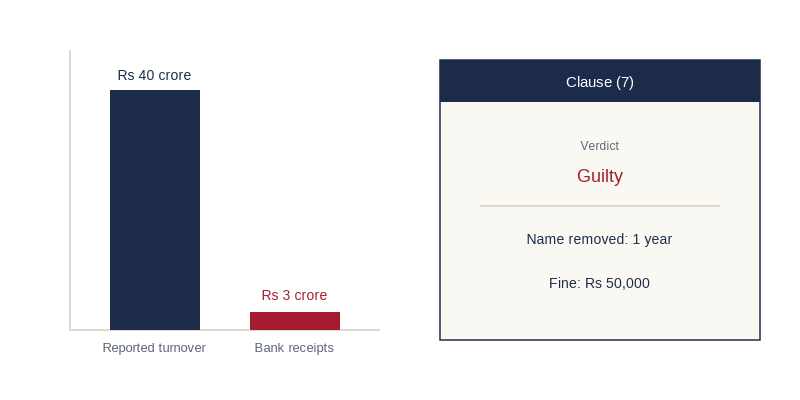
Case C: CA B. Balasubramanian (Capture Systems Private Limited). Ek auditor ne FY 2005 se FY 2009 tak statutory audit books of account verify kiye bina kiya. Financial statements false aur fabricated paaye gaye. Bank statements mein total receipts sirf Rs 3 crore the, jabki reported turnover Rs 40 crore tha. Koi service tax, VAT ya TDS nahi tha, aur koi supporting document nahi tha. Auditor ne report qualify nahi ki; Committee ne kaha ki SA 250 (laws and regulations) ko dekhte hue report qualify honi chahiye thi. Auditor ne valuation reports ke bina aur property ke against loan ghataye bina ek net worth certificate bhi issue kiya. Committee ne use Second Schedule ke Part I ke Clause (7) ke tahat guilty paaya aur 1 saal ke liye name removal aur Rs 50,000 ka fine lagaya (DC/644/2017).[21]
Clause (7) ka text hai "does not exercise due diligence, or is grossly negligent in the conduct of his professional duties".[21] Due diligence wo care hai jo ek reasonably competent chartered accountant dikhata. Turnover aur bank receipts ke beech itna bada gap kisi bhi reasonably competent auditor ko rok deta. SA 250 auditor ko laws and regulations dekhne ka nirdesh deta hai, isliye tax filings ka na hona red flag tha; SA 500 evidence maangta hai, aur yahan evidence tha hi nahi. Committee ne record kiya ki auditor ko report qualify karni chahiye thi aur usne nahi ki.[21]
Case D: CA Tapas Chakrabarti (Samudra Villa Pvt Ltd). Serious Fraud Investigation Office (SFIO) ne Prayag Infotech group ki jaanch mein complaint ki. FY 2012-13 mein company ki short-term borrowings Rs 29.83 crore thi, lekin related party disclosures mein sirf Rs 23.35 crore dikhi. Auditor ne CARO 2003 mein yeh bhi report kiya tha ki company ne Section 301 parties se loan nahi liya, jabki poori borrowing ek group company se thi. FY 2015-16 mein holding company (99.99% shareholding) ka disclosure hi nahi tha. Committee ne use Part I, Second Schedule ke items (5), (6) aur (7) ke tahat guilty paaya. 23 October 2026 ke order (findings 29 January 2026) se reprimand, ek mahine ke liye name removal aur Rs 50,000 ka fine lagaya gaya.[22]
Why the sanctions differ. Dono cases severity ki ek seedhi dikhate hain. Case C mein statements fabricated the aur pattern kai saal chala: ek saal ka removal. Case D mein lapses disclosure ke the: reprimand, ek mahina aur fine. Committee health, galti maanne aur cooperation jaise mitigating factors sun sakti hai. Sources mein koi aisa udaharan nahi hai jahan missing documentation ko mitigating maana gaya ho, aur students ke liye kaam ka niyam yahi hai ki wo mitigating nahi hai.
Lessons from the case study
- Group aur related-party exposure ke liye specific audit procedures chahiye; related-party receivable ya loan ek pehle darje ka risk hai.
- Jahan evidence missing ho wahan report qualify karna ek duty hai, ehsaan ya choice nahi.
- Chhote certifications (jaise net worth certificate) ko audit report jitni hi care chahiye.
- Related-party disclosures auditor ki checklist ki pehli cheez hain; auditor ka kaam group ke funds ka flow sahi dikhana hai.
- Documentation auditor ka bachav hai. File ke bina koi bachav nahi.
Worked problems
Problem 1: combined penalty, CDEL. Order no. 020/2024 mein lagaye gaye sabhi penalties ka total compute kijiye. Solution. Firm: Rs 10 crore = Rs 1,000 lakh. Engagement partner: Rs 50 lakh. EQCR partner: Rs 25 lakh. Dono individuals milakar: Rs 75 lakh. Total = 1,000 + 75 = Rs 1,075 lakh = Rs 10.75 crore.
Problem 2: combined penalty, ZEEL. ZEEL order ke penalties ka total compute kijiye. Solution. Firm: Rs 2 crore = Rs 200 lakh. Engagement partner: Rs 10 lakh. EQCR partner: Rs 5 lakh. Total = 200 + 10 + 5 = Rs 215 lakh = Rs 2.15 crore.
Problem 3: turnover versus receipts. Capture Systems matter mein reported turnover Rs 40 crore aur bank receipts Rs 3 crore the. Turnover receipts se kitna guna bada tha, aur unexplained difference kitna hai? Solution. 40 / 3 = 13.33, yaani turnover receipts se lagbhag 13 guna bada hai. Difference = 40 - 3 = Rs 37 crore. Itne bade gap par auditor ko evidence (SA 500) lena aur laws and regulations (SA 250) dekhna chahiye. Agar gap explain na ho, to report qualify karni chahiye.
Problem 4: borrowing mismatch. Samudra Villa matter mein FY 2012-13 ki short-term borrowings Rs 29.83 crore thi aur related party disclosures mein Rs 23.35 crore dikhe. Kitni raqam related party borrowing ke roop mein disclose nahi hui? Solution. 29.83 - 23.35 = Rs 6.48 crore. Auditor ne yeh bhi report kiya tha ki koi Section 301 party loan nahi tha, jabki saari borrowing ek group company se thi.
Problem 5: classify the standard. Har situation ke liye SA ka naam batayiye: (a) auditor yeh nahi dikha sakta ki kaunse procedures kiye gaye; (b) client ka bank confirmation request ka jawab nahi deta; (c) company ko losses hain aur working capital negative hai; (d) management controls override kar sakta hai. Solution. (a) SA 230, audit documentation. (b) SA 505, non-response par alternative procedures chahiye. (c) SA 570 (Revised), going concern. (d) SA 240, management override hamesha fraud risk hai aur journal entries test hote hain.
Problem 6: positive or negative confirmation. Ek auditor receivables confirm kar raha hai. Risk low hai, population bada aur similar hai, aur kam exceptions ki ummeed hai. Kaun sa request type akela use ho sakta hai, aur in conditions mein se koi ek fail ho to kya badalta hai? Solution. Negative request ko sole procedure tabhi banaya ja sakta hai jab risk low ho, population bada aur homogeneous ho aur low exception rate ki ummeed ho. Koi bhi condition fail ho to positive request (har case mein reply) ya additional procedures chahiye, kyunki negative request kam persuasive hai.
Chapter summary
Standards on Auditing Bharatiya audit profession ka common rulebook hain. Companies Act, 2013 ki Section 143(9) har auditor se unka paalan maangti hai, aur Section 143(10) Central Government ko ICAI ki recommendation aur NFRA se consultation ke baad standards prescribe karne deti hai. Tab tak ICAI ke standards hi auditing standards maane jaate hain. SA numbering standards ko purpose ke hisaab se baantti hai, general principles (200s) se special areas (800s) tak. ICAI 1 July 1949 ko bana aur profession ko regulate karta hai; NFRA 1 October 2018 ko bana aur Section 132 ke tahat bade companies ke auditors ki nigrani karta hai, jisme 10 saal tak debarment shamil hai. SA 240, SA 230, SA 505 aur SA 570 fraud, documentation, confirmations aur going concern ko govern karte hain. Listed company ke auditor par kai overseers hote hain, aur government company ke auditor par CAG bhi. PCAOB United States mein NFRA ka counterpart hai. NFRA ke CDEL aur ZEEL orders tatha ICAI ke Capture Systems aur Samudra Villa orders wahi failures dikhate hain: missing evidence, kamzor related-party kaam aur kharab documentation.
Review questions
Short answer
- Wo legal aadhar batayiye jis par SA ek auditor ko bind karta hai.
- Section 143(10) auditing standards prescribe karne ke baare mein kya kehti hai?
- Chhe SA series ke naam aur har ka subject batayiye.
- ICAI aur NFRA ko function aur formation date ke hisaab se alag kijiye.
- Management override of controls ko hamesha fraud risk kyun maana jaata hai?
- SA 230 documentation se ek experienced bahari auditor ko kya samajh aana chahiye?
- Positive aur negative confirmation request mein antar batayiye.
- Material Uncertainty Related to Going Concern section kya hai aur ise kab use karte hain?
- EQCR partner kya karta hai, aur CDEL order is role ke liye kyun mahatvapurn hai?
- Capture Systems aur Samudra Villa ke sanctions alag kyun hain?
Multiple choice
Q1. ICAI kis saal bana? (a) 1947 (b) 1949 (c) 1956 (d) 2013 Key: (b). ICAI 1 July 1949 ko bana.
Q2. Fraud se juda standard kaun sa hai? (a) SA 200 (b) SA 230 (c) SA 700 (d) SA 240 Key: (d). SA 240 fraud se judi auditor ki responsibilities ko cover karta hai.
Q3. Section 143(9) ke anusaar: (a) auditor sirf company policy follow karta hai (b) har auditor ko auditing standards follow karne hote hain (c) sirf listed company ka auditor SA follow karta hai (d) SA optional hain Key: (b). Section standards ka paalan anivarya banati hai.
Q4. NFRA kab bana? (a) 1 July 1949 (b) 12 April 1988 (c) 30 July 2002 (d) 1 October 2018 Key: (d). NFRA 1 October 2018 ko Section 132 ke tahat bana.
Q5. NFRA auditor ko adhiktam kitne saal ke liye debar kar sakta hai? (a) 1 saal (b) 3 saal (c) 10 saal (d) 5 saal Key: (c). Debarment 10 saal tak ho sakta hai.
Q6. Negative confirmation request mein recipient ko reply kab dena hota hai? (a) har case mein (b) sirf tab jab management kahe (c) sirf tab jab wo disagree kare (d) sirf report date ke baad Key: (c). Reply sirf disagreement par chahiye.
Q7. Kaun si body ke paas penalty power nahi hai aur wo sirf Parliament ko report karti hai? (a) NFRA (b) CAG (c) SEBI (d) PCAOB Key: (b). CAG report karta hai, aur action sarkar leti hai.
Q8. Part I, Second Schedule ka Clause (7) kis se judta hai? (a) opinion ke liye sufficient information na lena (b) fees na dena (c) due diligence aur gross negligence (d) advertising Key: (c). Sufficient information wala clause Clause (8) hai.
Q9. Capture Systems matter mein Committee ne kya order diya? (a) permanent removal (b) sirf reprimand (c) 10 saal ka debarment (d) 1 saal ka name removal aur Rs 50,000 ka fine Key: (d). Yeh Clause (7) ke tahat sanction tha.
Q10. Going concern ka standard kaun sa hai? (a) SA 230 (b) SA 530 (c) SA 570 (Revised) (d) SA 706 Key: (c). SA 570 (Revised) going concern ko cover karta hai.
Notes and references
[1] Companies Act, 2013, Section 143, kanoonhq.in, accessed 27 November 2026. https://kanoonhq.in/laws/A2013-18/sections/143. Supports: Section 143(9) auditing standards ka paalan; Section 143(10) Central Government prescribe kar sakti hai; tab tak ICAI standards deemed auditing standards.
[2] ICAI, "Auditing, Review and Other Standards (formerly known as AAS), complete text", icai.org, accessed 27 November 2026. https://www.icai.org/post/auditing-review-and-other-standards-formerly-known-as-aas-complete-text. Supports: SA series ki seemayein; SA 200, 230, 240, 300, 315, 320, 500, 530, 570, 700, 701, 705, 706 ke titles; Clarity Project header; SRE 2400, 2410 aur SAE 3400.
[3] "Institute of Chartered Accountants of India", Wikipedia, accessed 27 November 2026. https://en.wikipedia.org/wiki/Institute_of_Chartered_Accountants_of_India. Supports: Chartered Accountants Act, 1949 ke tahat 1 July 1949 ko formation.
[4] "National Financial Reporting Authority", Wikipedia, accessed 27 November 2026. https://en.wikipedia.org/wiki/National_Financial_Reporting_Authority. Supports: 1 October 2018 ko formation; Section 132; 10 saal tak debarment; NFRA Rules, 2018 ka Rule 3 scope.
[5] Companies Act, 2013, Section 147, kanoonhq.in, accessed 27 November 2026. https://kanoonhq.in/laws/A2013-18/sections/147. Supports: Section 143 ke contravention par Section 147(2) penalties.
[6] Business Standard, "Regulator fines BSR & Associates Rs 10 cr for lapses in Coffee Day audit", 20 August 2024. https://www.business-standard.com/companies/news/regulator-fines-bsr-associates-rs-10-cr-for-lapses-in-coffee-day-audit-124082000250_1.html. Supports: Rs 10 crore penalty; do CAs par Rs 75 lakh; 10-saal aur 5-saal bars; order summary mein cited SEBI report ke anusaar Rs 3,535 crore ka diversion.
[7] NFRA, Order no. 020/2024 dated 19 August 2024, Section 132(4)(c) ke tahat, BSR & Associates LLP ke matter mein. https://cdnbbsr.s3waas.gov.in/s3e2ad76f2326fbc6b56a45a56c59fafdb/uploads/2024/08/202408191036463933.pdf. Supports: firm Rs 10 crore; Maiya Rs 50 lakh aur 10 saal; Somani Rs 25 lakh aur 5 saal.
[8] Mint, "NFRA, Deloitte lapses, ZEEL audit, Yes Bank FD closure", 24 December 2024. https://www.livemint.com/companies/nfra-deloitte-lapses-zeel-audit-yes-bank-fd-closure-essel-group-subhash-chandra-sat-sebi-companies-act-punit-goenka-11735047401372.html. Supports: Deloitte par Rs 2 crore penalty; engagement partner par Rs 10 lakh aur 5 saal ka debarment; quality control partner par Rs 5 lakh aur 3 saal ka debarment; Yes Bank mein Rs 200 crore FD, July 2019.
[9] Business Standard, "NFRA slaps Rs 2 crore fine on Deloitte for Zee Entertainment audit", December 2024. https://www.business-standard.com/companies/news/nfra-slaps-rs-2-crore-fine-on-deloitte-for-zee-entertainment-audit-124122400710_1.html. Supports: ZEEL audit ke liye Deloitte Haskins par Rs 2 crore penalty.
[10] NFRA, "Orders", nfra.gov.in, accessed 27 November 2026. https://nfra.gov.in/document-category/orders/. Supports: upar ki table ke order titles aur dates.
[11] NFRA, ZEEL matter ka order, 23 December 2024 ko signed. https://cdnbbsr.s3waas.gov.in/s3e2ad76f2326fbc6b56a45a56c59fafdb/uploads/2024/12/202412271758055001.pdf. Supports: firm Rs 2 crore; engagement partner A B Jani Rs 10 lakh aur 5 saal; EQCR partner Rakesh Sharma Rs 5 lakh aur 3 saal.
[12] Note [2] ka hi ICAI page, SA 240, SA 230 aur SA 570 ke titles ke liye alag se dekha gaya. https://www.icai.org/post/auditing-review-and-other-standards-formerly-known-as-aas-complete-text
[13] ICAI, SA 505, "External Confirmations", full text, live.icai.org, accessed 27 November 2026. https://live.icai.org/bos/vcc-2nd-batch-recorded-lectures/pdf/SA%20505%20-%20External%20Confirmations.pdf. Supports: external confirmation, positive aur negative requests, non-response aur exception ki definitions; control over requests, management refusal, non-responses aur negative confirmation ki conditions par paragraphs 7-16; responses ki reliability par paragraph 10.
[14] Ministry of Corporate Affairs, Companies Act, 2013 page, mca.gov.in, accessed 27 November 2026. https://www.mca.gov.in/mca/html/mcav2_en/home/actsandrules/companies+act++2013/companiesact2013.html.
[15] "Securities and Exchange Board of India", Wikipedia, accessed 27 November 2026. https://en.wikipedia.org/wiki/Securities_and_Exchange_Board_of_India. Supports: establishment dates aur mandate.
[16] SEBI, Listing Obligations and Disclosure Requirements Regulations, 2015, last amended 14 July 2026, sebi.gov.in. https://www.sebi.gov.in/legal/regulations/jul-2026/securities-and-exchange-board-of-india-listing-obligations-and-disclosure-requirements-regulations-2015-last-amended-on-july-14-2026-_102974.html. Supports: Regulation 18 (audit committee); Regulation 33 (audit report aur statement of impact of audit qualifications ke saath financial results).
[17] "Comptroller and Auditor General of India", Wikipedia, accessed 27 November 2026. https://en.wikipedia.org/wiki/Comptroller_and_Auditor_General_of_India. Supports: Article 148; government-owned corporations ka statutory auditor; 51% ya adhik wali government companies ka supplementary audit; Parliament mein rakhi gayi reports jo PACs aur COPUs uthate hain.
[18] "Public Company Accounting Oversight Board", Wikipedia, accessed 27 November 2026. https://en.wikipedia.org/wiki/Public_Company_Accounting_Oversight_Board. Supports: Sarbanes-Oxley ke tahat creation, 30 July 2002 ko founded; chaar functions; inspection frequencies; fine caps; Arthur Andersen dwara audited WorldCom aur Enron; AICPA ke zariye pehle ki self-regulation.
[19] Companies Act, 2013, Section 177, kanoonhq.in, accessed 27 November 2026. https://kanoonhq.in/laws/A2013-18/sections/177. Supports: Section 177(5), Audit Committee auditors se internal control systems, audit scope aur observations par comments maang sakti hai.
[20] SEBI, LODR FAQ, April 2025. https://www.sebi.gov.in/sebi_data/faqfiles/apr-2025/1745399101865.pdf. Supports: Regulation 33(3)(d), audited annual results 60 din ke andar audit report aur modified opinions ke liye statement on impact of audit qualifications ke saath.
[21] ICAI Disciplinary Committee, order DC/644/2017, disc.icai.org. https://disc.icai.org/wp-content/uploads/2021/06/89.-DC-644-17.pdf. Supports: Second Schedule ke Part I ke Clause (7) aur Clause (8); Section 21B(3) ke tahat punishment; Rs 40 crore turnover ke against Rs 3 crore receipts; 1 saal removal aur Rs 50,000 fine; SA 250 cited; report qualify honi chahiye thi.
[22] CA Sansaar, "ICAI penalises auditor for incorrect related party disclosures, reporting lapses". https://www.casansaar.com/judiciary-icai-updates/icai-penalises-auditor-for-incorrect-related-party-disclosures-reporting-lapses/475.html. Supports: 23 October 2026 ka Disciplinary Committee order (findings 29 January 2026); related party disclosure lapses; reprimand, ek mahine ka removal aur Rs 50,000 fine.