Internal Control
Abstract
Is chapter mein internal control ko ek aise system ke roop mein samjhaya gaya hai jo management banata hai aur auditor samajhta tatha test karta hai. COSO framework ke paanch components aur satrah principles, segregation of duties, preventive, detective aur corrective controls, tatha IT general controls aur application controls ka vistrit vivaran diya gaya hai. Auditor ke sambandh ko SA 315, SA 330, SA 265 aur SA 610 ke madhyam se aur Companies Act, 2013 ki dhara 143(3)(i) aur 134(5)(e) ke saath joda gaya hai. Nau sourced cases (Wells Fargo, Barings, Societe Generale, Toshiba, Tesco, WorldCom, Parmalat, Punjab National Bank, Fortis) dikhate hain ki controls kaagaz par maujood hone ke bawajood kaise vifal hote hain. Kendriya nishkarsh yeh hai ki control ki asli pareeksha uska design nahi, balki roz ka sanchalan hai.
Learning objectives
Is chapter ko padhne ke baad pathak yeh kar sakega:
- Define karna: internal control, internal check, internal audit aur internal financial controls, aur unke beech ka antar batana.
- List karna: COSO ke paanch components aur har ek ka uddeshya.
- Distinguish karna: preventive, detective aur corrective controls, aur ek diye gaye control ko sahi category mein rakhna.
- Design karna: ek chhoti entity ke liye segregation of duties matrix aur compensating controls.
- Explain karna: IT general controls aur application controls ka sambandh, aur ITGC kamzor hone par auditor kya karta hai.
- Evaluate karna: SA 265 ke tahat deficiency ko kisko aur kaise report kiya jata hai.
- Analyse karna: nau cases ko COSO ke components par map karke batana ki kaun sa component vifal hua.
Introduction and research question
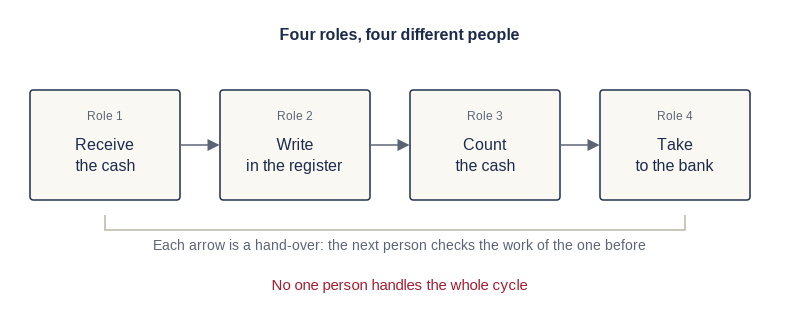
Ek chhoti tapri ka udaharan lijiye. Jab ek hi karmchari paise leta hai, hisaab likhta hai aur shaam ko gallaa ginkar bank bhi jaata hai, to kami nikalne par yeh tay karna kathin hai ki galti hai ya chori. Yeh isliye nahi ki wo vyakti beimaan hai; yeh isliye ki system ne chori ka darwaza khula chhod diya hai. Is darwaze ko band karna internal control ka kaam hai. Paise lena, likhna aur ginna teen alag vyaktiyon ko dene se kisi bhi gadbad ke liye kam se kam do-teen logon ka milna zaroori ho jaata hai.
Is chapter ka prashn hai: ek company apne aap ko galti aur dhokhe se kaise bachati hai, aur auditor us system ke saath kya karta hai? Pehla bhaag siddhant aur framework se, aur doosra bhaag cases ke saboot se uttar deta hai.
6.1 Internal control: arth, uddeshya aur seemayein
6.1.1 Definition aur zimmedari
Internal control woh niyam, prakriyayein aur vyavastha hain jo company apne aap ko galti aur dhokhe se bachane ke liye banati hai. Iske chaar uddeshya hain: sampatti ki suraksha, records ka sahi hona, kaam ka kushalta se hona, aur kanoon aur policies ka paalan. Controls management aur board banate hain. Auditor unhe nahi banata, kyunki jo auditor control banaye, wah apni hi banayi cheez ka audit karega aur self-review threat paida hoga (Chapter 4). Auditor ka kaam control ko samajhna aur, agar usper bharosa karna chahe, test karna hai.
6.1.2 Teen shabd: internal check, internal control, internal audit
Table 6.1: Internal check, internal control, internal audit aur IFC
| Term | Meaning | Who | Scope |
|---|---|---|---|
| Internal check | Kaam ko aise baantna ki ek ka kaam doosre par automatic check ban jaye | Staff ki vyavastha | Roz ke transactions |
| Internal control | Poora system: environment se monitoring tak (COSO ke paanch components) | Management aur board | Poore entity ke uddeshya |
| Internal audit | Alag function jo controls ko test karke management ya board ko report karta hai | Internal auditors | Samay samay par samiksha |
| IFC ya ICFR | Internal control ka woh hissa jo financial reporting se juda hai | Management; auditor raay deta hai (dhara 143(3)(i)) | Financial statements ki vishwasniyata |
ICFR internal control ka ek upaset hai. Internal control sanchalan aur compliance ko bhi dekhta hai; ICFR sirf financial reporting ko. ICFR sirf finance department ka control nahi hai: sales ka invoice sahi period mein kata ya nahi, yeh bhi ICFR hai, bhale hi prakriya sales department mein ho.
6.1.3 Seemayein: reasonable assurance
Koi bhi control system poori suraksha nahi deta. Woh sirf reasonable assurance deta hai. Karan teen hain. Pehla, insaan se galti hoti hai. Doosra, do ya zyada log milkar controls ko bypass kar sakte hain, jise collusion kehte hain. Teesra, management upar se control tod sakta hai, jise management override kehte hain. Ek chautha karan lagat hai: har control ka kharcha hota hai aur woh laabh se zyada nahi hona chahiye. COSO khud maanta hai ki internal control mein human action shamil hai, isliye error ki sambhavna rehti hai, aur control collusion ya senior management ke override se bypass ho sakta hai.[2]
6.2 COSO framework
6.2.1 Utpatti
COSO ka poora naam Committee of Sponsoring Organizations of the Treadway Commission hai. Usne 1992 mein "Internal Control - Integrated Framework" prakashit kiya aur 2013 mein ise punah jaari kiya.[2] Framework apne aap ko paanch aapas mein jude components mein sanghathit karta hai, jo satrah principles mein vibhajit hain. COSO ke anusar effective internal control ke liye (1) har component aur uske sambandhit principles present aur functioning hone chahiye, aur (2) paanchon components ek saath, integrated tarike se kaam karein.[2]
Table 6.2: COSO ke paanch components
| # | Component | Ek line mein | Udaharan |
|---|---|---|---|
| 1 | Control Environment | Company ka mahaul aur imaandari | Code of conduct, board ki nigrani |
| 2 | Risk Assessment | Apne khatre pehchanna | Naye product ka risk |
| 3 | Control Activities | Asli niyam aur jaanch | Approval, reconciliation |
| 4 | Information and Communication | Sahi jaankari sahi samay par | Reports, whistleblower line |
| 5 | Monitoring | Kya controls ab bhi chal rahe hain | Internal audit |
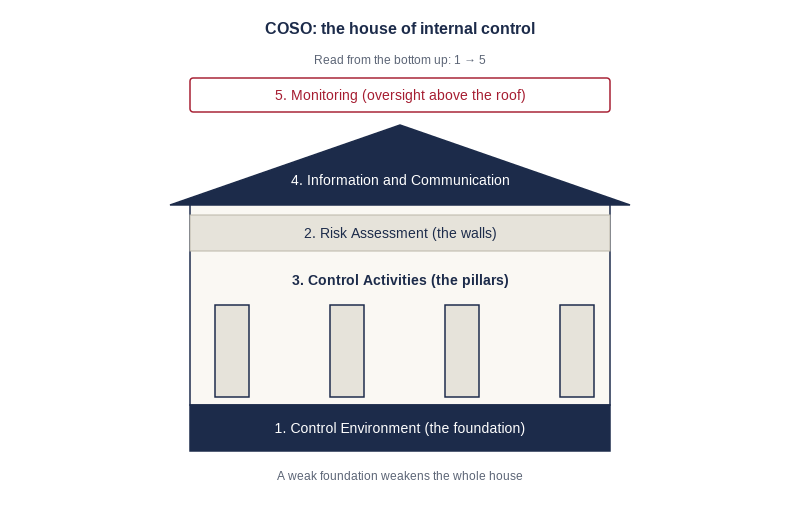
6.2.2 Har component ka arth
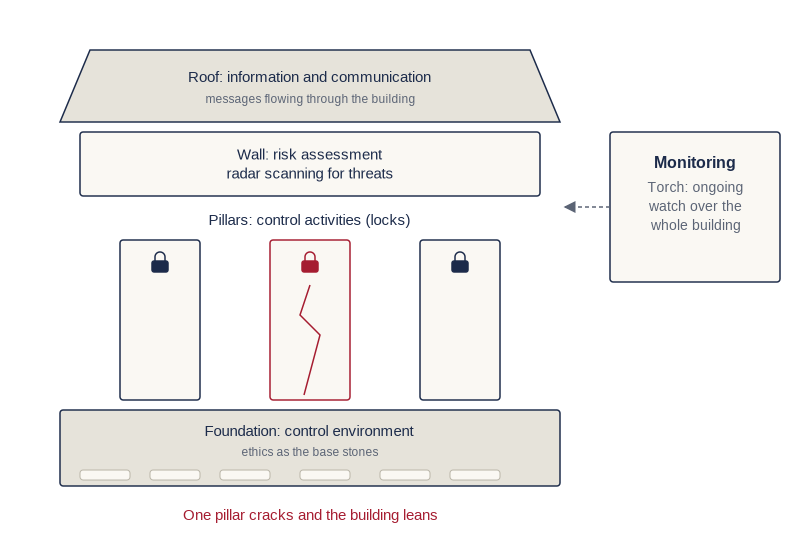
1. Control Environment (neev). Yeh sanstha ka tone tay karta hai aur logon ki control ke prati jaagrukta ko prabhavit karta hai. Isme integrity, ethical values, management ki karya-shaili, adhikaar ka delegation, aur logon ko manage tatha vikasit karne ki prakriyayein shamil hain.[2]
2. Risk Assessment (deewar). Entity bahari aur aantarik strotom se aane wale risks ka moolyankan karti hai. Iske liye objectives ka hona zaroori hai. Is component ke principles mein shamil hain: spasht objectives, risks ko kaise manage karna hai yeh tay karna, fraud ki sambhavna par vichar karna, aur un badlavon par nazar rakhna jo internal controls ko prabhavit kar sakte hain.[2]
3. Control Activities (khambe). Yeh woh policies aur procedures hain jo sunishchit karte hain ki management ke nirdesh paalan hon. Ye poore sanstha mein har star par hote hain: approvals, authorizations, verifications, reconciliations, operating performance reviews, sampatti ki suraksha aur kaamon ka vibhajan (segregation of functions).[2]
4. Information and Communication (chhat). Information systems woh reports banate hain jin par sanchalan aur niyantran chalta hai. Prabhavi communication ka matlab hai ki jaankari upar, neeche aur aas-paas behti rahe, jisme sandigdh fraud report karne ki aupcharik prakriyayein bhi shamil hain. Bahari pakshon ke saath bhi communication hona chahiye.[2]
5. Monitoring (nigrani). Internal control systems ki nigrani honi chahiye, nirantar monitoring ya alag moolyankan ke dwara. Jo kamiyan milein unhe upar report karna aur sudharatmak kadam uthana chahiye.[2]
6.2.3 Regimes aur aalochana
America mein Sarbanes-Oxley Act ki Section 404 ke tahat management aur bahari auditors ko financial information par internal control ki adequacy par report karni hoti hai.[2] Bharat mein Companies Act, 2013 ki dhara 143(3)(i) ke tahat statutory auditors ko internal financial controls par comment karna hota hai.[2] Ek vyavharik aalochana yeh hai ki CFO magazine ki reporting ke anusar companies COSO ke jatil model ko lagu karne mein sangharsh karti hain, aur kai sansthayein COSO model ko badalkar apni risk-and-control matrix banati hain.[2]
Exam trap. "COSO ke paanch components mein se chaar mazboot hon to system effective maana jayega" galat hai. COSO ka apna test hai: paanchon components present, functioning aur ek saath integrated hone chahiye. Ek kamzor kadi poori zanjeer ka score gira deti hai.
6.3 Control activities ka design
6.3.1 Segregation of duties
Segregation of duties (SoD) ka arth hai ki chaar kaam alag logon ke paas hon: authorization (manzoori), recording (likhna), custody (saamaan ya paise sambhalna) aur reconciliation ya jaanch. Yeh chaaron ek hi vyakti ke paas nahi hone chahiye. Control activities ke vyapak roop ko yaad rakhne ke liye "SARP-VA" suchak shabd upyogi hai: Segregation of duties, Authorization, Reconciliation, Physical controls, Verification, Access controls.
Table 6.3: SoD matrix: Kanpur Tools ki purchase prakriya (kalpanik)
| Task | Ravi (store) | Meena (accounts) | Suresh (director) |
|---|---|---|---|
| Maal ki requisition | X | ||
| Vendor ko order (PO) | X | ||
| Maal receive karna | X | ||
| Bill entry | X | ||
| Payment release | X | ||
| Vendor master mein naya vendor jodna | X |
Niyam yeh hai ki ek hi vyakti ke column mein zyada nishaan nahi hone chahiye. Ravi maal mangata aur receive karta hai, par record Meena likhti hai aur payment Suresh karta hai. Naya vendor sirf Suresh jodta hai, taaki Ravi apne rishtedaar ki dukaan ka fake vendor na bana sake.
Chhoti entity mein. Chhoti entities mein SoD kathin hota hai. Wahan compensating controls lagte hain: maalik swayam rozana nakdi gine, bank reconciliation dekhe, sales register ka random check kare. Compensating control SoD ka sampoorn vikalp nahi, par risk ko ghatata hai.
6.3.2 Preventive, detective aur corrective controls
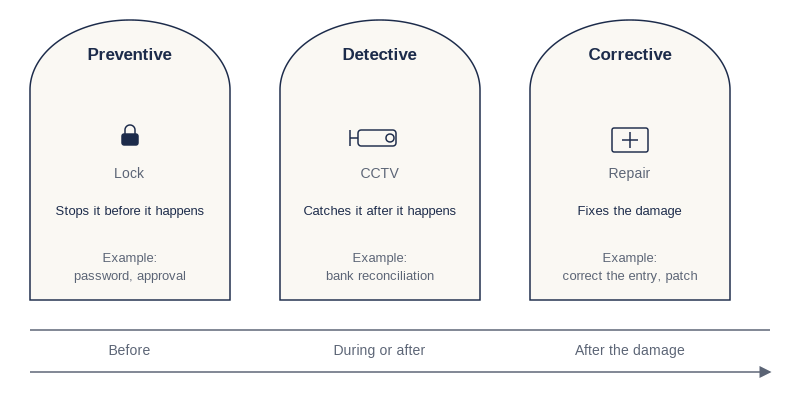
Preventive control galti hone se pehle rokta hai, jaise taala ya password. Detective control galti hone ke baad pakadta hai, jaise reconciliation. Corrective control galti ko sudharta hai, jaise correction entry. Sirf preventive par bharosa karne se jab woh fail ho to koi pakadne wala nahi hota, isliye har mahatvapurn area mein kam se kam ek detective control hona chahiye. Corrective tab kaam aata hai jab detective ne galti pakdi ho.
Table 6.4: Control type, samay aur udaharan
| Type | When it works | Example |
|---|---|---|
| Preventive | Galti se pehle | Approval, password, credit limit block |
| Detective | Galti ke baad | Reconciliation, exception report ki samiksha, physical count |
| Corrective | Pakde jaane ke baad | Correction entry, recovery, prakriya mein sudhaar |
Payroll ka udaharan. Preventive: salary mein badlav sirf HR ke manzoor patra se ho. Detective: har mahine payroll register ka headcount se milan, taaki ghost employees pakde ja sakein. Corrective: overpayment milne par vasooli ki prakriya aur employee master ka sudhaar. IT ka udaharan. Preventive: access rights, password policy. Detective: log review. Corrective: backup se restore, incident response.
Exam trap. "Detective controls galti hone se rokte hain" galat hai. Detective galti hone ke baad pakadte hain. Rokna preventive ka kaam hai. Bank reconciliation detective hai, password preventive hai.
6.3.3 Walkthrough: ek transaction ka safar
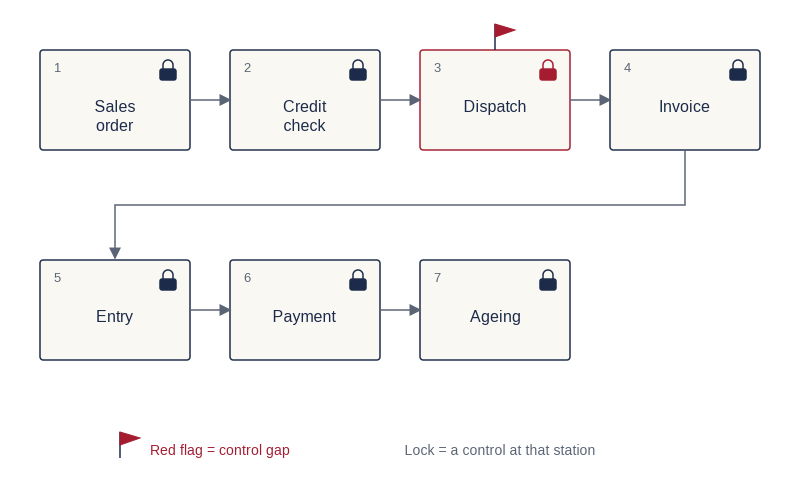
Auditor control ko samajhne ke liye walkthrough karta hai: ek transaction chunkar use system ke har charan se guzarte hue dekhna. Kanpur Tools ka ek sale order (kalpanik):
- Customer ka order aata hai aur sales team entry karti hai. Control: order form par customer code aur credit limit check.
- Credit limit 5 lakh se zyada hai to system block karta hai aur Suresh ki override manzoori chahiye.
- Godown se dispatch. Control: gate pass bina invoice ke nahi; dispatch log mein entry.
- Invoice auto-generate hota hai. Control: sequence-numbered invoices; cancelled invoice "cancelled" chinhit hokar file mein rehta hai.
- Accounts mein entry. Control: Meena entry karti hai; masik debtor statement customer ko jaata hai.
- Payment. Control: bank mein aata hai, debtor ledger se knock-off hota hai, antar ho to exception report.
- Mahine ke ant mein debtor ageing ki samiksha; 90 din se purane debtors par provision ki charcha.
Auditor har charan par poochhta hai: document kya hai, kaun manzoor karta hai, apwad (exception) par kya hota hai. Jahan jawab "woh to aise hi ho jaata hai" ho, wahi control gap hai. Walkthrough control ke design aur implementation ko samajhne ki prakriya hai; operating effectiveness ka test alag hota hai, samples par aur poori avadhi mein.
6.3.4 Flowchart soch
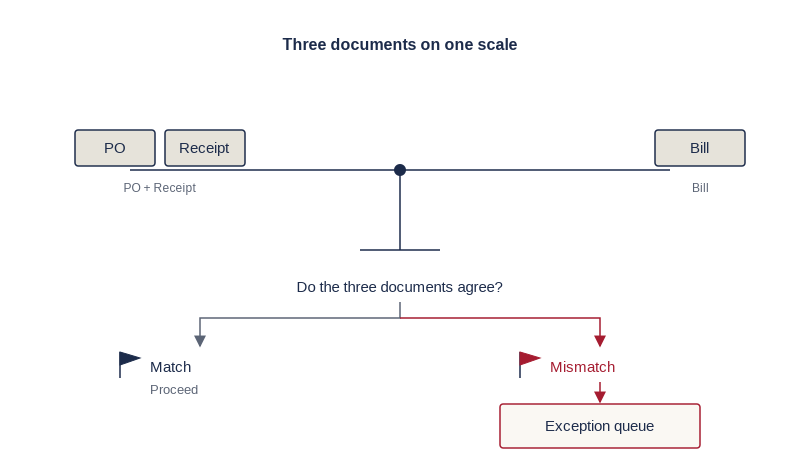
Controls ko flowchart ke roop mein sochna auditor ka buniyadi kaushal hai. Purchase-to-pay ka decision flow:
``` Order -> Maal aaya? --Nahi--> Follow-up ya cancel
    |
   Haan

    |
3-way match? (PO, receipt, bill)
    |--Nahi--> Exception queue -> supervisor samiksha
    |
   Haan

    |
Rashi seema se zyada? --Haan--> Director ki manzoori
|
Payment release -> bank reconciliation ```
Har diamond (nirnay bindu) ek control point hai. Auditor poochhta hai: kya yeh nirnay bindu maujood hai, kya woh chal raha hai, aur kya apwadon ka record hai? Flowchart ki har shakha ek test hai.
6.4 IT controls: general aur application
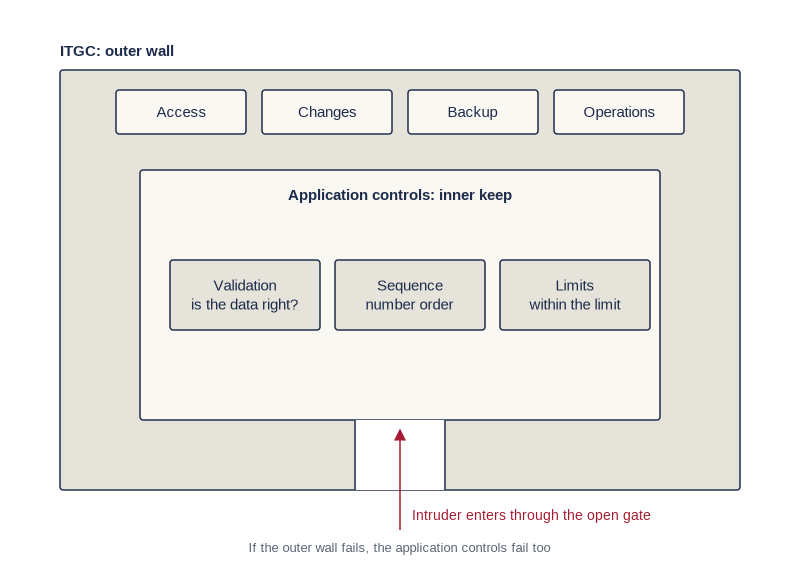
IT controls ke do star hote hain. IT general controls (ITGC) poore environment ke hote hain: kaun access kar sakta hai, program mein badlav kaun kar sakta hai, backup kaise hota hai, password policy kya hai. Application controls kisi vishisht application ke andar ke hote hain, jaise duplicate invoice number reject karna ya credit limit par block lagana. Application controls ITGC par khade hote hain. Agar koi bhi database mein ghuskar figure badal sakta hai (ITGC fail), to ERP ki automatic ganna kuch bhi ho, ant ka number galat ho sakta hai.
ITGC checklist
- Programs aur data tak pahunch: vyaktigat user ID, role-based rights, chhodkar jaane walon ka access turant band, admin rights seemit.
- Program changes: har badlav ki manzoori, testing aur go-live ka record; developer ko live data ka access nahi.
- Program development: naye system ka documentation aur sign-off.
- Computer operations: backup schedule, restore test, incident log, job scheduling ki samiksha.
Application controls ke udaharan (sales cycle)
- Input validation: galat customer code reject ho.
- Duplicate invoice number block ho.
- Credit limit ka auto-check (preventive).
- Sequence check: missing invoice numbers ki exception report (detective).
- Auto-posting rules jo kisi ek user dwara edit na ho saken.
Auditor ka approach. Jab automated environment mein sab kuch system ke andar hota hai aur manual trail nahi bachta, tab substantive procedures akele paryapt nahi hote, aur controls ka test zaroori ho jaata hai (Chapter 5, SA 330). Do systems ke beech ka interface bhi control maangta hai: PNB case isi ka udaharan hai.
Exam trap. "Automated controls 100% vishwasniya hote hain kyunki computer galti nahi karta" galat hai. Computer rule follow karta hai; rule galat ho, data galat ho ya access khula ho to automated control bhi galat result dega. Isliye ITGC pehle.
6.5 Auditor aur internal control
6.5.1 Samajhna, test karna, report karna
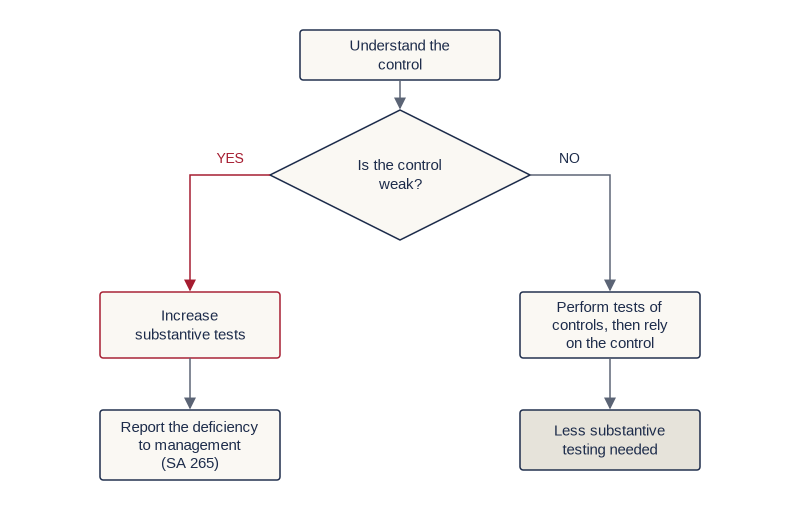
Auditor pehle control ko samajhta hai, phir test karta hai agar bharosa karna chahe. SA 315 auditor se control environment aur anya components ko samajhne ko kehta hai, aur yeh bhi ki kaun se controls risk ke liye sambandhit hain. SA 330 kehta hai ki agar auditor controls par bharosa karna chahta hai to tests of controls karne honge, aur agar substantive procedures akele paryapt saboot nahi de sakte to bhi controls test karne padte hain. Test ke tareeke: inquiry, observation, inspection aur re-performance. Control kamzor mile to auditor us par bharosa nahi karta, substantive tests badhata hai (bade sample, zyada seedhi jaanch), aur kamzori ki jaankari deta hai. Yeh SA 265 ka kaam hai.[14]
6.5.2 SA 265: deficiency ki reporting
SA 265 ka title ICAI ki list mein "Communicating Deficiencies in Internal Control to Those Charged with Governance and Management" hai.[14] Significant deficiency governance walon (TCWG) ko likhit roop mein batayi jaati hai. Baaki deficiencies management ko batayi jaati hain, jo pehle se na batayi gayi hon. Dhyan rahe ki "significant deficiency" SA 265 ki shabdavali hai; America mein "material weakness" shabd prachalit hai.
Table 6.5: Deficiency ka vargikaran
| Level | Meaning | Whom to inform |
|---|---|---|
| Control deficiency | Design ya sanchalan mein kami | Management |
| Significant deficiency | Itni mahatvapurn ki TCWG ka dhyan chahiye | TCWG ko likhit roop mein (SA 265) |
| Material weakness (US term) | Itni badi ki material misstatement ka tark-sangat chance | US ya SOX regime ka shabd; Bharat mein SA 265 ki shabdavali |
6.5.3 Companies Act mein
Dhara 143(3)(i) ke tahat auditor ko report mein batana hota hai ki company ke internal financial controls adequate hain ya nahi aur woh prabhavi roop se chal rahe hain ya nahi. MCA ki 2017 ki ek notification se kuch chhoti private companies ko chhoot hai. Directors ki apni zimmedari dhara 134(5)(e) mein hai: yeh dhara listed companies ke directors par lagti hai, jinhe batana hota hai ki internal financial controls paalan ho rahe hain aur prabhavi hain. Ek ICAI Guidance Note bhi ICFR ke audit par margdarshan deta hai. Directors system ke maalik hain; auditor us par raay deta hai. Yeh dono alag zimmedariyan hain, aur pariksha mein inhe aksar ghumaya jata hai.
Table 6.6: Auditor ka control ke saath rishta
| Stage | What the auditor does | Standard |
|---|---|---|
| Samajhna | Design aur implementation (walkthrough) | SA 315 |
| Test karna | Operating effectiveness (agar rely karna ho) | SA 330 |
| Report karna | Significant deficiencies TCWG ko | SA 265 |
| Opinion mein | IFC ki adequacy aur effectiveness (Bharat) | Companies Act dhara 143(3)(i) |
6.5.4 Internal audit, audit committee aur SA 610
Internal audit management ka apna monitoring function hai. Mazboot companies mein internal audit functionally audit committee (board ki ek up-samiti) ko report karta hai aur administratively management ko. Report line ka mahatva WorldCom ke case mein dikhta hai (section 6.6.6). Statutory auditor internal auditor ke kaam ka upyog kar sakta hai: SA 610 ("Using the Work of Internal Auditors") ke anusar pehle internal audit function ka moolyankan hota hai (uski sanghathanik sthiti, yogyata, vyavasthit approach), phir tay hota hai ki kis kaam ka upyog karna hai. Par materiality, significant risks aur opinion jaise judgment wale nirnay statutory auditor swayam leta hai.[14]
Exam trap. "Internal audit statutory audit ka hissa hai" galat hai. Internal audit management ka apna monitoring function hai. Statutory auditor uske kaam ka upyog kar sakta hai, par opinion ki zimmedari statutory auditor ki hi rehti hai. Aur "internal auditor independent hota hai kyunki woh audit karta hai" bhi galat hai: internal auditor sanstha ka hi hissa hai, uski independence relative hai aur report line se aati hai.
6.6 Case studies
Har case mein pehle sourced tathya aate hain. "COSO lens" aur "Lessons" is pustak ka vishleshan hain, source ka dawa nahi.
6.6.1 Case 1: Wells Fargo (control environment aur incentive)
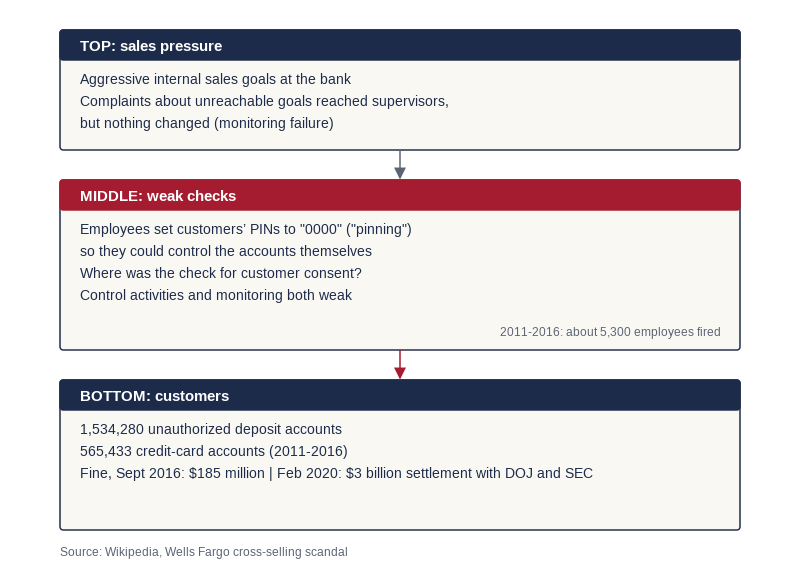
Kya hua. Wells Fargo ke karmchariyon ne aggressive internal sales goals ke karan customers ki sahmati ke bina lakhon savings aur checking accounts banaye.[1] September 2016 mein bank par US$185 million ka jurmana laga: CFPB ko 100 million, Los Angeles City Attorney ko 50 million aur OCC ko 35 million.[1] 2011 se 2016 ke beech 1,534,280 unauthorised deposit accounts aur 565,433 credit-card accounts payen gaye; May 2017 ke baad ke anumaan mein fraudulent accounts ki sankhya lagbhag 3,500,000 thi.[1] Karmchari customer ka PIN "0000" set kar dete the taaki wo account ko niyantrit kar saken aur use programs mein jod saken.[1] Is dauran lagbhag 5,300 karmchari nikale gaye.[1] CEO John Stumpf ne 12 October 2016 ko istifa diya, US$41 million ke unvested stock options chhode, aur April 2017 mein clawback se US$28 million wapas liye gaye.[1] February 2020 mein DOJ aur SEC ke saath US$3 billion ka settlement hua, aur Federal Reserve ne growth cap lagaya jisse recovery kathin hui.[1]
Table 6.7: Wells Fargo: sankhyaon se vishleshan
| Item | Figure | Computation |
|---|---|---|
| September 2016 jurmana | US$185 million | 100 + 50 + 35 |
| Unauthorised deposit aur credit-card accounts (2011 se 2016) | 2,099,713 | 1,534,280 + 565,433 |
| Baad ka kul anumaan (May 2017) | lagbhag 3,500,000 | Source |
| Pehli ginti se badhotri | lagbhag 1.4 million | 3,500,000 minus 2,099,713 |
| Stumpf ka clawback | US$28 million | Source |
| DOJ aur SEC settlement | US$3 billion | Source (February 2020) |
COSO scorecard. Yeh case ek diagnostic abhyas hai: har component ko tathyon ke saamne rakhkar dekhiye.
- Control environment. Aggressive sales goals hi fraud ka engine the. Lagbhag 5,300 karmchariyon ka nikala jaana dikhata hai ki samasya vyaktigat nahi, sanrachnatmak thi.
- Risk assessment. COSO ke risk assessment principles mein fraud ki sambhavna par vichar shamil hai;[2] bank ne apne hi incentive structure ke fraud risk ko assess nahi kiya.
- Control activities. Account kholne mein customer ki sahmati ka verification ya to tha nahi ya bypass hua; karmchariyon ne customer ko pata na chale iske liye apni contact information ka upyog kiya.[1] PIN "0000" access control ki vifalta dikhata hai.
- Information and communication. Wikipedia ke anusar supervisors ko asambhav lakshyon aur anuchit aacharan ki reports milne par bhi badlav nahi hua, aur LA Times ke lekh ke baad bhi sudhar nominal rahe.[1]
- Monitoring. Regulators ne jurmana lagaya, yaani pakad bahar se hui, andar se nahi.
Nishkarsh. Yeh case bank ke internal control ki vifalta ka hai, audit ki vifalta ka nahi. Source mein auditor ki vifalta ka koi dawa nahi hai, isliye yahan bhi nahi kiya gaya. COSO ka integrated test dikhta hai: paanchon components ek saath tootein.
6.6.2 Case 2: Barings Bank, 1995 (segregation of duties)
Kya hua. Barings Britain ka purana merchant bank tha. 1995 mein woh Singapore office ke karmchari Nick Leeson ke fraudulent investments se hue £827 million (lagbhag US$1.3 billion) ke nuksaan ke baad dhah gaya.[3] Leeson ko Osaka aur SIMEX ke beech Nikkei 225 futures ke daam ke antar se arbitrage karna tha; uski jagah usne bank ke apne paise se Japanese market ki disha par jua khela.[3]
Kaun sa control toota. Barings ne Leeson ko SIMEX trading ka general manager banaya aur saath mein settlement operations ka head bhi. Yeh bhumikayein aam taur par alag karmchariyon ke paas hoti hain.[3] Usne ek error account (account number 88888, "five-eights account") ko badla, taaki London ko trading, price aur status ki standard daily reports na milein.[3] December 1994 tak Leeson bank ko £200 million ka nuksaan pahuncha chuka tha, jabki tax authorities ko usne £102 million ka profit report kiya; bank ke paas tab £350 million capital tha.[3] Kobe ke bhookamp ne Asian markets ko hila diya, Leeson ka recovery wala daanv fail hua, aur nuksaan £827 million ho gaya, jo bank ke upalabdh trading capital ka do guna tha.[3] 26 February 1995 ko Barings insolvent ghoshit hua aur ING ne use £1 mein khareed liya.[3] Leeson ko Singapore mein saade chhah saal ki saza hui.[3] Collapse ke baad kai observers ne bank ke apne deficient internal control aur risk management ko zimmedar thehraya; Leeson ki gatividhiyon par uthayi gayi chintayein andekhi ki gayi thin.[3]
Table 6.8: Barings: sankhyaon se vishleshan
| Item | Figure | Computation |
|---|---|---|
| Kul nuksaan | £827 million | Source |
| Trading capital (anumaan) | lagbhag £413.5 million | 827 / 2 |
| December 1994 tak nuksaan | £200 million | Source |
| Tax authorities ko reported profit | £102 million | Source |
| Sach aur reported ke beech ka antar | £302 million | 200 + 102 |
| Us samay bank ka capital | £350 million | Source |
COSO lens. Control activities (segregation) ka sampoorn failure: front office (trade karna) aur back office (settle karna) ka vibhajan banking ka sabse buniyadi control hai. Information and communication bhi toota, kyunki daily reports 88888 account mein kho gayin.
Lessons. Jab trader khud apne trades settle karta hai, to nuksaan chhupane ke liye kisi aur ki sahmati nahi chahiye. December 1994 mein £350 million ke capital ke saamne £200 million ka nuksaan tha: samay par sach pata chalta to collapse shayad rukta. Isliye reconciliation London se Singapore tak swatantra hona chahiye.
6.6.3 Case 3: Societe Generale, 2008 (monitoring)
Kya hua. January 2008 mein French bank Societe Generale ne 21 se 23 January 2008 ke beech positions band karte samay lagbhag €4.9 billion ka nuksaan darj kiya, jab equity markets gir rahe the. Bank ke anusar yeh positions junior trader Jerome Kerviel ke fraudulent transactions thin.[4] Bank ke adhikariyon ka dawa tha ki Kerviel ne apni authority se bahut aage, €49.9 billion tak ke unauthorised trades kiye, jo bank ki kul market capitalisation se bhi zyada tha.[4]
Kaun sa control toota. Kerviel fake trades ko do ya teen din mein, bank ke timed controls ki soochna trigger hone se theek pehle, band kar deta tha aur positions ko naye trades mein khisaka deta tha. Executive Chairman Daniel Bouton ne is pattern ko "mutating virus" kaha: lakhon hidden trades.[4] Kerviel 2000 mein bank ke middle office (compliance) mein shamil hua aur 2005 mein Delta One products team mein padonnat hua.[4] BBC ke anusar 2007 ke ant tak usne €1.4 billion ke hidden profits banaye the; sawaal uthne par woh ise "mistake" kehkar trade radd karta aur doosre instrument mein badal deta.[4] 5 October 2010 ko use paanch saal ki saza hui (do suspended) aur financial services mein permanent ban laga.[4] Baad mein French Cour de cassation ne €4.9 billion ka restitution sanction radd kar diya, kyunki Societe Generale ki apni galtiyan sthapit ho chuki thin.[4]
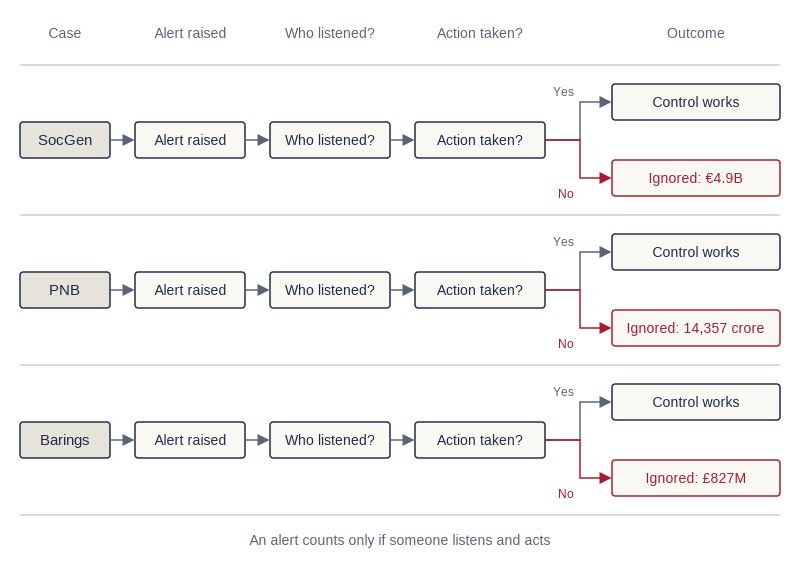
COSO lens. Monitoring ki vifalta sabse badi thi: alerts uthe par escalate nahi hue. Control activities timed the, aur unhe game kiya gaya; control ka design anumaanit tha. Risk assessment ne aise karmchari ke insider threat ko nahi pakda jo jaanta tha ki controls kahan hain aur kab trigger hote hain.
Lessons. Predictable ya timed controls ki kamzori yeh hai ki jo unhe jaanta hai woh unse bach nikalta hai. Alert hona kaafi nahi; response ki prakriya chahiye.
6.6.4 Case 4: Toshiba, 2015 (management override)
Toshiba ke tathya Chapter 5 mein diye gaye hain: July 2015 ki investigation report ke anusar company ne kai saalon mein operating profit 151.8 billion yen zyada dikhaya aur top management ko iski jaankari thi.[5] Yahan use internal control ke lens se dekha gaya hai.
Kaun sa control toota. Control environment, yaani COSO ki neev. Investigation ne bataya ki company mein upar walon ki ichha ke khilaf jaana mushkil tha, aur top management ne division heads ko profit targets diye jo unhe poore karne hi the.[5] SESC ne misstatements ko quantify kiya: 31 March 2010 ko samapt varsh mein consolidated net loss 19,743 million yen dikhaya gaya jabki sahi loss 53,943 million yen tha, aur kul administrative monetary penalty 7,373,500,000 yen ki sifarish hui.[6] Auditor Ernst & Young ShinNihon ko 1 January se 31 March 2016 tak naye engagements lene se roka gaya.[7]
COSO lens. Yeh management override ka paathyapustak udaharan hai. Koi bhi transaction-level control tab tak kaam karta hai jab tak senior management use follow kare. Toshiba mein dabav upar se aaya, isliye tone at the top hi fraud ka engine bana. Isiliye SA 240 mein management override ko hamesha significant risk maana jaata hai aur journal entry testing hoti hai.
6.6.5 Case 5: Tesco, 2014 (cut-off aur estimates)
Kya hua. 22 September 2014 ko Tesco ne market ko bataya ki usne half-year ke apekshit profit ko lagbhag £250 million se overstate kiya tha, jiska mukhya karan commercial income ki accelerated recognition aur costs ka delayed accrual tha.[8] Board ne Deloitte se independent review karwaya aur interim results 23 October 2014 tak taal diye gaye.[8] CEO Dave Lewis ne kaha ki unhone ek gambhir mudda khoja hai aur uske anusar pratikriya di hai.[8] FRC ne December 2014 mein accountants ke aacharan par jaanch shuru ki, aur June 2020 mein SFO ki karwai ke baad case ko bina aupcharik shikayat ke band kar diya.[9]
COSO lens. Commercial income (suppliers se milne wale rebates aur discounts) ka recognition judgment par chalta hai: kab earn hua aur kitna. Target ka dabav hone par woh judgment khisakta hai, yaani income ko peeche kheencha ja sakta hai aur costs ko aage dhakela ja sakta hai. Yeh cut-off aur estimate controls ka failure hai. Risk assessment mein company ne apne objectives (profit guidance) ko hit karne ke risk ko kam aanka.
Lessons. Revenue-side judgment areas (rebates, discounts, returns) aur period-end cut-off mein scepticism rakhiye. Jab timing ka laabh sirf ek disha mein ho, to woh error nahi, pattern hai.
6.6.6 Case 6: WorldCom, 2002 (monitoring ki safalta)
Kya hua. WorldCom America ki doosri sabse badi long-distance telephone company thi. June 2002 mein company ki apni internal audit team, division vice president Cynthia Cooper aur senior associate Eugene Morse ke netritva mein, aksar raat mein aur gupt roop se kaam karke shuruat mein US$3.8 billion ki fraudulent entries ujagar kar payi. Jaanch ek routine capital expenditure audit ke dauran mili sandigdh balance sheet entries se shuru hui thi.[10] Cooper ne June 2002 mein audit committee aur board ko soochit kiya; controller Myers ko istifa dene par majboor kiya gaya, CFO Sullivan ko nikala gaya, aur Arthur Andersen ne 2001 ka audit opinion waapas le liya.[10] 2003 ke ant tak anumaan tha ki company ki kul assets lagbhag US$11 billion se fraudulently badhayi gayi thin.[10] 21 July 2002 ko WorldCom ne Chapter 11 file kiya, jo tab America ki sabse badi bankruptcy thi, aur CEO Bernard Ebbers ko 15 March 2005 ko sabhi aaropon par doshi paaya gaya.[10] Sullivan, Myers, Yates aur anya ne guilty plea ki ya doshi paaye gaye.[10]
COSO lens. Control environment (top level se fraud) aur control activities (kharchon ko capitalise karke assets badhana) toote. Monitoring ne kaam kiya: internal audit function ne, jabki us par swayam dabav tha. Chaar components top-down bhrasht the; monitoring ne akele ghar sambhala. Isiliye internal audit ki report line (audit committee ko seedhi) itni zaroori hai. Cooper audit committee tak gayi, isliye CFO, jo fraud mein shamil tha, report ko daba nahi saka.
Lessons. Monitoring component bacha sakta hai, agar usme imaandari aur himmat ho, aur report line swatantra ho. Pehle initial figure US$3.8 billion tha aur 2003 tak anumaan US$11 billion tak pahunch gaya, yaani lagbhag 2.9 guna.
6.6.7 Case 7: Parmalat, 2003 (group aur offshore opacity)
Kya hua. Parmalat Italy ki dairy company thi. 2003 mein woh €14 billion ke karz ke saath dhah gayi, jo Europe ki sabse badi bankruptcy thi.[11] Fraud ka kendra Bonlat tha, Cayman Islands ki subsidiary. Bank of America ne ek document jaari kiya jisme dikhaya gaya ki Parmalat ke bank account mein dikhaye gaye €3.95 billion ek forgery the.[11] Chairman Calisto Tanzi ko hirasat mein liya gaya aur usne accounts mein €8 billion ke hole ko maana; auditors ne baad mein karz €14.3 billion aanke, jo shuru mein bataye gaye rashi se lagbhag aath guna zyada tha.[11] Tanzi ko fraud ke liye 10 saal ki saza hui.[11] Nayi Parmalat leadership ne Bank of America, Deloitte aur Grant Thornton International par mukadme kiye, yeh aarop lagakar ki unhone purani management ke fraud ko anjaam dene mein madad ki.[11] Naye CFO Alberto Ferraris ko pata chala ki kuch corporate books tak unki pahunch nahi thi aur woh chief accounting officer ke paas thin; unhe shak hua ki kul karz balance sheet se do guna se zyada hai.[11]
COSO lens. Consolidation aur group-level controls ka failure. Jab group structure ka ek kona offshore aur opaque ho, wahan se "cash" dikhana aur "debt" chhupana asaan ho jaata hai. Information and communication toota: CFO ko bhi kuch books tak access nahi tha. Monitoring toota: offshore subsidiaries ke cash aur debt par koi prabhavi consolidation review nahi tha.
Lessons. Bank confirmation seedha bank se auditor ko aani chahiye aur bheje gaye address ki pushti honi chahiye. €14.3 billion ka karz shuru mein bataye gaye rashi se lagbhag aath guna tha, yaani shuru ka figure lagbhag €1.8 billion tha (14.3 / 8). Yeh group audit mein debt ki completeness aur cash ki existence ka jokhim dikhata hai.
6.6.8 Case 8: Punjab National Bank, 2018 (system reconciliation)
Kya hua. Punjab National Bank ke Fort, Mumbai branch se fraudulent Letters of Undertaking (LoU) jaari hue jinke liye bank zimmedar ho gaya; ghotale ka aakar ₹14,357 crore (2018 mein lagbhag US$2 billion) tha.[12] Fraud ke peeche Nirav Modi, uske sahyogi aur sambandhit entities (jaise uncle Mehul Choksi) bataye gaye; CBI ki charge sheet mein kai PNB adhikari bhi named hain.[12]
Kaun sa control toota. Branch ke do karmchariyon ne LoUs ko SWIFT messaging system se overseas branches ko bheja (Allahabad Bank, Axis Bank aur Union Bank of India samet), par entries bank ke core banking system (CBS) mein dali hi nahi gayi; CBS bypass ho gaya.[12] LoUs ke liye bank ne kam se kam 100% cash margin manga tha, par firms ne kaha ki unhe pehle bhi bina aisi guarantee ke LoUs mili thin; branch records mein aisi suvidha dikh hi nahi rahi thi.[12] Anya niyam-bahya transactions ko ek naye niyukt bank adhikari ne pakda.[12] CBI ka aarop tha ki senior adhikariyon ne RBI ke kai circulars aur cautionary notices lagu nahi kiye, jinme SWIFT ko core banking system se reconcile karne ki baat thi.[12] Nirav Modi March 2019 mein London mein giraftar hua aur ED ne uske aur sahyogiyon ke ₹692.90 crore ke assets zabt kiye.[12]
COSO lens. Detective control ka abhav: SWIFT-CBS reconciliation hota to pehle LoU ke baad hi fraud rukta. Information and communication: RBI ne circulars bheje (bahari communication), par lagu nahi hue. Control environment: ek hi branch ke do log saalon tak system ke bahar kaam karte rahe, jo rotation aur supervision ki vifalta hai. Ek naye vyakti ne turant pakad liya, yaani pakad mushkil nahi thi; dekhne wala nahi tha.
Lessons. Do systems ke beech ka interface aur reconciliation ek control hai. Karmchari rotation sabse sasta control hai, kyunki "fresh eyes" chhupa hua gap dekh lete hain. Source ke anusar ₹692.90 crore ke zabt assets ₹14,357 crore ke lagbhag 4.8 pratishat hain (692.90 / 14,357).
6.6.9 Case 9: Fortis Healthcare, 2018 (promoter override)
Kya hua. Fortis Healthcare India ka private hospital network hai, jiska headquarters Gurgaon mein hai. February 2018 mein founders Malvinder Singh aur Shivinder Singh board se hat gaye, un aaropon ke baad ki unhone company se US$78 million nikale. Ek mahine pehle Delhi High Court ne Singapore arbitration tribunal ke 2016 ke us order ko barkarar rakha tha jisme Singh bhaiyon ko Daiichi Sankyo ko ₹3,500 crore (US$550 million) ka harjana dena tha, Ranbaxy Laboratories ki bikri ke samay jaankari galat batane ke liye.[13] Baad mein Malaysia ki IHH Healthcare ne bidding war ke baad Fortis ka 31.1% controlling stake ₹4,000 crore mein hasil kiya aur board mein apne pratinidhi baithaye.[13]
COSO lens. Yeh related party aur promoter override ka case hai. Jab founders hi board aur management dono hon, to internal approvals unke haath mein hote hain: authorization control aupcharik roop se maujood hai par woh khud ko hi authorise karte hain. Control environment (promoter dominance) aur information and communication (board tak sahi aur poori jaankari na pahunchna) mukhya kamzoriyan hain. Naye maalik ke aane par pehla kaam board badalna hua, yaani sudhar bhi control environment se shuru hua.
Lessons. Related party transactions ki pehchan aur disclosure par vishesh dhyan: promoters ya unki entities ko bina market terms ke loan ya advances. SA 550 (related parties) ka kshetra isiliye alag hai: yeh saamanya vyapar nahi, nature se material cheez hai.
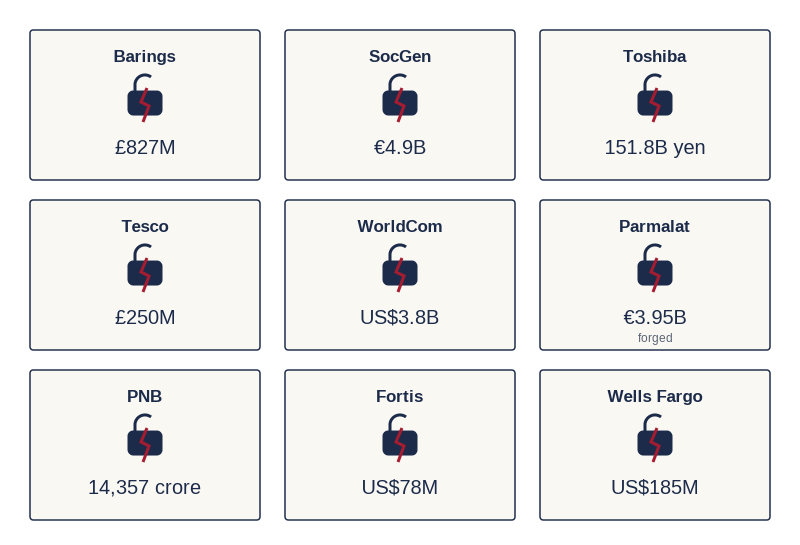
Table 6.9: Nau cases ka ek-line saar
| Case | Year | Failed control | Key number |
|---|---|---|---|
| Wells Fargo | 2016 | Control environment aur incentive | US$185 million jurmana (2016) |
| Barings | 1995 | Segregation of duties | £827 million nuksaan |
| Societe Generale | 2008 | Monitoring (alerts par action nahi) | €4.9 billion nuksaan |
| Toshiba | 2015 | Control environment (target ka dabav) | 151.8 billion yen overstatement |
| Tesco | 2014 | Cut-off aur income recognition | £250 million overstatement |
| WorldCom | 2002 | Environment aur activities; monitoring ne pakda | US$3.8 billion shuruaati khoj |
| Parmalat | 2003 | Group aur offshore opacity | €3.95 billion forged bank document |
| PNB | 2018 | System reconciliation (SWIFT-CBS) | ₹14,357 crore |
| Fortis | 2018 | Promoter override, related party | US$78 million nikale gaye |
Saajha pattern. Har case mein controls kaagaz par maujood the: Barings ke paas SoD ka niyam tha, PNB ke paas RBI circulars the, Societe Generale ke paas timed alerts the. Vifalta design ki nahi, sanchalan (operation) ki thi. Isiliye auditor design aur implementation ke baad operating effectiveness test karta hai.
6.7 Exam traps ka vishleshan
- "Auditor ka kaam internal control banana hai." Galat. Controls management banata hai; auditor unhe samajhta aur test karta hai. Auditor control banaye to self-review threat aata hai.
- "Har control deficiency TCWG ko likhit roop mein batani hoti hai." Galat. SA 265 ke tahat significant deficiencies TCWG ko likhit mein jaati hain; baaki management ko batayi jaati hain, jo pehle se na batayi gayi hon.[14]
- "Controls mazboot hain to substantive testing zero ho sakti hai." Galat. Har material account par kuch substantive procedures hamesha hote hain.
- "Internal control absolute assurance deta hai." Galat. Sirf reasonable assurance, kyunki cost-benefit, human error, collusion aur management override hain.[2]
- "Dhara 143(3)(i) sirf listed companies par lagti hai." Galat. Yeh auditor reporting ki aavashyakta companies par saamanya roop se lagti hai, MCA ki 2017 ki chhoot ke saath. Dhara 134(5)(e), yaani directors ka IFC statement, listed companies ke directors par lagti hai. Do alag dharayein hain.
- "Preventive control mehnga hota hai, isliye sirf detective rakhiye." Galat. Dono ka santulan chahiye. Societe Generale yaad kijiye.
- "IT mein application controls mazboot hon to general controls ki jaanch zaroori nahi." Galat. ITGC kamzor hon to application controls par bharosa nahi kiya ja sakta. PNB mein CBS aur SWIFT ke beech ka interface hi khatra tha.
- "Segregation of duties sirf cashier par lagti hai." Galat. SoD har prakriya mein lagti hai. Barings mein trading aur settlement ka milna cashier se bhi khatarnak sanyojan tha.
- "Walkthrough ek test of control hai." Galat. Walkthrough design aur implementation samajhne ki prakriya hai. Operating effectiveness ka test samples par, poori avadhi mein hota hai.
- "ICFR sirf finance department ka control hai." Galat. ICFR un sabhi prakriyaon ko chhuta hai jahan se financial data banta hai.
6.8 Practice scenarios
Scenario 1: Ek hi vyakti, teen kaam. Kanpur Tools (kalpanik) ke ek chhote branch mein ek hi accountant order book karta hai, maal receive karta hai aur supplier payment ki bank file upload karta hai (director manzoori deta hai par verify nahi karta). Vishleshan. Yeh SoD ka classic gap hai. Payment upload karne wala apne pasandida vendor ko pay kar sakta hai. Compensating controls: director payment se pehle 3-way match ki screen swayam dekhe; vendor master changes par alag manzoori; supplier statement reconciliation doosre office se. Audit mein is branch ke payments ko high risk maniye, vendor ki existence verify kijiye aur duplicate bank account numbers scan kijiye.
Scenario 2: Override wali bikri. 31 March ko raat 11 baje CFO swayam 6 sales invoices bana raha hai, kul 4.2 crore, sab "dispatched" chinhit, par gate pass register mein in dispatches ki koi entry nahi. Vishleshan. Cut-off, override aur revenue fraud risk ek saath hain. Gate pass aur invoice ka milan kijiye, transporter se confirmation lijiye, subsequent returns dekhiye. Agar maal nikla hi nahi to yeh fictitious revenue hai: significant risk, TCWG ko batayiye aur fraud assessment update kijiye. CFO ka khud invoice banana hi control breach hai, kyunki recording uska kaam nahi.
Scenario 3: Exception report jise koi nahi padhta. ERP mein har raat "price below cost" wali sales ki exception report banti hai. Woh kisi ko nahi jaati. Pichhle saal 340 entries jama hain. Vishleshan. Control design mein hai par operate nahi ho raha. Yeh monitoring ka failure hai, Societe Generale wali bimari. Report ki maujoodgi ko control mat ginye. Yeh significant deficiency ho sakti hai (SA 265). In 340 entries ko substantive procedure se review kijiye, kyunki cost se neeche ki bikri related party ko hui ho to baat alag hai.
Scenario 4: Ek hi login. Accounts department ke chaar log ek hi login "admin" use karte hain kyunki "license sasti padi". Vishleshan. Access control aur accountability dono toote. Kisne kya entry ki, yeh sthapit hi nahi ho sakta, isliye audit trail bekaar hai. Sudhar: vyaktigat logins, role-based access. Audit mein journal entries par zyada substantive testing kijiye.
Worked problems: control design drills
Sabhi figures kalpanik hain.
Problem 6.1: Stationery shop ka cash
Do salesmen ek hi cash drawer use karte hain. Shaam ko maalik ginta hai aur aksar 50 se 100 rupaye ka antar milta hai; dono ek doosre par dalte hain. Control design kijiye.
Solution. Vyaktigat uttardayitva gayab hai. Har salesman ka alag drawer ya alag shift, pre-numbered receipt book, drawer transfer par dono ke hastakshar, aur salesman-wise daily reconciliation. Yeh SoD ka chhota roop hai: custody (cash) ko record (receipt) se jod diya gaya.
Problem 6.2: Godown ka return gate
Kanpur Tools ke godown se damaged maal "return" gate se jaata hai. Return slip supervisor khud banata aur khud sign karta hai. Pichhle mahine 12 returns (12 units) huye; stock register se 14 units kam hain. Antar aur control gap batayiye.
Solution. Antar = 14 minus 12 = 2 units. Authorization aur recording ek hi haath mein hain, jo Barings pattern ka chhota roop hai. Control: return slip ek department banaye, godown physically verify kare, gate par teesri jaanch ho; returns ka saptahik saar kisi doosre ko jaye jo stock register se milaye. 2 units ke antar ki jaanch zaroori hai.
Problem 6.3: Salary advance
HR executive salary advance process karta hai, 20,000 tak khud manzoor karta hai aur vasooli ki suchi bhi wahi banata hai. Sudhar suggest kijiye.
Solution. Approval aur vasooli ki nigrani alag kijiye. Advance ki suchi har mahine finance head ko jaye, na-vasool advances ki ageing ho, aur payroll system mein auto-deduction ka niyam ho. HR executive sirf process kare, manzoor na kare.
Problem 6.4: Price master
Sales team ka ek sadasya price master edit kar sakta hai. Usne apne do pasandida customers ka discount 5% se 25% kar diya, aur teen mahine baad margin report se pata chala. Kya sudhar hona chahiye?
Solution. Antar = 25% minus 5% = 20 percentage points. Master file changes ke liye maker-checker workflow, change log ki masik samiksha, aur "discount 10% se zyada" ki exception report. Detective control teen mahine der se chala, yaani monitoring cycle kamzor tha. Ghuspaith transactions ke andar nahi, unke niyamon ke andar hui thi.
Problem 6.5: Laptop register
Company laptops deti hai. Register Excel mein hai aur IT admin swayam use sambhalta hai. Do karmchari laptops waapas kiye bina chale gaye. Sudhar suggest kijiye.
Solution. Asset register HR aur IT dono ke paas ho, joining aur leaving checklist mein asset return anivarya ho, aur full-and-final settlement asset clearance ke bina na ho. Saal mein ek baar physical verification kijiye. Custody aur record ek hi vyakti (IT admin) ke paas the, wahi purana pattern.
Problem 6.6: Online refunds
Refund executive 5,000 tak refund khud initiate aur manzoor karta hai. Ek executive ne 8 mahine mein apne bank account mein 60 refunds bheje. Kaun sa detective control pakad leta?
Solution. "Refunds by beneficiary account" ki masik report, jisme ek hi account par kai refunds saaf dikhte. Saath mein maker-checker approval aur customer complaint se cross-check. Pahle hi mahine mein pattern dikh jaata. Yeh PNB ka sabak hai: system mein kshamata thi, reconciliation nahi thi. Ausatan refunds = 60 / 8 = 7.5 per mahina.
Problem 6.7: Barings ke figures
Kul nuksaan £827 million tha, jo available trading capital ka do guna tha. December 1994 mein nuksaan £200 million aur reported profit £102 million tha. Capital aur antar nikaliye.
Solution. Trading capital = 827 / 2 = £413.5 million. December 1994 mein sach (nuksaan 200) aur reported (profit 102) ke beech antar = 200 + 102 = £302 million, jo us samay ke £350 million capital ke 86 pratishat ke baraabar hai (302 / 350 = 0.863).
Problem 6.8: Wells Fargo ke accounts
2011 se 2016 ke beech unauthorised deposit accounts 1,534,280 aur credit-card accounts 565,433 the. Total aur May 2017 ke lagbhag 3,500,000 anumaan se antar nikaliye.
Solution. Total = 1,534,280 + 565,433 = 2,099,713. Antar = 3,500,000 minus 2,099,713 = 1,400,287, yaani lagbhag 1.4 million zyada. Pehli ginti ke mukable baad ka anumaan lagbhag 1.67 guna tha (3,500,000 / 2,099,713).
Chapter summary
Internal control management ka banaya system hai jo sampatti, records, kushalta aur kanoon ke paalan ki raksha karta hai. Auditor use samajhta aur test karta hai, banata nahi. Internal check, internal control, internal audit aur ICFR alag cheezein hain. COSO ke paanch components (Control Environment, Risk Assessment, Control Activities, Information and Communication, Monitoring) satrah principles mein vibhajit hain, aur effective control ke liye sab present, functioning aur integrated hone chahiye. Segregation of duties authorization, recording, custody aur reconciliation ko alag haathon mein rakhti hai; chhoti entity mein compensating controls lagte hain. Preventive, detective aur corrective controls ka mix zaroori hai. ITGC kamzor ho to application controls par bharosa nahi kiya ja sakta. SA 315 samajhne, SA 330 test karne aur SA 265 deficiency report karne ka framework deta hai; significant deficiency TCWG ko likhit roop mein jaati hai. Dhara 143(3)(i) auditor ki IFC par raay se aur dhara 134(5)(e) listed companies ke directors ki zimmedari se judti hai. Internal audit ki report line audit committee tak honi chahiye aur SA 610 statutory auditor ko uske kaam ka upyog karne deta hai, zimmedari nahi baantta. Nau cases mein controls kaagaz par the par sanchalan mein vifal hue, aur pakad aksar bahar se hui. Koi bhi control system reasonable assurance se zyada nahi deta.
Review questions
Short-answer questions
- Internal control ki paribhasha dijiye aur uske chaar uddeshya likhiye.
- Internal check, internal control aur internal audit mein antar bataiye.
- COSO ke paanch components likhiye aur har ek ka ek udaharan dijiye.
- Effective internal control ke liye COSO kya do sharten rakhta hai?
- Segregation of duties ke chaar kaam kaun se hain?
- Compensating control kya hai? Chhoti dukaan ka udaharan dijiye.
- ITGC kamzor hone par auditor application controls par bharosa kyun nahi kar sakta?
- SA 265 ke tahat significant deficiency kisko aur kis roop mein report hoti hai?
- Dhara 143(3)(i) aur dhara 134(5)(e) mein kya antar hai?
- WorldCom case internal audit ki report line ke baare mein kya sikhata hai?
Multiple-choice questions
Q1. Barings Bank ke collapse mein sabse buniyadi control vifalta kya thi? (a) System dheema tha (b) Ek hi vyakti trading aur settlement dono sambhalta tha (c) Office mein taala nahi tha (d) Salary kam thi Answer: (b). Front office aur back office ka vibhajan banking ka aadhaar hai; Leeson apne trades khud settle karta tha.
Q2. Societe Generale mein Kerviel fake trades do-teen din mein kyun band karta tha? (a) Bonus ke liye (b) Weekend se pehle (c) Bank ke timed controls ke trigger hone se pehle chhupane ke liye (d) Tax bachane ke liye Answer: (c). Woh predictable timed controls ko game kar raha tha.
Q3. WorldCom mein fraud kisne ujagar kiya? (a) Bahari auditor (b) SEC (c) Media (d) Internal audit team, Cynthia Cooper ke netritva mein Answer: (d). Routine capital expenditure audit mein sandigdh entries mili thin.
Q4. Parmalat ke US$/euro account mein dikhaye gaye €3.95 billion kya nikle? (a) Sahi the (b) Forged document (c) Doosri company ke (d) Frozen the Answer: (b). Bank of America ne document ko forgery bataya.
Q5. PNB case mein LoUs ka saalon tak pata kyun nahi chala? (a) Files jal gayin (b) CCTV band tha (c) RBI ne poochha nahi (d) SWIFT messages core banking system mein darj nahi hote the aur dono ka reconciliation nahi hota tha Answer: (d). CBS bypass hua aur reconciliation ka abhav tha.
Q6. COSO ke anusar effective internal control ke liye kya chahiye? (a) Koi teen components mazboot (b) Paanchon components present, functioning aur integrated (c) Sirf control activities (d) Sirf monitoring Answer: (b). Aanshik mazbooti kaafi nahi.
Q7. Bank reconciliation kis type ka control hai? (a) Detective (b) Preventive (c) Corrective (d) Directive Answer: (a). Galti hone ke baad milan karke pakadta hai.
Q8. SA 265 ke tahat significant deficiency kisko report hoti hai? (a) Press ko (b) Sirf shareholders ko (c) TCWG ko likhit roop mein (d) Kisi ko nahi Answer: (c). Baaki deficiencies management ko.
Q9. Walkthrough ka uddeshya kya hai? (a) Paise ginna (b) Client ko daraana (c) Samay vyateet karna (d) Design aur implementation samajhna, ek transaction ko trace karke Answer: (d). Operating effectiveness ka test alag hai.
Q10. "Controls kaagaz par the, sanchalan mein nahi" yeh kathan kin cases par baithta hai? (a) Sirf Barings (b) Sirf PNB (c) Is chapter ke lagbhag sabhi cases par (d) Kisi par nahi Answer: (c). Rules maujood the (SoD, RBI circulars, timed alerts); vifalta sanchalan ki thi.
Notes and references
[1] Wikipedia, "Wells Fargo cross-selling scandal", https://en.wikipedia.org/wiki/Wells_Fargo_cross-selling_scandal, accessed 2026-11-27. Supports: fraudulent accounts without consent and aggressive sales goals; 2016 fines of US$185 million (CFPB 100, LA City Attorney 50, OCC 35); account counts for 2011 to 2016 and the later estimate of about 3,500,000; "pinning" with PIN "0000"; about 5,300 employees fired; use of employees' own contact information; supervisors' reports not leading to change; nominal reforms after the LA Times article; Stumpf's resignation, forgone options and clawback; US$3 billion settlement in February 2020; Federal Reserve growth cap. [2] Wikipedia, "Committee of Sponsoring Organizations of the Treadway Commission", https://en.wikipedia.org/wiki/Committee_of_Sponsoring_Organizations_of_the_Treadway_Commission, accessed 2026-11-27. Supports: 1992 framework and 2013 re-release; five components and 17 principles; requirements for effectiveness; description of each component; limitations (human error, collusion, override); Sarbanes-Oxley Section 404; Companies Act dhara 143(3)(i); CFO magazine criticism. [3] Wikipedia, "Barings Bank", https://en.wikipedia.org/wiki/Barings_Bank, accessed 2026-11-27. Supports: all Barings facts and figures in section 6.6.2. [4] Wikipedia, "2008 Societe Generale trading loss", https://en.wikipedia.org/wiki/2008_Soci%C3%A9t%C3%A9_G%C3%A9n%C3%A9rale_trading_loss, accessed 2026-11-27. Supports: all Societe Generale facts and figures in section 6.6.3. [5] Reuters, "Toshiba inflated profits by $1.2 billion with top execs' knowledge: investigation", https://www.reuters.com/article/business/toshiba-inflated-profits-by-12-billion-with-top-execs-knowledge-investigatio-idUSKCN0PU0E8/, accessed 2026-11-27. Supports: 151.8 billion yen overstatement; top management awareness; culture and profit targets. [6] Financial Services Agency of Japan, SESC recommendation, https://www.fsa.go.jp/sesc/english/news/reco/20151207-1.htm, accessed 2026-11-27. Supports: net loss figures for the year ended 31 March 2010; penalty of 7,373,500,000 yen. [7] Financial Services Agency of Japan, press release of 22 December 2015, https://www.fsa.go.jp/en/news/2015/20151222-2.html, accessed 2026-11-27. Supports: suspension of EY ShinNihon from new engagements, 1 January to 31 March 2016. [8] Tesco PLC, trading update, https://www.tescoplc.com/trading-update-1, accessed 2026-11-27. Supports: £250 million overstatement; cause; Deloitte review; interim results on 23 October 2014; CEO statement. [9] Financial Reporting Council, "FRC announces closure of Tesco investigation", https://www.frc.org.uk/news-and-events/news/2020/06/frc-announces-closure-of-tesco-investigation/, accessed 2026-11-27. Supports: investigation from December 2014; closure in June 2020 without formal complaint. [10] Wikipedia, "WorldCom", https://en.wikipedia.org/wiki/WorldCom, accessed 2026-11-27. Supports: all WorldCom facts and figures in section 6.6.6. [11] Wikipedia, "Parmalat", https://en.wikipedia.org/wiki/Parmalat, accessed 2026-11-27. Supports: all Parmalat facts and figures in section 6.6.7. [12] Wikipedia, "Punjab National Bank Scam", https://en.wikipedia.org/wiki/Punjab_National_Bank_Scam, accessed 2026-11-27. Supports: all PNB facts and figures in section 6.6.8. [13] Wikipedia, "Fortis Healthcare", https://en.wikipedia.org/wiki/Fortis_Healthcare, accessed 2026-11-27. Supports: all Fortis facts and figures in section 6.6.9. [14] ICAI, list of Standards on Auditing (formerly AAS), https://icai.org/post/auditing-review-and-other-standards-formerly-known-as-aas-complete-text, accessed 2026-11-27. Supports: titles of SA 265 and SA 610; SA 315 and SA 330 as used in this chapter.