Consolidated Cheat Sheets, Checklists and Glossary
Abstract
Ye chapter is pustak ke sabhi chapters ka condensed reference layer hai: ek nazar me samajh aane wali cheat sheets, kaam ke samay kaam aane wali checklists, aur 179 shabdon ki consolidated glossary. Uddeshya dohra (dual) hai - pehla, pariksha se pehle ki raat ka last-mile revision; doosra, audit ke kaam ke dauran turant reference. Chapter me audit process, accounting equation, assertions, evidence procedures, Companies Act 2013 ke audit sections, Constitution ke audit-finance Articles, opinion decision tree, financial formulas, GFR purchase flow aur fraud triangle ke at-a-glance sheets hain. Iske baad vouching, verification aur govt audit ki checklists, chaar sourced case studies (Wirecard, Toshiba, Yes Bank, Kingfisher), chaar solved scenarios, self-assessment MCQs aur review prashn diye gaye hain.
Learning Objectives
Is chapter ko padhne ke baad vidyarthi saksham hoga:
- Audit process ke saat steps ko sahi kram me define karna;
- Accounting equation, assertions aur evidence procedures ko practical situations par apply karna;
- Companies Act 2013 ke audit sections aur Constitution ke audit-finance Articles ko unke vishay ke saath distinguish karna;
- Opinion decision tree ka use karke di gayi sthiti me sahi opinion type evaluate karna;
- Vouching aur verification checklists ko diye gaye transactions par apply karna;
- Real audit failures ke case studies se regulatory outcomes aur lessons evaluate karna.
Introduction and Research Question
Is chapter ka research question: kya poore audit syllabus ko aise condensed roop me sameta ja sakta hai jo last-mile revision me bhi kaam aaye aur daily reference me bhi? Uttar teen design decisions me hai. Pehla: har sheet ek hi nazar me poori ho - ek concept, ek table ya ek list. Doosra: har technical term ka ek line ka plain definition glossary me ho, taaki shabd ki wajah se koi prashn na chhoote. Teesra: theory ko real cases se joda jaye, kyunki pariksha me case ke figures nahi, unke principles poochhe jaate hain. Chapter ko isi kram me padho: pehle cheat sheets (concept ka naksha), phir checklists (kaam ka naksha), phir glossary (shabdon ka naksha), aur ant me cases aur scenarios (judgment ka abhyaas).
20.1 The Audit Process at a Glance
Audit ek independent examination hai jisme auditor evidence ikattha karke financial statements par ek opinion deta hai. Ek line me: independent jaanch + saboot + opinion. Auditing ke dauran sabse bada khatra independence ka kho jaana hai - jis din auditor par dabav aa gaya, us din uski report ki keemat khatam ho jaati hai. Aur jab kuch galat pakda jaye, to use report me likhna padta hai; kabhi-kabhi opinion bhi badalna padta hai. Chhupana auditor ka kaam nahi hai.
| Step | What Happens | Output |
|---|---|---|
| 1. Engagement | Client accept, terms tay | Engagement letter |
| 2. Planning | Business samajhna, risk dekhna | Audit plan, materiality |
| 3. Internal control review | Controls kaise chal rahe hain | Control assessment |
| 4. Evidence gathering | Vouching, verification, testing, sampling | Working papers |
| 5. Evaluation | Galtiyan ginna, kitni badi hain | Summary of misstatements |
| 6. Reporting | Opinion banana | Audit report |
| 7. Follow-up | Management se baat, aage ki baatein | Management letter |
(Process ki shape standard hai. Exact standard numbers ke liye Ch 5 aur Ch 13 dekho.)
Critical Discussion
Audit ek assurance engagement hai: auditor risk ko kam karne ke liye evidence ikattha karta hai aur reasonable assurance deta hai - absolute assurance nahi, kyunki testing, sampling aur inherent limitations hoti hain. Ye farak exam me bhi aata hai aur practice me bhi: "100% guarantee" dene wala auditor apne hi standard ke khilaf hai. Doosri seema: audit process ka har step management ki responsibilities par tikta hai; fraud rokna primary roop se management aur those charged with governance ka kaam hai, auditor reasonable assurance deta hai.
20.2 Accounting Equation and Double Entry
- Assets = Liabilities + Capital
- Har transaction me: total Debit = total Credit
- Personal account: Receiver Debit, Giver Credit
- Real account: Jo aaye Debit, jo jaaye Credit
- Nominal account: Kharcha/loss Debit, income/gain Credit
Worked example: Owner ne 10,000 rupaye lagaye aur 5,000 rupaye udhaar liye. Cash 15,000 = 5,000 (liability) + 10,000 (capital). Dono taraf barabar - equation santulit.
Critical Discussion
Equation ki barabari ka matlab "sahi accounting" nahi hai. Galat head me sahi amount daalne par bhi equation barabar rehti hai; isliye trial balance sirf arithmetical accuracy pakadta hai, errors of principle nahi. Double entry ki taqat uski self-checking me hai, par usi taqat ki seema bhi yehi hai.
20.3 Audit Assertions
Assertion management ki wo representation hai jise auditor test karta hai - jaise "ye stock maujood hai" ya "sab sales record ho gayi".
| Assertion | Question | Example Test |
|---|---|---|
| Existence | Cheez sach me hai? | Stock ko khud ginna |
| Completeness | Sab kuch likha gaya? | Bills ka sequence check |
| Rights and obligations | Cheez company ki hai? | Title documents |
| Valuation | Sahi keemat par? | Market price se milana |
| Cut-off | Sahi period me? | Saal ke end ki entries dekhna |
| Presentation | Sahi tarah dikhaya? | Disclosures check |
Critical Discussion
Har substantive test kisi na kisi assertion ko hi prove karta hai; assertion ke bina test ka design adhoora hai. Exam trap: "existence" assets ke liye zyada relevant hai, "completeness" liabilities ke liye - creditors ka risk chhupane ka hota hai, assets ka dikhane ka.
20.4 Evidence-Gathering Procedures
Audit evidence ikattha karne ke saat tareeke: Inspection, Observation, Inquiry, Confirmation, Recalculation, Reperformance, Analytical procedures. Yaad rakhne ka short form: "I O I C R R A".
Critical Discussion
Evidence ki reliability ka kram (hierarchy) yaad rakho: external source ka evidence internal se strong; auditor ka khud ka prapt (direct) evidence client ke haath se guzre evidence se strong; original document copy se strong. Inquiry akele kabhi kaafi nahi - use hamesha corroborating evidence chahiye (Section 20.13 ke Wirecard case me isi principle ka failure hai).
20.5 Companies Act 2013: Audit Sections
Companies Act 2013 ka audit chapter sections 132 se 148 tak hai. Neechy ki table har section ka vishay ek line me deti hai .
Companies Act 2013: Audit Sections at a Glance
| Section | Subject |
|---|---|
| 132 | NFRA ka gathan |
| 139 | Auditor ki appointment (first: Board, 30 din; phir members, 5 saal ka term) |
| 140 | Resignation, removal, casual vacancy |
| 141 | Qualifications aur disqualifications (audit limit 20 companies shamil) |
| 142 | Remuneration |
| 143 | Powers aur duties; 143(3) report matters; 143(11) CARO; 143(12) fraud reporting |
| 144 | Prohibited non-audit services (internal audit, investment banking aadi) |
| 145 | Auditor ka audit report par sign karna |
| 146 | Auditors ka general meeting (AGM) me attend karna |
| 147 | Punishments |
| 148 | Cost records aur cost audit |
[1]
Exam trap: Section ka number aur vishay dono yaad rakho, par kram se nahi, jode se: 139-appointment, 141-disqualify, 143-duty, 144-prohibited, 148-cost. "139 se appointment, 141 se hatao (disqualify), 143 se kaam, 144 se rok" - ye rhyme kaam aayegi.
20.6 Constitutional Articles on Audit and Finance
Government audit aur public finance ke constitutional anchors neecy table me hain; har Article ko uske vishay ke saath jod kar yaad karo.
Constitutional Articles on Audit and Finance
| Article | Subject |
|---|---|
| 110 | Money Bill ki definition |
| 112 | Annual Financial Statement (Budget) |
| 116 | Vote on account |
| 148 | CAG: appointment, oath, conditions |
| 149 | CAG ki duties aur powers |
| 150 | Accounts ka form (President on CAG advice) |
| 151 | CAG reports President/Governor ko, phir Parliament/Legislature me |
| 265 | Tax sirf kanoon ke adhikaar se |
| 266 | Consolidated Fund (1) aur Public Account (2) |
| 267 | Contingency Fund |
| 279A | GST Council |
| 280 | Finance Commission |
[2] [3] [4]
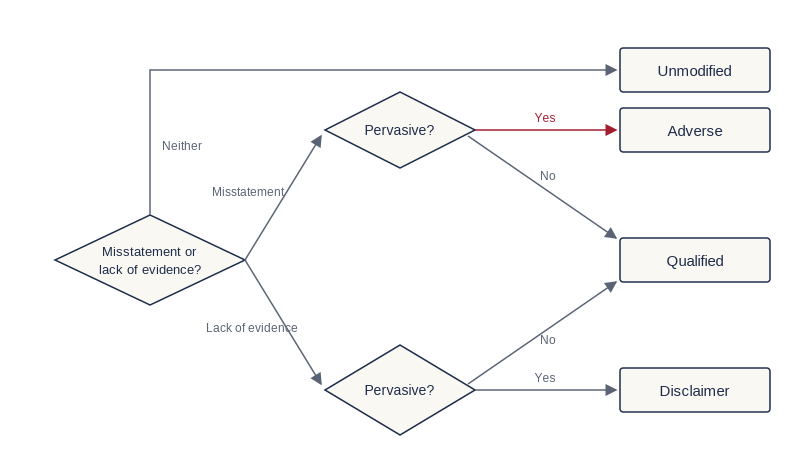
20.7 Audit Opinion: Decision Tree
Opinion ka type do faisalon se banta hai: (1) kya dikkat hai, misstatement ya evidence ki kami; (2) kya wo pervasive hai, yaani statements ke ek hisse tak seemit nahi. Neechy ka decision tree SA 705 ke framework ko operational banata hai.
Audit Opinion: Decision Tree
- Misstatement/evidence ki dikkat hai? Nahi -> Unmodified.
- Haan. Misstatement material hai? Nahi -> Unmodified (immatters ko report me kachra mat banao).
- Haan. Pervasive hai (kahin kahin nahi, poora statements prabhavit)? Haan -> Adverse.
- Nahi pervasive -> Qualified.
- Dikkat misstatement nahi, evidence ka abhav hai? Pervasive doubt -> Disclaimer; nahi -> Qualified.
- Matter sahi se disclosed hai par zaroori batana hai -> Emphasis of Matter (opinion modify nahi).
20.8 Financial Formulas in One Place
Sab formulas ek jagah; derivation aur worked examples ke liye Ch 2 dekho.
Financial Formulas in One Place
- Assets = Liabilities + Capital
- COGS = Opening stock + Net purchases + direct expenses - Closing stock
- GP = Sales - COGS; NP = GP - indirect expenses + indirect incomes
- GP ratio = GP/Sales x 100; NP ratio = NP/Sales x 100
- Current ratio = CA/CL; Quick ratio = (CA - Stock - Prepaid)/CL
- Debt-equity = Long-term debt/Equity; Working capital = CA - CL
- Stock turnover = COGS/Average stock; Debtors turnover = Credit sales/Average debtors
- Collection period = 365/Debtors turnover; Payment period = 365/Creditors turnover
- SLM depreciation = (Cost - Scrap)/Life; WDV = Rate x Opening book value
- Closing capital = Opening + Profit + Additional capital - Drawings
- Single entry me profit = Closing capital - Opening + Drawings - Additional capital
- HP total interest = HP price - Cash price
- SI = P x R x T/100; CI = P(1+R/100)^T - P
- Audit risk = Inherent x Control x Detection
20.9 GFR Purchase Flow
GFR ke tahat sarkari kharid ka standard flow neecy hai; CAG ke audit me yahi flow check hota hai, isliye ye sheet audit karne wale aur karwane wale dono ke liye hai.
GFR Purchase Flow
- Zaroorat likho (indent) aur competent authority ka sanction lo.
- Store me stock dekho - pehle se hai to kharid nahi.
- Tender chuno: open (default), limited (specialised/urgent), single (emergency/monopoly, reasons likhna).
- EMD lo; technical bid pehle, phir financial bid.
- L1 ko order (terms likhit me), performance security lo.
- Maal aaye to inspection + GRN; bill ka 3-way match (PO, GRN, invoice).
- Payment voucher ke saath; stock register/bin card me entry.
- Utilisation certificate jahan grant ho; audit objections ka time-bound jawab (ATN).
(CAG ke audit me yahi flow check hota hai: [5])
20.10 Fraud Triangle and Three Responses
Fraud ke teen elements - incentive/pressure, opportunity, rationalisation - aur har ek ka control response. (Fraud triangle ka vistaar Ch 17 me hai; real cases ke figures Ch 16 me sourced hain.)
Fraud Triangle and Three Responses
- Pressure: targets, loan covenants, personal financial problem. Jawab: hotline, HR support, realistic targets.
- Opportunity: weak controls, ek aadmi ka poora control. Jawab: separation of duties, rotation, surprise checks.
- Rationalisation: "sab karte hain", "baad me lauta dunga". Jawab: culture, tone at the top, consequences.
Exam trap: Fraud triangle ke teen elements confuse mat karna: incentive/pressure, opportunity, rationalisation. Exam me "attitude" bhi rationalisation ke naam se likha aata hai.
20.11 Audit Checklists
Checklists ka uddeshya saral hai: kaam ke samay koi step na chhoote. Har checklist ka ek item ek auditable point hai; jis item ka uttar "nahi" aaye, wahi agla kaam hai.
First Day of the Audit
- [ ] Client ka business aur industry samjha?
- [ ] Independence ki declaration li?
- [ ] Engagement letter sign?
- [ ] Previous year ki report padhi?
- [ ] Risk areas likhe?
- [ ] Materiality tay?
- [ ] Team aur time tay?
Fraud Red Flags
- Pressure (targets, loan covenants)
- Opportunity (weak controls, ek aadmi ka sab control)
- Rationalisation ("sab karte hain")
- Round numbers, late-night entries, missing documents
- Management auditor ko records dene me taal-matol kare
(Fraud triangle ka detail ch17 me hai. Real cases ke figures ch16 me sourced hain.)
General Vouching Steps (Every Transaction)
- [ ] Voucher available hai, original hai?
- [ ] Date accounting period ke andar?
- [ ] Client ke naam par hai?
- [ ] Amount words aur figures me same?
- [ ] Authorised signatory ka approval?
- [ ] Sahi account head me classify?
- [ ] Capital/revenue galat to nahi?
- [ ] Revenue stamp/cancellation laga (jahan chahiye)?
- [ ] Related party to nahi (disclosure check)?
Vouching of Purchases
- [ ] Purchase order se match?
- [ ] GRN se match (quantity, quality)?
- [ ] Supplier invoice (rate, calculations, GST)?
- [ ] Purchase book me entry, ledger posting?
- [ ] Cut-off: period end ke GRN sahi saal me?
Vouching of Sales
- [ ] Sales invoice series complete (missing numbers)?
- [ ] Dispatch/delivery proof?
- [ ] Customer order se match?
- [ ] Returns ke credit notes authorised?
- [ ] Cut-off: dispatch aur invoice same period?
Cash and Bank
- [ ] Surprise physical cash count kiya?
- [ ] Cash book roz likhi ja rahi hai?
- [ ] Collections same/next day bank me jama?
- [ ] BRS har mahine banta hai, old items pursue?
- [ ] Stale cheques aur unpresented purane items ki wajah?
- [ ] Bank confirmation directly auditor ko?
Verification of Fixed Assets
- [ ] Fixed assets register maintained?
- [ ] Physical verification cycle chal raha hai?
- [ ] Title deeds/invoice ownership ke?
- [ ] Additions capitalised sahi (installation shamil)?
- [ ] Disposals authorised, profit/loss nikala?
- [ ] Depreciation rate/method consistent, Schedule II ke hisaab se?
Verification of Debtors
- [ ] Ageing analysis banaya?
- [ ] Direct confirmations bheje (sample)?
- [ ] Subsequent receipts check ki?
- [ ] Doubtful ke liye provision adequate?
- [ ] Credit policy follow ho rahi?
- [ ] Related party debtors disclose?
Additional Points for Government Audit
- [ ] Sanction competent authority ka?
- [ ] Tender process follow (open/limited/single justification)?
- [ ] Store records (bin card, ledger, physical verification)?
- [ ] Utilisation certificates time par?
- [ ] Advances ka adjustment pending kitna purana?
- [ ] Previous audit objections ke ATN file hue?
In the Examination Hall (20 December)
- [ ] Admit card, ID, photo - raat ko bag me
- [ ] OMR bubble poora bharo, aadha nahi
- [ ] Pehle 60 minute me sab aasan Q
- [ ] Numeric me units aur sign check
- [ ] 2-option elimination ho to guess lagao (EV positive)
- [ ] Aakhri 10 minute: OMR review + flagged Q
- [ ] Ek galat answer par rona nahi; agla sawaal naya client hai
20.12 Consolidated Glossary (A-Z)
Is glossary me is pustak ke sabhi chapters ke 179 terms hain, har ek ke saath ek line ki plain definition. Jahan term kisi statute ya standard se juda hai, wahan section/SA number bhi diya gaya hai. Revision ka tareeka: har letter ke terms ko ek baar bolo; jo term atke, uska chapter dobara kholo.
A
- Account: Kisi cheez ya vyakti ka hisaab rakhne ka sthan, T-shape me.
- Accounting equation: Assets = Liabilities + Capital; balance sheet ki buniyaad.
- Accounting period: Jis duration ke liye accounts bante hain, aam taur par 1 April se 31 March.
- Accounting policies: Company ke chune hue accounting ke tareeke (AS 1 me disclose hote hain).
- Accrual basis: Kamai/kharcha tab record jab hua, cash aaya ya gaya tab nahi.
- Adjusting entry: Saal ke end me accrual/prepaid jaise adjustments ki entry.
- Adverse opinion: Jab financial statements bahut galat aur pervasive misstatements se bhare hon.
- Amortisation: Intangible assets (patent, goodwill) ki cost ka baantna.
- Analytical procedures: Numbers ke patterns se galti ka andaza.
- Annual report: Company ka saalana package: financials + reports + notes.
- Assertion: Management ka dawa, jaise "cash hai", jise auditor test karta hai.
- Assurance: Bharosa jo auditor deta hai.
- Audit committee: Board ka sub-committee jo audit aur financial reporting par nazar rakhta hai (CA 2013 s.177). [6]
- Audit evidence: Saboot jis par opinion banta hai.
- Audit plan: Poori audit strategy ka naksha: kya, kab, kitna.
- Audit programme: Step-by-step procedures ki list jo team follow karti hai.
- Audit risk: Galat opinion dene ka risk = Inherent x Control x Detection.
- Audit trail: Entry se original document tak ka raasta.
- Auditor's report: Opinion wala final document.
- Authorised capital: Maximum shares ki value jo company issue kar sakti hai.
B
- Bad debt: Wo debtor ka paisa jo ab nahi milega.
- Balance sheet: Ek date par assets aur liabilities ka statement (financial position).
- Bank reconciliation statement (BRS): Cash book aur pass book ka milan patra.
- Bearer cheque: Jo bhi pesh kare, use milne wala cheque.
- Bill of exchange: Written order jisme ek party doosri se fixed date par paise maangti hai (NI Act s.5). [7]
- Bin card: Store me har item ki quantity ka card.
- Book value: Asset ki value books me: cost minus accumulated depreciation.
- Budget: Aane wale period ka financial plan.
- Budgetary control: Actual ko budget se mila kar control karna.
C
- CAAT: Computer Assisted Audit Techniques - software se audit testing (ch18).
- CAG: Comptroller and Auditor General of India; sarkari accounts ke supreme auditor (Art 148). [8]
- Capital: Business me owner ka laga hua paisa.
- Capital expenditure: Lambi life wala kharch (machine, building); balance sheet me jaata hai.
- CARO: Companies (Auditor's Report) Order; auditor ko extra points par report karni hoti hai.
- Cash book: Cash aur bank transactions ki subsidiary book.
- Cash flow statement: Cash kahan se aaya aur kahan gaya (operating, investing, financing).
- Charge (on profit): Profit ho ya na ho, pehle dena hi hai (jaise debenture interest).
- Closing stock: Saal ke end me bacha hua maal; cost ya NRV, jo kam.
- Competent authority: Jise sanction ka adhikaar ho (GFR me har kharch isi se).
- Compliance audit: Rules aur procedures follow hue ya nahi, iski jaanch.
- Contingency Fund: Emergency kharch ke liye fund (India: Art 267).
- Contra entry: Cash book me wahi entry jo debit aur credit dono taraf aaye (cash-bank).
- Control risk: Client ke controls ki galti pakadne me fail hone ka risk.
- Core banking (CBS): Sab branches ka ek hi network; kahin se bhi account.
- Creditors: Jinhne udaar diya hai; liabilities me.
- Crossed cheque: Do parallel lines wala cheque; counter cash nahi, sirf account me.
- Current assets: Jo 12 mahine me cash ban sakte hain (stock, debtors, cash).
- Current liabilities: Jo 12 mahine me chukani hain.
- Cut-off: Transaction sahi period me gaya ya nahi.
D
- Debenture: Company ka udhaar patra; fixed interest, charge on profit.
- Debit/Credit: Double entry ke do side.
- Debtors: Jinhone udhaar liya hai; assets me.
- Deferred revenue expenditure: Bada revenue kharch jo kuch saalon me baanta jaata hai.
- Depreciation: Fixed asset ka wear and tear jo expense ban kar har saal kat-ta hai.
- Detection risk: Auditor ke procedures misstatement na pakadne ka risk.
- Digital signature: Public key cryptography par based electronic signature (IT Act 2000). [9]
- Disclaimer of opinion: Jab auditor opinion de hi na sake (evidence hi nahi mila).
- Dividend: Profit ka wo hissa jo shareholders ko milta hai; appropriation hai, charge nahi.
- Double account system: Capital aur revenue ke alag accounts dikhane ka presentation method (bijli companies).
- Double entry: Har transaction ka do asar.
- Drawings: Owner ka business se personal nikaal.
E
- E-way bill: GST me maal ke transport ka electronic document.
- Electronic cash ledger: GST portal par har taxpayer ka cash hisaab (CGST s.49). [10]
- Emphasis of Matter: Report ka paragraph jo disclosed matter par dhyan dilata hai; opinion modify nahi.
- Engagement letter: Audit ke terms ka patra.
- Equity: Owners ka share: capital + reserves.
- Error: Anjaane me hui galti.
- Evidence (sufficient and appropriate): Kaafi aur kaam ka saboot.
- Exam trap (kitaab ka term): Wo jagah jahan commission ghuma kar sawaal karta hai.
F
- Fictitious assets: Na asli asset, na bikne layak; sirf write-off hone wala kharch (jaise preliminary expenses).
- Final audit: Saal khatam hone ke baad ek saath hone wala audit.
- Financial statements: Trading, P&L, balance sheet (aur companies me cash flow, notes).
- Fiscal deficit: Total expenditure minus total receipts (borrowings chhod kar).
- Fixed assets: Lambe use ke liye rakhe assets (machine, building); bechne ke liye nahi.
- Forensic audit: Fraud khojne wala audit.
- Fraud: Jaan boojhkar dhokha.
- FRBM Act: Fiscal Responsibility and Budget Management Act, 2003.
G
- GAAP: Generally Accepted Accounting Principles; accounting ke maanye niyam.
- GFR: General Financial Rules; sarkari kharch aur kharid ke niyam (Finance Ministry).
- Going concern: Company aage chalegi ya nahi.
- Goodwill: Business ki reputation ka intangible asset; kharidne par books me aata hai.
- Gross profit: Sales minus cost of goods sold.
- GSTIN: 15 character ki GST pehchaan (state code + PAN + entity code).
H
- Hierarchy of accounts: Computerised accounting me group/sub-group ka structure.
- Hire purchase: Possession turant, payment kiston me, ownership aakhri kist par.
- HUF: Hindu Undivided Family; income tax me alag "person".
I
- Imprest: Petty cash ka system: fixed amount, kharch ke baad wapas bharna.
- Income and expenditure account: Non-profit ka P&L jaisa account, accrual basis par.
- Independence: Dabav se mukt hona.
- Inherent risk: Controls se pehle hi kisi area me misstatement ki fitri sambhavna.
- Insolvent: Jo apni liabilities demand par na chuka sake.
- Intangible assets: Bina physical roop ke assets: goodwill, patent, trademark.
- Interim audit: Saal ke beech me hone wala audit; final audit ka bojh kam karta hai.
- Internal audit: Company ke andar ka audit.
- Internal control: Galti/fraud rokne ke niyam.
- Inventory: Stock: raw material, work-in-progress, finished goods (AS 2).
- Investing activities: Cash flow me assets kharidna/bechna.
- Invoice: Seller ka diya bill: maal, rate, tax ke saath.
J
- Joint audit: Do ya zyada auditors ka ek saath ek hi audit.
- Journal: Transactions ka pehla, date-wise record; narration ke saath.
K
- Key audit matters: Listed company ki report me auditor ke sabse zaroori mudde.
L
- Ledger: Journal se posting ke baad account-wise record.
- Liabilities: Business par doosron ka haq: creditors, loans, outstanding.
- Limited review: Audit se halki jaanch; negative assurance ("kuch galat nazar nahi aaya").
- Loading: Invoice price me joda hua profit, jo stock reserve se adjust hota hai.
M
- Management letter: Auditor ka client ko patra jisme control weaknesses likhi hoti hain.
- Master budget: Sab functional budgets ka consolidated set + budgeted statements.
- Material misstatement: Wo galti jo users ka faisla badal sake.
- Materiality: Kitni badi galti se faisle badal jaate hain.
- Minimum rent: Royalty agreement me kam se kam pakki rakam.
- Misstatement: Financial statements me galat jaankari.
- Mnemonic coding: Letters se coding (jaise DL, UP32).
N
- Narration: Journal entry ke neeche ek line ka kaaran.
- NEFT: Batch-based fund transfer; ab 24x7.
- Net profit: Gross profit minus indirect expenses plus indirect incomes.
- NFRA: National Financial Reporting Authority (CA 2013 s.132). [11]
- Nominal account: Income aur expense ke accounts; saal end me band.
- Non-performing asset (NPA): Bank ka wo loan jisme byaj/kist time par na aa rahi ho.
- Notes to accounts: Financial statements ke neeche ki detail aur policies; contingent liabilities yahin.
O
- OMR: Optical Mark Recognition sheet; exam me bubble bharne wali.
- Opening entry: Naye books me pichhle balances lane ki entry.
- Opinion (unmodified/qualified/adverse/disclaimer): Auditor ka nateeja, 4 type.
- Order cheque: Named person ya uske order ko pay hone wala cheque.
- Outstanding expense: Kharch ho chuka, payment baaki; liability.
P
- PAC: Public Accounts Committee; CAG reports ko Parliament ki taraf se jaanchti hai (LS 15 + RS 7). [12]
- Paid-up capital: Shareholders ne actually kitna paisa diya.
- Partnership deed: Partners ke beech ka written agreement. Deed silent ho to profit barabar, partner ke loan par interest 6% p.a. [13]
- Petty cash: Chhote kharchon ke liye haath ka cash; imprest system.
- Preference shares: Pehle dividend aur pehle capital wapasi wale shares.
- Preliminary expenses: Company banane ka kharch (IT Act 1961 s.35D me amortise; 1 April 2026 se Income-tax Act 2025 me section numbers alag hain).
- Prepaid expense: Agle saal ka kharch is saal de diya; asset.
- Professional skepticism: Auditor ka sawaal poochhte rehna aur saboot maangna.
- Propriety audit: Kharch ki wisdom aur uchita hone ki jaanch (govt audit).
- Provision: Known liability/loss ke liye bana charge, amount estimated.
- Public Account: Sarkar ka wo account jisme wo banker/trustee ki tarah rakhti hai (Art 266(2)). [14]
- Purchase requisition: Store se purchase department ko maal kharidne ki maang.
Q
- Qualified opinion: "Sab theek, siway is matter ke" - material par pervasive nahi.
R
- Ratio analysis: Numbers ke sambandhon se health check (current, quick, debt-equity).
- Re-order level: Stock ka wo level jahan naya order daalna padta hai.
- Reasonable assurance: Bahut bharosa, par 100% nahi.
- Receipts and payments account: Non-profit ka cash book summary.
- Related party: Jinka company par/company ka jinpar prabhav ho; transactions disclose hote hain.
- Reserve: Profit ka rakha hua hissa; appropriation hai, charge nahi.
- Residual value: Asset ki anumaanit aakhri (scrap) keemat.
- Revenue: Roz ke kaam se aamdani.
- Revenue deficit: Revenue expenditure minus revenue receipts.
- Revenue expenditure: Roz ke chalane ka kharch; usi saal P&L me.
- RTGS: Real Time Gross Settlement; bade transfers turant, ek ek karke.
S
- SA (Standards on Auditing): ICAI ke jaari audit ke niyam (SA 230 documentation, SA 500 evidence, SA 570 going concern, SA 700 opinion, SA 705 modifications, SA 706 emphasis). [15]
- Sales book: Credit sales of goods ki subsidiary book.
- Sampling: Poore data me se kuch hisse jaanchna.
- Schedule III: Companies Act ka financial statements format.
- Securities premium: Par se zyada par issue hui shares ki extra rakam (s.52).
- Short workings: Minimum rent aur actual royalty ka farak.
- Solvent: Assets > liabilities.
- Statutory audit: Kanoon dwara compulsory audit.
- Stock reserve: Invoice price me jude profit ka adjustment account (branch accounts).
- Subsidiary books: Sales book, purchase book, returns books, cash book, bills books, journal proper.
- Substantive procedures: Seedhe numbers jaanchna.
- Suspense account: Trial balance na mile to temporary park karne ka account.
T
- TDS: Tax Deducted at Source; payment karte waqt tax kaatna.
- Tests of controls: Controls chalte hain ya nahi, ye jaanchna.
- Trade discount: List price par chhoot; books me record nahi hota.
- Treasury: Sarkari paise jama/nikalne ka sthan.
- Trial balance: Sab ledger balances ki list; arithmetical accuracy ki jaanch.
- Turnover: Total sales (ya GST me aggregate turnover ki apni definition).
U
- Unmodified opinion: Clean report; framework ke hisaab se true and fair.
- Utilisation certificate (UC): Grant sahi kaam me lagi, iska pramaan patra.
V
- Valuation: Asset/liability ki keemat sahi hai ya nahi, iski jaanch.
- Verification: Cheez ki maujoodgi aur keemat jaanchna.
- Vote on account: Poora budget pass hone se pehle interim kharch ki permission.
- Voucher: Har transaction ka documentary saboot (receipt, invoice, GRN).
- Vouching: Entry ko saboot se milana.
W
- WDV (Written Down Value): Cost minus accumulated depreciation; diminishing balance ka base.
- Whistleblower: Andar se galat batane wala.
- Working capital: Current assets minus current liabilities.
- Working papers: Auditor ke kaam ke records.
Z
- Zero-based budgeting: Har kharch naye sire se justify hota hai; pichhla saal base nahi.
- Zero-rated supply: Exports jaise: tax rate zero par ITC/refund milta hai (exempt se alag).
20.13 Case Studies (Sourced)
Neechy chaar real cases hain - do global (Wirecard, Toshiba) aur do Indian (Yes Bank, Kingfisher Airlines). Har case ka format same hai: kya hua, audit failure, regulatory outcome, seekh, aur exam angle. Yaad rakho: pariksha me case ke figures nahi, unke principles poochhe jaate hain.
Case Study 1: Wirecard (2020): Cash That Never Existed
Kya hua: Wirecard Germany ka payment processor tha, DAX index ka member. Saalon se shak tha, par 2019 me Financial Times ki investigations aur whistleblower complaints ke baad maamla phoota. 25 June 2020 ko company ne insolvency file ki, kyunki usne bataaya ki €1.9 billion "missing" hain - paisa jo Philippine banks ke trustee accounts me hone ki daawa kiya jaata tha, waqai tha hi nahi. CEO Markus Braun arrest hua. [16]
Audit failure: Wirecard ka lamba auditor Ernst & Young tha. Baad me KPMG ke special audit me nikla ki EY cash reserves ki existence verify nahi kar paya aur jo bank statements dikhaye gaye wo fraudulent lag rahe the; trustee accounts me rakha cash third-party acquirers ke zariye Wirecard ki balance sheet me gina jaata tha. Singapore me baad me do log (Shanmugaratnam, O'Sullivan) false confirmation letters ke liye jail gaye, jisme Citadelle ke naam par €1.1 billion ke jhoote letters shamil the. [17]
Seekh: Cash verification ka golden rule - independent, direct confirmation. Jo saboot client ke haath se guzar kar aaye, use peet par chhuri maan kar nahi, shaqq ki nazar se dekho. Professional skepticism ka ulta chalan yahan chala: bade naam, bade regulator (BaFin), bada index - sab ke saamne auditor jhuk gaya.
Exam angle: SA 505 external confirmations, evidence ki reliability hierarchy (external > internal, original > copy), aur "existence" assertion - teeno is case se judte hain. Sawaal aayega: "Cash balance verify karne ka best tareeka?" Jawab: bank se seedha confirmation.
Case Study 2: Toshiba (2015): Seven Years of Inflated Profits
Kya hua: May 2015 me Toshiba ne admit kiya ki use apne pichhle saalon ke profits revise karne pad sakte hain. Investigation me khula ki profits ko lagbhag $1.2 billion se inflate kiya gaya tha, pichhle saat saalon me. 21 July 2015 ko CEO Hisao Tanaka ne isteefa diya aur isse company ke 140-saal ke itihaas ka "most damaging event" kaha; aath aur senior officials, jinme do pichhle CEOs shamil, bhi gaye. [18]
Audit failure: Yahan problem sirf numbers ki nahi, pressure ki thi. "Challenge" naam ke targets itne sakht the ki division heads quarterly profits dikhane ke liye accounting techniques (jaise percentage-of-completion me future losses ko aage dhakelna) use karte rahe. Tone at the top toot chuka tha. Ye sab auditor (Ernst & Young ShinNihon) ke saamne saalon tak chalta raha. India ke exam ke liye point ye hai: estimates wali areas (long-term contracts, provisions) sabse zyada manipulation-prone hoti hain, aur auditor ko wahan sabse zyada skepticism chahiye hoti hai.
Baad ka sabak: Company par asar dekho: Westinghouse nuclear subsidiary ki losses ke baad 2017 me auditor PwC ne accounts sign karne se mana kar diya aur Toshiba ne khud likha ki going concern par "substantial doubt" hai. [19]
Seekh: Estimates = judgment = risk. Jab management ke targets aur estimates ek hi haath me hon, to auditor ka kaam double ho jaata hai.
Exam angle: Inherent risk high kaise decide hota hai (estimates, pressure, complex transactions), going concern (SA 570), aur "true and fair" ka matlab. Sawaal aayega: "Going concern doubt ho to auditor kya kare?" Jawab: disclosure dekhe, aur sahi disclose na ho to opinion modify.
Case Study 3: Yes Bank (2020): Moratorium and Reconstruction
Kya hua: Yes Bank 2004 se chal raha private bank tha, founder Rana Kapoor. March 2020 me RBI ne moratorium lagaya aur withdrawals par seema bandhi, kyunki bank ki financial position girti ja rahi thi: bad loans ka dher, capital raise fail. 13 March 2020 ko Union Cabinet ne reconstruction scheme approve ki: State Bank of India ki aguwai me saath investors (ICICI, HDFC, Axis, Kotak aadi) ne mil kar ₹120 billion (₹12,000 crore) ka capital dala, Prashant Kumar naye CEO bane. [20]
Audit angle (AT1 bonds): Reconstruction me ₹8,415 crore ke AT1 bonds write-down kar diye gaye the. Bondholders court gaye. High Court ne write-down quash kiya, aur 15 October 2026 ko Supreme Court ne bhi quashing barkarar rakhi - faisla final ho gaya. [21]
Seekh: Banking audit me sabse bada assertion valuation hai: loans ki asli keemat kya hai (NPA provisioning). Regulator (RBI) ka khud ka audit/supervision framework hota hai, aur statutory auditors ke saath uska sambandh samajhna zaroori hai. Doosri seekh: legal outcomes audit opinions se alag track par chalte hain; auditor apne time ke available evidence ke hisaab se opinion deta hai.
Exam angle: Banking Regulation Act 1949 (PYQ P2-2 se jodo), NPA aur provisioning ka concept, aur regulator ka role. Sawaal aayega: "Bank ka audit kaun regulate karta hai?" Jawab: RBI + Companies Act dono ka mila framework.
Case Study 4: Kingfisher Airlines (2012): The Going Concern That Was Not
Kya hua: Vijay Mallya ki Kingfisher Airlines 2005 me udhi, 2011 tak desh ki doosri sabse badi domestic airline rahi, par shuru se hi losses me thi. Air Deccan ki kharid (2007) ne haalat aur bigaadi; saalon ke losses jo itne badhe ki 2012 ki shuruat tak accumulated losses ₹70 billion se zyada ho gaye. 2012 me salaries ruk gayi, staff strike par aa gaya, aur 20 October 2012 ko operations band ho gaye. [22]
Audit failure (classic going concern wala): Sabse kathpatli wali baat: jab airline doob rahi thi, tab bhi company BSE filing me likhti rahi ki statements going concern basis par banaye gaye hain, kyunki "economic sentiment improve ho raha hai" aur debt recast ho raha hai. Management ki going concern assessment ko auditor ko challenge karna chahiye tha: cash flows negative, salaries unpaid, accounts freeze ho rahe the (Income Tax department ne accounts freeze kiye), fleet ground ho rahi thi. Ye sab SA 570 ke "events or conditions" ki textbook list hai.
Seekh: Going concern ke red flags kabhi ignore mat karo: negative operating cash flows, unpaid employees, frozen accounts, license/suspension ka khatra, aur "hume bas ek aur debt recast chahiye" wali aashayein. Jab sab ek saath dikhein, to Emphasis of Matter se zyada ki zaroorat ho sakti hai.
Exam angle: SA 570 (going concern), audit opinion modifications, aur auditor ki reporting duty. Sawaal aayega: "Going concern appropriate nahi par management ne waise hi banaya?" Jawab: Adverse opinion.
Exam trap: Case studies ke figures exam me nahi aate, unke principles aate hain. "Wirecard me kya galat hua" nahi poochhenge; "cash verify karne ka best tareeka" poochhenge. Isliye har case ki "Seekh" line ko ghar jaisa yaad rakho.
20.14 Worked Problems: Four Audit Scenarios with Full Solutions
Neechy chaar scenarios practice-level judgment problems hain. Pehle khud jawab socho, phir solution padho. Har solution ka structure: principle, procedure, aur reporting consequence.
Scenario 1. Raat ke 10 baje. Client ka CFO phone par hai: "Ye 2 crore ki sale abhi record kar do, goods kal bhej denge." Tum auditor ho. Kya karte ho? Solution: Goods bheje bina sale record karna revenue recognition ka violation hai (cut-off + occurrence). Pehle management ko samjhao. Na maane to misstatement quantify karke report me dalo; material ho to opinion modify. Sale tabhi jab risks/rewards transfer hon.
Scenario 2. Stock count ke din tumhe do warehouses me se ek me jaane se mana kar diya gaya, "safety reasons" bol kar. Solution: Scope limitation ka classic sign. Alternate procedures try karo (baad ka count, roll-back, documentation). Na ho sake to evidence ki kami evaluate karo; pervasive ho to disclaimer tak ja sakta hai. Aur dimaag me ghanti: "safety" ke peeche kuch aur ho sakta hai.
Scenario 3. Client ke sab vendors ka ek hi address nikla, aur wo address client ke director ke rishtedar ka hai. Solution: Related party + fictitious vendors ka combo red flag. Purchases ki genuineness check karo: GRN, transport, payments. Related party ho to disclosure zaroori; jhoote vendors hon to fraud investigation aur s.143(12) ki taraf socho.
Scenario 4. Tumhari hi team ka junior kehta hai, "Sir, ye 500 vouchers check karne ka time nahi, maine aadhe me tick laga diye." Solution: Tick-mark fraud audit ke andar ka fraud hai. Work redo karao, junior ko training do (daanto nahi pehle), aur audit programme me time buffer kyun nahi tha, ye review karo. Working papers me jo tick hai, uske peeche kaam hona chahiye; warna tumhari profession ki buniyaad hil jaati hai.
20.15 Self-Assessment MCQs (S1-S15)
S1. Working papers kis baat ko prove karte hain? (a) Auditor ne kaam kiya aur care li (b) Profit (c) Tax (d) Fees. Ans: a. Working papers auditor ki diligence ka saboot hain; court ya disciplinary proceeding me yahi bachate hain. (Ch 9)
S2. Engagement letter me kaun si baat NAHI hoti? (a) Scope (b) Agle saal ka profit (c) Management ki responsibilities (d) Auditor ki fees ka aadhar. Ans: b. Engagement letter scope, responsibilities aur fees framework likhta hai; profit ki guarantee usme kabhi nahi hoti. (Ch 5)
S3. Opinion modify karne wale do kaaran? (a) Sirf misstatement (b) Sirf delay (c) Misstatement ya evidence ki kami (d) Sirf fees. Ans: c. SA 705 ke do bases: material misstatement, ya sufficient appropriate evidence na milna; dono ke saath pervasive test lagta hai. (Ch 11, Ch 13)
S4. Emphasis of Matter me kaun sa matter aata hai? (a) Galat disclosure (b) Fraud (c) Fees dispute (d) Sahi se disclosed, par user ke liye fundamental. Ans: d. Jo matter sahi disclose hua hai par itna zaroori hai ki dhyan dilana banta hai; galat disclosure ho to wo misstatement ban jaata hai. (Ch 11, Ch 13)
S5. External confirmation sabse zyada kis assertion ko strong karta hai? (a) Presentation (b) Cut-off (c) Existence (d) Occurrence of income. Ans: c. Seedha teesre paksh se jawab existence ka strong saboot hai. (Ch 9, Ch 13)
S6. Audit trail digital systems me kyun zaroori? (a) Speed ke liye (b) Entry se source document tak trace karne ke liye (c) Sajawat ke liye (d) Tax ke liye. Ans: b. Computerised environment me bhi har transaction ka raasta milna chahiye; warna vouching namumkin hai. (Ch 18)
S7. Companies Act me auditor ka term (pehla appointment AGM me)? (a) 5 saal (b) 1 saal (c) 10 saal (d) 3 saal. Ans: a. s.139(1) me term 5 saal ka hai (ratification subject to Act); rotation alag baat hai [23]. (Ch 12)
S8. NFRA ka ek kaam? (a) Tax collection (b) Bank license dena (c) Budget banana (d) Accounting/auditing standards ki monitoring aur auditors par oversight. Ans: d. NFRA s.132 ke tahat audit quality aur auditors ki disciplinary oversight karta hai. (Ch 13)
S9. ICAI ka gathan kis Act se hua? (a) Companies Act (b) Chartered Accountants Act, 1949 (c) RBI Act (d) SEBI Act. Ans: b. ICAI ka gathan Chartered Accountants Act, 1949 se hua [24]. (Ch 13)
S10. CAG report ka Parliament tak ka raasta? (a) CAG -> PM (b) CAG -> Court (c) CAG -> President -> Parliament -> PAC (d) CAG -> Media. Ans: c. Article 151 ka path; PAC phir detailed examination karti hai [25]. (Ch 14)
S11. PAC me Rajya Sabha ke kitne members hote hain? (a) 7 (b) 15 (c) 22 (d) 10. Ans: a. PAC 22 members ki hai: Lok Sabha 15 + Rajya Sabha 7 [26]. (Ch 14)
S12. Appropriation audit kya dekhta hai? (a) Speed (b) Profit (c) Tax (d) Kharch voted grant aur purpose ke andar hua. Ans: d. Grant se zyada kharch ya galat head me kharch irregularity hai. (Ch 14)
S13. Voucher ka sabse pehla check? (a) Color (b) Size (c) Client ke naam ka hona (d) Font. Ans: c. Doosre ke naam ka voucher client ke books me nahi aa sakta; phir date, amount, authorisation. (Ch 7)
S14. Teeming and lading pakadne ka best tareeka? (a) Interview (b) Surprise cash count + banking pattern check (c) Ratio (d) Photo. Ans: b. Collections ka timely banking aur achanak count is fraud ko tod deta hai. (Ch 7, Ch 17)
S15. Debtors confirmation me "negative confirmation" kab use hoti hai? (a) Controls achhe aur balances chhote hon (b) Hamesha (c) Kabhi nahi (d) Sirf fraud me. Ans: a. Negative confirmation me sirf disagree karne par reply aata hai; weak evidence, isliye low-risk cases me. (Ch 10, Ch 13)
20.16 Chapter Summary
- Audit ka saar teen shabdon me hai: independent jaanch + saboot + opinion; output audit report hai.
- Process ke saat steps hain - engagement se follow-up tak; har step ka apna output document hai.
- Assertions chhe hain (existence se presentation tak); har substantive test kisi na kisi assertion ko prove karta hai.
- Evidence ke saat tareeke hain (I O I C R R A); reliability ka kram: external > internal, direct > client-routed, original > copy.
- Companies Act 2013 ke audit sections jodkar yaad karo: 139 appointment, 141 disqualification, 143 duties, 144 prohibited services, 148 cost audit.
- Constitution me Articles 148-151 CAG ke hain, 112 budget, 265-267 funds aur taxation authority, 279A GST Council.
- Opinion decision tree do sawaalon par chalta hai: misstatement/evidence ki dikkat hai ya nahi, aur wo pervasive hai ya nahi.
- Vouching entry se document tak hai; verification asset ki existence, ownership aur valuation tak; checklists dono ko operational banati hain.
- Chaar case studies (Wirecard, Toshiba, Yes Bank, Kingfisher) dikhati hain ki failures ke patterns wahi hain: evidence ka shortcut, estimates ka pressure, valuation ka bhram, aur going concern ke ignored red flags.
- Fraud ke teen jawab fraud triangle ke teen elements se jude hain: pressure, opportunity, rationalisation - har ek ka apna control response hai.
20.17 Review Questions
Short-Answer Questions (10)
- Audit ka final output kya hai? (Opinion, jo audit report me diya jaata hai)
- Vouching kise kehte hain? (Entry ko documentary saboot se milana)
- Materiality kya batati hai? (Kitni badi galti users ke faisle badal degi)
- Audit opinion ke kitne types hain? (Chaar: unmodified, qualified, adverse, disclaimer)
- Fraud aur error me farak? (Fraud jaan-boojhkar, error anjaane me)
- Audit evidence ke saat tareeke likho. (Inspection, Observation, Inquiry, Confirmation, Recalculation, Reperformance, Analytical procedures)
- Audit risk ka formula? (Inherent risk x Control risk x Detection risk)
- Kya Emphasis of Matter opinion ko modify karta hai? (Nahi; wo keval dhyan dilata hai)
- PAC ki composition kya hai? (22 members: Lok Sabha 15 + Rajya Sabha 7)
- Going concern assumption ka matlab? (Business near future me chalta rahega; SA 570 is par auditor ki duty tay karta hai)
Multiple-Choice Questions (10)
R1. Going concern ke doubt me auditor ka pehla step? (a) Turant adverse opinion (b) Report band karna (c) Management ki assessment aur plans evaluate karna (d) Fees badhana. Ans: c. Pehle management ke plans evaluate hote hain; phir disclosure aur opinion ka faisla. (Ch 13)
R2. Utilisation certificate kaun deta hai? (a) Grant lene wali sanstha (b) CAG (c) Bank (d) Auditor hamesha. Ans: a. Grantee UC deta hai; auditor ya grantor uski jaanch karta hai. (Ch 14)
R3. GST me ITC ka sabse common trap? (a) ITC lena hi galat hai (b) Bina valid invoice ke ITC lena (c) Export par ITC lena (d) Capital goods par ITC lena. Ans: b. Valid document ke bina ITC invalid hai; reverse charge aur blocked credits bhi trap hain [27]. (Ch 15)
R4. Bank reconciliation me "direct deposit by customer" pehle kahan dikhega? (a) Cash book me (b) Dono books me (c) Kisi me nahi (d) Pass book me. Ans: d. Customer ne seedha bank me jama kiya; business ko pata chalne par cash book update hoti hai. (Ch 2, Ch 7)
R5. Professional skepticism ka practical roop? (a) Sab par shaq karna (b) Kisi par bharosa na karna (c) Har assertion ke liye corroborating evidence maangna (d) Har transaction reject karna. Ans: c. Skepticism balanced hota hai: na naivety, na paranoia. (Ch 5)
R6. Creditors ke understatement ke liye kaun sa substantive test? (a) Sirf trial balance dekhna (b) Subsequent payments aur unmatched GRN ka review (c) Sales check (d) Fixed assets count. Ans: b. Creditors me risk chhupane ka hota hai, isliye search for unrecorded liabilities. (Ch 10)
R7. Management representation letter ke baare me sahi baat? (a) Uske baad audit band (b) Wo audit report hai (c) Kabhi lena nahi chahiye (d) Wo evidence ka substitute nahi, sirf confirmation hai. Ans: d. Written representations baaki evidence ki jagah nahi leti. (Ch 9, Ch 13)
R8. Sampling me "tolerable misstatement" ka matlab? (a) Utna misstatement jitna chal sakta hai bina opinion badle (b) Zero misstatement (c) Poora balance (d) Auditor ki fees. Ans: a. Materiality se chhota working threshold jo testing ka design tay karta hai. (Ch 8)
R9. Analytical procedures me unexpected fluctuation mile to? (a) Ignore karo (b) Seedha adverse opinion (c) Inquiry + corroborating evidence (d) Data hata do. Ans: c. Pehle management se wajah, phir us wajah ka saboot; sirf explanation kaafi nahi. (Ch 9, Ch 13)
R10. Audit ke baad ka "management letter" kis se juda hai? (a) Fees (b) Control weaknesses aur improvement suggestions (c) Tax (d) Dividend. Ans: b. Ye report ka hissa nahi, client ki seva hai; weaknesses ka record auditor ke liye bhi raksha hai. (Ch 11)
Notes and References
[1] Wikipedia, "Companies Act 2013: sections 132-148 audit framework", 2026-11-27, https://en.wikipedia.org/wiki/Companies_Act%2C_2013 [2] Wikipedia, "Articles 148-151", 2026-11-27, https://en.wikipedia.org/wiki/Comptroller_and_Auditor_General_of_India [3] Wikipedia, "Articles 110, 112, 116, 265-267", 2026-11-27, https://en.wikipedia.org/wiki/Union_budget_of_India [4] Wikipedia, "Article 279A GST Council", 2026-11-27, https://en.wikipedia.org/wiki/Goods_and_Services_Tax_(India) [5] Wikipedia, "govt audit jo purchase/store rules par tikta hai", 2026-11-27, https://en.wikipedia.org/wiki/Comptroller_and_Auditor_General_of_India [6] Wikipedia, "s.177 audit committee", 2026-11-27, https://en.wikipedia.org/wiki/Companies_Act%2C_2013 [7] Wikipedia, "bill of exchange, cheque, promissory note", 2026-11-27, https://en.wikipedia.org/wiki/Negotiable_Instruments_Act%2C_1881 [8] Wikipedia, "CAG role and Articles", 2026-11-27, https://en.wikipedia.org/wiki/Comptroller_and_Auditor_General_of_India [9] Wikipedia, "digital signatures legal recognition", 2026-11-27, https://en.wikipedia.org/wiki/Information_Technology_Act%2C_2000 [10] Wikipedia, "GST returns, ledgers, registration", 2026-11-27, https://en.wikipedia.org/wiki/Goods_and_Services_Tax_(India) [11] Wikipedia, "NFRA, audit oversight", 2026-11-27, https://en.wikipedia.org/wiki/Companies_Act%2C_2013 [12] Wikipedia, "PAC composition and role", 2026-11-27, https://en.wikipedia.org/wiki/Public_Accounts_Committee_(India) [13] Wikipedia, "Partnership Act 1932 default rules", 2026-11-27, https://en.wikipedia.org/wiki/Indian_Partnership_Act%2C_1932 [14] Wikipedia, "budget, funds, Articles 112/266/267", 2026-11-27, https://en.wikipedia.org/wiki/Union_budget_of_India [15] Wikipedia, "ICAI aur standards jaari karne ki shakti", 2026-11-27, https://en.wikipedia.org/wiki/Chartered_Accountants_Act%2C_1949 [16] Wikipedia, "€1.9bn missing, insolvency 25 June 2020, CEO arrest, EY auditor", 2026-11-27, https://en.wikipedia.org/wiki/Wirecard_scandal [17] Wikipedia, "false confirmation letters, Singapore convictions", 2026-11-27, https://en.wikipedia.org/wiki/Wirecard_scandal [18] Wikipedia, "$1.2bn profit inflation over seven years, CEO resignation 21 July 2015", 2026-11-27, https://en.wikipedia.org/wiki/Toshiba [19] Wikipedia, "Westinghouse write-down, PwC not signing off, going concern doubt 2017", 2026-11-27, https://en.wikipedia.org/wiki/Toshiba [20] Wikipedia, "March 2020 moratorium, Cabinet-approved reconstruction, ₹120bn infusion", 2026-11-27, https://en.wikipedia.org/wiki/Yes_Bank [21] Wikipedia, "₹8,415 crore AT1 write-down quashed, SC final 15 Oct 2026", 2026-11-27, https://en.wikipedia.org/wiki/Yes_Bank [22] Wikipedia, "continuous losses, accumulated losses over ₹70bn by early 2012, operations ceased 20 Oct 2012", 2026-11-27, https://en.wikipedia.org/wiki/Kingfisher_Airlines [23] Wikipedia, "s.139 appointment and term", 2026-11-27, https://en.wikipedia.org/wiki/Companies_Act%2C_2013 [24] Wikipedia, "ICAI establishment", 2026-11-27, https://en.wikipedia.org/wiki/Chartered_Accountants_Act%2C_1949 [25] Wikipedia, "reporting path Art 151", 2026-11-27, https://en.wikipedia.org/wiki/Comptroller_and_Auditor_General_of_India [26] Wikipedia, "PAC composition", 2026-11-27, https://en.wikipedia.org/wiki/Public_Accounts_Committee_(India) [27] Wikipedia, "ITC concept", 2026-11-27, https://en.wikipedia.org/wiki/Goods_and_Services_Tax_(India)