Previous-Year Questions, Trend Analysis and Practice for the UPSSSC Auditor Examination
Abstract
Is chapter ka uddeshya UPSSSC Auditor aur Assistant Accountant Mains pariksha ki taiyari ko ek systematic, evidence-based process banana hai. Chapter me pariksha ka pattern, negative marking ka ganit, previous-year questions (PYQ) padhne ki teen-round vidhi, aur 201 official Mains prashnon ka unit-wise bank diya gaya hai, jo 5 January 2025 aur 16 February 2025 ke papers se liya gaya hai. Har PYQ ke saath ek line ka rationale aur is pustak ka chapter-link hai. Iske alawa 300 original practice prashn, 120 additional MCQs, chhah full mock tests (50 prashn pratyek) aur unit-wise revision sheets shamil hain. Trend analysis keval inhi do papers ke internal count par aadharit hai; chhote sample ki seemaon ka kritik (critical) mulyankan chapter me hi kiya gaya hai.
Learning Objectives
Is chapter ko padhne ke baad vidyarthi saksham hoga:
- Pariksha ke pattern, marking scheme aur time budget ko define karna;
- Negative marking ke expected value ko compute karke guessing strategy ka evaluate karna;
- PYQ ko topic, difficulty aur type ke adhar par tag karke trend analysis karna;
- Official answer key aur statute text ke conflict ko distinguish karna aur pariksha me sahi response chunna;
- Mock test scores se weak areas ka mulyankan karke ek 28-din revision plan banana;
- Accounting, audit, GFR, tax, computer aur UP GK units ke high-frequency sub-topics ki priority evaluate karna.
Introduction and Research Question
Is chapter ka kendriya prashn (research question) ye hai: ek seemit preparation window me kaunse topics, kis kram me, aur kis practice method se padhe jayein, ki 100-prashn aur 120-minute wali is pariksha me score maximise ho?
Is prashn ka uttar teen tarkon par khada hai. Pehla tark: jis pariksha ko hum nahi jaante, uski taiyari nahi ho sakti; isliye sabse pehle pattern aur marking scheme ka sahi gyan zaroori hai. Doosra tark: commission ki soch uske purane papers me dikhti hai - kaunsa topic baar-baar aata hai, kitni depth maangi jaati hai, aur options kaise banaye jaate hain. Teesra tark: gyan tab tak adhoora hai jab tak use timed practice me parakha na jaye; isliye chapter ka aadha se zyada hissa prashn-banks, rationales aur mock tests ko diya gaya hai.
Chapter ki rachna isi tark-kram ke anusaar hai: pehle pattern aur method, phir weightage aur trend, phir prashn-bank aur uske rationales, aur ant me mocks, revision sheets, ek case study, solved numericals aur review prashn.
19.1 Examination Pattern and Marking Scheme
Pariksha pattern (examination pattern) se tatsamay hai: prashnon ki sankhya, marks, samay aur marking ka niyam. Neechy ki table ka vivran ummeedwar ke apne syllabus notes aur syllabus PDF par aadharit hai. Ye details official notice ke adhin badal sakti hain; ant confirmation ke liye hamesha upsssc.gov.in ka navintam (latest) notice dekha jana chahiye.
| Item | Detail (source: candidate's syllabus notes) |
|---|---|
| Examination | UPSSSC Auditor aur Assistant Accountant Mains |
| Date | 20 December 2026 (UPSSSC proposed calendar ke anusaar tentative, abhi confirm nahi) |
| Format | OMR, 100 questions, 100 marks |
| Time | 120 minutes |
| Negative marking | 0.25 per galat uttar |
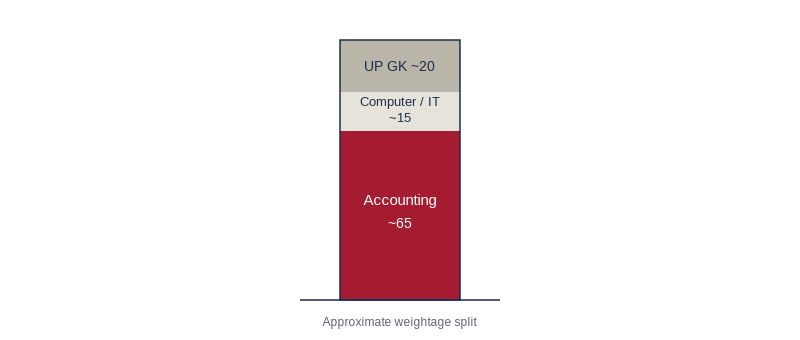
| Weightage (approx.) | ~65 accounting (audit, final accounts, double entry, BRS, GFR, taxation, advanced accountancy), ~15 computer/IT, ~20 UP GK (UP current affairs shamil) |
Worked Example 19.1: Negative Marking ka Expected Value
Expected value (EV) kisi guess ka ausat parinam hai, agar wahi guess baar-baar kiya jaye. Maan lijiye ek prashn ke chaar options hain aur ummeedwar bilkul andha (blind) guess karta hai:
- Sahi hone ki probability = 1/4, laabh = +1 mark
- Galat hone ki probability = 3/4, haani = -0.25 mark
EV = (1/4 x 1) - (3/4 x 0.25) = 0.25 - 0.1875 = +0.0625 mark
Nishkarsh: blind guess ka EV thoda positive hai, par labh bahut chhota hai. Yadi ummeedwar chaar me se do options ko eliminate kar sake, to EV = (1/2 x 1) - (1/2 x 0.25) = +0.375 mark, aur guess lagana tarksangat (rational) ho jaata hai. Yadi ek bhi option eliminate na ho aur topic bilkul anjaan ho, to guess ka fayda keval +0.0625 hai - ye risk vyavaharik roop se seemit labh deta hai.
Critical Discussion
Teen exam-traps yahan dhyan deneya hain. Pehla: EV ka ganit keval tab kaam karta hai jab prashnon ki sankhya bahut badi ho; ek-do prashnon par variance bahut zyada hota hai, isliye "EV positive hai" ka matlab "har sawaal par guess karo" nahi hai. Doosra: 120 minute me 100 prashn ka matlab prati prashn lagbhag 1 minute 12 second hai; numeric prashn is se zyada samay lete hain, isliye pehle round me keval aasan prashn hal karne chahiye aur calculation wale baad ke round ke liye chhodne chahiye. Teesra: OMR sheet me bubble poora aur sahi bharna utna hi zaroori hai jitna sahi uttar chunna; aakhri 10 minute OMR review aur flagged prashnon ke liye reserved rakhne chahiye.
19.2 Using Previous-Year Questions: Method and Limits
Previous-year question (PYQ) wo prashn hai jo kisi pichhli official pariksha me vaastav me poochha gaya ho. PYQ mahatvapurna isliye hai kyunki usme commission ki soch dikhti hai: kaunsa topic baar-baar aata hai, kitni depth maangi jaati hai, aur options kaise frame kiye jaate hain. Is pustak ke liye 201 official Mains prashnon ka bank taiyar kiya gaya hai (Section 19.4).
Teen-Round Vidhi
PYQ bank ko padhne ki anushansit (recommended) vidhi teen rounds me hai:
- Round 1 - Solve: sabhi prashn bina uttar dekhe hal kiye jaate hain. Iska uddeshya baseline janna hai: kaunse topics me gyan pehle se hai aur kaunse me nahi.
- Round 2 - Error analysis: har galat prashn ko alag notebook me likha jaata hai, aur galti ki wajah vargikrit (classify) ki jaati hai: concept ki kami, calculation ki galti, ya prashn padhne me truti.
- Round 3 - Spaced repetition: wahi galat prashn teen din baad dobara hal kiye jaate hain. Jo prashn teesre round me bhi galat ho, wahi vidyarthi ka vaastavik weak point hai, aur usi se sambandhit chapter dobara khola jana chahiye.
Official Answer Key ke Saath Vyavhar
Official answer key ko aadhar (base) maana jana chahiye. Par yadi kisi key par shak ho, to use standard text se verify karna chahiye - Companies Act, Standards on Auditing, ya ICAI ki samagri se - aur apni note rakhi jani chahiye. Is chapter ke bank me aise 8 prashn hain jinpar fact-check ke dauran sandeh vyakt kiya gaya hai; unhe "(flagged)" mark kiya gaya hai aur Section 19.11 ki case study me unka vishleshan hai. Pariksha ke dristi se niyam saral hai: jo uttar official key maanti hai, wahi tick karna hai, chahe chalta kanoon badal chuka ho; par conceptual samajh ke liye dono - key wala uttar aur vartaman kanoon - yaad rakhne chahiye.
Time Management
120 minute me 100 prashn: prati prashn ausat 1 minute 12 second. Pehle round me keval aasan prashn, doosre round me calculation wale, aur aakhri 10 minute OMR check aur sandigdh (doubtful) prashnon ke liye. Guessing ka niyam Worked Example 19.1 se aata hai: do options eliminate ho saken to guess lagana uchit hai.
Critical Discussion
Trend analysis ki sahi paddhati (method) ye hai ki har PYQ ko teen axis par tag kiya jaye: (topic, sub-topic, difficulty), aur type (concept / numeric / section-number) alag se. Iske baad frequency table banakar hi koi nishkarsh nikala jana chahiye. Do hi papers (~200 prashn) ka sample chhota hai; is se koi pakka niyam nahi banta. Trend ek prior hai - pichhle paper me baar-baar aaya topic agli baar aane ki sambhavna thodi zyada rakhta hai - guarantee nahi, kyunki commission naye topics bhi ghushata hai; isliye syllabus ka poora coverage avashyak hai. Ant me, difficulty calibration: numeric prashnon me samay zyada lagta hai, isliye unki priority "marks per minute" ke adhar par tay karni chahiye, na ki keval unki frequency ke adhar par.
Ummeedwar ke notes ke anusaar pichhle Mains papers (5 January 2025 aur 16 February 2025 ki official answer keys) me in topics ka punravritti (recurrence) dikha: depreciation methods, cheque aur NI Act, store documents, hire purchase, GST aur Income Tax ke sections, UP ke zile, aur 1857 ke leaders. Ye observation ummeedwar ke apne notes par aadharit hai aur Section 19.6 ki trend tables se milti-julti hai.
19.3 Topic Weightage and Preparation Priorities
Weightage ka anumaan ummeedwar ke notes se hai aur approximate hai. Neechy ki table taiyari ka kram (priority) dikhati hai; priority 1 wale topics sabse pehle aur sabse gehraayi se padhe jane chahiye.
| Unit | Approx. Weight | Preparation Priority |
|---|---|---|
| Final accounts, double entry, rectification, BRS | High | 1 |
| Depreciation (SLM, WDV), hire purchase | High | 1 |
| Auditing basics: vouching, verification, internal control, audit report | High | 1 |
| Companies Act: audit provisions, auditor appointment | Medium | 2 |
| GFR, CAG, PAC, govt audit | Medium | 2 |
| GST, Income Tax basics | Medium | 2 |
| Computer / IT (MS Office, internet, e-banking, RTGS) | Medium (~15) | 2 |
| UP GK, current affairs, Arthik Samiksha | ~20 | 2 |
28-Din Preparation Plan
| Day | Work |
|---|---|
| 1-7 | Accounting core (journal se final accounts, BRS, depreciation, hire purchase), roz 30 numeric prashn |
| 8-12 | Auditing basics aur Companies Act (is pustak ke Ch 1-13) |
| 13-16 | Govt audit, GFR, CAG, PAC (Ch 14), tax basics (Ch 15) |
| 17-19 | Computer/IT aur e-banking, RTGS |
| 20-22 | UP GK aur Arthik Samiksha |
| 23-26 | Full mock (100 Q, 120 min), analysis |
| 27 | Keval galat-prashn notebook |
| 28 | Halka revision aur paryaapt neend |
Examination-Day Strategy
- Pehle 60 minute me sabhi aasan prashn.
- Numeric prashnon me units aur sign check (Dr/Cr, loss/profit).
- Negative marking 0.25 hai: blind guess nahi, par 2-option elimination par guess uchit.
- Section-number wale prashn yaad se aate hain; isliye cheat sheet (Chapter 20) ka upyog.
- Aakhri 10 minute OMR bubble check.
Critical Discussion
Weightage ke anka approximate hain; unka satyaapan (verification) tabhi hoga jab 201 PYQ ka poora tagged data uplabdh ho. Section 19.6 ki tables is disha me pehla kadam hain, kyunki wo keval bank ke andar ke counts par aadharit hain, bahar ke anumaan par nahi. Vidyarthi ko chahiye ki wo priority order ko niyam nahi, disha ki tarah le: priority 2 ka topic chhodna galat hai; keval samay ka aavantan (allocation) alag hai.
19.4 Previous-Year Question Bank (201 Questions)
Neechy ka bank 201 official Mains prashnon ka unit-wise sangrah hai: UPSSSC Mains 5 January 2025 (P1, official key) aur 16 February 2025 (P2, revised official key), jaise ki ummeedwar ki quiz site (https://clock-quiz.netlify.app) par darj hain. Prashn ka text yahan English me hai; Hindi versions quiz site par uplabdh hain. Har uttar usi key ke anusaar hai jo site par use hui hai. Keys ko ummeedwar apni official answer key PDFs se match kar le; jin items par sandeh tha unhe Section 19.5 me "(flagged)" mark kiya gaya hai.
Unit 1: Audit (13 questions)
Is unit ke prashn audit ke foundations par hain: definitions (Montgomery), audit ke types (statutory), CAG ke constitutional provisions (Article 148, reporting path), aur Companies Act 1956 ke purane section numbers (s.314, s.227(4A)). Dhyan dijiye ki do prashn (P1-3, P1-4) 1956 Act ke hain; inka vishleshan Section 19.11 ki case study me hai. Is unit me do accounting prashn (closing stock, GP ratio) bhi paper ne audit section me rakhe hain, isliye topic boundaries ko rigid nahi samajhna chahiye.
-
[P1-1] "Auditing is a systematic examination of the books and records of a business... to ascertain or verify, and to report upon the facts" - this definition is given by
Options: Montgomery (correct); Spicer and Pegler; Dicksee; Kohler
Answer: Montgomery. -
[P1-2] A compulsory audit carried out every year by an auditor is called the ___ audit
Options: Statutory (correct); Internal; Cost; Continuous
Answer: Statutory. -
[P1-3] Which Section of the Companies Act, 1956 restricts relatives/partners of a director from holding an office of profit in the company?
Options: Section 314 (correct); Section 227; Section 292; Section 143
Answer: Section 314. -
[P1-4] Under Section ___ of the Companies Act, 1956 the company auditor makes specific comments on matters covered by an order notified by the Central Government
Options: 227-4A (correct); 314; 233; 185
Answer: 227-4A. -
[P1-5] Under which Article does the President appoint the Comptroller and Auditor General of India?
Options: Article 148 (correct); Article 112; Article 266; Article 280
Answer: Article 148. -
[P1-6] To whom does the CAG submit the audit report?
Options: The President (correct); Prime Minister; Finance Minister; Speaker of Lok Sabha
Answer: The President. -
[P1-7] ___ stock is valued at cost or realisable price, whichever is less
Options: Closing (correct); Opening; Dead; Buffer
Answer: Closing. -
[P1-8] ___ losses, like cash defalcation or stock destroyed by fire not covered by insurance, are
Options: Abnormal (correct); Normal; Operating; Deferred
Answer: Abnormal. -
[P1-11] Gross profit Rs 4,88,000 and sales Rs 21,80,000. Gross profit ratio is
Options: 22.39% (correct); 20.39%; 24.59%; 18.65%
Answer: 22.39%. (4,88,000 / 21,80,000) x 100 = 22.39%. -
[P1-14] A ___ liability is not an actual liability but becomes one on the happening of an uncertain event
Options: Contingent (correct); Current; Long-term; Fixed
Answer: Contingent. -
[P2-1] The book "An Introduction to Indian Government Accounts and Audit" (3rd ed.) is issued by
Options: Comptroller and Auditor General of India (correct); Reserve Bank of India; Ministry of Finance; ICAI
Answer: Comptroller and Auditor General of India. -
[P2-2] The Banking Regulation Act, 1949 deals with the audit of ___ companies
Options: Banking (correct); Insurance; Electricity; Manufacturing
Answer: Banking. -
[P2-3] Who acts as a watch-dog for the directors, while the statutory auditor acts as a watch-dog for shareholders?
Options: Internal auditor (correct); Cost auditor; Tax auditor; Registrar of Companies
Answer: Internal auditor.
Unit 2: Fundamentals of accounting (24 questions)
Fundamentals unit me accounting equation, solvency (assets > liabilities), GAAP, depreciation methods (SLM, WDV, depletion), error rectification (P&L Adjustment account) aur free samples jaise adjustments poochhe gaye hain. Ye unit numeric aur conceptual dono type ka hai. Depreciation methods ka farak keval ratta nahi hai; har method ki logic samajhne se ghooma-hua prashn bhi hal hota hai.
-
[P1-9] If assets exceed liabilities, the firm is called
Options: Solvent (correct); Insolvent; Bankrupt; Liquid
Answer: Solvent. -
[P1-10] Goods distributed as free samples are debited to
Options: Advertisement Account (correct); Purchases Account; Sales Account; Drawings Account
Answer: Advertisement Account. -
[P1-12] ___ are guidelines establishing standards for sound accounting practices and reporting
Options: Accounting Principles (correct); Accounting Vouchers; Audit Programmes; Trial Balances
Answer: Accounting Principles. -
[P1-13] The word "Journal" is derived from the ___ word "Jour", meaning a day
Options: French (correct); Latin; Greek; German
Answer: French. -
[P1-15] After rectification of last year's errors, the balance of the Profit and Loss Adjustment Account is transferred to the
Options: Capital Account (correct); Drawings Account; Suspense Account; Reserve Account
Answer: Capital Account. -
[P1-16] Depreciable amount of an asset is historical cost less the estimated ___ value
Options: Residual (correct); Market; Book; Replacement
Answer: Residual. -
[P1-17] Under which depreciation method is a fixed percentage of the original cost written off every year?
Options: Fixed Instalment (Straight Line) (correct); Diminishing Balance; Annuity; Sum of Years' Digits
Answer: Fixed Instalment (Straight Line). -
[P1-18] ___ relates to cost allocation for intangible assets such as patents and leaseholds
Options: Amortisation (correct); Depletion; Appreciation; Revaluation
Answer: Amortisation. -
[P1-19] Under which method is depreciation charged each year at a fixed percentage on the balance brought forward from the previous year?
Options: Diminishing balance (correct); Straight line; Revaluation; Annuity
Answer: Diminishing balance. -
[P1-20] Which Accounting Standard requires disclosure of all material items that could influence users' decisions?
Options: Accounting Standard 1 (correct); Accounting Standard 2; Accounting Standard 6; Accounting Standard 10
Answer: Accounting Standard 1. AS-1 is "Disclosure of Accounting Policies". -
[P1-44] Types of vouchers are
Options: All of these (receipt, payment, journal, contra etc.) (correct); Only receipt vouchers; Only payment vouchers; Only journal vouchers
Answer: All of these (receipt, payment, journal, contra etc.). -
[P1-94] Wear and tear or depletion of capital stock over time is
Options: Depreciation (correct); Amortisation of goodwill; Appreciation; Inflation
Answer: Depreciation. -
[P2-4] Which entries are passed at the end of each accounting period to close nominal accounts?
Options: Closing entries (correct); Opening entries; Rectifying entries; Contra entries
Answer: Closing entries. -
[P2-5] Liabilities not payable within the next accounting period but payable in the next five to ten years are
Options: Long-term liabilities (correct); Current liabilities; Contingent liabilities; Fictitious liabilities
Answer: Long-term liabilities. -
[P2-6] Which tax charged from customers on sale of goods is not part of sales revenue?
Options: Sales tax (correct); Income tax; Property tax; Wealth tax
Answer: Sales tax. -
[P2-7] Which account is prepared from nominal accounts?
Options: Profit and Loss Account (correct); Balance Sheet; Cash Book; Trial Balance
Answer: Profit and Loss Account. -
[P2-8] Which accounting concept means information is reliable and verifiable with some evidence?
Options: Objective evidence concept (correct); Going concern concept; Dual aspect concept; Money measurement concept
Answer: Objective evidence concept. -
[P2-9] Cash or goods taken from the business by the proprietor for personal use is called
Options: Drawings (correct); Capital; Loan; Bad debt
Answer: Drawings. -
[P2-10] If a nominal account is wrongly debited, ___ will reduce or loss will increase
Options: Profit (correct); Capital; Liability; Asset
Answer: Profit. -
[P2-11] Which discount is allowed by a creditor to a debtor for prompt payment?
Options: Cash discount (correct); Trade discount; Quantity discount; Bonus
Answer: Cash discount. -
[P2-12] Permanent, continuing and gradual shrinkage in the book value of a fixed asset is
Options: Depreciation (correct); Appreciation; Fluctuation; Impairment of stock
Answer: Depreciation. -
[P2-13] Which system of accounting distributes cost less salvage over the estimated useful life of a tangible asset?
Options: Depreciation accounting (correct); Inflation accounting; Cash accounting; Social accounting
Answer: Depreciation accounting. -
[P2-14] Under which depreciation method is the amount spent on buying an asset treated as an investment earning interest at a fixed rate?
Options: Annuity method (correct); Straight line method; Insurance policy method; Machine hour method
Answer: Annuity method. -
[P2-15] Under which method is the asset revalued at year end and compared with its value at the start of the year?
Options: Revaluation method (correct); Annuity method; Depletion method; Written down value method
Answer: Revaluation method.
Unit 3: Double entry, GFR (26 questions)
Ye unit NI Act 1881 (cheque s.6, banker ki duty s.31) aur double account system (bijli companies: assets original value par, SLM since 1979, contingency reserve 5% tak, development reserve) ke ird-gird ghoomta hai, saath me stores/GFR documents (purchase requisition, tender, GRN, bin card). Double account system ek chhota par scoring topic hai: 4-5 facts pakke karne se poora cover ho jaata hai.
-
[P1-21] Under which Section of the Negotiable Instruments Act, 1881 is a cheque defined?
Options: Section 6 (correct); Section 4; Section 5; Section 31
Answer: Section 6. -
[P1-22] Under which Section must a banker having sufficient funds of the drawer pay a duly presented cheque, or compensate for loss?
Options: Section 31 (correct); Section 6; Section 138; Section 85
Answer: Section 31. -
[P1-23] Under which system are separate accounts of capital and revenue receipts and payments prepared?
Options: Double Account System (correct); Single Entry System; Cash Basis System; Mercantile System
Answer: Double Account System. -
[P1-24] Since 1 April 1979, which depreciation method can be charged under the double account system?
Options: Straight Line Method (correct); Diminishing Balance Method; Annuity Method; Depletion Method
Answer: Straight Line Method. -
[P1-25] Under the double account system, the company appropriates to contingency reserve not less than 1/4% and not more than 1/2% of original cost of fixed assets until it reaches ___ of that cost
Options: 5% (correct); 10%; 15%; 2%
Answer: 5%. -
[P1-26] Under the double account system, development reserve is based on income tax saved on development rebate under which year's Income Tax Act?
Options: 1961 (correct); 1922; 1991; 2005
Answer: 1961. -
[P1-27] The purchase requisition prepared by the storekeeper is generally in
Options: Triplicate (correct); Single copy; Duplicate; Five copies
Answer: Triplicate. -
[P1-28] Regular purchase requisitions are prepared when stores reach the ___ level
Options: Re-ordering (correct); Maximum; Danger; Minimum
Answer: Re-ordering. -
[P1-29] Which tender method invites quotations from many parties through advertisement?
Options: Open tender (correct); Limited tender; Single tender; Negotiated tender
Answer: Open tender. -
[P1-30] Depending on the organisation's size, how many copies of a purchase order are prepared?
Options: Three to five (correct); One; Two only; Ten
Answer: Three to five. -
[P1-31] After inspection, the goods receiving clerk records the materials received in a ___ note
Options: Goods received (correct); Credit; Debit; Delivery
Answer: Goods received. -
[P1-32] Which card records receipts and issues of material and is kept for each item of stores?
Options: Bin card (correct); Job card; Time card; Debit card
Answer: Bin card. -
[P2-16] Which reserve is created from profits above the reasonable return earned by an electric undertaking?
Options: Tariffs and Dividends Control Reserve (correct); General reserve; Capital reserve; Secret reserve
Answer: Tariffs and Dividends Control Reserve. -
[P2-17] In the double account system, assets are shown in the capital account at their
Options: Original value (correct); Market value; Scrap value; Written down value
Answer: Original value. -
[P2-18] Which account system is only a method of presentation of final accounts?
Options: Double account system (correct); Double entry system; Single entry system; Cost accounting
Answer: Double account system. -
[P2-19] Which depreciation method is compulsorily used and invested in securities in the double account system?
Options: Depreciation fund method (correct); Straight line method; Diminishing balance method; Sum of digits method
Answer: Depreciation fund method. -
[P2-20] Which cheque is payable to the person named in it, or to the bearer?
Options: Bearer cheque (correct); Order cheque; Crossed cheque; Stale cheque
Answer: Bearer cheque. -
[P2-21] Which cheque is payable to the person named in it, or to his order?
Options: Order cheque (correct); Bearer cheque; Post-dated cheque; Traveller's cheque
Answer: Order cheque. -
[P2-22] Under which section of the Negotiable Instruments Act is the amount stated in words given priority over figures?
Options: Section 18 (correct); Section 6; Section 31; Section 138
Answer: Section 18. -
[P2-23] Which requisition is sent to the purchase department when stock reaches the re-order level?
Options: Purchase requisition (correct); Material requisition; Bill of materials; Credit note
Answer: Purchase requisition. -
[P2-24] Which document authorises and records issue of materials from the store?
Options: Material requisition (correct); Purchase requisition; Goods received note; Invoice
Answer: Material requisition. -
[P2-25] A list of standard quantities of all materials required for a job, work order or process is
Options: Bill of materials (correct); Bin card; Stores ledger; Job card
Answer: Bill of materials. -
[P2-26] Direct transfer of materials between departments should be done through a ___ note
Options: Material transfer (correct); Debit; Credit; Delivery
Answer: Material transfer. -
[P2-27] The system of finding quantity and value of inventory by actual physical count at end of the period is
Options: Periodic inventory system (correct); Perpetual inventory system; ABC analysis; Just-in-time
Answer: Periodic inventory system. -
[P2-28] Which card shows maximum level, minimum level and re-order level?
Options: Bin card (correct); Job card; Time card; ATM card
Answer: Bin card. -
[P2-30] Which pay certificate is also necessary before the first payment of pension to a retired government servant?
Options: Last pay certificate (correct); First pay certificate; Average pay certificate; Bonus certificate
Answer: Last pay certificate.
Unit 4: E-banking (16 questions)
E-banking unit me budgets (master budget, budgetary control, long-term vs current budgets, past-performance based budgets) aur computerised accounting (hierarchy of accounts, coding relationships) ke prashn hain, saath me RTGS, NEFT, UPI aur AePS jaise payment rails.
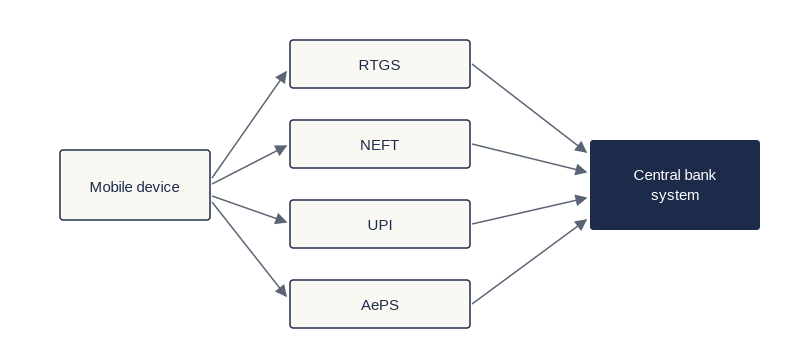
in char rails ka flow dikhata hai.
-
[P1-33] RTGS stands for
Options: Real Time Gross Settlement (correct); Rapid Transfer of Gross Savings; Real Transaction Gateway System; Regional Transfer and Gross Settlement
Answer: Real Time Gross Settlement. -
[P1-35] A ___ is a detailed statement of forecast resulting from joint action of a number of planned operations
Options: Budget (correct); Balance Sheet; Voucher; Ledger
Answer: Budget. -
[P1-36] ___ is a technique of managerial control through budgets
Options: Budgetary control (correct); Standard costing; Cost audit; Marginal costing
Answer: Budgetary control. -
[P1-37] Which budget is the most important and of primary importance?
Options: Sales budget (correct); Cash budget; Production budget; Purchase budget
Answer: Sales budget. -
[P1-38] Which budget is established on a long-term basis?
Options: Research and Development Cost Budget (correct); Cash budget; Sales budget; Material usage budget
Answer: Research and Development Cost Budget. -
[P1-39] ___ budgets are prepared mainly on past performance and actual costs
Options: Conventional (correct); Zero-based; Flexible; Performance
Answer: Conventional. -
[P1-42] In computerised accounting, ___ is described by a definite relationship between super group and sub-group
Options: Hierarchy of accounts (correct); Trial balance; Voucher series; Audit trail
Answer: Hierarchy of accounts. -
[P1-43] In which coding system are identifying characters letters of an alphabet?
Options: Mnemonic coding (correct); Numeric coding; Block coding; Sequential coding
Answer: Mnemonic coding. -
[P1-45] ___ is a way of conducting business electronically with the help of internet technology
Options: E-commerce (correct); E-learning; E-mail; Telex
Answer: E-commerce. -
[P1-46] ___ cards allow users to borrow money up to a certain limit
Options: Credit (correct); Debit; Prepaid; Smart
Answer: Credit. -
[P1-74] Which of the following is not an E-Government model?
Options: Business-to-Business (B2B) (correct); Government-to-Citizen (G2C); Government-to-Business (G2B); Government-to-Government (G2G)
Answer: Business-to-Business (B2B). -
[P1-75] IMPS stands for
Options: Immediate Payment Service (correct); Instant Money Payment System; Internet Mobile Payment Service; Immediate Postal Money Service
Answer: Immediate Payment Service. -
[P1-76] Payment with identification and authentication through the Aadhaar database is called
Options: AePS (correct); NEFT; BBPS; ECS
Answer: AePS. AePS = Aadhaar Enabled Payment System. -
[P2-32] The consolidated summary of the various functional budgets is the
Options: Master budget (correct); Cash budget; Sales budget; Capital budget
Answer: Master budget. -
[P2-34] Networking of bank branches so that customers can operate accounts from any branch is
Options: Core banking (correct); Mobile banking; Telebanking; Branch banking
Answer: Core banking. -
[P2-36] Which is an instant inter-bank electronic fund transfer system in India that works 24x7?
Options: IMPS (Immediate Payment Service) (correct); NEFT batch only; Cheque clearing; Demand draft
Answer: IMPS (Immediate Payment Service).
Unit 5: Advanced accounts (21 questions)
Advanced accounts me hire purchase (possession turant, default par repossession, maintenance reserve), branch accounts (wholesale price, unsold stock ka reserve), insolvency (insolvent ki definition) aur departmental accounts hain. Concepts seemit hain par numeric lamba ho sakta hai; marks-per-minute ke adhar par inhe second round ke liye rakho.
-
[P1-34] An ___ is one who cannot pay his liabilities as and when claimed
Options: Insolvent (correct); Solvent; Liquidator; Receiver
Answer: Insolvent. -
[P1-47] Under which system does the buyer get possession immediately and pay the total price in instalments, ownership passing on the last instalment?
Options: Hire purchase (correct); Credit sale; Consignment; Cash sale
Answer: Hire purchase. -
[P1-48] Which equation is correct?
Options: Hire Purchase Price - Cash Price = Total Interest (correct); Hire Purchase Price + Cash Price = Total Interest; Cash Price - Down Payment = Total Interest; Hire Purchase Price x Cash Price = Total Interest
Answer: Hire Purchase Price - Cash Price = Total Interest. -
[P1-49] On default of an instalment, the vendor may repossess the goods and forfeit the amount received, treating it as
Options: Hire charge (correct); Capital; Loan; Penalty fine
Answer: Hire charge. -
[P1-50] Goods sold with a guarantee of free maintenance: the maintenance charge is credited to a separate account called
Options: Maintenance Suspense account (correct); Reserve account; Sales return account; Provision account
Answer: Maintenance Suspense account. -
[P1-51] For hire purchase sales, the rate of gross profit is ___ on cost (as given in the paper)
Options: 32% (correct); 25%; 20%; 40%
Answer: 32%. -
[P1-52] Goods sent by head office to branches at wholesale price: unsold goods at the branch must be reduced to ___ price
Options: Cost (correct); Market; Retail; Invoice
Answer: Cost. -
[P1-53] Under departmental accounts, depreciation is allocated among departments on the basis of
Options: Assets employed (correct); Sales of each department; Number of employees; Floor area
Answer: Assets employed. -
[P1-54] The Presidency Towns Insolvency Act, applicable to Mumbai, Kolkata and Chennai, was enacted in
Options: 1909 (correct); 1920; 1881; 1932
Answer: 1909. -
[P1-55] The excess of minimum rent over actual royalty (based on output or sales) is called
Options: Short workings (correct); Recoupment; Surplus royalty; Landlord's share
Answer: Short workings. -
[P1-56] A fire insurance policy usually includes an average clause to discourage ___ insurance of stock
Options: Under (correct); Over; Double; Full
Answer: Under. -
[P2-29] Under which system can the seller sue for the price in court if the buyer defaults in an instalment?
Options: Instalment purchase system (correct); Hire purchase system; Cash sale system; Consignment system
Answer: Instalment purchase system. In hire purchase the seller can only repossess; in instalment purchase ownership passes at once and he can sue for the price. -
[P2-37] The amount paid at the time of taking delivery of goods under hire purchase is the
Options: Down payment (correct); Hire charge; Last instalment; Interest
Answer: Down payment. -
[P2-38] Who closes the hire purchaser's account by transferring its balance to Goods Repossessed account?
Options: Vendor (seller) (correct); Hire purchaser; Bank; Auditor
Answer: Vendor (seller). -
[P2-39] Under which branch accounting system does head office open a separate account for each branch to find profit or loss?
Options: Debtors system (correct); Final accounts system; Stock and debtors system; Wholesale system
Answer: Debtors system. -
[P2-40] In departmental accounts, goods transferred from one department to another are usually transferred at ___ price
Options: Selling (or cost plus agreed margin) (correct); Scrap; Face value; Zero
Answer: Selling (or cost plus agreed margin). -
[P2-41] If a competent court passes an order of adjudication against a person, he is called
Options: Insolvent (correct); Solvent; Trustee; Official receiver
Answer: Insolvent. -
[P2-42] After the order of adjudication, interest is paid to creditors at (as per the paper)
Options: 6% per annum (correct); 12% per annum; 9% per annum; 3% per annum
Answer: 6% per annum. As keyed by UPSSSC; check the Act for the current rate. -
[P2-43] A periodic payment based on output or sales for use of a certain asset is
Options: Royalty (correct); Rent; Salary; Commission on sales
Answer: Royalty. -
[P2-44] Credit balance of Short-workings Suspense account, if recoverable later, is carried forward and shown as a liability in the
Options: Balance sheet (correct); Trading account; Profit and loss account; Cash book
Answer: Balance sheet. -
[P2-45] Under a loss-of-profit insurance claim, "annual turnover" means turnover during the ___ months immediately before the damage
Options: 12 (correct); 3; 6; 24
Answer: 12.
Unit 6: Tax and arithmetic (18 questions)
Tax unit me Income-tax Act 1961 ke key sections (87A rebate, 10(10AA) leave encashment, 24(b) home-loan interest, 35D preliminary expenses) aur GST (1 July 2017 launch, CGST Act s.25 registration) hain, saath me simple/compound interest aur percentage ke arithmetic prashn. Yaad rakhiye: 1 April 2026 se Income-tax Act 2025 lagu hai aur section numbering badal chuki hai; PYQ key me 1961 Act ke purane numbers hi hain [12].
-
[P1-57] Under which Section of the Income Tax Act is the rebate available only to a resident individual?
Options: Section 87A (correct); Section 80C; Section 80D; Section 44AD
Answer: Section 87A. -
[P1-58] Under which Section is leave encashment received while still in service taxable in full?
Options: Section 10(10AA) (correct); Section 10(10); Section 80C; Section 16
Answer: Section 10(10AA). -
[P1-59] For a building acquired/constructed with borrowed capital, the maximum interest deduction limit (as per the paper) is
Options: Rs 30,000 (correct); Rs 1,50,000; Rs 2,00,000; Rs 50,000
Answer: Rs 30,000. As keyed by UPSSSC; limits change by law, so verify current rules before relying on it. -
[P1-60] Under which Section are specified preliminary expenses of an Indian company allowed?
Options: Section 35D (correct); Section 32; Section 37; Section 43B
Answer: Section 35D. -
[P1-61] GST was introduced in India from
Options: 1 July 2017 (correct); 1 April 2017; 1 January 2018; 1 July 2016
Answer: 1 July 2017. -
[P1-62] Which Section of the CGST Act, 2017 deals with the procedure for registration?
Options: Section 25 (correct); Section 22; Section 16; Section 39
Answer: Section 25. -
[P1-63] Under which Section of the CGST Act is "electronic commerce operator" defined?
Options: Section 2(45) (correct); Section 2(17); Section 9; Section 24
Answer: Section 2(45). -
[P1-64] If the person furnishes the return within ___ days of the assessment order, the assessment order is withdrawn (as per the paper)
Options: 30 (correct); 15; 60; 90
Answer: 30. -
[P1-65] Per the paper, a supplier must register under GST if aggregate turnover in a financial year exceeds Rs
Options: 20 lakh (correct); Rs 10 lakh; Rs 40 lakh; Rs 1 crore
Answer: 20 lakh. As keyed by UPSSSC (general threshold for services; goods and special-category states differ, check current law). -
[P2-46] Under which Income Tax section is expenditure on current repairs of machinery, plant or furniture allowed?
Options: Section 31 (correct); Section 35D; Section 80C; Section 10(10AA)
Answer: Section 31. -
[P2-47] Under which section can an assessee claim a deduction for donations to charitable institutions and relief funds?
Options: Section 80G (correct); Section 80C; Section 80D; Section 87A
Answer: Section 80G. -
[P2-48] A person liable to register under GST must apply within ___ days of becoming liable
Options: 30 (correct); 15; 45; 90
Answer: 30. -
[P2-49] Which commercial document is issued by a seller to a buyer to reduce the buyer's dues, for example on goods returned?
Options: Credit note (correct); Debit note; Delivery challan; Quotation
Answer: Credit note. -
[P2-50] Under which section of the CGST Act is the electronic cash ledger defined/maintained for each registered person?
Options: Section 49(1) (correct); Section 25; Section 39; Section 16
Answer: Section 49(1). -
[P2-51] A long-term capital asset is held for more than ___ months before transfer (general rule as keyed)
Options: 36 (correct); 12; 24; 60
Answer: 36. The holding period has changed for some assets (12 or 24 months) after 2024. Check current law. -
[P2-52] Men and women workers are in the ratio 5:3, daily wages in the ratio 3:2. The ratio of total weekly wages is
Options: 105 : 42 (correct); 15 : 7; 25 : 9; 5 : 2
Answer: 105 : 42. Daily wages = 5x3 : 3x2 = 15 : 6 = 5 : 2. The key (105:42) multiplies by 7 days. As keyed by UPSSSC. -
[P2-53] The fourth proportional to 5, 8 and 16 is
Options: 25.6 (correct); 10; 20; 32
Answer: 25.6. 5 : 8 = 16 : x so x = 8 x 16 / 5 = 25.6. -
[P2-54] Simple interest on Rs 1600 for one year at 10% p.a. is
Options: Rs 160 (correct); Rs 16; Rs 1,760; Rs 320
Answer: Rs 160. SI = 1600 x 10 x 1 / 100 = 160.
Unit 7: Computer/IT (35 questions)
Ye sabse bada non-GK unit hai: computer history (Babbage), hardware (ALU, CU), data storage, languages, internet history (ARPANET, email, WWW, Ethernet), MS Office shortcuts aur IT Act 2000. Content lagbhag poora recall-based hai; ek structured reading aur do revisions se ye unit pakka ho jaata hai.
-
[P1-40] ___ is a system computers use to achieve orderly storage of data
Options: Database Management System (correct); Operating System; Network Protocol; Compiler
Answer: Database Management System. -
[P1-41] ___ is one of the most effective hardware controls enabling timely detection of errors
Options: Parity bit (correct); Header label; Cache; Bus
Answer: Parity bit. -
[P1-66] Who is the Father of the Computer?
Options: Charles Babbage (correct); Alan Turing; Bill Gates; Steve Jobs
Answer: Charles Babbage. -
[P1-67] Arithmetic and logical operations are performed by
Options: Arithmetic and Logical Unit (ALU) (correct); Control Unit; Memory Unit; Input Unit
Answer: Arithmetic and Logical Unit (ALU). -
[P1-68] PCI stands for
Options: Peripheral Component Interconnect (correct); Personal Computer Interface; Program Control Instruction; Primary Core Input
Answer: Peripheral Component Interconnect. -
[P1-69] A program in execution is called
Options: Process (correct); Thread library; Compiler; File
Answer: Process. -
[P1-70] The fundamental language of a computer is
Options: Machine level language (correct); High level language; Assembly language; Fourth generation language
Answer: Machine level language. -
[P1-71] Shortcut key for Paste
Options: Ctrl + V (correct); Ctrl + C; Ctrl + X; Ctrl + Z
Answer: Ctrl + V. -
[P1-72] The act of breaking into computer security is
Options: Hacking (correct); Debugging; Compiling; Formatting
Answer: Hacking. -
[P1-73] Which is a physical thing appearing on an Ethernet or some wire?
Options: Packet (correct); Protocol; Domain; Cookie
Answer: Packet. -
[P1-77] Which is real-time communication between two users via computer?
Options: Chat (correct); E-mail; Blog; Newsgroup
Answer: Chat. -
[P1-78] DNS stands for
Options: Domain Name System (correct); Digital Network Service; Data Name Server; Dynamic Network System
Answer: Domain Name System. -
[P1-79] Algorithms are tested by
Options: Data (correct); Printers; Compilers only; Scanners
Answer: Data. -
[P1-80] Human-resembling robots are called
Options: Humanoids (correct); Androids only; Cyborgs; Drones
Answer: Humanoids. -
[P2-31] Which computers deal with actual numbers and obtain the answer by counting?
Options: Digital (correct); Analog; Hybrid; Mechanical
Answer: Digital. -
[P2-33] The set of programs that make the computer perform the desired work is
Options: Software (correct); Hardware; Firmware only; Peripheral
Answer: Software. -
[P2-35] The Information Technology Act, 2000 came into force on
Options: 17 October 2000 (correct); 9 June 2000; 15 August 2000; 1 January 2001
Answer: 17 October 2000. -
[P2-55] How many bits of data are sent at one time in a parallel port?
Options: 8 bits (correct); 1 bit; 4 bits; 64 bits
Answer: 8 bits. -
[P2-56] Which channel sends signals in one direction only?
Options: Simplex (correct); Half-duplex; Full-duplex; Multipoint
Answer: Simplex. -
[P2-57] Which channel sends signals in one direction at a time, like a walkie-talkie?
Options: Half-duplex (correct); Simplex; Full-duplex; Point-to-point
Answer: Half-duplex. -
[P2-58] Which channel sends signals in both directions simultaneously?
Options: Full-duplex (correct); Simplex; Half-duplex; Broadcast only
Answer: Full-duplex. -
[P2-59] A HALT instruction
Options: stops the program and halts the computer (correct); starts a new program; clears the screen; prints a file
Answer: stops the program and halts the computer. -
[P2-60] Running multiple programs at once in memory is called
Options: Concurrent program execution (correct); Program loading; Halting; Booting
Answer: Concurrent program execution. -
[P2-61] An equation that performs operations on worksheet data is a
Options: Formula (correct); Chart; Macro; Filter
Answer: Formula. -
[P2-62] Which is a layered set of protocols?
Options: TCP/IP (correct); HTML; URL; JPEG
Answer: TCP/IP. -
[P2-63] What was the first protocol for relaying IP packets over dial-up lines?
Options: Serial Line IP (SLIP) (correct); FTP; SMTP; HTTP
Answer: Serial Line IP (SLIP). -
[P2-64] Which device lets your computer connect to the telephone system?
Options: Modem (correct); Scanner; Plotter; Monitor
Answer: Modem. -
[P2-65] Which is a precursor of the Internet, funded by the US Department of Defense in 1969?
Options: ARPANET (correct); Ethernet; X.25; Wi-Fi
Answer: ARPANET. -
[P2-66] Who developed the standard "username@hostname" email format in 1971?
Options: Ray Tomlinson (correct); Tim Berners-Lee; Vint Cerf; Bob Metcalfe
Answer: Ray Tomlinson. -
[P2-67] Who developed the concept of the World Wide Web in 1991?
Options: Tim Berners-Lee (correct); Ray Tomlinson; Charles Babbage; Bill Gates
Answer: Tim Berners-Lee. -
[P2-68] Ethernet protocol was developed in 1973 at
Options: Xerox PARC (correct); Bell Labs; IBM; Microsoft
Answer: Xerox PARC. -
[P2-69] Which technology lets you connect to the internet without a direct line from your PC to the ISP?
Options: Wi-Fi (correct); Dial-up modem; Leased line; Coaxial cable
Answer: Wi-Fi. -
[P2-70] Software made available with the right to redistribute copies is
Options: Shareware (correct); Firmware; Spyware; Malware
Answer: Shareware. -
[P2-71] Machine learning comprises ___ that use data to learn
Options: Algorithms (correct); Printers; Cables; Spreadsheets only
Answer: Algorithms. -
[P2-72] In big data, "veracity" refers to
Options: trustworthiness (accuracy) of the data (correct); speed of data; size of data; variety of data
Answer: trustworthiness (accuracy) of the data.
Unit 8: UP GK (48 questions)
UP GK sabse bada aur sabse phaila hua unit hai: culture (gharana, Kajari, Khayal ke forms, Kalinjar fair), geography (climate), 1857 ke leaders, zile aur mandal, Vidhan Parishad ki composition, awards aur current affairs. Cramming se zyada roz thoda-thoda spaced reading kaam karti hai. Time-bound facts (GI tags ki sankhya, expressways) ko exam ke mahine ke current affairs se update kiya jana chahiye.
-
[P1-81] Which gharana is a blend of Khayal gayaki and Dhrupad-Dhamar?
Options: Agra Gharana (correct); Gwalior Gharana; Kirana Gharana; Patiala Gharana
Answer: Agra Gharana. -
[P1-82] In 1858 the Delhi division was separated from the North-Western Region and the capital was shifted from Agra to
Options: Allahabad (correct); Lucknow; Kanpur; Varanasi
Answer: Allahabad. -
[P1-83] Which folk song/dance of Uttar Pradesh is performed before the arrival of monsoons?
Options: Kajari (correct); Chaiti; Birha; Nautanki
Answer: Kajari. -
[P1-84] Which of the following is not a form of Khayal?
Options: Diwari Khayal (correct); Bada Khayal; Chhota Khayal; Tarana
Answer: Diwari Khayal. -
[P1-85] The Kalinjar fair of Uttar Pradesh is held annually at
Options: Banda (correct); Jhansi; Mirzapur; Sitapur
Answer: Banda. -
[P1-86] The climate of Uttar Pradesh is
Options: Tropical monsoon (correct); Mediterranean; Equatorial; Tundra
Answer: Tropical monsoon. -
[P1-87] Which district of UP is famous for the lock industry?
Options: Aligarh (correct); Firozabad; Moradabad; Bhadohi
Answer: Aligarh. -
[P1-88] In which city of Uttar Pradesh is the Raza Library situated?
Options: Rampur (correct); Bareilly; Lucknow; Meerut
Answer: Rampur. -
[P1-89] Uttar Pradesh is divided into how many agro-climatic zones?
Options: 9 (correct); 5; 7; 12
Answer: 9. -
[P1-90] Bundelkhand soil is found in the
Options: Southern plateau (correct); Terai region; Ganga plain; Himalayan foothills
Answer: Southern plateau. -
[P1-91] The colour extracted from the bark of Gum Acacia (babul) is used for
Options: Dyeing leather items (correct); Colouring sweets; Painting walls; Printing newspapers
Answer: Dyeing leather items. -
[P1-92] The White Revolution in India is associated with
Options: Milk production (correct); Wheat production; Egg production; Fish production
Answer: Milk production. -
[P1-93] GDP deflator is the ratio of
Options: Nominal GDP to real GDP (correct); Real GDP to nominal GDP; GDP to population; Exports to imports
Answer: Nominal GDP to real GDP. -
[P1-95] Which of the following is the state animal of Uttar Pradesh?
Options: Swamp deer (Barasingha) (correct); Tiger; Blackbuck; Elephant
Answer: Swamp deer (Barasingha). -
[P1-96] Where has India's first multi-modal terminal been built?
Options: Varanasi (correct); Kolkata; Kanpur; Prayagraj
Answer: Varanasi. On the Ganga (National Waterway-1) at Varanasi. -
[P1-97] How many times has the UP Legislative Assembly been constituted till date (as per the paper)?
Options: Eighteen (correct); Sixteen; Fifteen; Twenty
Answer: Eighteen. As keyed in Jan 2025. -
[P1-98] In which year was Chaudhary Charan Singh awarded the Bharat Ratna?
Options: 2024 (correct); 2019; 2022; 2000
Answer: 2024. -
[P1-99] Shri Radhey Shyam Khemka was awarded the Padma Vibhushan 2022 in which field?
Options: Literature and Education (correct); Medicine; Sports; Trade and Industry
Answer: Literature and Education. -
[P1-100] How many GI-tagged products does UP have, the most of any state (as per the paper)?
Options: 75 (correct); 45; 60; 100
Answer: 75. As keyed in Jan 2025; the count changes as new GI tags are granted. -
[P2-73] Bhadohi in Uttar Pradesh is famous for
Options: Carpet making (correct); Brassware; Locks; Glass bangles
Answer: Carpet making. -
[P2-74] Which is the only open university of the UP state government?
Options: Rajarshi Tandon Open University, Prayagraj (correct); IGNOU; BHU; Allahabad University
Answer: Rajarshi Tandon Open University, Prayagraj. -
[P2-75] Teerthanker Mahaveer University is located in
Options: Moradabad (correct); Meerut; Agra; Aligarh
Answer: Moradabad. -
[P2-76] Which is the largest residential university in UP and Asia (as keyed)?
Options: Banaras Hindu University (BHU) (correct); Allahabad University; Aligarh Muslim University; Lucknow University
Answer: Banaras Hindu University (BHU). -
[P2-77] Allahabad University was established in which year?
Options: 1887 (correct); 1857; 1916; 1920
Answer: 1887. -
[P2-78] Mirza Ghalib and Firaq Gorakhpuri are famous for
Options: Ghazal (correct); Thumri; Kathak; Qawwali only
Answer: Ghazal. -
[P2-79] Harivansh Rai Bachchan was a prominent figure in which literary movement (as keyed)?
Options: Nayi Kavita (correct); Bhakti movement; Chhayavad only; Dalit literature
Answer: Nayi Kavita. Bachchan is best known for Madhushala and the Halavad (Pre-Nayi Kavita) period. This is the UPSSSC key, so treat it as exam-specific. -
[P2-80] Which of these is NOT a work of Rahul Sankrityayan (as keyed)?
Options: Shanti Dharma (correct); Volga se Ganga; Madhya Asia ka Itihas; Ghumakkad Shastra
Answer: Shanti Dharma. -
[P2-81] Which statement about Buland Darwaza is incorrect?
Options: It was built to commemorate Akbar's victory over Peshawar (correct); It is at Fatehpur Sikri; It was built by Akbar; It commemorates Akbar's Gujarat victory
Answer: It was built to commemorate Akbar's victory over Peshawar. -
[P2-82] Which soil is found in the entire central region of UP (as keyed)?
Options: Sandy loam (correct); Black soil; Laterite; Peaty soil
Answer: Sandy loam. -
[P2-83] Who founded the Gupta dynasty (Maharaja title as first king)?
Options: Srigupta (correct); Samudragupta; Chandragupta II; Skandagupta
Answer: Srigupta. -
[P2-84] Who is called the "Napoleon of India"?
Options: Samudragupta (correct); Ashoka; Kanishka; Harshavardhana
Answer: Samudragupta. -
[P2-85] The Fourth Buddhist Council was held under which ruler?
Options: Kanishka (correct); Ashoka; Ajatashatru; Kalashoka
Answer: Kanishka. -
[P2-86] The Chinese traveller Fa-hien visited India during the reign of
Options: Chandragupta II (correct); Ashoka; Harsha; Akbar
Answer: Chandragupta II. -
[P2-87] Who led the Revolt of 1857 at Lucknow?
Options: Begum Hazrat Mahal (correct); Rani Lakshmibai; Kunwar Singh; Nana Sahib
Answer: Begum Hazrat Mahal. -
[P2-88] Who led the Revolt of 1857 at Allahabad?
Options: Maulvi Liyaquat Ali (correct); Begum Hazrat Mahal; Tantia Tope; Bahadur Shah Zafar
Answer: Maulvi Liyaquat Ali. -
[P2-89] Who led the Revolt of 1857 at Meerut region (as keyed)?
Options: Kadam Singh (correct); Devi Singh; Maulvi Liyaquat Ali; Begum Hazrat Mahal
Answer: Kadam Singh. -
[P2-90] Who led the Revolt of 1857 at Mathura (as keyed)?
Options: Devi Singh (correct); Kadam Singh; Kunwar Singh; Nana Sahib
Answer: Devi Singh. -
[P2-91] Which sanctuary in UP is renowned for gharial conservation?
Options: National Chambal Sanctuary (correct); Dudhwa National Park; Sohagi Barwa; Kaimur Sanctuary
Answer: National Chambal Sanctuary. -
[P2-92] Which is correct about Rakar soil of UP?
Options: Crops like sesame and gram are grown here (correct); It is the most fertile soil for rice; It is found in the Terai; It is a saline soil
Answer: Crops like sesame and gram are grown here. -
[P2-93] UP's rank in rapeseed and mustard production per Economic Survey 2023-24 (as keyed)
Options: 2nd (correct); 1st; 4th; 6th
Answer: 2nd. As keyed by UPSSSC. Rankings change yearly. -
[P2-94] Members nominated by the Governor in the UP Legislative Council
Options: 10 (correct); 8; 36; 38
Answer: 10. -
[P2-95] Members of the UP Legislative Council elected by local bodies
Options: 36 (correct); 10; 8; 38
Answer: 36. -
[P2-96] Members of the UP Legislative Council elected by the Legislative Assembly
Options: 38 (correct); 36; 10; 8
Answer: 38. -
[P2-97] Members of the UP Legislative Council elected by teachers
Options: 8 (correct); 10; 36; 38
Answer: 8. Total 100 = 38 + 36 + 10 (nominated) + 8 (graduates) + 8 (teachers). -
[P2-98] The Obra thermal power station is in which district?
Options: Sonbhadra (correct); Mirzapur; Lalitpur; Raebareli
Answer: Sonbhadra. -
[P2-99] Lalitpur district is part of which division?
Options: Jhansi (correct); Chitrakoot; Kanpur; Agra
Answer: Jhansi. -
[P2-100] Kaushambi district is part of which division?
Options: Prayagraj (correct); Varanasi; Ayodhya; Lucknow
Answer: Prayagraj. -
[P2-101] Which railway station in UP has been renamed Swami Paramhans?
Options: Bani (correct); Gonda; Basti; Mankapur
Answer: Bani.
19.5 Answer Rationales for the Question Bank
Sirf uttar yaad karna paryaapt nahi hai; pariksha me wahi prashn ghoom kar aa sakta hai. Isliye neecy har PYQ ke liye teen cheezein di gayi hain: key ka uttar, ek line me uski wajah (rationale), aur is pustak ka chapter jahan wo concept vistaar se hai. Jahan topic ka koi chapter nahi hai (e-banking, advanced accounts, UP GK), wahan "-" likha hai; unke liye wahi ek line hi revision note hai. Jin 8 items par answer key ke baare me sandeh tha, unhe "(flagged)" mark kiya gaya hai aur wajah me poori sthiti likhi hai. In items ko tab tak "as keyed" maana jaye jab tak ummeedwar apni official answer key PDF se match na kar le.
Exam trap: P1-3 aur P1-4 jaise purane section-number prashn pariksha me waise ke waise aa sakte hain, kyunki commission ke question banks purane hote hain. Key 1956 Act ka number maanti hai to wahi tick karo, par yaad rakho ki chalta kanoon 2013 Act hai. Paper me key, real life me 2013 Act - dono me bhram nahi rakhna.
Unit 1: Audit (13 questions)
| PYQ | Answer | One-Line Rationale | Chapter Link |
|---|---|---|---|
| P1-1 | Montgomery | "Systematic examination... to report upon the facts" wali classic definition Montgomery ki hai; baaki authors ki wording alag hai | ch1 |
| P1-2 | Statutory | Jo audit kanoon ne har saal compulsory kar diya, wo statutory audit | ch3 |
| P1-3 (flagged) | Section 314 | Office of profit wali restriction Companies Act 1956 ke s.314 me thi; 2013 Act me related-party transactions s.188 me hain - as keyed, question me "1956" hona chahiye | ch12 |
| P1-4 (flagged) | 227-4A | 1956 Act ke s.227(4A) me auditor Central Govt ke notified order (CARO) par comment karta tha; ab 2013 Act s.143(11) ke saath CARO 2020 - as keyed | ch12 |
| P1-5 | Article 148 | CAG ki niyukti President karta hai, Article 148 ke tahat | ch14 |
| P1-6 | The President | CAG Union ki audit report President ko deta hai, jo use Parliament me rakhwata hai (Art 151) | ch14 |
| P1-7 | Closing | Closing stock cost ya net realisable value, jo kam ho, par likha jaata hai (conservatism) | ch2, ch10 |
| P1-8 | Abnormal | Cash defalcation ya uninsured fire jaisa aakasmik nuksan normal business loss nahi, abnormal loss hai | - |
| P1-11 | 22.39% | GP ratio = GP / Sales x 100 = 4,88,000 / 21,80,000 x 100 = 22.39% | ch2 |
| P1-14 | Contingent | Jo liability kisi uncertain event ke hone par hi bane, wo contingent liability | ch10 |
| P2-1 | CAG of India | "An Introduction to Indian Government Accounts and Audit" CAG hi jaari karta hai | ch14 |
| P2-2 | Banking | Banking Regulation Act, 1949 banking companies ke accounts/audit ka kanoon hai | ch3 |
| P2-3 | Internal auditor | Internal auditor directors (management) ki taraf, statutory auditor shareholders ki taraf watchdog | ch6 |
Companies Act ke current audit sections (s.139 se s.148, CARO 2020) ke liye: [1]. CAG ke Articles 148-151 ke liye: [2].
Exam trap: P1-3 aur P1-4 jaise purane section-number sawaal exam me waise ke waise aa sakte hain kyunki commission ke question bank purane hote hain. Key 1956 Act ka number maanti hai to wahi tick karo, par dimaag me rakhna ki chalta kanoon 2013 Act hai. Dono me confuse mat hona: paper me key, real life me 2013.
Unit 2: Fundamentals of accounting (24 questions)
| PYQ | Answer | One-Line Rationale | Chapter Link |
|---|---|---|---|
| P1-9 | Solvent | Assets > liabilities to firm solvent; ulta ho to insolvent ki taraf | ch2 |
| P1-10 | Advertisement Account | Free samples business ko badhane ke liye hain, isliye advertisement expense | ch2 |
| P1-12 | Accounting Principles | Sound accounting ke liye jo guidelines hain, unhe accounting principles kehte hain | ch2 |
| P1-13 | French | Journal ka mool French "jour" (din) hai - roz ka record | ch2 |
| P1-15 | Capital Account | Pichhle saal ke errors ki rectification P&L Adjustment se hoti hai, jo seedha Capital me jaata hai | ch2 |
| P1-16 | Residual | Depreciable amount = historical cost - estimated residual (scrap) value | ch2 |
| P1-17 | Fixed Instalment (SLM) | SLM me har saal original cost ka fixed percentage kat-ta hai | ch2 |
| P1-18 | Amortisation | Intangible assets (patent, leasehold) par cost allocation ko amortisation kehte hain | ch2 |
| P1-19 | Diminishing balance | WDV me har saal brought-forward balance par fixed rate lagta hai | ch2 |
| P1-20 | AS 1 | AS 1 "Disclosure of Accounting Policies" material items ki disclosure maangta hai | ch2 |
| P1-44 | All of these | Voucher receipt, payment, journal, contra sab type ke hote hain | ch2 |
| P1-94 | Depreciation | Time ke saath capital stock ka wear and tear = depreciation | ch2 |
| P2-4 | Closing entries | Saal ke end me nominal accounts band karne ke liye closing entries | ch2 |
| P2-5 | Long-term liabilities | Agle 5-10 saal me deni liabilities long-term hain; ek saal me deni current | ch2 |
| P2-6 | Sales tax | Customer se liya sales tax seller ka revenue nahi, government ka collect hua tax hai | ch15 |
| P2-7 | Profit and Loss Account | P&L nominal accounts (income/expense) se banta hai | ch2 |
| P2-8 | Objective evidence concept | Information reliable aur saboot se verifiable ho - objective evidence | ch2 (concept), ch9 (evidence) |
| P2-9 | Drawings | Owner ka personal use ke liye cash/goods nikaalna = drawings | ch2 |
| P2-10 | Profit | Nominal account galat debit = expense zyada = profit kam (ya loss zyada) | ch2 |
| P2-11 | Cash discount | Jaldi payment par creditor jo chhoot deta hai wo cash discount; trade discount list price par | ch2 |
| P2-12 | Depreciation | Fixed asset ki book value me permanent, gradual shrinkage = depreciation | ch2 |
| P2-13 | Depreciation accounting | Tangible asset ki cost minus salvage ko useful life me baantne ka system | ch2 |
| P2-14 | Annuity method | Is method me asset ki cost ek investment maani jaati hai jo fixed rate se interest kamati | ch2 |
| P2-15 | Revaluation method | Saal ke end par asset ko dobara value karke shuru se compare | ch2 |
Accounting Standards (AS 1, AS 2 aur baaki) ICAI dwara jaari hote hain: [3].
Exam trap: Depreciation ke paanch method (SLM, WDV, annuity, revaluation, depletion) ek hi paper me poochhe gaye hain (P1-16 se P1-19, P2-12 se P2-15). Commission ka favourite trap hai: "fixed percentage of original cost" = SLM, "fixed percentage of balance brought forward" = WDV. Do shabd padhna mat bhoolna.
Unit 3: Double entry, GFR (26 questions)
| PYQ | Answer | One-Line Rationale | Chapter Link |
|---|---|---|---|
| P1-21 | Section 6 | NI Act 1881 ke s.6 me cheque defined hai: bill of exchange on a banker, payable on demand | - (NI Act; ch7 me cheque ka vouching) |
| P1-22 | Section 31 | s.31 banker par duty daalta hai: funds hote hue sahi cheque pay kare, warna compensate kare | - |
| P1-23 | Double Account System | Capital aur revenue receipts/payments ke alag alag accounts = double account system (bijli companies) | - |
| P1-24 | Straight Line Method | 1 April 1979 se double account system me SLM hi allowed hai (Electricity Supply Act change ke baad) | - |
| P1-25 | 5% | Contingency reserve original cost ke 1/4% se 1/2% saalana banta hai, jab tak 5% na pahunche | - |
| P1-26 | 1961 | Development reserve, Income-tax Act 1961 ke development rebate par bache tax se juda hai | ch15 |
| P1-27 | Triplicate | Storekeeper ka purchase requisition aam taur par teen copies me banta hai | ch14 (stores) |
| P1-28 | Re-ordering | Stock re-order level par pahunche tab regular purchase requisition uthta hai | ch14 |
| P1-29 | Open tender | Advertisement se sab parties se quotation mangwana = open tender | ch14 |
| P1-30 | Three to five | Organisation ke size ke hisaab se purchase order ki 3 se 5 copies banti hain | ch14 |
| P1-31 | Goods received | Inspection ke baad receiving clerk goods received note (GRN) me record karta hai | ch14 |
| P1-32 | Bin card | Har store item ki receipts/issues bin card par hoti hain | ch14 |
| P2-16 | Tariffs and Dividends Control Reserve | Reasonable return se upar ka profit is reserve me jaata hai (bijli undertaking) | - |
| P2-17 | Original value | Double account system me assets capital account me original value par dikhte hain | - |
| P2-18 | Double account system | Ye double entry nahi, sirf final accounts dikhane ka presentation method hai | - |
| P2-19 | Depreciation fund method | Is method me depreciation ki rakam securities me invest hoti hai, double account system me compulsory | - |
| P2-20 | Bearer cheque | Jo named person ya bearer ko pay ho, wo bearer cheque | - |
| P2-21 | Order cheque | Jo named person ya uske order ko pay ho, wo order cheque | - |
| P2-22 | Section 18 | NI Act s.18: amount words aur figures me alag ho to words wali raqam maani jayegi | - |
| P2-23 | Purchase requisition | Re-order level par store purchase department ko purchase requisition bhejta hai | ch14 |
| P2-24 | Material requisition | Store se material issue karne ka authorisation = material requisition note | ch14 |
| P2-25 | Bill of materials | Job ke liye zaroori sab materials ki standard quantity list = bill of materials | ch14 |
| P2-26 | Material transfer | Departments ke beech direct transfer material transfer note se hota hai | ch14 |
| P2-27 | Periodic inventory system | Period ke end me physical count se quantity/value nikaalna = periodic system | ch10 |
| P2-28 | Bin card | Bin card par maximum, minimum aur re-order level teeno likhe hote hain | ch14 |
| P2-30 | Last pay certificate | Retired govt servant ki pehli pension payment se pehle LPC zaroori hai | ch14 |
NI Act sections (s.6, s.18, s.31) ke liye: [4]. Government stores, tender aur GFR processes ke liye: [5].
Exam trap: "Purchase requisition" aur "material requisition" me mat uljhna. Stock kharidna ho to purchase requisition (store se purchase department ko); stock nikalna ho to material requisition (department se store ko). Ek khareed ki maang hai, doosra jaari karne ka order.
Unit 4: E-banking, budgets aur computerised accounting (16 questions)
| PYQ | Answer | One-Line Rationale | Chapter Link |
|---|---|---|---|
| P1-33 | Real Time Gross Settlement | RTGS = har transaction turant (real time), alag alag (gross) settle hota hai | - (e-banking; ch18 me IT controls) |
| P1-35 | Budget | Planned operations ke joint action ka detailed forecast = budget | - |
| P1-36 | Budgetary control | Budgets ke zariye managerial control ki technique = budgetary control | - |
| P1-37 | Sales budget | Sabse pehle aur primary budget sales budget hota hai; baaki sab isi par tike hain | - |
| P1-38 | Research and Development Cost Budget | R&D lambe horizon ka hota hai, isliye long-term budget wahi | - |
| P1-39 | Conventional | Past performance aur actual costs par bane budgets conventional hain | - |
| P1-42 | Hierarchy of accounts | Computerised accounting me super group/sub-group ka definite relation = hierarchy | ch18 |
| P1-43 | Mnemonic coding | Letters of alphabet ko code banane wali coding mnemonic hai (jaise DL = Delhi) | ch18 |
| P1-45 | E-commerce | Internet technology se business chalana = e-commerce | - |
| P1-46 | Credit | Credit card limit tak udhaar deta hai; debit apne paise se kat-ta hai | - |
| P1-74 | B2B | E-Government models G2C, G2B, G2G hain; B2B business ka model hai, government ka nahi | - |
| P1-75 | Immediate Payment Service | IMPS = Immediate Payment Service, NPCI ka 24x7 instant transfer | - |
| P1-76 | AePS | Aadhaar database se identification + authentication wala payment = AePS | - |
| P2-32 | Master budget | Sab functional budgets ka consolidated summary = master budget | - |
| P2-34 | Core banking | Branches ki networking se kahin se bhi account operate = core banking (CBS) | - |
| P2-36 | IMPS | 24x7 instant inter-bank transfer IMPS hai; NEFT bhi ab 24x7 hai par IMPS instant hai | - |
E-banking terms (RTGS, IMPS, AePS) ke exam me aane ka trend is book ke PYQ bank ke Unit 4 se saaf hai; inka koi alag chapter nahi, isliye ye table aur Section 19.10 ki revision sheet hi inki taiyari hai.
Exam trap: "Budget sabse pehle kaun sa?" me cash budget mat tick karna. Cash budget zaroori lagta hai, par sequence sales budget se shuru hota hai: pehle bikri ka andaza, phir production, phir cash.
Unit 5: Advanced accounts (21 questions)
| PYQ | Answer | One-Line Rationale | Chapter Link |
|---|---|---|---|
| P1-34 | Insolvent | Jo apni liabilities demand par na chuka sake, wo insolvent | - |
| P1-47 | Hire purchase | Possession turant, payment kiston me, ownership aakhri kist par = hire purchase | - |
| P1-48 | HP Price - Cash Price = Total Interest | HP price me cash price + poora interest shamil hai, isliye difference hi total interest | - |
| P1-49 | Hire charge | Default par vendor goods wapas le kar mile hue paise ko hire charge (kiraaya) maan sakta hai | - |
| P1-50 | Maintenance Suspense account | Free maintenance wali sale me maintenance charge alag suspense account me credit | - |
| P1-51 (flagged) | 32% on cost | Question text adhoora hai (kisi specific numerical ka hissa); key 32% hai - as keyed, apni answer key PDF se confirm karo | - |
| P1-52 | Cost | Wholesale price par bheje gaye unsold branch goods ko cost par laana padta hai (loading hatane ke liye) | - |
| P1-53 | Assets employed | Departmental depreciation us department ke assets ke hisaab se baantte hain | - |
| P1-54 | 1909 | Presidency Towns Insolvency Act (Mumbai, Kolkata, Chennai) 1909 ka hai; baaki UP ke liye Provincial Insolvency Act 1920 | - |
| P1-55 | Short workings | Minimum rent jo actual royalty se zyada ho, wo farak = short workings | - |
| P1-56 | Under | Average clause under-insurance rokne ke liye hai: kam insurance to claim bhi proportionate kam | - |
| P2-29 | Instalment purchase system | Instalment system me ownership turant jaati hai, isliye seller price ke liye court ja sakta hai; HP me sirf repossession | - |
| P2-37 | Down payment | Delivery lete waqt jo rakam dete hain, wo down payment | - |
| P2-38 | Vendor (seller) | Hirer ka account band karke balance Goods Repossessed me vendor hi transfer karta hai | - |
| P2-39 | Debtors system | Head office har branch ka alag account kholkar profit/loss nikaale = debtors system | - |
| P2-40 | Selling (cost + margin) | Inter-department transfer aam taur par selling price ya cost plus margin par hota hai | - |
| P2-41 | Insolvent | Competent court ka adjudication order milte hi vyakti insolvent kehlata hai | - |
| P2-42 (flagged) | 6% per annum | Adjudication ke baad creditors ko interest key ke mutabik 6%; Act ke current text se verify karna baaki - as keyed | - |
| P2-43 | Royalty | Output/sales par based periodic payment (mine, patent ke use ka) = royalty | - |
| P2-44 | Balance sheet | Short-workings Suspense ka credit balance, agar aage recoverable, to liability ki tarah balance sheet me | - |
| P2-45 | 12 | Loss-of-profit claim me "annual turnover" damage se theek pehle ke 12 mahine ka turnover | - |
Hire purchase, branch/departmental accounts, insolvency aur royalty ke numericals ka koi alag chapter nahi; inke step-by-step examples Sections 19.8 aur 19.9 me diye hain.
Exam trap: Hire purchase vs instalment system sabse zyada ghumane wala topic hai. Teen fark yaad rakho: (1) ownership kab jaati hai (HP: aakhri kist; instalment: turant), (2) default par seller kya kar sakta hai (HP: repossess; instalment: price ke liye suit), (3) hirer buyer hai ya baad me banega (HP me wo "hirer" hai, buyer tab banta hai jab last kist de).
Unit 6: Tax and arithmetic (18 questions)
| PYQ | Answer | One-Line Rationale | Chapter Link |
|---|---|---|---|
| P1-57 | Section 87A | Rebate (tax kam karne wali) sirf resident individual ko milti hai, s.87A me | ch15 |
| P1-58 | Section 10(10AA) | Service ke dauran mila leave encashment fully taxable; retirement par hi s.10(10AA) ki exemption | ch15 |
| P1-59 (flagged) | Rs 30,000 | Home-loan interest ki Rs 30,000 limit sirf khaas cases ki hai (purane/repair wale loans); self-occupied ke liye general limit alag hai - as keyed, general rule mat samajhna | ch15 |
| P1-60 | Section 35D | Specified preliminary expenses Indian company ko s.35D me amortisation ke roop me milte hain | ch15 |
| P1-61 | 1 July 2017 | GST desh me 1 July 2017 se lagu hua | ch15 |
| P1-62 | Section 25 | CGST Act me registration ki procedure s.25 me hai (liability s.22 me) | ch15 |
| P1-63 | Section 2(45) | "Electronic commerce operator" ki definition CGST s.2(45) me hai | ch15 |
| P1-64 | 30 | Best-judgment assessment order ke 30 din ke andar return de do to order withdraw ho jaata hai (s.62) | ch15 |
| P1-65 (flagged) | Rs 20 lakh | Registration threshold services ke liye Rs 20 lakh; goods ke liye Rs 40 lakh, special category states me kam - as keyed | ch15 |
| P2-46 | Section 31 | Machinery, plant, furniture ki current repairs ka kharcha s.31 me allowed | ch15 |
| P2-47 | Section 80G | Charitable donations ki deduction s.80G me | ch15 |
| P2-48 | 30 | GST registration ki liability bante hi 30 din me apply karna hai | ch15 |
| P2-49 | Credit note | Buyer ki dues kam karne ke liye (goods returned par) seller credit note deta hai | ch2, ch15 |
| P2-50 | Section 49(1) | Electronic cash ledger har registered person ke liye s.49(1) me maintain hota hai | ch15 |
| P2-51 | 36 | Key ke mutabik general long-term holding period 36 months; 2024 ke baad kuch assets par 12/24 ho gaya - current law check karo | ch15 |
| P2-52 | 105 : 42 | Roz ki wages 5x3 : 3x2 = 15:6; hafte (7 din) me 105:42 - key weekly maangti hai | - (arithmetic) |
| P2-53 | 25.6 | 5 : 8 = 16 : x, to x = 8 x 16 / 5 = 25.6 | - |
| P2-54 | Rs 160 | SI = 1600 x 10 x 1 / 100 = 160 | - |
Income-tax sections (87A, 10(10AA), 35D, 31, 80G) Income-tax Act 1961 ke hain; naya Income-tax Act 2025 section numbers badal chuka hai, isliye exam tak key wale purane numbers hi yaad rakho: [6]. GST ke sections (22, 25, 2(45), 49, 62) CGST Act 2017 ke hain: [7].
Exam trap: Tax ke section-number sawaal key ke hisaab se do, current law ke hisaab se nahi, jab dono takra rahe hon (jaise P2-51). Par jab key hi galat lag rahi ho aur option me current law ka answer ho, to pehle official notice/errata dekho; warna key hi follow karo. Is book me humne har aisi jagah (flagged) laga di hai.
Unit 7: Computer/IT (35 questions)
| PYQ | Answer | One-Line Rationale | Chapter Link |
|---|---|---|---|
| P1-40 | DBMS | Data ki orderly storage ke liye system = Database Management System | ch18 |
| P1-41 | Parity bit | Parity bit hardware control hai jo transmission errors jaldi pakadta hai | ch18 |
| P1-66 | Charles Babbage | Analytical Engine ke concept ke liye Babbage "Father of the Computer" | ch18 |
| P1-67 | ALU | Arithmetic aur logical operations ALU me hote hain; CU control karta hai | ch18 |
| P1-68 | Peripheral Component Interconnect | PCI expansion bus standard hai | ch18 |
| P1-69 | Process | Chalta hua program = process | ch18 |
| P1-70 | Machine level language | Computer ki mool bhasha machine language (0/1) hai | ch18 |
| P1-71 | Ctrl + V | Paste ka shortcut Ctrl+V | ch18 |
| P1-72 | Hacking | Computer security todna = hacking | ch18 |
| P1-73 | Packet | Network wire par physical unit jo dikhayi deta hai = packet | ch18 |
| P1-77 | Chat | Do users ke beech real-time communication = chat | ch18 |
| P1-78 | Domain Name System | DNS naam ko IP address me badalta hai | ch18 |
| P1-79 | Data | Algorithms ko data se test kiya jaata hai | ch18 |
| P1-80 | Humanoids | Insaan jaisi shakal ke robots = humanoids | ch18 |
| P2-31 | Digital | Digital computers count karke jawab dete hain; analog measure karte hain | ch18 |
| P2-33 | Software | Desired kaam karane wale programs ka set = software | ch18 |
| P2-35 | 17 October 2000 | IT Act 2000 (President ki assent 9 June 2000) 17 October 2000 ko lagu hua | ch18 |
| P2-55 | 8 bits | Parallel port ek saath 8 bits (1 byte) bhejta hai | ch18 |
| P2-56 | Simplex | Ek hi disha me signal = simplex (radio broadcast) | ch18 |
| P2-57 | Half-duplex | Ek samay par ek disha, baari baari = half-duplex (walkie-talkie) | ch18 |
| P2-58 | Full-duplex | Dono disha ek saath = full-duplex (telephone) | ch18 |
| P2-59 | Stops the program | HALT instruction program aur computer ko rok deta hai | ch18 |
| P2-60 | Concurrent program execution | Ek saath memory me kai programs chalna = concurrent execution | ch18 |
| P2-61 | Formula | Worksheet data par operation karne wala equation = formula | ch18 |
| P2-62 | TCP/IP | TCP/IP protocols ka layered set hai | ch18 |
| P2-63 | Serial Line IP (SLIP) | Dial-up lines par IP packets relay karne ka pehla protocol SLIP tha | ch18 |
| P2-64 | Modem | Computer ko telephone line se jodne ka device = modem | ch18 |
| P2-65 | ARPANET | 1969 me US DoD ka ARPANET internet ka precursor hai | ch18 |
| P2-66 | Ray Tomlinson | 1971 me username@hostname email format Ray Tomlinson ne diya | ch18 |
| P2-67 | Tim Berners-Lee | 1991 me World Wide Web ka concept Tim Berners-Lee ka | ch18 |
| P2-68 | Xerox PARC | 1973 me Ethernet Xerox PARC me bana | ch18 |
| P2-69 | Wi-Fi | Bina direct line ke internet = Wi-Fi (wireless) | ch18 |
| P2-70 (flagged) | Shareware | Key shareware maanti hai; vaastav me "redistribute copies" wali definition free/open-source software ki zyada hai - as keyed, apni key PDF se confirm karo | ch18 |
| P2-71 | Algorithms | Machine learning me data se seekhne wale algorithms hote hain | ch18 |
| P2-72 | Trustworthiness (accuracy) | Big data ke V's me veracity = data ki vishwasniyata/accuracy | ch18 |
IT Act 2000 ki date aur cyber terms ke liye: [8].
Exam trap: IT Act ke sawaal me do dates hoti hain: President ki assent (9 June 2000) aur lagu hone ki date (17 October 2000). Paper "came into force" poochhe to 17 October; "passed/assent" poochhe to 9 June. Wahi simplex/half/full-duplex wala trio bhi har do saal me ek baar zaroor aata hai.
Unit 8: UP GK (48 questions)
| PYQ | Answer | One-Line Rationale | Chapter Link |
|---|---|---|---|
| P1-81 | Agra Gharana | Agra gharana Khayal aur Dhrupad-Dhamar ka blend hai | - |
| P1-82 | Allahabad | 1858 me capital Agra se Allahabad (Prayagraj) shift hua | - |
| P1-83 | Kajari | Monsoon se pehle gaaya jaane wala lok geet Kajari | - |
| P1-84 | Diwari Khayal | Bada, Chhota, Tarana Khayal ke roop hain; "Diwari Khayal" nahi | - |
| P1-85 | Banda | Kalinjar ka mela Banda (jile me Kalinjar fort) me lagta hai | - |
| P1-86 | Tropical monsoon | UP ki jalvayu tropical monsoon type hai | - |
| P1-87 | Aligarh | Taala (lock) industry Aligarh ki pehchaan | - |
| P1-88 | Rampur | Raza Library Rampur me hai | - |
| P1-89 | 9 | UP ke 9 agro-climatic zones hain | - |
| P1-90 | Southern plateau | Bundelkhand ki mitti dakshin ke plateau (pathar) region me milti hai | - |
| P1-91 | Dyeing leather items | Babul ki chhaal se nikla rang chamde ko dye karne me kaam aata hai | - |
| P1-92 | Milk production | White Revolution = doodh (Operation Flood) | - |
| P1-93 | Nominal GDP / Real GDP | GDP deflator nominal ko real se divide karke milta hai (price level ka map) | - |
| P1-95 | Swamp deer (Barasingha) | UP ka state animal Barasingha hai | - |
| P1-96 | Varanasi | Desh ka pehla multi-modal terminal Ganga (NW-1) par Varanasi me bana | - |
| P1-97 (flagged)(time-bound) | Eighteen | Jan 2025 ki key ke mutabik 18वीं Vidhan Sabha; nayi assembly banne par badlega | - |
| P1-98 | 2024 | Chaudhary Charan Singh ko Bharat Ratna 2024 me mila | - |
| P1-99 | Literature and Education | Radhey Shyam Khemka (Gita Press) ko Padma Vibhushan 2022 sahitya/shiksha me | - |
| P1-100 (flagged)(time-bound) | 75 | Jan 2025 key: 75 GI-tagged products (sabse zyada); naye tags se badhta rahega | - |
| P2-73 | Carpet making | Bhadohi carpets ke liye mashhoor | - |
| P2-74 | Rajarshi Tandon Open University | UP sarkar ka ekmaatr open university, Prayagraj | - |
| P2-75 | Moradabad | Teerthanker Mahaveer University Moradabad me hai | - |
| P2-76 | BHU | Key ke mutabik sabse badi residential university BHU | - |
| P2-77 | 1887 | Allahabad University 1887 me sthaapit | - |
| P2-78 | Ghazal | Ghalib aur Firaq dono ghazal ke ustad | - |
| P2-79 (flagged) | Nayi Kavita | Key Nayi Kavita maanti hai; Bachchan ko aksar Chhayavad ke baad ke Halavad/Madhushala daur se joda jaata hai - exam-specific, apni key se confirm karo | - |
| P2-80 | Shanti Dharma | Sankrityayan ki rachnaon me "Shanti Dharma" nahi hai | - |
| P2-81 | Peshawar victory wali statement | Buland Darwaza Akbar ki Gujarat victory (1573) ki yaad me bana, Peshawar nahi | - |
| P2-82 | Sandy loam | Key ke mutabik central UP ki mitti sandy loam | - |
| P2-83 | Srigupta | Gupta vansh ka sansthapak (pehla Maharaja) Srigupta | - |
| P2-84 | Samudragupta | Prayag Prashasti ke vijayon ke kaaran use "Napoleon of India" kaha gaya | - |
| P2-85 | Kanishka | Fourth Buddhist Council Kanishka ke kaal me (Kashmir) hui | - |
| P2-86 | Chandragupta II | Fa-hien Chandragupta II (Vikramaditya) ke samay aaya | - |
| P2-87 | Begum Hazrat Mahal | 1857 Lucknow ki netritva Begum Hazrat Mahal ne kiya | - |
| P2-88 | Maulvi Liyaquat Ali | Allahabad me Maulvi Liyaquat Ali | - |
| P2-89 | Kadam Singh | Meerut region me key ke mutabik Kadam Singh | - |
| P2-90 | Devi Singh | Mathura me key ke mutabik Devi Singh | - |
| P2-91 | National Chambal Sanctuary | Gharial conservation ke liye National Chambal Sanctuary | - |
| P2-92 | Sesame aur gram wali | Rakar mitti par til aur chana jaise faslein hoti hain | - |
| P2-93 | 2nd | Economic Survey 2023-24 key: rapeseed/mustard me UP 2nd; rankings har saal badalti hain | - |
| P2-94 | 10 | Vidhan Parishad me Governor 10 members nominate karta hai | - |
| P2-95 | 36 | Local bodies 36 members chunti hain | - |
| P2-96 | 38 | Vidhan Sabha 38 members chunti hai | - |
| P2-97 | 8 | Teachers 8, graduates 8; total 100 = 38+36+10+8+8 | - |
| P2-98 | Sonbhadra | Obra thermal power station Sonbhadra me hai | - |
| P2-99 | Jhansi | Lalitpur Jhansi mandal ka hissa | - |
| P2-100 | Prayagraj | Kaushambi Prayagraj mandal me hai | - |
| P2-101 | Bani | Bani station ka naya naam Swami Paramhans | - |
UP GK ke time-bound facts (GI count, assembly number, rankings) "as keyed" hain; exam se pehle latest UP current affairs aur Arthik Samiksha se update kar lena.
Exam trap: Vidhan Parishad ki composition (38+36+10+8+8=100) ek hi paper me chaar alag sawaalon me poochhi gayi (P2-94 se P2-97). Yaani ek table yaad karo, chaar marks pakke. Aise hi 1857 ke leaders (Lucknow, Allahabad, Meerut, Mathura, Kanpur, Jhansi) ek list me yaad karo.
19.6 Trend Analysis of the 201 Previous-Year Questions
Ye tables is chapter ke PYQ bank (P1: 5 January 2025, P2: 16 February 2025, total 201 prashn) ke andar ke count se bani hain. Bahar ka koi anumaan shamil nahi. Count chhota hai (do hi papers), isliye inhe "pakka niyam" nahi, keval disha ki tarah padha jana chahiye.
Table 1: Paper ke andar ka mix
| Unit | Qs in P1 | Qs in P2 | Total | Share of PYQ Bank |
|---|---|---|---|---|
| Audit | 11 | 3 | 14* | ~7% |
| Fundamentals of accounting | 12 | 12 | 24 | ~12% |
| Double entry, GFR, stores | 12 | 14 | 26 | ~13% |
| E-banking, budgets, computerised accounting | 13 | 3 | 16 | ~8% |
| Advanced accounts | 11 | 10 | 21 | ~10% |
| Tax and arithmetic | 9 | 9 | 18 | ~9% |
| Computer/IT | 14 | 21 | 35 | ~17% |
| UP GK | 20 | 28 | 48 | ~24% |
*Unit 1 ke 13 listed questions me P1-11 GP ratio accounting ka hai par paper ne audit section me diya; isliye 13+1 ka farak table me dikhta hai. Totals chapter ke unit headings se liye gaye hain.
Table 2: Repeat offenders (jo sub-topics dono papers me aaye)
| Sub-topic | P1 | P2 | Lesson |
|---|---|---|---|
| Depreciation methods | P1-16, 17, 18, 19, 94 | P2-12, 13, 14, 15 | 5 methods ka fark ratta nahi, samajh |
| Cheque / NI Act | P1-21, 22 | P2-20, 21, 22 | s.6, s.18, s.31 + bearer/order |
| Store documents | P1-27, 28, 29, 30, 31, 32 | P2-23, 24, 25, 26, 28 | GRN, bin card, requisitions, tender |
| Hire purchase | P1-47, 48, 49, 50, 51 | P2-29, 37, 38 | HP vs instalment system pakka |
| GST / Income Tax sections | P1-57 se 65 | P2-46 se 51 | Section-number ratta zaroori |
| Computer history | - | P2-63, 65, 66, 67, 68 | ARPANET, email, WWW, Ethernet, SLIP |
| 1857 leaders | - | P2-87, 88, 89, 90 (+P1 me nahi) | Ek list, chaar marks |
| UP Vidhan Parishad | - | P2-94, 95, 96, 97 | 38+36+10+8+8 = 100 |
Table 3: Kahan time lagana hai (difficulty x frequency)
| Priority | What | Why |
|---|---|---|
| 1 | Accounting concepts + depreciation + ratios | Dono papers me sabse steady, numeric bhi |
| 1 | Store documents / GFR basics | 11+ Qs, ek din ka topic, guaranteed marks |
| 1 | Computer basics + history | 35 Qs, sabse bada unit, mostly ratta |
| 2 | UP GK (districts, awards, 1857, councils) | 48 Qs par bahut phaila; roz thoda |
| 2 | Tax sections | 9-10 sections hi repeat hote hain |
| 2 | Advanced accounts (HP, branch, insolvency) | Concepts limited, numerical thoda lamba |
| 3 | E-banking / budgets | 16 Qs, 2 ghante ka revision kaafi |
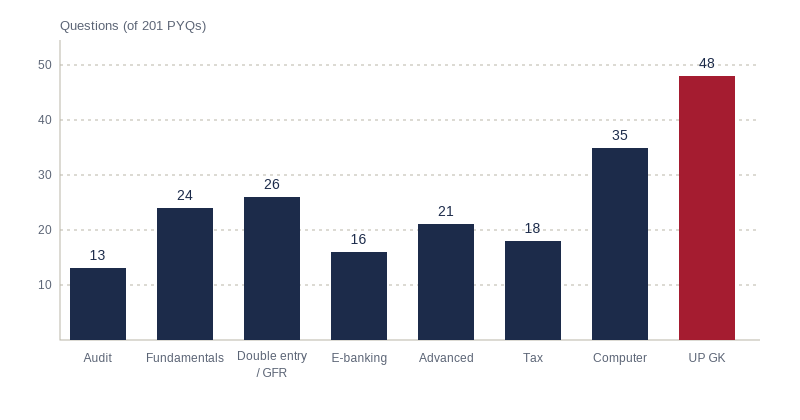
Critical Discussion
Do papers ka sample chhota hai; isliye in tables ko probability ka "prior" samjho, kanoon nahi. Commission naye topics daal hi sakta hai, aur ek hi paper me ek table ke chaar marks (Vidhan Parishad, P2-94 se P2-97) dikhate hain ki list-based topics ka return-on-time bahut zyada hai. Practical niyam: pehle repeat offenders (Table 2) pakke karo, phir bade units (Computer, UP GK) ko roz thoda, aur aakhri me chhote units ka ek baar sweep.
19.7 Practice Sets A-G (300 Original Questions)
Neechy ke 300 prashn original practice prashn hain; ye official PYQ nahi hain. Har prashn ek mark ka hai. Vidhi: pehle prashn set ko bina uttar dekhe hal karo, phir uttar milao, aur har galat prashn ko Section 19.2 ki error-analysis vidhi se tag karo. Sets unit-wise hain, taaki har set ke baad sambandhit chapter dobara khola ja sake. Jahan kisi prashn ke saath "(verify)" likha hai, wahan law section ya ank ko official source se confirm karna shesh hai.
Set A: Accounting basics (Q1-Q60)
- Accounting equation: Assets = ? (a) Capital - Liabilities (b) Income + Expenses (c) Liabilities - Capital (d) Capital + Liabilities. Ans: d
- Owner ne dukaan se goods apne ghar ke liye liye. Debit hoga? (a) Purchases (b) Sales (c) Capital (d) Drawings. Ans: d
- Real account ka golden rule: (a) Debit what comes in (b) Debit the receiver (c) Credit what comes in (d) Debit all expenses. Ans: a
- Nominal account ka rule: (a) Debit the giver (b) Debit incomes (c) Debit expenses and losses, credit incomes and gains (d) Credit expenses. Ans: c
- Personal account ka rule: (a) Debit the giver (b) Debit what goes out (c) Debit the receiver, credit the giver (d) Credit receiver. Ans: c
- Machinery credit par X se kharidi. Entry: (a) Dr Cash, Cr Machinery (b) Dr Purchases, Cr X (c) Dr Machinery, Cr X (d) Dr X, Cr Machinery. Ans: c
- Trial balance ke dono taraf ka total barabar hone se kya sabit hota hai? (a) Arithmetical accuracy (b) Profit sahi (c) Koi error nahi (d) Accounts poori tarah sahi. Ans: a
- Kaun si galti trial balance se pakadi NAHI jaati? (a) Complete omission of a transaction (b) Wrong posting amount ek side (c) Extra credit (d) Sirf debit side ki galat jodna. Ans: a
- Trial balance na mile to temporary rakhne ka account: (a) Reserve (b) Suspense (c) Drawings (d) Contra. Ans: b
- Purchase return book me kya likhte hain? (a) Cash sales (b) Cheque (c) Customer se aaye goods (d) Suppliers ko lautaye goods. Ans: d
- Sales book me kya likha jaata hai? (a) Cash only (b) Sab sales (c) Asset sale (d) Credit sales of goods. Ans: d
- Imprest system kis se judi hai? (a) Petty cash (b) Stock (c) Bank (d) Debtors. Ans: a
- Bill of exchange me likhne wala (jo order deta hai) kehlata hai: (a) Drawer (b) Endorsee (c) Payee (d) Drawee. Ans: a
- Cash book me bank overdraft kis taraf dikhta hai? (a) Kisi me nahi (b) Debit (c) Dono (d) Credit. Ans: d
- Cash book balance Rs 10,000 (Dr). Issued cheques not yet presented Rs 2,000; deposited cheques not yet collected Rs 1,500. Pass book balance? (a) 13,500 (b) 10,500 (c) 6,500 (d) 9,500. Ans: b
- Bank ne charges kaate par cash book me nahi hai. Cash book balance se kya karein? (a) Ignore (b) Double (c) Add (d) Deduct. Ans: d
- Closing stock ki valuation: (a) Market high (b) Selling price (c) Cost ya NRV, jo zyada (d) Cost ya NRV, jo kam. Ans: d
- Accrual concept: (a) Sirf bank (b) Sirf profit (c) Cash aane par hi (d) Income aur expense jab hote hain tab record. Ans: d
- Going concern concept ka matlab: (a) Sirf partnership (b) Business band hoga (c) Sirf loss (d) Business aage bhi chalega. Ans: d
- Matching concept: (a) Revenue ke saath uske expenses match (b) Debit credit match (c) Bank match (d) Stock match. Ans: a
- Prepaid expense: (a) Capital (b) Income (c) Asset (d) Liability. Ans: c
- Outstanding rent: (a) Income (b) Asset (c) Drawings (d) Liability. Ans: d
- Capital expenditure ka example: (a) Salary (b) Machine ki kharid (c) Machine ki repair (d) Rent. Ans: b
- Gross Profit = ? (a) Purchases - Sales (b) Sales - all expenses (c) Sales - COGS (d) COGS - Sales. Ans: c
- COGS = ? (a) Opening stock + Purchases - Closing stock (b) Sales - Opening stock (c) Opening stock + Closing stock - Purchases (d) Purchases - Sales. Ans: a
- Opening stock 5,000; purchases 40,000; closing stock 8,000. COGS? (a) 43,000 (b) 37,000 (c) 53,000 (d) 47,000. Ans: b
- Sales 60,000, COGS 37,000. Gross profit? (a) 23,000 (b) 97,000 (c) 37,000 (d) 13,000. Ans: a
- Net profit = ? (a) Sales - purchases (b) Gross profit - indirect expenses + indirect incomes (c) GP - drawings (d) GP + expenses. Ans: b
- Bad debt ki entry: (a) Dr Cash, Cr Debtors (b) Dr Debtors, Cr Bad debts (c) Dr Sales, Cr Debtors (d) Dr Bad debts, Cr Debtors. Ans: d
- Debtors 80,000; provision for doubtful debts 5%. Provision? (a) 40,000 (b) 400 (c) 4,000 (d) 8,000. Ans: c
- Discount allowed customers ko: (a) Liability (b) Asset (c) Income (d) Expense/loss. Ans: d
- Carriage inwards kis account me jaata hai? (a) Balance sheet (b) P&L (c) Capital (d) Trading. Ans: d
- Machine lagane ke liye wages: (a) P&L expense (b) Reserve (c) Machine ki cost me add (d) Drawings. Ans: c
- Interest on capital (jab allow ho) business ke liye: (a) Asset (b) Reserve (c) Expense (d) Income. Ans: c
- Drawings ka effect capital par: (a) Double (b) Kam (c) Zyada (d) None. Ans: b
- Single entry system ko kehte hain: (a) Incomplete records (b) Cost accounting (c) Double entry (d) Perfect records. Ans: a
- Receipts and Payments account kisi organisation ka? (a) Partnership (b) Bank (c) Company only (d) Non-profit. Ans: d
- Income and Expenditure account kis type ka hai? (a) Personal (b) Real (c) Cash only (d) Nominal account type, accrual basis. Ans: d
- Subscription advance me mili hui: (a) Expense (b) Asset (c) Income (d) Liability. Ans: d
- Debenture interest: (a) Drawings (b) Dividend (c) Profit se pehle ka charge (d) Reserve. Ans: c
- Rent paid galti se landlord ke personal account me debit. Sahi entry: (a) Dr Landlord, Cr Rent (b) No entry (c) Dr Rent, Cr Landlord (d) Dr Cash, Cr Rent. Ans: c
- Error of principle ka example: (a) Math galti (b) Capital expenditure ko revenue expense maanna (c) Posting reversal (d) Omission. Ans: b
- Compensating errors ka TB par asar: (a) Debit zyada (b) Mismatch (c) Credit zyada (d) None. Ans: d
- Transposition error (jaise 12 ki jagah 21) se TB difference: (a) 5 se divisible (b) 9 se divisible (c) 7 (d) Koi pattern nahi. Ans: b
- Current ratio = ? (a) CA/CL (b) CL/CA (c) Debt/Equity (d) Stock/CL. Ans: a
- Quick ratio = ? (a) (CA - Stock)/CL (b) CA/CL (c) Cash/Capital (d) Stock/Sales. Ans: a
- CA 60,000, CL 30,000. Current ratio? (a) 3:1 (b) 2:1 (c) 1:2 (d) 1:1. Ans: b
- Debt-equity ratio: (a) Profit/Debt (b) Debt/Sales (c) Debt/Equity (d) Equity/Debt. Ans: c
- Stock turnover = ? (a) Sales/Debtors (b) Purchases/Creditors (c) COGS/Average stock (d) Stock/Sales. Ans: c
- Debtors turnover: (a) Credit sales/Average debtors (b) Cash sales/Debtors (c) Debtors/Sales (d) COGS/Debtors. Ans: a
- Working capital = ? (a) CA - CL (b) CL - CA (c) CA + CL (d) Fixed assets - CL. Ans: a
- Fixed asset kharid cash flow me: (a) Koi nahi (b) Investing (c) Operating (d) Financing. Ans: b
- Dividend paid cash flow me: (a) Investing (b) Financing (c) Operating (d) Koi nahi. Ans: b
- Deed silent ho to partnership profit ka batwara: (a) Age ke hisaab (b) Barabar (c) Capital ratio (d) Ek partner. Ans: b (Indian Partnership Act, 1932; verify)
- Deed silent ho to partner ke loan par interest: (a) 9% (b) 12% (c) 6% p.a (d) 0%. Ans: c (Partnership Act s.13(d); verify)
- Sacrificing ratio = ? (a) Old ratio - New ratio (b) Old + New (c) New - Old (d) Old x New. Ans: a
- Gaining ratio = ? (a) New x Old (b) Old - New (c) New ratio - Old ratio (d) Old + New. Ans: c
- Free samples ka kharcha: (a) Asset (b) Advertisement expense (c) Drawings (d) Purchase. Ans: b
- Contingent liability kahan dikhate hain? (a) P&L (b) Notes to accounts (c) Nahi dikhate (d) Balance sheet liabilities me. Ans: b
- Accounting standard (Indian GAAP) AS 2 kis vishay par hai? (a) Revenue (b) Leases (c) Inventories (d) Cash flow. Ans: c (verify)
Set B: Depreciation, Hire Purchase, Final Accounts, Ratios (Q61-Q120)
- Cost 1,00,000; scrap 10,000; life 5 saal. SLM depreciation per year: (a) 20,000 (b) 22,000 (c) 16,000 (d) 18,000. Ans: d
- WDV 10% par cost 1,00,000, pehle saal depreciation: (a) 11,000 (b) 9,000 (c) 8,100 (d) 10,000. Ans: d
- Upar wala, doosre saal depreciation: (a) 10,000 (b) 11,000 (c) 8,100 (d) 9,000. Ans: d
- Teesre saal depreciation: (a) 9,000 (b) 10,000 (c) 8,100 (d) 7,290. Ans: c
- Cost 1,20,000; scrap 0; life 8 saal; SLM. Annual depreciation: (a) 12,000 (b) 20,000 (c) 15,000 (d) 10,000. Ans: c
- Upar ka rate of depreciation (cost par): (a) 15% (b) 12.5% (c) 8% (d) 10%. Ans: b
- Depreciation ka purpose: (a) Cash bachana (b) Tax chori (c) Cost ko useful life me allocate karna (d) Asset badhana. Ans: c
- Depreciation hai: (a) Non-cash expense (b) Income (c) Cash outflow (d) Liability. Ans: a
- Machine 2,00,000 ki 1 October ko kharidi; saal 31 March ko khatam; SLM 10% p.a., scrap nil. Is saal depreciation: (a) 5,000 (b) 10,000 (c) 15,000 (d) 20,000. Ans: b
- Machine 2,00,000, WDV 20%. Saal 2 ka depreciation: (a) 36,000 (b) 32,000 (c) 28,800 (d) 40,000. Ans: b
- Machine ka book value 50,000, bika 60,000. Result: (a) No effect (b) Profit 10,000 (c) Loss 10,000 (d) Profit 60,000. Ans: b
- Book value 50,000, bika 45,000. Result: (a) Loss 45,000 (b) Loss 5,000 (c) Profit 5,000 (d) No effect. Ans: b
- Mines ke liye depreciation method: (a) SLM only (b) Revaluation (c) Depletion (d) Annuity. Ans: c
- Loose tools ke liye aksar method: (a) Sum of years (b) None (c) Depletion (d) Revaluation. Ans: d
- Hire purchase me ownership kab milti hai? (a) Aakhri kist ke baad (b) Pehli kist par (c) Delivery par hamesha (d) Kabhi nahi. Ans: a
- HP price 1,20,000; cash price 1,00,000. Interest: (a) 20,000 (b) 1,20,000 (c) 1,00,000 (d) 2,20,000. Ans: a
- Cash price 90,000; HP: down 30,000 + 3 kist x 25,000. Total interest: (a) 10,000 (b) 5,000 (c) 25,000 (d) 15,000. Ans: d
- Baaki 80,000 par 10% p.a. byaj, pehle saal: (a) 80,000 (b) 10,000 (c) 800 (d) 8,000. Ans: d
- HP me hirer depreciation: (a) Vendor charge karta hai (b) Charge karta hai (c) Bank (d) Koi nahi. Ans: b
- Hire purchase aur installment system me fark: (a) Dono me nahi milti (b) Ulta (c) Koi nahi (d) HP me ownership last kist par, installment me delivery par. Ans: d
- Finance lease ka lakshan: (a) Ek saal ka (b) Almost sab risk aur reward lessee ko (c) Ownership kabhi nahi (d) Sirf rent. Ans: b
- Consignment me goods ka owner kaun? (a) Bank (b) Consignor (c) Customer (d) Consignee. Ans: b
- Consignee ka commission, consignor ke liye: (a) Asset (b) Income (c) Expense (d) Capital. Ans: c
- Consignment me abnormal loss ki valuation: (a) Market (b) Cost par (c) Selling price (d) Zero. Ans: b
- Del credere commission kis ke liye? (a) Freight (b) Rent (c) Insurance (d) Bad debt risk. Ans: d
- Joint venture me profit: (a) Loss me nahi (b) Tax free (c) Sab ek ko (d) Agreed ratio me. Ans: d
- Royalty me minimum rent: (a) Tax (b) Maximum (c) Kam se kam rakam jo hamesha dena (d) Discount. Ans: c
- Branch accounting me debtors system: (a) Branch ka debtors account (b) Share (c) Bank (d) Stock. Ans: a
- Share capital me authorised capital: (a) Issued (b) Paid (c) Called (d) Maximum jo company issue kar sakti hai. Ans: d
- Calls in arrears: (a) Premium (b) Called par abhi tak na mile paise (c) Discount (d) Advance. Ans: b
- Securities premium ka ek upyog: (a) Bonus shares (b) Dividend (c) Rent (d) Salary. Ans: a (Companies Act s.52; verify)
- Shares ki forfeiture: (a) Buyback (b) Dividend par (c) Calls na dene par (d) Transfer par. Ans: c
- Debenture discount par issue ka loss: (a) Income (b) Capital (c) Deferred/ amortised (d) Reserve. Ans: c
- Preference shares ka redemption: (a) Rent (b) Loan only (c) Nahi hota (d) Profits ya fresh issue se. Ans: d
- CRR ka full form: (a) Cash Reserve Ratio (b) Capital Ratio Reserve (c) Company Reserve Rate (d) Capital Redemption Reserve. Ans: d (company accounts me; banking me bhi CRR hota hai)
- Companies Act 2013 ka Schedule III kis vishay par? (a) Depreciation (b) Audit report (c) Financial statements ka format (d) Meetings. Ans: c (verify)
- Schedule II kis par? (a) Tax (b) Directors (c) Format (d) Useful life aur depreciation. Ans: d (verify)
- Trade payables hain: (a) Current liability (b) Income (c) Non-current asset (d) Equity. Ans: a
- Reserve aur provision: (a) Same (b) Dono income (c) Reserve profit ka appropriation, provision known liability/loss ke liye charge (d) Ulta. Ans: c
- Final dividend kaun declare karta hai? (a) Tax officer (b) Auditor (c) Bank (d) Shareholders AGM me. Ans: d
- Interim dividend: (a) SEBI (b) Govt (c) Board declare karta hai (d) Auditor. Ans: c
- Cash flow statement ke liye standard (Indian GAAP): (a) AS 3 (b) AS 9 (c) AS 1 (d) AS 12. Ans: a (verify)
- Revenue recognition standard: (a) AS 2 (b) AS 3 (c) AS 9 (d) AS 14. Ans: c (verify; naye Ind AS me alag)
- Net profit 20,000; sales 2,00,000. Net profit ratio: (a) 1% (b) 5% (c) 20% (d) 10%. Ans: d
- GP ratio 25%, sales 1,00,000. COGS: (a) 75,000 (b) 25,000 (c) 50,000 (d) 1,25,000. Ans: a
- CA 90,000; stock 30,000; CL 40,000. Quick ratio: (a) 2.25 (b) 3 (c) 1.5 (d) 0.75. Ans: c
- Debtors 40,000; credit sales 3,65,000. Collection period (365 din): (a) 36.5 din (b) 4 din (c) 40 din (d) 91 din. Ans: c
- Creditors 50,000; credit purchases 3,65,000. Payment period: (a) 5 din (b) 73 din (c) 50 din (d) 36.5 din. Ans: c
- EBIT 1,00,000; interest 20,000. Interest coverage: (a) 8 (b) 4 (c) 5 times (d) 0.2. Ans: c
- Capital 2,00,000; profit 50,000; drawings 10,000. Closing capital: (a) 1,40,000 (b) 2,40,000 (c) 2,50,000 (d) 2,60,000. Ans: b
- Opening capital 1,00,000; closing capital 1,50,000; drawings 20,000; additional capital 10,000. Profit: (a) 80,000 (b) 60,000 (c) 50,000 (d) 40,000. Ans: b (150-100 = 50; +20 drawings - 10 additional = 60)
- Sales 5,00,000; sales return 20,000. Net sales: (a) 4,80,000 (b) 4,20,000 (c) 5,00,000 (d) 5,20,000. Ans: a
- Purchases 3,00,000; returns 10,000; carriage inwards 5,000. Net cost of purchases: (a) 3,15,000 (b) 2,85,000 (c) 2,95,000 (d) 3,05,000. Ans: c
- Prepaid insurance 2,000 hai. Adjustment: (a) Ignore (b) Insurance expense me se ghatao (c) Add (d) Capital me. Ans: b
- Outstanding salary 5,000: (a) Ghatao (b) Expense me add, liability banao (c) Asset (d) Ignore. Ans: b
- Accrued income: (a) Capital (b) Expense (c) Asset (d) Liability. Ans: c
- Income received in advance: (a) Liability (b) Reserve (c) Asset (d) Income. Ans: a
- Trial balance me kaun sa item aam taur par NAHI hota agar closing stock adjustment me diya ho? (a) Capital (b) Debtors (c) Closing stock (d) Bank. Ans: c
- Trading account ka natija: (a) Net profit (b) Gross profit/loss (c) Capital (d) Cash. Ans: b
- Balance sheet kab ka statement? (a) Ek date par (b) Poore saal ka (c) Mahine ka (d) Sirf profit. Ans: a
Set C: Auditing basics (Q121-Q180)
- Audit ka matlab: (a) Books ki jaanch aur raay dena (b) Stock rakhna (c) Books likhna (d) Tax bharna. Ans: a
- Company ka auditor report kisko deta hai? (a) Police (b) Customers (c) Members/shareholders (d) Staff. Ans: c
- Statutory auditor aam taur par kaun appoint karta hai? (a) Shareholders (AGM) (b) Tax officer (c) Staff (d) Customers. Ans: a (first auditor Board; verify s.139)
- Vouching ka kendra: (a) Total (b) Ratio (c) Transaction ka documentary saboot (d) Asset ki physical. Ans: c
- Verification ka matlab: (a) Tax (b) Ledger posting (c) Asset/liability ki existence, ownership, valuation confirm (d) Entries ka total. Ans: c
- Valuation kya check karta hai? (a) Signature (b) Rate of tax (c) Entry ki date (d) Asset ki sahi keemat. Ans: d
- Internal check ka matlab: (a) Kaam ka batwara taaki ek doosre ko check kare (b) Tax (c) Audit report (d) Stock. Ans: a
- Internal audit kaun karta hai? (a) Customers (b) Statutory auditor only (c) CAG (d) Company ke andar/ appointed internal auditor. Ans: d
- Test checking ka matlab: (a) Sab check (b) Koi check nahi (c) Ratio (d) Sample le kar jaanch. Ans: d
- Audit programme: (a) Letter (b) Report (c) Procedures ki detailed plan (d) Bill. Ans: c
- Working papers ka malik: (a) Govt (b) Auditor (c) Client (d) Bank. Ans: b
- Audit evidence kaisa hona chahiye (SA 500)? (a) Sirf client ka (b) Sirf zyada (c) Sufficient aur appropriate (d) Sirf verbal. Ans: c
- Sabse bharosemand evidence: (a) External, written, original (b) Hearsay (c) Verbal internal (d) Photocopy. Ans: a
- Qualified opinion kab? (a) Misstatement material par pervasive nahi (b) Pervasive (c) Kuch nahi (d) Evidence zero. Ans: a
- Adverse opinion kab? (a) Chhoti galti (b) Material aur pervasive misstatement (c) Sab sahi (d) Sirf delay. Ans: b
- Disclaimer of opinion kab? (a) Rate galat (b) Evidence nahi mila aur effect pervasive ho sakta hai (c) Chhoti galti (d) Sab sahi. Ans: b
- Unmodified (clean) opinion ka matlab: (a) Fraud nahi hua guarantee (b) Tax nahi (c) Financials true and fair (framework ke hisaab se) (d) Profit pakka. Ans: c
- Emphasis of matter paragraph: (a) Opinion modify (b) Hataata hai (c) Adverse (d) Disclosed matter par dhyaan dilata hai, opinion modify nahi. Ans: d
- Going concern ka standard: (a) SA 240 (b) SA 500 (c) SA 570 (d) SA 230. Ans: c (verify)
- Materiality ka matlab: (a) Wo misstatement jo users ke decision ko badal sake (b) Profit (c) Kul amount (d) Tax. Ans: a
- Audit risk = ? (a) Inherent x Control x Detection risk (b) IR + CR (c) Sirf inherent (d) Sales x Risk. Ans: a
- Inherent risk: (a) Control ki kamzori (b) Auditor ki galti (c) Controls se pehle misstatement ki sambhavna (d) Tax. Ans: c
- Continuous audit: (a) Sirf stock (b) Saal bhar chalta (c) Saal ke ant par (d) Sirf interim. Ans: b
- Cash receipts vouch: (a) Tax return (b) Receipt counterfoil aur cash book (c) Photo (d) Bank statement only. Ans: b
- Wages vouch: (a) Wage sheet aur attendance (b) Ledger only (c) Balance sheet (d) PAN. Ans: a
- Purchases vouch: (a) Bank (b) Invoice, GRN, order (c) Sales invoice (d) Payroll. Ans: b
- Sales vouch: (a) Tax (b) Sales invoice aur dispatch note (c) PO (d) GRN. Ans: b
- Purchase return ke liye document: (a) Debit note (b) Receipt (c) Credit note (d) Voucher none. Ans: a
- Sales return ke liye: (a) PO (b) GRN (c) Debit note (d) Credit note. Ans: d
- Investments verify: (a) Tax (b) Certificates ki physical inspection (c) Verbal (d) Ignore. Ans: b
- Inventory verify: (a) Ratio (b) Physical count mein attend aur records match (c) Ignore (d) Sirf management letter. Ans: b (SA 501)
- Debtors verify: (a) Tax return (b) Ignore (c) Balance confirmation (d) Staff opinion. Ans: c (SA 505)
- Creditors me kaun sa risk zyada? (a) Understatement/unrecorded liabilities (b) Koi nahi (c) Overstatement (d) Rate. Ans: a
- Fixed assets ownership ka saboot: (a) Tax (b) Title deeds/invoice (c) Photo only (d) Verbal. Ans: b
- Cut-off test: (a) Total (b) Transactions sahi period me record (c) Rate (d) Sign. Ans: b
- Management representation letter: (a) Management ki written confirmations (b) Tax (c) Court order (d) Auditor report. Ans: a (SA 580)
- NPO audit me sabse pehle: (a) Trust deed/rules dekhna (b) Tax (c) Stock (d) Balance sheet. Ans: a
- Auditor ka fraud par duty: (a) Prevention (b) Guarantee (c) Reasonable assurance (d) Koi nahi. Ans: c
- Audit committee kis section me hai? (a) 143 (b) 139 (c) 177 (d) 141. Ans: c (verify)
- Auditor ke report ka sambodhan: (a) Bank (b) Members (c) Police (d) Customers. Ans: b
- Auditor ko books dekhne ka adhikaar: (a) Sirf saal ant (b) Nahi (c) Sirf AGM (d) Kisi bhi samay. Ans: d (s.143(1); verify)
- Auditor ko company ki baithak me: (a) Aane ka adhikaar (b) Sirf bank (c) Nahi (d) Sirf board. Ans: a
- Companies Act me auditor ka pehla term: (a) 5 saal (b) 3 saal (c) 10 saal (d) 1 saal. Ans: a (s.139(1); verify)
- Listed company me individual auditor kitne term (5-5 saal)? (a) Do term (b) Ek term (c) Koi limit nahi (d) Teen term. Ans: b (s.139(2); verify)
- Audit firm kitne term tak? (a) Limit nahi (b) Teen term (c) Ek term (d) Do term. Ans: d (verify)
- Cooling-off ke baad kitne saal wapas nahi? (a) 10 saal (b) 1 saal (c) 3 saal (d) 5 saal. Ans: d (verify)
- Auditor ke liye kaun si service prohibited hai (s.144)? (a) Internal audit jaise kuch services (b) None (c) Statutory audit (d) Tax audit. Ans: a (verify)
- Auditor ki fees kaun tay karta hai? (a) Members (ya unke dwara tay tarika) (b) Police (c) Tax officer (d) Auditor khud. Ans: a (s.142; verify)
- Companies (Auditor's Report) Order ka short naam: (a) CARO (b) CAG (c) CIN (d) CAAT. Ans: a
- Internal financial controls par auditor ki reporting kis sub-section me? (a) 143(12) (b) 141 (c) 143(3)(i) (d) 139. Ans: c (verify)
- Auditor ko fraud ka shak ho (limit se upar), to kaise report? (a) Bank (b) Sirf client (c) Central Govt ko (d) Media. Ans: c (s.143(12) ke hisaab se; limit aur process verify)
- Auditor ko ek saath kitni companies ke audit ki limit? (a) 10 (b) 5 (c) 20 (d) 50. Ans: c (s.141(3)(g); verify)
- Auditor disqualification: (a) Experience (b) Company ke officer ya employee ban jaye (c) Chartered Accountant hona (d) Age. Ans: b
- SA 700 kis par? (a) Planning (b) Fraud (c) Sampling (d) Financial statements par opinion banana aur report. Ans: d
- SA 705 kis par? (a) Opinion me modification (b) Sampling (c) Documentation (d) Planning. Ans: a
- SA 706 kis par? (a) Going concern (b) Sampling (c) Emphasis of Matter aur Other Matter paragraphs (d) Fraud. Ans: c
- SA 230 kis par? (a) Fraud (b) Planning (c) Audit documentation (d) Sampling. Ans: c
- SA 320 kis par? (a) Fraud (b) Materiality in planning and performing an audit (c) Group (d) Estimates. Ans: b
- SA 530 kis par? (a) Audit sampling (b) Evidence (c) Going concern (d) Fraud. Ans: a
- SA 560 kis par? (a) Subsequent events (b) Sampling (c) Fraud (d) Planning. Ans: a
Set D: Govt audit, CAG, GFR, Constitution and standards (Q181-Q230)
- CAG ka sambandh kis anuchhed se? (a) 324 (b) 148 (c) 280 (d) 124. Ans: b
- CAG ko kaun appoint karta hai? (a) President (b) CJI (c) PM (d) Parliament. Ans: a
- CAG ko hatane ki prakriya kiske barabar? (a) Minister (b) Governor (c) PM (d) Supreme Court ke judge. Ans: d
- CAG ka karyakaal: (a) 6 saal ya 65 saal ki umra (jo pehle) (b) 4 saal (c) 10 saal (d) 5 saal. Ans: a (verify)
- Union ke accounts par CAG report kisko deta hai? (a) PM (b) CJI (c) Speaker (d) President (laid before Parliament). Ans: d
- State accounts par CAG report kisko? (a) President (b) Speaker (c) CM (d) Governor. Ans: d
- CAG reports kis committee dwara jaanchi jaati hain? (a) PAC (b) Estimates (c) Rules (d) Privileges. Ans: a
- PAC ka sadasya sankhya (LS 15 + RS 7): (a) 25 (b) 30 (c) 22 (d) 15. Ans: c (verify)
- Estimates Committee ke sadasya: (a) 25 (b) 15 (c) 30, sirf Lok Sabha (d) 22. Ans: c (verify)
- Consolidated Fund of India ka anuchhed: (a) 266 (b) 267 (c) 268 (d) 265. Ans: a
- Contingency Fund of India: (a) 267 (b) 280 (c) 270 (d) 266. Ans: a
- Vote on account ka anuchhed: (a) 110 (b) 112 (c) 116 (d) 114. Ans: c
- Money bill ki paribhasha: (a) 116 (b) 110 (c) 112 (d) 148. Ans: b
- Annual Financial Statement (budget): (a) 110 (b) 148 (c) 112 (d) 151. Ans: c
- CAG report ko Parliament me rakhne ka anuchhed: (a) 148 (b) 150 (c) 151 (d) 266. Ans: c
- Fiscal deficit = ? (a) Total expenditure - total receipts (excluding borrowings) (b) Borrowing only (c) Revenue - expenditure (d) Tax - spending. Ans: a
- Revenue deficit = ? (a) Tax - non tax (b) Capital - revenue (c) Fiscal - borrowing (d) Revenue expenditure - revenue receipts. Ans: d
- FRBM Act kis saal? (a) 2003 (b) 2013 (c) 2017 (d) 1991. Ans: a
- GFR ka puura naam: (a) Government Fund Rules (b) General Financial Rules (c) General Fund Register (d) None. Ans: b
- GFR 2017 kis ministry ke dwara? (a) Home (b) Defence (c) Finance (Dept of Expenditure) (d) Law. Ans: c (verify)
- Appropriation audit ka matlab: (a) Kharch sanctioned grant ke andar hua ya nahi (b) Stock (c) Tax check (d) Ratio. Ans: a
- Propriety audit: (a) Kharch ki wisdom aur sahi hone ki jaanch (b) Payroll (c) Cash count (d) Tax. Ans: a
- Government companies ke auditor ki appointment: (a) SEBI (b) CAG (c) PM (d) Board. Ans: b (s.139(5); verify)
- CAG ka supplementary audit kis section me? (a) 142 (b) 139 (c) 143(6) (d) 177. Ans: c (verify)
- NFRA kiske tahat? (a) Income Tax (b) RBI Act (c) Companies Act 2013 s.132 (d) GST. Ans: c (verify)
- ICAI kis Act se bana? (a) SEBI Act (b) RBI Act (c) Chartered Accountants Act 1949 (d) Companies Act. Ans: c (verify)
- NFRA ka full form: (a) New Financial Rules Act (b) National Financial Reporting Authority (c) National Fund Reserve Authority (d) None. Ans: b
- SEBI ka kaam: (a) Tax (b) Court (c) Securities market regulate (d) Currency. Ans: c
- RBI ka kaam: (a) Audit (b) Police (c) Tax (d) Monetary policy aur banks regulate. Ans: d
- Government accounting me cash basis ka matlab: (a) Cash aane jaane par record (b) Estimate (c) Accrual (d) Bank. Ans: a
- Treasury kya hai? (a) School (b) Tax (c) Court (d) Govt ke paise jama aur nikalne ka sthan. Ans: d
- Public Account of India: (a) 266(1) (b) 112 (c) Art. 266(2) (d) 267. Ans: c
- Audit Board kya karta hai? (a) CAG ke tahat audit kaam (b) Tax (c) Police (d) Court. Ans: a (verify)
- Lok Sabha me budget presented by: (a) Speaker (b) PM only (c) President (d) Finance Minister. Ans: d
- Finance Bill kab pesh? (a) Saal ke ant (b) Court me (c) Budget ke saath (d) Kabhi nahi. Ans: c
- Expenditure ka sanction kisse? (a) Clerk (b) Competent authority (c) Police (d) Bank. Ans: b
- Surrender of savings: (a) Kharch badhana (b) Bachi hui grant lauta dena (c) Tax (d) Loan. Ans: b
- Re-appropriation: (a) Loan (b) Tax (c) Audit (d) Ek head se doosre me funds shift. Ans: d
- Imprest in govt: (a) Tax (b) Advance for petty expenses (c) Loan (d) Salary. Ans: b
- Contingent bill (DCC): (a) Tax (b) Salary (c) Chhote kharch ke liye (d) Loan. Ans: c (verify)
- Utilisation certificate kis ko? (a) Tax (b) Salary (c) Report (d) Grant ke upyog ka saboot. Ans: d
- Stock register kis ke liye? (a) Tax (b) Salary (c) Court (d) Store items ka record. Ans: d
- Store receipt: GRN. Full form: (a) Goods Received Note (b) Goods Return Note (c) Grand Record (d) General Register. Ans: a
- Indent kya hai? (a) Bill (b) Order (c) Stock (d) Store se maal ki maang. Ans: d
- Bin card kiske liye? (a) Cash (b) Tax (c) Ledger (d) Store ke stock ka quantity record. Ans: d
- Tender ka matlab: (a) Supplier se boli/quotation (b) Audit (c) Tax (d) Salary. Ans: a
- GeM kya hai? (a) Government e-Marketplace (b) Tax portal (c) Court (d) Bank. Ans: a
- Audit objections ka reply kis ko? (a) Bank (b) Audit party/office ko (c) Police (d) Media. Ans: b
- Draft paragraph (DP) kya hai? (a) Order (b) Tax (c) Final report (d) CAG audit ka initial observation. Ans: d (verify)
- Action Taken Note (ATN) kiska? (a) Police (b) CAG/PAC recommendations par sarkar ka jawab (c) Bank (d) Court. Ans: b
Set E: GST aur Income Tax (concepts) (Q231-Q260)
Note: Income-tax Act 2025 naya kanoon hai aur section numbers badle hain (verify before using section numbers). Isliye yahan concept par Qs hain.
- GST kab se lagu? (a) 1 Jan 2018 (b) 1 April 2017 (c) 1 Oct 2016 (d) 1 July 2017. Ans: d (verify)
- GST Council kaun si article me? (a) 279A (b) 148 (c) 266 (d) 280. Ans: a (verify)
- Intra-state supply par kaun se GST? (a) Excise (b) IGST (c) Customs (d) CGST + SGST. Ans: d
- Inter-state supply par: (a) Excise (b) VAT (c) CGST + SGST (d) IGST. Ans: d
- GSTIN me kitne characters? (a) 15 (b) 16 (c) 12 (d) 10. Ans: a
- Input Tax Credit (ITC) ka matlab: (a) Penalty (b) Fee (c) Khareed par chuka GST output tax se adjust (d) Refund only. Ans: c
- GSTR-1 me kya? (a) Outward supplies ki details (b) Audit (c) Annual (d) Inward. Ans: a
- GSTR-3B: (a) Annual return (b) Refund (c) Summary return aur tax payment (d) Audit. Ans: c
- Composition scheme kis ke liye? (a) Sab (b) Export (c) Chhote taxpayers ko saral compliance (d) Bade. Ans: c
- E-way bill kya hai? (a) Maal ke transport ka electronic document (b) Refund (c) Return (d) Audit. Ans: a
- HSN code kis ke liye? (a) Goods ka classification (b) Bank (c) Services only (d) Tax rate only. Ans: a
- SAC kis ke liye? (a) Audit (b) Services classification (c) Tax (d) Goods. Ans: b
- Export par GST: (a) Double tax (b) Zero-rated (c) Exempt always (d) Nahi lagta kabhi. Ans: b
- Reverse charge: (a) Nahi (b) Recipient tax deta hai (c) Govt (d) Supplier. Ans: b
- Tax invoice me kya hona zaroori? (a) Supplier GSTIN, date, value, tax (b) Sirf naam (c) Nahi (d) Photo. Ans: a
- PAN me kitne characters? (a) 10 (b) 16 (c) 12 (d) 8. Ans: a
- Income ke kitne heads (traditional)? (a) 4 (b) 5 (c) 7 (d) 3. Ans: b
- Kaun sa income ka traditional head NAHI hai? (a) Other sources (b) Salary (c) Capital expenditure (d) Capital gains. Ans: c
- TDS ka matlab: (a) Tax dues (b) Source par tax kaatna (c) Total deduction (d) Tax deposit slip. Ans: b
- Advance tax: (a) Penalty (b) Refund (c) Saal ke dauran kisht me tax (d) Saal ke baad. Ans: c
- Previous year kya hai? (a) Jis saal income hui (b) Koi nahi (c) Agla saal (d) Jis saal tax bharna. Ans: a
- Assessment year: (a) Pehle ka (b) Previous year ke baad ka saal (c) Same (d) 5 saal. Ans: b
- Tax audit (concept): (a) Statutory audit (b) Internal (c) Tax law ke compliance ke liye audit (d) Cost. Ans: c
- Tax audit report ka form (purana kanoon): (a) 3CD/3CB (b) 16 (c) 15G (d) 26AS. Ans: a (verify, naye Act me badal sakta hai)
- Form 16: (a) PAN (b) Salary par TDS certificate (c) Audit (d) ITR. Ans: b
- Form 26AS/AIS: (a) Salary (b) Audit (c) Tax credit statement (d) Refund. Ans: c
- Tax evasion vs avoidance: (a) Dono illegal (b) Ulta (c) Evasion illegal, avoidance legal planning (d) Dono legal. Ans: c
- Capital gain kab banta hai? (a) Capital asset ke transfer par (b) Gift (c) Rent (d) Salary. Ans: a
- Exempt income ka example: (a) Agricultural income (b) Interest (c) Business (d) Salary. Ans: a
- Penalty ka matlab: (a) Niyam todne par jurmana (b) Tax (c) Fees (d) Refund. Ans: a
Set F: Computer aur IT (Q261-Q280)
- RAM hai: (a) Volatile memory (b) Permanent (c) Optical (d) Non-volatile. Ans: a
- ROM hai: (a) Cache (b) Volatile (c) Non-volatile memory (d) Temporary. Ans: c
- CPU ke do bhaag (control aur arithmetic): (a) RAM aur ROM (b) CU aur ALU (c) Disk aur Tape (d) Input aur Output. Ans: b
- 1 Byte = ? (a) 4 bits (b) 16 bits (c) 2 bits (d) 8 bits. Ans: d
- 1 KB = ? (a) 8 bytes (b) 1000 bits (c) 100 bytes (d) 1024 bytes. Ans: d
- Excel me total ka function: (a) PLUS (b) SUM (c) ADD (d) TOTAL. Ans: b
- Excel me kisi table se value dhoondhne ka function: (a) SUM (b) VLOOKUP (c) IF only (d) COUNT. Ans: b
- Undo ka shortcut: (a) Ctrl+Z (b) Ctrl+X (c) Ctrl+S (d) Ctrl+Y. Ans: a
- Copy ka shortcut: (a) Ctrl+X (b) Ctrl+P (c) Ctrl+V (d) Ctrl+C. Ans: d
- Save ka shortcut: (a) Ctrl+N (b) Ctrl+S (c) Ctrl+A (d) Ctrl+P. Ans: b
- URL ka full form: (a) User Resource Locator (b) Unit Resource Line (c) Universal Record Link (d) Uniform Resource Locator. Ans: d
- HTTP ka full form: (a) Hyper Transfer Text Process (b) HyperText Transfer Protocol (c) None (d) High Text Transfer Program. Ans: b
- IP address kis ke liye? (a) Bank (b) Tax (c) Network par device ki pehchaan (d) Email only. Ans: c
- Firewall kya karta hai? (a) Network ko unauthorized access se bachata (b) Tax (c) Speed badhata (d) Data delete. Ans: a
- Phishing: (a) Network cable (b) Nakli message se password/information churana (c) Backup (d) Printer. Ans: b
- RTGS me minimum amount: (a) Rs 50,000 (b) Rs 2 lakh (c) Rs 1 lakh (d) Koi nahi. Ans: b (RBI; verify latest)
- NEFT kab available? (a) Nahi (b) 24x7 (c) Sirf Monday (d) Sirf working hours. Ans: b (verify)
- UPI ko kaun manage karta hai? (a) NPCI (b) CAG (c) ICAI (d) SEBI. Ans: a
- IFSC code me kitne characters? (a) 12 (b) 8 (c) 10 (d) 11. Ans: d
- CBS ka full form: (a) Cash Bank Service (b) Core Banking Solution (c) Central Bank System (d) Core Bill System. Ans: b
Set G: UP GK (Q281-Q300)
- UP ki rajdhani: (a) Lucknow (b) Agra (c) Kanpur (d) Prayagraj. Ans: a
- UP me kitne zile (district)? (a) 72 (b) 75 (c) 70 (d) 80. Ans: b (verify latest)
- UP Vidhan Sabha ki sadasya sankhya: (a) 400 (b) 403 (c) 300 (d) 250. Ans: b
- UP se Lok Sabha seats: (a) 80 (b) 75 (c) 543 (d) 60. Ans: a
- UP se Rajya Sabha seats: (a) 40 (b) 25 (c) 31 (d) 28. Ans: c (verify)
- Taj Mahal kis shahar me? (a) Varanasi (b) Jhansi (c) Agra (d) Lucknow. Ans: c
- Sarnath kis liye prasiddh? (a) Fort (b) Buddha ka pehla updesh (c) Port (d) Taj. Ans: b
- Rani Lakshmibai kis riyasat ki? (a) Jhansi (b) Awadh (c) Agra (d) Kanpur. Ans: a
- 1857 me Kanpur me kaun neta? (a) Raja Ram (b) Bahadur Shah (c) Tipu (d) Nana Sahib. Ans: d
- 1857 me Lucknow me kaun? (a) Nana Sahib (b) Begum Hazrat Mahal (c) Lakshmibai (d) Kunwar Singh. Ans: b
- 1857 ka vidroh kahan se shuru? (a) Meerut (b) Jhansi (c) Kanpur (d) Delhi. Ans: a
- Chauri Chaura kand kis jile me? (a) Agra (b) Meerut (c) Gorakhpur (d) Lucknow. Ans: c
- Kakori kand kis saal? (a) 1942 (b) 1925 (c) 1930 (d) 1922. Ans: b
- Uttarakhand UP se kab alag? (a) 2000 (b) 1950 (c) 2010 (d) 1990. Ans: a
- UP ka rajya pakshi: (a) Peacock (b) Parrot (c) Sparrow (d) Sarus crane. Ans: d
- UP ka rajya pushp: (a) Lotus (b) Rose (c) Palash (d) Jasmine. Ans: c (verify)
- UP ka rajya pashu: (a) Elephant (b) Barasingha (c) Tiger (d) Lion. Ans: b (verify)
- Sangam kahan hai? (a) Prayagraj (b) Kanpur (c) Lucknow (d) Agra. Ans: a
- Ganga aur Yamuna ka milan: (a) Mathura (b) Varanasi (c) Kanpur (d) Prayagraj. Ans: d
- Uttar Pradesh ka high court: (a) Prayagraj (Allahabad) (b) Agra (c) Lucknow (d) Kanpur. Ans: a (principal seat Prayagraj, bench Lucknow)
Critical Discussion
In 300 prashnon aur PYQ bank me ek mahatvapurna farak hai: PYQ calibration deta hai (commission kaisa poochta hai), jabki ye original sets coverage dete hain (syllabus ka kaunsa hissa bacha hai). Practice set ka score exam-readiness ka direct map nahi hai; ye keval topic-level kamzori dikhata hai. Jahan "(verify)" flag hai, wahan uttar tab tak provisional maana jaye jab tak official source se confirm na ho. Set-wise analysis ka sujhav: har set ke baad galat prashnon ko teen dabbon me baanto - concept, calculation, reading - aur agle din ka pehla ghanta sabse bhare dabbe ko do.
19.8 Additional Practice Questions (N1-N120)
Ye 120 prashn Section 19.7 ke 300 practice prashnon se alag hain aur PYQ bank ka hissa bhi nahi. Numbering N1 se N120 tak hai. Har uttar ke saath do line ki wajah di gayi hai, kyunki wajah hi wo cheez hai jo pariksha me ghooma-hua prashn pakadti hai.
Topic 1: Audit basics (N1-N15)
N1. Audit ka sabse pehla kadam kaun sa hai? (a) Report likhna (b) Engagement accept karna aur terms tay karna (c) Stock ginna (d) Opinion dena. Ans: b. Kaam shuru hone se pehle auditor aur client ke beech terms likhit me tay hote hain (engagement letter). Iske bina scope, fees aur zimmedari par baad me jhagda hota hai. (ch5)
N2. "Auditor is a watchdog, not a bloodhound" ka matlab? (a) Auditor fraud dhoondhe hi nahi (b) Auditor ko reasonable care rakhni hai, har fraud pakadna uski guarantee nahi (c) Auditor police hai (d) Auditor kutta hai. Ans: b. Ye classic principle hai: auditor ko professional skepticism ke saath kaam karna hai, par detection ki absolute guarantee nahi. Fraud rokna management ka kaam hai. (ch1, ch17)
N3. Interim audit kab hota hai? (a) Saal ke beech me, final audit se pehle (b) Sirf saal ke end par (c) Har roz (d) Kabhi nahi. Ans: a. Interim audit accounting period ke dauran hota hai aur final audit ka bojh kam karta hai. Continuous audit se fark: continuous saal bhar lagatar chalta hai. (ch3)
N4. Audit me "professional skepticism" ka matlab? (a) Client par kabhi bharosa na karna (b) Sab kuch maan lena (c) Sawal poochhte rehna aur evidence maangna (d) Fees badhana. Ans: c. Skepticism ka matlab alert dimaag: na andha-vishwas, na andha-shak. Har assertion ke peeche saboot maangna auditor ki aadat hai. (ch5, ch9)
N5. Kaun sa audit shareholders ki requirement nahi, management ki ichha se hota hai? (a) Statutory audit (b) Internal audit (c) Govt audit (d) Tax audit. Ans: b. Internal audit management ke liye hota hai, scope bhi management tay karta hai. Statutory aur tax audit kanoon ki maang hain. (ch3, ch6)
N6. Cost audit kis par focus karta hai? (a) Sirf tax (b) Cost records aur cost accounting ki accuracy (c) CSR (d) Salary. Ans: b. Cost audit me check hota hai ki company ne cost records sahi banaye hain ya nahi. Specified companies par Companies Act ke tahat lagta hai. (ch3, ch12)
N7. Management audit ka uddeshya? (a) Sirf fraud pakadna (b) Management ki efficiency aur decisions ka review (c) Tax bachana (d) Share price badhana. Ans: b. Management audit me dekha jaata hai ki organisation ke goals ke liye management kitna effective hai. Ye books se aage, performance ka audit hai. (ch3)
N8. Secret reserves banane se kya dikhayi deta hai? (a) Profit hamesha sahi (b) Financial position actual se kamzor ya majboot dikh sakti hai (c) Tax zero (d) Koi fark nahi. Ans: b. Secret reserves (jaise assets ko knowingly undervalue karna) true and fair view bigaadte hain. Isliye auditor ko unhe pakadna aur report karna padta hai. (ch10, ch11)
N9. Window dressing ka matlab? (a) Khidki saaf karna (b) Balance sheet ko asli se behtar dikhana (c) Naya software (d) Audit programme. Ans: b. Saal ke end ke aas-pas entries ghuma kar position sundar dikhana window dressing hai. Auditor ka cut-off testing isi ko pakadti hai. (ch11, ch17)
N10. Teeming and lading (cash chori ka method) me kya hota hai? (a) Stock churana (b) Ek customer ke paise se doosre ki receipt adjust karte rehna (c) Salary badhana (d) Loan lena. Ans: b. Cashier aaj ki collection chura kar kal ki collection se aaj ka gap bharta hai, aur ye chain chalti rehti hai. Cash receipts ki timely banking aur surprise cash count se pakda jaata hai. (ch7, ch17)
N11. Audit notebook me kya likha jaata hai? (a) Sirf final report (b) Audit ke dauran uthe doubts, queries aur unke jawab (c) Client ka personal data (d) Tax return. Ans: b. Audit notebook staff ki queries aur observations ka roz ka record hai. Baad me ye report banane aur yaad taza rakhne me kaam aata hai. (ch9)
N12. Kaun si galti "error of omission" hai? (a) Galat account me likhna (b) Transaction ko bilkul hi record na karna (c) 12 ko 21 likhna (d) Principle todna. Ans: b. Transaction books me aaya hi nahi to omission hai. Trial balance se nahi pakdi jaati kyunki debit-credit dono gayab hain. (ch2)
N13. Compensating error kab hoti hai? (a) Jab do galtiyan ek doosre ka asar kaat dein (b) Jab TB na mile (c) Jab ek entry do baar ho (d) Kabhi nahi. Ans: a. Ek galti debit side me, dusri utni hi credit side me, to TB mil jaata hai par accounts galat rehte hain. Isliye TB milna perfect accounts ka saboot nahi. (ch2)
N14. Final audit ka ek nuksan? (a) Saal ke end me ek saath kaam ka dher aur delay (b) Kabhi hota hi nahi (c) Bahut mehenga nahi (d) Fraud zero. Ans: a. Final audit saal khatam hone ke baad hota hai, to kaam ek jagah jama ho jaata hai aur report der se banti hai. Interim/continuous audit isi ka ilaaj hai. (ch3)
N15. Auditor ko "reasonable assurance" hi kyun dena padta hai, absolute kyun nahi? (a) Aalas (b) Testing, sampling, estimates aur fraud ki chhipi fitrat ki wajah se (c) Kanoon mana karta hai (d) Fees kam hai. Ans: b. Audit sampling par chalta hai, management estimates par, aur designed fraud chhip sakta hai. Isliye assurance high hota hai par 100% nahi. (ch5, ch8)
Topic 2: Accounting fundamentals (N16-N30)
N16. Kaun sa account "representative personal account" hai? (a) Cash account (b) Outstanding salary account (c) Machinery account (d) Sales account. Ans: b. Outstanding salary kisi insaan ka account nahi par insaanon ka pratinidhitva karta hai. Isliye personal account ka rule lagta hai. (ch2)
N17. Goods Rs 5,000 ke cash me bechne par kya credit hoga? (a) Cash (b) Sales account (c) Purchases (d) Capital. Ans: b. Sale par income badhti hai, aur nominal rule me income credit hoti hai. Cash debit hoga kyunki asset aaya. (ch2)
N18. Capital account ka balance normally kis taraf hota hai? (a) Debit (b) Credit (c) Dono (d) Koi nahi. Ans: b. Capital business ki owner ke prati liability hai, aur liabilities ka normal balance credit hota hai. (ch2)
N19. Journal proper me kaun si entry NAHI aati? (a) Credit purchase of goods (b) Opening entry (c) Credit purchase of asset (d) Rectification entry. Ans: a. Goods ki credit purchase purchase book me jaati hai. Journal proper me wahi aata hai jiske liye koi subsidiary book na ho. (ch2)
N20. Ledger aur journal ka mool fark? (a) Dono same (b) Journal chronological record hai, ledger account-wise classification (c) Ledger pehle banta hai (d) Journal optional hai. Ans: b. Pehle journal me date-wise likhte hain, phir posting karke ledger me account-wise jama karte hain. (ch2)
N21. Sales Rs 2,00,000, COGS Rs 1,20,000, expenses Rs 50,000. Net profit? (a) 80,000 (b) 30,000 (c) 50,000 (d) 1,30,000. Ans: b. Pehle GP = 2,00,000 - 1,20,000 = 80,000. Phir NP = 80,000 - 50,000 = 30,000. Do step ka sawaal hai, seedha mat nikaalna. (ch2)
N22. Kaun sa item Trading account me NAHI aata? (a) Carriage inwards (b) Opening stock (c) Office rent (d) Purchases. Ans: c. Office rent indirect expense hai, P&L me jaata hai. Trading me sirf direct kharch (maal banane/khareedne tak ke). (ch2)
N23. Provision for discount on debtors kis par lagta hai? (a) Total debtors (b) Debtors minus provision for doubtful debts (c) Cash (d) Creditors. Ans: b. Discount sirf unhi debtors par diya jayega jo waqai pay karenge. Isliye pehle doubtful nikaalo, phir baaki par discount ka provision. (ch2)
N24. Interest on drawings kiske liye income hai? (a) Owner (b) Business (c) Bank (d) Employee. Ans: b. Owner ne jab paise nikaale to business ne use byaj dene par majboor kiya. Business ke liye income, owner ke liye expense. (ch2)
N25. Trial balance me discount received kis taraf? (a) Debit (b) Credit (c) Koi nahi (d) Dono. Ans: b. Discount received income hai, isliye credit. Discount allowed expense hai, debit. Yaad rakho: "mila to credit, diya to debit". (ch2)
N26. Machinery 1,00,000 ki kharidi, installation 10,000, repair 2,000. Capitalise kitna hoga? (a) 1,00,000 (b) 1,10,000 (c) 1,12,000 (d) 2,000. Ans: b. Asset ko working condition me laane tak ka har kharcha cost me judta hai, isliye installation judega. Baad ki repair revenue expense hai. (ch2)
N27. Kaun sa concept kehta hai ki business aur owner alag hain? (a) Going concern (b) Business entity concept (c) Matching (d) Accrual. Ans: b. Isi liye owner ke nikale paise drawings ban jaate hain, expense nahi. (ch2)
N28. Dual aspect concept ka seedha matlab? (a) Har transaction ke do asar, debit = credit (b) Do business (c) Do owner (d) Do saal. Ans: a. Isi par accounting equation Assets = Liabilities + Capital tiki hai. (ch2)
N29. Cash discount aur trade discount me fark? (a) Koi nahi (b) Trade discount list price par diya jaata hai aur books me record nahi hota; cash discount prompt payment par milta hai aur record hota hai (c) Dono record nahi hote (d) Trade discount jaldi payment par. Ans: b. Invoice trade discount kaat kar banta hai, isliye books me sirf net amount aata hai. Cash discount baad me milta hai, isliye entry banti hai. (ch2)
N30. Cost 80,000, life 10 saal, scrap 8,000, SLM. Saal 5 ke end tak accumulated depreciation? (a) 7,200 (b) 36,000 (c) 40,000 (d) 8,000. Ans: b. Saalana depreciation = (80,000 - 8,000)/10 = 7,200. Paanch saal me 7,200 x 5 = 36,000. (ch2)
Topic 3: Double entry, GFR aur stores (N31-N45)
N31. Crossed cheque ko cash counter par kaun nikaal sakta hai? (a) Koi bhi (b) Sirf banker ke through account me (c) Drawer (d) Bearer. Ans: b. Crossing ka matlab payment sirf bank account ke raaste hogi, counter par cash nahi. Ye fraud rokne ka sabse aasan tareeka hai. (-; NI Act)
N32. Cheque ki validity (stale hone se pehle) aam taur par kitni hai? (a) 6 mahine (b) 3 mahine (c) 1 saal (d) 1 mahina. Ans: b. RBI ke mutabik cheque 3 mahine me present karna chahiye, warna stale ho jaata hai. (-; RBI practice; verify latest)
N33. Account payee crossing ka matlab? (a) Sirf named payee ke account me jama (b) Cash milega (c) Koi bhi transfer kare (d) Cheque cancel. Ans: a. "A/c payee only" likhne se proceeds sirf usi vyakti ke account me jaate hain jiske naam cheque hai. Sabse safe crossing. (-)
N34. GFR me purchase ke liye "competent authority" ka matlab? (a) Koi bhi clerk (b) Jise us rakam ka sanction karne ka adhikaar delegated ho (c) CAG (d) Vendor. Ans: b. General Financial Rules me har sanction usi authority se hota hai jise wo power mili ho. Bina competent sanction ka kharch audit objection khata hai. (ch14)
N35. Limited tender kab bulaya jaata hai? (a) Hamesha (b) Jab suppliers limited/known hon ya urgency ho, niyam ke tahat (c) Kabhi nahi (d) Sirf import me. Ans: b. Open tender default hai, par jab maal specialized ho ya samay kam, to GFR conditions ke andar limited tender allowed hai. Emergency me single tender bhi conditions ke saath. (ch14)
N36. Earnest Money Deposit (EMD) kyun liya jaata hai? (a) Tax ke liye (b) Bidder ki seriousness pakki karne ke liye (c) Salary ke liye (d) Discount ke liye. Ans: b. EMD ensure karta hai ki bidder mazaak me bid na kare ya beech me bhaag na jaye. Successful bidder ka EMD aam taur par lautaya jaata hai ya security me adjust hota hai. (ch14)
N37. Performance security kab li jaati hai? (a) Bid ke pehle (b) Contract milne par, kaam sahi se karane ki guarantee ke liye (c) Kabhi nahi (d) Sirf loan par. Ans: b. Contract award ke baad supplier se performance guarantee/security li jaati hai taaki default par sarkar ko nuksan na ho. (ch14)
N38. Store ledger aur bin card me fark? (a) Dono same (b) Bin card store me quantity record karta hai, ledger value ke saath quantity accounts me rakhta hai (c) Ledger sirf cash (d) Bin card value rakhta hai. Ans: b. Bin card storekeeper ke paas (sirf quantity), stores ledger accounts section me (quantity + value). Dono ka milan ek internal check hai. (ch14, ch6)
N39. Perpetual inventory system me physical verification ki zaroorat kyun rehti hai? (a) Zaroorat nahi (b) Book balance aur actual stock ka difference (theft, shrinkage) pakadne ke liye (c) Sirf formality (d) Tax ke liye. Ans: b. Records kitne bhi acche hon, chori aur waste records me nahi dikhti. Isliye periodic physical verification compulsory rehti hai. (ch10, ch14)
N40. Re-order level ka formula (basic)? (a) Maximum usage x maximum lead time (b) Minimum usage (c) Average stock (d) Zero. Ans: a. Re-order level utna rakhte hain ki naya maal aane tak kaam na ruke: sabse zyada consumption x sabse lamba lead time. (ch14)
N41. Government me "audit para" kya hai? (a) Report ka decoration (b) Audit dwara uthaya hua objection jo report me paragraph ban kar aata hai (c) Bill (d) Budget head. Ans: b. Audit me mili irregularity ko department se jawab maang kar para ke roop me report me dala jaata hai. Upar se compliance/ATN ka process chalta hai. (ch14)
N42. Voucher ke bina payment ka kya hoga? (a) Kuch nahi (b) Audit me disallowance/objection ki gunjaish (c) Discount (d) Promotion. Ans: b. Govt accounts me har payment ka saboot (voucher) mandatory hai. Bina voucher ka kharch audit me tikta nahi. (ch7, ch14)
N43. "Non-plan" aur "plan" expenditure ka fark aaj kis roop me hai? (a) Wahi purana (b) 2017-18 se ye vibhajan khatam, ab revenue aur capital expenditure ka vargikaran (c) Kabhi tha hi nahi (d) Sirf states me. Ans: b. Budget me plan/non-plan ka classification hata diya gaya hai; ab revenue aur capital heads me baata jaata hai. Exam me purana term aaye to samajh jao, naya classification yaad rakho. (ch14)
N44. Advance di gayi rakam ka adjustment kab hota hai? (a) Kabhi nahi (b) Kaam/samaan milne ke baad bill ke through (c) Turant cancel (d) Sirf saal end me. Ans: b. Govt advances ko second advance tabhi diya jaata hai jab pehle ka adjustment aa jaye (GFR principle). Advance ka lambi udhaari audit objection hai. (ch14)
N45. Cash book aur pass book me farak ki wajah se bana statement? (a) Trial balance (b) Bank Reconciliation Statement (c) P&L (d) Ledger. Ans: b. BRS dono balances ke beech ke difference ko item-wise milata hai: unpresented cheques, uncredited deposits, bank charges, direct credits. (ch2, ch7)
Topic 4: E-banking, budgets aur e-governance (N46-N60)
N46. NEFT aur RTGS ka mool fark? (a) Dono same (b) RTGS real-time aur gross (ek ek transaction turant), NEFT batches me net settlement (ab dono 24x7) (c) NEFT sirf gaon me (d) RTGS band ho gaya. Ans: b. RTGS bade amounts ke liye, instant, per-transaction settle. NEFT near-real-time batch settlements me kaam karta hai. (-)
N47. UPI ka full form? (a) Unified Payments Interface (b) Universal Payment Instrument (c) Union Pay India (d) Unified Processing Interface. Ans: a. UPI NPCI dwara chalaya jaata hai aur bank accounts ko mobile se instant jodta hai. (-)
N48. BBPS kis ke liye hai? (a) Share trading (b) Bill payments ka bharosamand interoperable system (c) Railway ticket (d) Income tax. Ans: b. Bharat Bill Payment System se bijli, paani, DTH jaise bills ek jagah se bhare ja sakte hain. (-)
N49. Mobile wallet (PPI) me "KYC" ka matlab? (a) Know Your Customer (b) Keep Your Cash (c) Key Yield Certificate (d) Kisan Yojana Card. Ans: a. KYC me customer ki pehchaan verify hoti hai. Bina full KYC ke wallet ki limits aur features restricted rehte hain. (-)
N50. Zero-based budgeting ka matlab? (a) Zero kharcha (b) Har activity ko scratch se justify karna, pichhle saal ke figures ko base na maanna (c) Sirf deficit (d) Sirf profit. Ans: b. ZBB me har kharch naye sire se apna wajood saabit karta hai. Conventional budgeting pichhle saal par tiki hoti hai. (-)
N51. Flexible budget kya karta hai? (a) Fix rehta hai (b) Activity level ke hisaab se badalta hai (c) Sirf cash (d) Sirf sales. Ans: b. Jab output badalta hai to flexible budget us level ke hisaab se costs adjust karta hai, jisse comparison meaningful banta hai. (-)
N52. Performance budget ka focus? (a) Sirf paise (b) Output/result aur uska kharch dono (c) Sirf staff (d) Sirf tax. Ans: b. Performance budgeting me yojana ka parinaam (roads, schools, output) aur uska cost saath dekha jaata hai. (-, ch14)
N53. G2C model ka example? (a) Online railway ticket nagrik ke liye (b) Do companies ka vyapaar (c) Do departments ki file (d) Company ka sarkar ko saman. Ans: a. Government-to-Citizen me sarkar seedhe nagrik ko seva deti hai. B2B e-commerce hai, e-governance nahi. (-)
N54. Digital signature ka base kya hai? (a) Handwriting scan (b) Public key cryptography (c) Photo (d) OTP only. Ans: b. Digital signature public-private key pair par kaam karta hai aur IT Act 2000 me isse legal mannayata mili. (ch18)
N55. NEFT/RTGS me IFSC ka kaam? (a) Tax kaatna (b) Branch ki unique pehchaan (c) PIN (d) Balance. Ans: b. IFSC ka pehla hissa bank, aakhri hissa branch batata hai. Bina sahi IFSC ke transfer route nahi hota. (-)
N56. E-banking me "two-factor authentication" ka example? (a) Sirf password (b) Password + OTP (c) Sirf photo (d) Sirf card. Ans: b. 2FA me do alag prakaar ke pramaan lagte hain: jo tumhe yaad hai (password) + jo tumhare paas hai (OTP/device). (ch18)
N57. Budget manual kya hai? (a) Budget ki tayyari ki written instructions aur responsibilities (b) Balance sheet (c) Audit report (d) Ledger. Ans: a. Budget manual me hota hai kaun kab kya estimate bhejega, format kya hoga. (-)
N58. Sales budget banate waqt sabse pehle kya chahiye? (a) Sales forecast (b) Cash balance (c) Salary list (d) Tax rate. Ans: a. Sales budget ka aadhar sales forecast hai: kitna, kab, kahan bikega. Baaki budgets isi se nikalte hain. (-)
N59. Master budget me kaun sa NAHI aata? (a) Cash budget (b) Production budget (c) Audit report (d) Budgeted P&L. Ans: c. Master budget sab functional budgets + budgeted financial statements ka set hai. Audit report uska hissa nahi. (-)
N60. AePS me paise nikaalne ke liye kya kaafi hai? (a) Sirf card (b) Aadhaar number + biometric authentication (c) Cheque (d) Passbook. Ans: b. AePS Aadhaar aur fingerprint/iris se kaam karta hai, micro-ATM/business correspondent ke through. (-)
Topic 5: Advanced accounts (N61-N75)
N61. Hire purchase me hirer apni books me asset kab record karta hai? (a) Aakhri kist par (b) Agreement/delivery par hi, poori cash price par (c) Kabhi nahi (d) Aadhi price par. Ans: b. Substance ke hisaab se hirer asset use kar raha hai, isliye delivery par hi uski books me asset (cash price par) aur vendor ki liability banti hai. Ownership baad me aaye, record pehle. (-)
N62. HP interest ko allocate karne ka common method? (a) Hamesha barabar (b) Sum-of-digits / actuarial method jaisa time ke hisaab se (c) Random (d) Pehle saal poora. Ans: b. Interest baaki principal par lagta hai, isliye shuru ki kiston me zyada, baad me kam. Sum-of-years-digits isi ko approx karta hai. (-)
N63. Cash price 60,000; HP: down 15,000 + 3 saalana kist 20,000. Total interest? (a) 15,000 (b) 20,000 (c) 75,000 (d) 10,000. Ans: a. HP price = 15,000 + 60,000 = 75,000. Interest = 75,000 - 60,000 = 15,000. (-)
N64. Repossession ke baad vendor "Goods Repossessed" account kis value par kholta hai? (a) Original cost (b) Estimated realisable/valued amount par (c) Zero (d) HP price. Ans: b. Wapas liye goods ki dusri baar bikri unki realisable value par hoti hai, isliye wahi value record hoti hai. (-)
N65. Branch ko goods invoice price par bheje jayein to "loading" kahan adjust hota hai? (a) Kabhi nahi (b) Branch stock reserve / stock adjustment account me (c) Sales me (d) Capital me. Ans: b. Invoice price me profit jama hota hai; unsold stock ka loading nikaalne ke liye stock reserve banta hai taaki profit sahi nikle. (-)
N66. Departmental accounts ka maqsad? (a) Sirf tax (b) Har department ka alag profit/loss jaanna (c) Staff kam karna (d) Audit se bachna. Ans: b. Isse pata chalta hai kaun sa department ghata de raha hai aur kaun chala raha hai. Common expenses fair basis par baantte hain. (-)
N67. Rent department me kis basis par baanta jaata hai? (a) Sales (b) Floor area (c) Profit (d) Staff count hamesha. Ans: b. Jagah ke hisaab se lagne wala kharch (rent, lighting ka hissa) area ke proportion me baantte hain. Sales-based allocation advertisement jaise kharchon ke liye behtar hai. (-)
N68. Royalty 2/unit, minimum rent 10,000. Output 4,000 units. Landlord ko kitna milega? (a) 8,000 (b) 10,000 (c) 12,000 (d) 4,000. Ans: b. Actual royalty 8,000 minimum rent 10,000 se kam hai, to landlord ko minimum rent milega. 2,000 short workings ke roop me recoup ho sakta hai (agar clause ho). (-)
N69. Short workings recoup karne ka matlab? (a) Dobara dena (b) Aane wale saalon ke surplus royalty se adjust kar lena (c) Maaf karna (d) Tax kaatna. Ans: b. Jo saal royalty minimum se kam rahi, wo farak baad ke saalon me royalty minimum se upar jaane par wasool kar liya jaata hai, agreement me fixed/floating period ke mutabik. (-)
N70. Insolvency me "preferential creditors" kaun hote hain? (a) Sab creditors (b) Wages, tax jaise kanoon dwara pehle dene wale claims (c) Sirf bank (d) Shareholders. Ans: b. Insolvency ke distribution me kuch claims (worker wages, government dues) secured/unsecured se pehle chukaye jaate hain. (-)
N71. Statement of affairs kis me banta hai? (a) Company AGM (b) Insolvency proceedings me assets/liabilities ka summary (c) Budget (d) Audit report. Ans: b. Ye insolvent ki financial position ka snapshot hota hai: assets, secured/preferential/unsecured creditors aur expected deficiency/surplus. (-)
N72. Fire claim me "average clause" ka asar kya hai? (a) Poora claim hamesha (b) Agar stock kam value par insured hai to claim usi ratio me kat-ta hai (c) Claim double (d) Koi asar nahi. Ans: b. Stock 2,00,000 ka, policy 1,00,000 ki (50%), to 40,000 ke nuksan par sirf 20,000 milega. Isliye poora insurance karwana chahiye. (-)
N73. Loss of profit policy me indemnity period ka matlab? (a) Policy ki poori avadhi (b) Wo period jiske liye business interruption ka loss cover hoga (c) Sirf ek din (d) Claim process. Ans: b. Fire ke baad business jitne time me normal hota hai, usi indemnity period ka profit loss milta hai. (-)
N74. Consignment aur sale me mool fark? (a) Koi nahi (b) Consignment me ownership consignor ke paas rehti hai jab tak consignee bech na de (c) Consignment me consignee owner (d) Sale me risk seller ki. Ans: b. Consignee sirf agent hai. Isi liye unsold stock consignor ka asset bana rehta hai. (-)
N75. Joint venture aur partnership me pramukh fark? (a) Koi nahi (b) JV aam taur par ek specific kaam ke liye temporary hota hai (c) JV kabhi profit nahi (d) Partnership illegal hai. Ans: b. Venture khatam, JV khatam. Partnership continuing business relationship hoti hai. (-)
Topic 6: Tax aur arithmetic (N76-N90)
N76. GST me "supply" ka matlab? (a) Sirf bikri (b) Sale, transfer, barter, exchange, lease, import jaise sab roop (c) Sirf gift (d) Sirf import. Ans: b. GST ka charge "supply" par lagta hai, aur supply ki definition bahut chaudi hai. (ch15)
N77. Composition scheme ka ek bada pratibandh? (a) Inter-state supply nahi kar sakte (general rule) (b) Kuch nahi (c) GSTIN nahi milta (d) Audit nahi hota. Ans: a. Composition dealer ki inter-state outward supply par pratibandh hai aur wo ITC bhi nahi le sakta. Chhote business ke liye aasaan, par simit. (ch15)
N78. ITC lene ki ek jaroori shart? (a) Sirf chahat (b) Sahi tax invoice aur supplier dwara tax jama hona (c) Cash payment hamesha (d) GSTIN na hona. Ans: b. Bina valid invoice/document ke ITC nahi milta, aur supplier ka tax bharna/return dena bhi conditions me hai. (ch15)
N79. GST me "place of supply" kyun zaroori hai? (a) Sajawat ke liye (b) Ye tay karta hai CGST+SGST lagega ya IGST (c) Sirf records (d) Discount ke liye. Ans: b. Same state me supply to CGST+SGST, doosre state me to IGST. Galat tax bharne par refund/credit ka chakkar padta hai. (ch15)
N80. Income tax me "person" me kaun NAHI aata? (a) Individual (b) HUF (c) Company (d) Koi nahi, teeno aate hain. Ans: d. Act me person ki definition chaudi hai: individual, HUF, company, firm, AOP/BOI, local authority, artificial juridical person. (ch15)
N81. Residential status kis basis par tay hota hai? (a) Nagrikta (b) India me bitaye din (c) Income ki rashi (d) Dharma. Ans: b. Citizenship se koi lena dena nahi; previous year me India me kitne din raha, wahi matter karta hai. (ch15)
N82. Salary me HRA exemption ka base kaun sa section hai (1961 Act)? (a) 80C (b) 10(13A) (c) 44AD (d) 87A. Ans: b. HRA ki exemption s.10(13A) me rule 2A ke formula se milti hai. (ch15)
N83. 80C ki combined limit (key wali, 1961 Act) kitni hai? (a) Rs 1,00,000 (b) Rs 1,50,000 (c) Rs 2,00,000 (d) Rs 50,000. Ans: b. PPF, LIC, ELSS jaise investments ki combined deduction Rs 1.5 lakh (80C/80CCC/80CCD(1) mila kar). (ch15; as per Act, verify latest)
N84. Presumptive taxation s.44AD kiske liye? (a) Sirf companies (b) Eligible chhote businesses jo estimated profit dikha sakein (c) Sirf salaried (d) Sab. Ans: b. Chhote eligible business turnover ke fixed percentage ko income maan kar books ka bojh kam kar sakte hain. (ch15)
N85. Capital asset me kaun sa NAHI aata (general)? (a) Shares (b) Personal jewellery (c) Business ka stock-in-trade (d) Zameen. Ans: c. Stock-in-trade capital asset ki definition se bahar hai; uski sale business income banti hai, capital gain nahi. (ch15)
N86. TDS salary par kis section me kat-ta hai (1961 Act)? (a) 192 (b) 194A (c) 80G (d) 10(10). Ans: a. s.192 salary par, s.194A interest par (non-security) TDS se juda hai. (ch15)
N87. Simple interest Rs 2,500 par 12% p.a., 8 mahine? (a) 200 (b) 250 (c) 300 (d) 240. Ans: a. SI = 2500 x 12 x (8/12) / 100 = 200. Mahine ho to time years me badalna mat bhoolo. (-)
N88. Compound interest Rs 10,000 par 10% p.a., 2 saal (annual)? (a) 2,000 (b) 2,100 (c) 2,200 (d) 1,000. Ans: b. Pehle saal 1,000; doosre saal 11,000 ka 10% = 1,100; total 2,100. CI me interest par interest. (-)
N89. A:B = 2:3 aur B:C = 4:5, to A:C = ? (a) 8:15 (b) 2:5 (c) 5:8 (d) 3:4. Ans: a. A:B:C = 8:12:15, to A:C = 8:15. B ko common banane ke liye ratios multiply karo. (-)
N90. 12 workers 15 din me kaam karte hain, to 10 workers kitne din me? (a) 18 (b) 12 (c) 20 (d) 15. Ans: a. Inverse proportion: 12 x 15 = 10 x D, D = 18. Workers kam to din zyada. (-)
Topic 7: Computer aur IT (N91-N105)
N91. Operating system ka mool kaam? (a) Game chalana (b) Hardware aur programs ke beech resource manager banana (c) Internet dena (d) Printing. Ans: b. OS memory, CPU, devices allocate karta hai taaki applications kaam kar sakein. Windows, Linux, Android sab OS hain. (ch18)
N92. Compiler aur interpreter me fark? (a) Koi nahi (b) Compiler poora program ek saath translate karta hai, interpreter line-by-line (c) Interpreter fast hamesha (d) Compiler sirf hardware. Ans: b. Compile hone ke baad executable chalta hai; interpreter har run par line line translate karta rehta hai. (ch18)
N93. Cache memory kyun hoti hai? (a) Backup ke liye (b) CPU aur RAM ki speed ka gap kam karne ke liye (c) Virus ke liye (d) Storage badhane. Ans: b. Cache bahut tez (aur mehngi) memory hai jo frequently used data CPU ke paas rakhti hai. (ch18)
N94. SSD aur HDD me mool fark? (a) Koi nahi (b) SSD me moving parts nahi, isliye tez aur shock-resistant (c) HDD tez (d) SSD volatile hai. Ans: b. SSD flash memory par kaam karta hai, HDD magnetic spinning disks par. Dono non-volatile hain. (ch18)
N95. IPv4 address kitne bits ka hota hai? (a) 16 (b) 32 (c) 64 (d) 128. Ans: b. IPv4 ke 32 bits (4 octets, jaise 192.168.1.1); IPv6 ke 128 bits. (ch18)
N96. LAN, WAN, MAN ka sahi kram (chhote se bade)? (a) LAN, MAN, WAN (b) WAN, LAN, MAN (c) MAN, LAN, WAN (d) LAN, WAN, MAN. Ans: a. LAN ek building/campus, MAN ek shahar, WAN desh/duniya tak. (ch18)
N97. Excel me absolute cell reference ka symbol? (a) # (b) $ (c) @ (d) %. Ans: b. $A$1 likhne se copy karne par reference nahi badalta. Relative reference (A1) copy par shift ho jaata hai. (ch18)
N98. Mail merge kis ke liye? (a) Email delete (b) Ek template se kai personalized letters/labels banana (c) Photo edit (d) Backup. Ans: b. Data source (jaise Excel list) + template = har vyakti ke naam ka alag document. (ch18)
N99. PowerPoint me slide show shuru karne ki common shortcut? (a) F5 (b) Ctrl+P (c) Alt+Tab (d) F1. Ans: a. F5 se show shuru, Esc se band. (ch18)
N100. Ransomware kya karta hai? (a) Speed badhata hai (b) Files encrypt karke paise maangta hai (c) Backup banata hai (d) Anti-virus hai. Ans: b. Isse bachne ke do niyam: regular offline backup aur unknown attachments na kholna. Audit me iska risk IT controls me aata hai. (ch18)
N101. Two-tier aur three-tier client-server me fark? (a) Koi nahi (b) Three-tier me beech me application server layer aati hai (c) Two-tier me server nahi (d) Dono same. Ans: b. Two-tier: client seedha database se. Three-tier: client -> application server -> database, zyada scalable aur secure. (ch18)
N102. Digital signature aur digital certificate ka sambandh? (a) Dono same (b) Certificate public key ki ownership pramaanit karta hai (CA dwara), signature usi key pair se banta hai (c) Certificate photo hai (d) Koi sambandh nahi. Ans: b. IT Act 2000 me Certifying Authorities digital certificates jaari karti hain jin par digital signature ka bharosa tika hai. (ch18)
N103. Data aur information me fark? (a) Koi nahi (b) Data raw facts, information processed/meaningful roop (c) Information raw hai (d) Data hamesha digital. Ans: b. 100, 200, 300 raw data hai; "sales 50% badhi" information. Audit me dono ka evidence ke roop me role hai. (ch18)
N104. Audit ke liye CAAT ka matlab? (a) Computer Assisted Audit Techniques (b) Central Audit and Tax (c) Computer Aided Accounting Training (d) None. Ans: a. CAAT (jaise IDEA, ACL, Excel analytics) se auditor poore data ko test kar sakta hai, sirf sample ko nahi. (ch18)
N105. Data analytics me "Benford's Law" kis kaam aata hai? (a) Speed (b) Fraud ke liye numbers ke unnatural patterns pakadne me (c) Printing (d) Tax rate. Ans: b. Asli numbers me pehle digit ka distribution ek pattern follow karta hai; banaye gaye numbers aksar us pattern se hatke hote hain. Forensic analytics ka classic tool. (ch17, ch18)
Topic 8: UP GK (N106-N120)
N106. UP ka sabse bada jila (kshetra me)? (a) Lakhimpur Kheri (b) Agra (c) Varanasi (d) Gorakhpur. Ans: a. Area ke hisaab se Lakhimpur Kheri sabse bada hai. (-; verify latest)
N107. UP me kitne mandal (divisions) hain (key wala count)? (a) 18 (b) 75 (c) 21 (d) 17. Ans: a. 18 divisions aur 75 districts - dono numbers ek saath yaad rakho. (-; verify latest)
N108. Dudhwa National Park kis jile me hai? (a) Lakhimpur Kheri (b) Pilibhit (c) Bahraich (d) Barabanki. Ans: a. Dudhwa Lakhimpur Kheri me hai; Pilibhit ka apna tiger reserve alag hai. (-)
N109. UP ki sabse lambi gufa/pathar chitr wali sthal kahan mashhoor hai? (a) Sonbhadra (b) Agra (c) Noida (d) Etawah. Ans: a. Sonbhadra aur aas-paas ke Kaimur kshetra ki cave paintings (rock art) ke liye jana jaata hai; saath hi Obra/Rihand power hub bhi yahin hai. (-)
N110. "Purvanchal" kaun sa kshetra hai? (a) Poorvi UP (Varanasi, Gorakhpur aadi) (b) Paschimi UP (c) Madhya UP (d) Bundelkhand. Ans: a. UP ke cultural kshetra: Purvanchal (poorv), Madhyanchal/Awadh (beech), Paschimanchal (pachhim), Bundelkhand (dakshin). (-)
N111. UP me Ganga ki sabse badi sahayak nadi kaun si hai (UP ke andar)? (a) Yamuna (b) Ghaghara (c) Betwa (d) Ken. Ans: b. Ghaghara (Karnali) discharge (paani ki matra) me Ganga ki sabse badi sahayak nadi hai aur UP me bahti hai; Yamuna lambai aur basin me badi hai par Prayagraj par hi milti hai. Exam me "discharge" ya "UP ke andar" likha ho to Ghaghara, "lambai" likha ho to Yamuna. (-)
N112. UP ka pehla GIS/GPS based census of cattle kis vibhag se juda tha? (a) Pashudhan vibhag (b) Shiksha (c) PWD (d) IT. Ans: a. Aise current-affairs sawaal Arthik Samiksha aur latest survey se aate hain; exam se pehle update zaroor karo. (-; time-bound)
N113. 2019 ka Ardh Kumbh kis shahar me hua? (a) Prayagraj (b) Haridwar (c) Nashik (d) Ujjain. Ans: a. 2019 ka Ardh Kumbh Prayagraj me tha (2025 ka Maha Kumbh bhi wahin). Prayagraj, Haridwar, Nashik, Ujjain chaar Kumbh sthal hain. (-)
N114. UP ki mukhya fasal (area me sabse zyada)? (a) Gehu (b) Dhaan (c) Ganna (d) Jowar. Ans: a. Area aur production dono me gehu aage hai; ganne me UP desh me pehle number par hai. (-)
N115. UP Expressway me sabse lamba (operational) kaun sa hai (key trend)? (a) Ganga Expressway (b) Purvanchal Expressway (c) Yamuna Expressway (d) Agra-Lucknow. Ans: a. Ganga Expressway (Meerut-Prayagraj, 594 km) ka 29 April 2026 ko udghatan hua aur ye UP ka sabse lamba expressway hai; Purvanchal (~341 km) ab doosre number par hai. Time-bound fact - exam ke mahine ka current affairs dekho. [9] (-; verify latest)
N116. UP ka state tree? (a) Neem (b) Ashoka (c) Mango (d) Banyan. Ans: b. UP ka rajya vriksha Ashoka hai. Rajya pakshi Sarus crane, pushp Palash, pashu Barasingha - ye chaaron ek saath yaad karo. (-; verify)
N117. Jhansi ki Rani ka janam naam kya tha? (a) Manikarnika (b) Ahilya (c) Jijabai (d) Razia. Ans: a. Manikarnika Tambe (Manu) - 1857 ki nayika, Varanasi me janmi. (-)
N118. "Ganga-Jamuni tehzeeb" kis shahar se sabse zyada jodi jaati hai? (a) Lucknow (b) Noida (c) Jhansi (d) Chitrakoot. Ans: a. Awadh ki ganga-jamuni sanskriti Lucknow ki pehchaan hai: nawabi, adab, kathak, kabab. (-)
N119. UP me panchayati raj ke kitne star hain? (a) 2 (b) 3 (c) 4 (d) 1. Ans: b. Gram, kshetra (block), zila - teen star. 73va constitutional amendment isi ka aadhar hai. (-)
N120. UP ki Arthik Samiksha (Economic Survey) kaun jaari karta hai? (a) RBI (b) UP sarkar ka finance/planning vibhag (c) CAG (d) NITI Aayog. Ans: b. Har saal budget se pehle state apni Economic Survey jaari karti hai; UP GK ke current figures yahin se aate hain. (-)
Exam trap (saare N-sets par): Jo option "sabse zyada logical" lagta hai wahi trap hota hai. N111 jaisa sawaal: "sabse badi sahayak nadi" me Yamuna aur Ghaghara dono options honge, aur sawaal ke andar chhupa shabd ("UP ke andar") faisla karega. Sawaal ko aakhri shabd tak padhna auditor ki verification jaisa hai.
19.9 Mock Examinations 1-6
Niyam (har mock ke liye same): 50 prashn, 50 marks, samay 60 minute (asli pariksha 100 Q / 120 min ka aadha-pressure practice). Har galat uttar par -0.25 maan kar score nikalo: Score = sahi - (0.25 x galat). Pehle poora mock do, phir key kholo. 35+ ka score achha, 40+ bahut achha.
Mock Test 1
- Audit report me "true and fair view" ka matlab? (a) 100% error-free guarantee (b) Framework ke hisaab se fair presentation (c) Tax free (d) Profit guarantee
- Pehle auditor (first auditors) ko company me kaun appoint karta hai? (a) Shareholders (b) Board of Directors (c) CAG (d) ROC
- Audit evidence me external confirmation kis SA se judi hai? (a) SA 505 (b) SA 230 (c) SA 700 (d) SA 240
- Audit me "assertion" ka matlab? (a) Auditor ka opinion (b) Management ki representation jise auditor test karta hai (c) Tax claim (d) Court order
- Internal control ka ek component? (a) Control environment (b) Dividend (c) Sales budget (d) Share capital
- Surprise cash count kis liye? (a) Time pass (b) Cash ki existence aur teeming-lading pakadne ke liye (c) Tax ke liye (d) Bonus ke liye
- Qualified aur adverse opinion me fark? (a) Koi nahi (b) Adverse me misstatement material + pervasive hota hai (c) Qualified me evidence nahi (d) Dono same
- Audit working papers ka maalik? (a) Client (b) Auditor (c) ROC (d) Bank
- Debit note kab issue hota hai? (a) Sales return par (b) Purchase return par (c) Cash sale par (d) Capital par
- Journal me narration kyun likhte hain? (a) Sajawat (b) Entry ka kaaran samjhane ke liye (c) Kanooni majboori nahi (d) Tax ke liye
- Cash book ka balance hamesha hota hai? (a) Credit (b) Debit (agar overdraft na ho) (c) Zero (d) Koi nahi
- Contra entry kahan hoti hai? (a) Sales book (b) Cash book ke dono taraf (cash-bank transaction) (c) Purchase book (d) Ledger nahi
- Closing stock Trial balance ke andar ho to Balance sheet me kahan jayega? (a) Sirf assets (b) Assets me hi (trading me nahi, kyunki adjust ho chuka) (c) Liabilities (d) Kahin nahi
- 2,000 ki bad debt provision 10% par naye debtors 30,000. Naya provision? (a) 3,000 (b) 2,000 (c) 3,200 (d) 1,000
- Capital 5,00,000, liabilities 3,00,000. Assets? (a) 8,00,000 (b) 2,00,000 (c) 5,00,000 (d) 3,00,000
- Goods destroyed by fire (uninsured) kis account me? (a) Trading me credit, loss P&L me (b) Capital (c) Sales (d) Drawings
- Outstanding expense Trial balance me kis taraf? (a) Debit (b) Credit (c) Koi nahi (d) Dono
- Kaun sa error suspense account se rectified nahi hota? (a) One-sided error (b) Two-sided complete omission (c) Wrong amount ek taraf (d) Extra posting ek taraf
- Maximum stock level ka formula me minimum consumption x minimum lead time ka role? (a) Ghataya jaata hai re-order level se (b) Joda jaata hai (c) Koi role nahi (d) Multiply
- Tender me "technical bid" aur "financial bid" alag rakhne ka fayda? (a) Koi nahi (b) Pehle quality judge hoti hai, price se prabhavit hue bina (c) Sasta milta hai hamesha (d) Tax bachta hai
- GFR me kaun sa principle kehta hai ki sarkari paise se utna hi kharch ho jitna zaroori? (a) Economy principle (b) Luxury principle (c) Speed principle (d) None
- Hire purchase me hirer ke books me interest kab likha jaata hai? (a) Sirf aakhri saal (b) Har period me baaki principal ke hisaab se (c) Kabhi nahi (d) Pehle din poora
- Departmental accounts me advertisement ka allocation aam taur par? (a) Area (b) Sales (c) Assets (d) Time
- Insolvency me secured creditor ka haq? (a) Sabse aakhir me (b) Apne security ke proceeds me pehle (c) Kabhi nahi (d) Sirf wages ke baad
- Royalty agreement me minimum rent ka uddeshya? (a) Lessee ko nuksan (b) Landlord ko kam se kam pakki aamdani (c) Tax (d) Bonus
- Branch accounts me goods sent at cost ho to closing stock adjust karna zaroori? (a) Haan, sirf quantity (b) Haan, value sahi lane ke liye (c) Nahi (d) Kabhi nahi
- GST me exempt aur zero-rated supply me fark? (a) Koi nahi (b) Zero-rated (exports) par ITC/refund milta hai, exempt par nahi (c) Dono par ITC (d) Exports exempt hain
- Income tax me belated return par kya ho sakta hai? (a) Kuch nahi (b) Late fee aur interest (c) Reward (d) Exemption badh jaati hai
- GST ka dual model matlab? (a) Do baar tax (b) Centre aur state dono ka tax ek hi supply par (CGST+SGST) (c) Do GSTIN (d) Do returns hamesha
- TDS certificate deductee ko kaun deta hai? (a) Deductor (b) RBI (c) CAG (d) Bank hamesha
- Compound interest Rs 5,000 par 10% p.a., 2 saal? (a) 1,000 (b) 1,050 (c) 1,100 (d) 500
- Ratio 3:4 ka fourth proportional 24 ke saath (3:4 = 24:x)? (a) 32 (b) 18 (c) 28 (d) 36
- GUI ka full form? (a) Graphical User Interface (b) General User Internet (c) Global Utility Index (d) Graph Utility Interface
- Kaun sa input device hai? (a) Monitor (b) Scanner (c) Printer (d) Speaker
- Operating system ka example? (a) Linux (b) Oracle (c) MS Word (d) Tally
- Backup ka 3-2-1 rule? (a) 3 copies, 2 media, 1 offsite (b) 3 password (c) 2 computer (d) 1 file
- CPU ki speed kin me maapi jaati hai? (a) GHz (b) GB (c) DPI (d) Mbps
- Spam ka matlab? (a) Anchahe bulk messages (b) Fast mail (c) Secure mail (d) Virus file only
- Sarnath kis nadi ke paas hai? (a) Ganga (Varanasi ke paas) (b) Yamuna (c) Gomti (d) Betwa
- UP me IIM kahan hai? (a) Lucknow (b) Kanpur (c) Agra (d) Jhansi
- UP ka sabse bada saahar jansankhya me? (a) Lucknow (b) Kanpur (c) Varanasi (d) Agra
- "Sangam" me kaun si teen nadiyan maani jaati hain? (a) Ganga, Yamuna, Saraswati (b) Ganga, Gomti, Yamuna (c) Ganga, Kosi, Yamuna (d) Ganga, Chambal, Betwa
- UP Vidhan Sabha ka pehla sitting city? (a) Lucknow (b) Prayagraj (c) Agra (d) Kanpur
- Rani Lakshmibai ka sambandh kis battle/centre se? (a) Jhansi (b) Meerut (c) Delhi (d) Bareilly
- UP me "Mandala" system kis sthar ka prashasan hai? (a) Zila aur sambhag ke beech ka (b) Gaon (c) Ward (d) Tehsil hi
- RTGS ka sabse bada fayda? (a) Turant, final, bade transfers (b) Free hamesha (c) Chhote amounts (d) International only
- Digital India ka kendra kya hai? (a) Sirf mobile (b) Services ka digital delivery (c) Sirf email (d) Sirf gaming
- Audit me "cut-off" kis assertion se juda hai? (a) Sahi period me recording (b) Valuation (c) Rights (d) Presentation only
- Vouching ke dauran invoice par kya dekhte hain? (a) Sirf amount (b) Date, party, amount, authorisation, goods ka description (c) Sirf signature (d) Kuch nahi
- Working capital ka matlab? (a) CA - CL (b) FA - CA (c) Capital + profit (d) Cash only
Answer key Mock 1: 1-b 2-b 3-a 4-b 5-a 6-b 7-b 8-b 9-b 10-b 11-b 12-b 13-b 14-a 15-a 16-a 17-b 18-b 19-a 20-b 21-a 22-b 23-b 24-b 25-b 26-b 27-b 28-b 29-b 30-a 31-b 32-a 33-a 34-b 35-a 36-a 37-a 38-a 39-a 40-a 41-b 42-a 43-a 44-a 45-a 46-a 47-b 48-a 49-b 50-a
Score guide: 45-50: exam ready. 38-44: chhinne wale topics ke chapters dohrao. 30-37: pehle Section 19.5 ki rationale tables phir se. 30 se kam: ruko mat, par aaj se roz 2 chapter + 1 set.
Mock Test 2
- Statutory audit ka aadhar? (a) Bank (b) Kanoon (c) Staff (d) Management ki marzi
- Auditor ki independence sabse zyada kis se khatre me? (a) Office size (b) Staff (c) Fees ka ek hi client se zyada aana (d) Travel
- Internal check system ka lakshya? (a) Discount (b) Speed (c) Kaam ka aisa vibhajan ki koi ek vyakti poori transaction na sambhale (d) Tax
- Test checking ka sahi use kab? (a) Sirf fraud me (b) Kabhi nahi (c) Controls strong hon aur volume zyada ho (d) Hamesha 100%
- Audit me "materiality" kis par nirbhar? (a) Size aur nature dono (b) Sirf size (c) Sirf nature (d) Auditor ke mood
- Fraud rokna primary zimmedari kiski? (a) Bank (b) Management/those charged with governance (c) CAG (d) Auditor
- Emphasis of Matter paragraph opinion ko? (a) Modify nahi karta (b) Disclaimer hai (c) Modify karta hai (d) Report radd karta hai
- Company auditor ko hatane (remove) ka process kis section me? (a) 141 (b) 140 (c) 148 (d) 139
- Balance sheet me "contingent liabilities" dikhati hain? (a) P&L me (b) Kahin nahi (c) Notes to accounts me (d) Assets me
- Drawings account ka closing transfer? (a) Trading (b) P&L (c) Capital account me (d) Suspense
- Bank overdraft balance sheet me? (a) Current liability (b) Reserve (c) Capital (d) Asset
- Cash 4,000, bank 6,000, stock 10,000, creditors 8,000. Working capital? (a) 8,000 (b) 12,000 (c) 28,000 (d) 20,000
- Depreciation na lagane se kya hoga? (a) Koi asar nahi (b) Liability badhegi (c) Profit kam (d) Profit zyada aur asset overvalue
- Purchase day book ka source document? (a) Receipt (b) Supplier invoice (c) GRN only (d) Payslip
- Suspense account ka balance aakhir me? (a) Hamesha rehta hai (b) Capital me hamesha (c) P&L me hamesha (d) Rectification ke baad zero hona chahiye
- Accrued commission (milna baaki) balance sheet me? (a) Asset (b) Reserve (c) Liability (d) Income nahi
- Trial balance ka purpose? (a) Tax (b) Profit pakka karna (c) Fraud pakadna (d) Arithmetical accuracy ki prathamik jaanch
- Error of principle pakdi jaati hai TB se? (a) Kabhi kabhi haan (b) Haan (c) Hamesha (d) Nahi
- Store me "lead time" ka matlab? (a) Order se delivery tak ka samay (b) Shelf life (c) Payment time (d) Audit time
- Purchase order kis ko jaata hai? (a) Customer ko (b) Auditor ko (c) Supplier ko (d) Storekeeper ko
- Govt me "vote on account" kab? (a) Sirf deficit me (b) Jab poora budget pass hone me samay lage aur interim kharch chahiye (c) Kabhi nahi (d) Har roz
- HP agreement me "option to purchase" ka matlab? (a) Kabhi bhi cancel (b) Aakhri kist ke baad maalik banne ka adhikaar (c) Bechne ka adhikaar turant (d) Rent hi
- Branch debtors system me branch account kis tarah ka account hai? (a) Contra (b) Nominal (c) Personal type (branch ka hisaab) (d) Real only
- Insolvent ke liye "adjudication order" kaun deta hai? (a) Bank (b) Court (c) Auditor (d) Police
- Fire insurance me salvage ka matlab? (a) Claim form (b) Bache hue maal ki value (c) Premium (d) Policy
- Departmental trading account banane ka pehla kadam? (a) Direct income/expense department-wise chhaantna (b) Loan (c) Audit (d) Tax bharna
- GST me ITC ka time limit jaisa provision kis section parivar me hai? (a) s.16 (b) s.25 (c) s.2 (d) s.122
- Form 26AS kya dikhata hai? (a) TDS/TCS aur tax credits (b) ITR form (c) Bank balance (d) Salary slip
- Advance tax kab dena hota hai? (a) Kabhi nahi (b) Sirf companies (c) Jab tax liability threshold se upar ho, saal ke dauran kiston me (d) Sirf saal ke baad
- Income tax me previous year aur assessment year ka fark? (a) PY me income hoti hai, AY me assess (b) Dono same (c) AY pehle (d) Koi fark nahi
- 15% p.a. SI par 2 saal me interest 600. Principal? (a) 4,000 (b) 3,000 (c) 5,000 (d) 2,000
- A ka B se 20% zyada. B = 500. A? (a) 550 (b) 400 (c) 600 (d) 520
- MICR cheque me kahan hota hai? (a) Neeche ki band me (b) Peeche (c) Beech me (d) Upar
- Kaun sa output device hai? (a) Plotter (b) Mouse (c) Scanner (d) Keyboard
- HTML ka use? (a) Database (b) OS (c) Network (d) Web page structure
- Phishing email pakadne ka ek lakshan? (a) Acchi grammar (b) Known sender (c) Kuch nahi (d) Urgency + suspicious link/attachment
- 1 GB = ? (a) 1024 MB (b) 1000 KB (c) 100 MB (d) 10 MB
- Volatile memory ka example? (a) SSD (b) ROM (c) RAM (d) DVD
- UP ka high court bench kahan hai? (a) Agra (b) Kanpur (c) Meerut (d) Lucknow
- Taj Mahotsav kis shahar me? (a) Mathura (b) Lucknow (c) Varanasi (d) Agra
- UP me IIT kahan-kahan hain (key trend)? (a) Kanpur aur BHU-Varanasi (b) Jhansi (c) Agra (d) Sirf Lucknow
- Kathak ka gharana kis shahar se juda? (a) Patna (b) Gaya (c) Surat (d) Lucknow gharana
- UP ki rajbhasha? (a) Awadhi (b) Hindi (c) Bhojpuri (d) Urdu
- 1857 me Bareilly me kaun? (a) Nana Sahib (b) Tantia Tope (c) Khan Bahadur Khan (d) Mangal Pandey
- Diye gaye options me UP ka sabse chhota jila (area, key trend; asli sabse chhota jila Hapur hai)? (a) Lucknow (b) Sant Ravidas Nagar (Bhadohi) (c) Ghaziabad (d) Varanasi
- IMPS ki maximum limit aam taur par (trend)? (a) 10,000 (b) 50,000 (c) Limitless (d) 5 lakh tak (verify latest)
- Cyber security me "patch" ka matlab? (a) Wire (b) Password (c) Software ki vulnerability theek karne ka update (d) Backup
- Debtors ko verify karne ka sabse strong tareeka? (a) Sirf ledger (b) Direct balance confirmation (c) Verbal (d) Guess
- Audit me "walkthrough test" kya hai? (a) Interview (b) Office ki sair (c) Ek transaction ko process ke shuru se end tak trace karna (d) Stock count
- Contingent asset disclose hota hai? (a) P&L me (b) Hamesha (c) Sirf notes me hamesha (d) Nahi, jab tak virtually certain na ho
Answer key Mock 2: 1-b 2-c 3-c 4-c 5-a 6-b 7-a 8-b 9-c 10-c 11-a 12-b 13-d 14-b 15-d 16-a 17-d 18-d 19-a 20-c 21-b 22-b 23-c 24-b 25-b 26-a 27-a 28-a 29-c 30-a 31-d 32-c 33-a 34-a 35-d 36-d 37-a 38-c 39-d 40-d 41-a 42-d 43-b 44-c 45-b 46-d 47-c 48-b 49-c 50-d
Mock Test 3
- Continuous audit sabse upyukt kis ke liye? (a) Chhote firm (b) Sirf banks nahi (c) Sirf NPO (d) Bade organisation jahan transactions bahut zyada hon
- Audit programme banane se pehle auditor ko kya samajhna chahiye? (a) Sirf staff (b) Kuch nahi (c) Sirf fees (d) Client ka business, controls aur risk areas
- Vouching ka prathamik object? (a) Valuation only (b) Tax (c) Speed (d) Transactions ki authenticity aur authority
- Kaun sa substantive procedure hai? (a) Interview (b) Organisation chart (c) Debtors se confirmation (d) Sirf control walkthrough
- Audited financial statements ki antim zimmedari kiski? (a) CA firm (b) Auditor (c) Management (d) ROC
- Joint audit kab hota hai? (a) Do alag years (b) Do ya zyada auditors milkar ek hi assignment (c) Kabhi nahi (d) Sirf govt
- CARO report kis ke saath attach hoti hai? (a) Auditor's report ke saath (b) Balance sheet alag (c) Tax return (d) Director report nahi
- "True and fair" ka koi exact kanooni definition hai? (a) Sirf court (b) Sirf ICAI (c) Nahi, concept standards aur practice se banta hai (d) Haan, ek line
- Purchases 50,000, returns 5,000, opening stock 8,000, closing 6,000. COGS? (a) 43,000 (b) 51,000 (c) 45,000 (d) 47,000
- Prepaid rent 1,200 Trial balance me kis taraf? (a) Credit (b) Debit (c) Nahi aata (d) Dono
- Sales return 3,000 ko galti se purchase return book me likh diya. Ye kaun si error? (a) Omission (b) Commission (galat book/account) (c) Compensating (d) Principle
- Cash discount allowed 500 ka asar? (a) Profit badhe (b) Profit kam (c) Asset badhe (d) Koi nahi
- Trial balance me "Returns inward" ka balance? (a) Zero (b) Debit (c) Koi nahi (d) Credit
- Machinery ka sale 80,000, WDV 65,000. Ye kahan dikhega? (a) Profit on sale P&L me (b) Capital me seedha (c) Trading me (d) Kahin nahi
- Interest on capital ka journal entry? (a) Koi entry nahi (b) Dr Cash Cr Capital (c) Dr P&L nahi pehle Dr Interest, Cr Capital (d) Dr Capital Cr Cash
- Closing entries ke baad kaun se accounts khule rehte hain? (a) Real aur personal (b) Nominal (c) Sirf cash (d) Sab band
- 9 se divisible difference ka matlab? (a) Koi sanket nahi (b) Transposition/slide error ka sanket (c) Fraud pakka (d) Rounding
- Fixed assets revalue karne par increase kahan jaata hai? (a) Sales (b) Revaluation reserve (c) Capital seedha hamesha (d) P&L hamesha
- Material requisition slip par kaun sign karta hai? (a) Auditor (b) Department head (authorisation) (c) Customer (d) Bank
- Goods received note ka ek copy kisko? (a) Sirf supplier (b) Sirf godown (c) Accounts department ko bill match ke liye (d) Kisi ko nahi
- Govt accounting me "contingency fund" kiske adhin hota hai? (a) President/Governor ke discretion par urgent kharch (b) CAG (c) PAC (d) RBI
- Hire purchase me vendor ki books me "H.P. sales" kab record hoti hai? (a) Kabhi nahi (b) Aadhi (c) Delivery/agreement par (d) Aakhri kist par
- Minimum rent 20,000, royalty 25,000. Short workings? (a) Zero (5,000 surplus) (b) 45,000 (c) 5,000 (d) 20,000
- Insolvency me "deficiency account" kya batata hai? (a) Salary (b) Tax (c) Profit (d) Creditors ko kitna kam milega
- Consignment stock balance sheet me kiski? (a) Consignor ki (b) Consignee ki (c) Dono ki (d) Kisi ki nahi
- Departmental results bigaadne wala common expense allocation ho to kya karein? (a) Ignore (b) Sab ek department me (c) Fair basis chuno aur disclose karo (d) Band karo
- GST me credit note kab issue hoti hai? (a) Kabhi nahi (b) Taxable value/tax zyada charge hone ya goods return par (c) Sirf cash sale (d) Sirf export
- GST me annual return ka form (regular taxpayer)? (a) GSTR-3B (b) GSTR-1 (c) GSTR-2A (d) GSTR-9
- Income tax me "belated return" ka matlab? (a) Revised return hi (b) Due date ke baad par time ke andar file ki return (c) Advance return (d) Kabhi nahi
- Section 80D kis ka deduction? (a) Education loan (b) Donation (c) Health insurance premium (d) HRA
- 20% loss par becha, SP 4,800. CP? (a) 5,760 (b) 5,000 (c) 4,000 (d) 6,000
- Train 60 km/h se 3 ghante me doori? (a) 180 km (b) 20 km (c) 200 km (d) 63 km
- Cache clear karne ka ek kaaran? (a) Virus banana (b) Data delete sab (c) Purane/galat stored data se bachne (d) Speed kam
- Kaun sa programming language high-level hai? (a) Assembly ka binary (b) Binary (c) Python (d) Machine code
- Firewall kabire me? (a) Traffic filter karta hai rules se (b) Speed badhata (c) Files delete (d) Printer hai
- Spreadsheet me cell ka address kaisa hota hai? (a) Sirf letter (b) Color (c) Sirf number (d) Column letter + row number
- Kaunsa ek search engine NAHI hai? (a) HTTP (b) DuckDuckGo (c) Google (d) Bing
- Cloud storage ka ek fayda? (a) Kahin se bhi access + offsite backup (b) Internet na chahiye (c) Bilkul free hamesha (d) Security guaranteed
- Chunar ka kila kis jile me? (a) Jhansi (b) Agra (c) Mirzapur (d) Banda
- UP me kis shahar ko "Manchester of the East" kaha gaya? (a) Kanpur (b) Bareilly (c) Meerut (d) Agra
- UP ki do pramukh classical dance paramparayein? (a) Odissi (b) Bharatnatyam (c) Bihu (d) Kathak (Lucknow) aur Nautanki (folk)
- Kushinagar kis liye prasiddh? (a) Lake (b) Taj (c) Fort (d) Buddha ki mahaparinirvana sthali
- UP ka pashudhan (livestock) ke liye prasiddh breed? (a) Gir (b) Ongole (c) Murrah (nearby region) / Gangatiri (UP) (d) Sahiwal only
- UP ke kis shahar me "Begum" ka naam juda 1857 me? (a) Agra (b) Kanpur (c) Jhansi (d) Lucknow (Hazrat Mahal)
- UP me Ramgarh Taal kahan hai? (a) Etawah (b) Gorakhpur (c) Banda (d) Agra
- NEFT ka settlement ab? (a) Sirf din me (b) Band (c) 24x7 half-hourly batches (d) Weekly
- Digital locker (DigiLocker) kis ka hissa? (a) Bank locker (b) Tax portal (c) Gaming (d) Digital India initiative
- Inventory verification me auditor kya kare? (a) Physical count attend karke test counts kare (b) Sirf photo (c) Kuch na kare (d) Sirf management par bharosa
- Related party transactions ka disclosure kyun zaroori? (a) Sirf listed me hi kabhi nahi (b) Conflict of interest aur pricing ki transparency (c) Sirf tax (d) Zaroori nahi
- Audit me "subsequent events" kis date tak dekhe jaate hain? (a) 10 saal (b) Audit report date tak (jo report date ke pehle known hon) (c) Kabhi nahi (d) Sirf AGM
Answer key Mock 3: 1-d 2-d 3-d 4-c 5-c 6-b 7-a 8-c 9-d 10-b 11-b 12-b 13-b 14-a 15-c 16-a 17-b 18-b 19-b 20-c 21-a 22-c 23-a 24-d 25-a 26-c 27-b 28-d 29-b 30-c 31-d 32-a 33-c 34-c 35-a 36-d 37-a 38-a 39-c 40-a 41-d 42-d 43-c 44-d 45-b 46-c 47-d 48-a 49-b 50-b
Mock Test 4
- Audit of accounts ka sabse bada fayda stakeholder ko? (a) Loan pakka (b) Guaranteed profit (c) Reliance/credibility badhti hai (d) Tax mukti
- "Auditor ki liability for negligence" kab uthti hai? (a) Sirf fraud me (b) Kabhi nahi (c) Jab duty of care ka breach aur usse nuksan ho (d) Hamesha
- Kaun sa document auditor ko management se milna chahiye audit ke end me? (a) Tax notice (b) PAN (c) Management representation letter (d) Resignation
- Sampling risk ka matlab? (a) Tax (b) Fraud hi (c) Speed (d) Sample se nikla nishkarsh population se alag ho sakta hai
- Internal audit report kis ko jaati hai? (a) Sirf govt (b) Sirf shareholders (c) Management/board ko (d) Media
- Statutory auditor ke removal me kis ki approval chahiye (general)? (a) Shareholders (special resolution process + prescribed approval) (b) Koi nahi (c) Sirf auditor (d) Sirf peon
- Audit me "professional judgment" kahan use hota hai? (a) Sirf travel (b) Sirf fees (c) Materiality, risk, evidence ki sufficiency me (d) Kabhi nahi
- Negative (liability) wala opinion kaun sa? (a) Adverse (b) Emphasis (c) Unmodified (d) Clean
- Sales 3,00,000, GP ratio 30%. COGS? (a) 2,10,000 (b) 90,000 (c) 1,00,000 (d) 3,30,000
- Capital 1,50,000, net profit 40,000, drawings 25,000. Closing capital? (a) 1,65,000 (b) 1,90,000 (c) 2,15,000 (d) 1,15,000
- Wages 20,000 galti se machinery me debit. Ye hai? (a) Omission (b) Error of principle (c) Posting error (d) Compensating
- Debit balance wala expense account? (a) Capital (b) Salary (c) Sales (d) Creditors
- Bank statement me "unpresented cheque" ka matlab? (a) Cancel (b) Bounce (c) Stale hi (d) Issue hua par bank me abhi tak pay nahi hua
- Bad debt recovered kahan likha jaata hai? (a) Capital (b) P&L me income ke roop me (c) Trading (d) Asset
- Consignment me consignee ki entry goods milne par? (a) Capital (b) Purchase debit (c) Sales credit (d) Koi entry nahi uski books me (sirf memo)
- Provision for doubtful debts badhane ka asar? (a) Profit kam (b) Profit badhe (c) Koi nahi (d) Asset badhe
- Interest on drawings ka entry? (a) Dr P&L Cr Cash (b) Dr Capital/Drawings, Cr Interest on drawings (c) Dr Cash Cr Capital (d) Koi nahi
- Cash book ke bank column ka credit balance dikhata hai? (a) Capital (b) Zyada cash (c) Profit (d) Overdraft
- Re-order level 500 units, lead time 2 weeks, weekly use 200. Safety stock? (a) 100 (b) 200 (c) 400 (d) 500
- Tender evaluation me "L1" ka matlab? (a) Largest (b) Local (c) Lowest bidder (d) Last
- Stores me ABC analysis ka matlab? (a) Random (b) Value ke hisaab se items ka vargikaran (A = high value) (c) Alphabetical (d) Tax
- HP me "hirer" kaun hota hai? (a) Goods use karne wala jo kist deta hai (b) Bank (c) Auditor (d) Vendor
- Branch accounts me "stock reserve" kyun banaya jaata hai? (a) Bonus (b) Tax (c) Invoice price me jude profit ko adjust karne ke liye (d) Salary
- Royalty me "recoupment" ka time aam taur par? (a) Kabhi nahi (b) 100 saal (c) Agreement ke mutabik fixed ya floating period (d) Hamesha 1 din
- Insolvency me garnishee order ka sambandh? (a) Tax refund (b) Bonus (c) Salary (d) Debtor ke debtor se direct wasooli
- Fire claim me "average clause" ka formula? (a) Claim = Loss x (Policy amount / Actual value) (b) Claim = Loss x 2 (c) Claim = Zero (d) Claim = Premium
- GST me e-invoicing kis liye? (a) Salary (b) Gaming (c) B2B invoices ka standardized electronic reporting (d) Sirf personal
- Income tax me "gross total income" kya hai? (a) Sirf business (b) Sab heads ka total deductions se pehle (c) Tax ke baad (d) Sirf salary
- Section 80E kis ka deduction? (a) Health (b) Rent (c) Donation (d) Higher education loan ka interest
- Capital gains me indexation ka fayda (jahan applicable; 23 July 2024 se zyadatar assets par indexation hata diya gaya)? (a) Kuch nahi (b) Cost ko inflation ke hisaab se badha kar gain kam dikhana (c) Tax badhana (d) Exemption
- 250 ka 12% = ? (a) 30 (b) 36 (c) 25 (d) 12
- A 5 din me 1/3 kaam karta hai. Poora kaam kitne din me? (a) 15 (b) 3 (c) 8 (d) 5
- Motherboard par "CMOS battery" ka kaam? (a) Speed (b) Internet (c) Sound (d) BIOS settings aur clock banae rakhna
- Kaun sa web browser hai? (a) Oracle (b) Linux (c) Apache server (d) Firefox
- Antivirus ka "quarantine" ka matlab? (a) Ignore (b) Rename (c) Delete hamesha (d) Infected file ko alag isolate karna
- Excel me IF function kya karta hai? (a) Chart (b) Condition ke hisaab se value deta hai (c) Sum (d) Print
- Kaun sa topology me ek central hub hota hai? (a) Bus (b) Ring (c) Star (d) Mesh
- Email me CC ka matlab? (a) Close circuit (b) Cancel copy (c) Credit card (d) Carbon copy (baaki ko copy)
- Prayagraj ka purana naam? (a) Kashi (b) Awadh (c) Allahabad (d) Ayodhya
- UP me "Noida" kis jile me? (a) Meerut (b) Agra (c) Ghaziabad (d) Gautam Buddha Nagar
- UP ke kis shahar me "Chikankari" mashhoor hai? (a) Jhansi (b) Banda (c) Lucknow (d) Agra
- Mathura kis bhagwan ki janmabhoomi ke roop me prasiddh? (a) Ram (b) Krishna (c) Mahavir (d) Buddha
- UP ka sabse bada river port (multi-modal terminal)? (a) Kanpur (b) Prayagraj (c) Agra (d) Varanasi
- "Bhartendu" kis sahityik yug ka naam hai? (a) Hindi ka Bhartendu yug (Harishchandra) (b) Modern (c) British (d) Mughal
- UP me Sur Sarovar (Keetham Lake) kahan? (a) Agra (b) Lucknow (c) Banda (d) Jhansi
- UPI me "VPA" ka matlab? (a) None (b) Virtual Payment Address (c) Verified PAN (d) Very Personal Account
- OTP share karne par kya khatra? (a) Speed (b) Kuch nahi (c) Account se paise chori ho sakte hain (d) Bonus
- Bank reconciliation me bank charges jo pass book me hain par cash book me nahi, unka treatment? (a) Double (b) Cash book me deduct karke update (c) Ignore (d) Add
- Audit me "analytical procedure" ka example? (a) Signature (b) GP ratio ka saal-dar-saal comparison (c) Sirf counting (d) Stamp
- Management letter (letter of weakness) kis ko diya jaata hai? (a) Staff (b) Bank (c) Media (d) Management ko control weaknesses batane ke liye
Answer key Mock 4: 1-c 2-c 3-c 4-d 5-c 6-a 7-c 8-a 9-a 10-a 11-b 12-b 13-d 14-b 15-d 16-a 17-b 18-d 19-a 20-c 21-b 22-a 23-c 24-c 25-d 26-a 27-c 28-b 29-d 30-b 31-a 32-a 33-d 34-d 35-d 36-b 37-c 38-d 39-c 40-d 41-c 42-b 43-d 44-a 45-a 46-b 47-c 48-b 49-b 50-d
Mock Test 5
- External audit aur internal audit me sabse bada fark? (a) Fees (b) Appoint karne wala aur report ka audience (c) Time (d) Language
- Auditor ka "right of access" kis tak hai? (a) Sirf cash book (b) Sirf vouchers (c) Sab books, records aur information jo audit ke liye maange (d) Sirf balance sheet
- Audit risk me detection risk kis ke haath me hai? (a) Management (b) Client (c) Auditor (procedures design karke) (d) Bank
- Kaun sa test of control hai? (a) Purchase invoice par approval sign ka check (b) Debtors confirmation (c) Stock count (d) Ratio analysis
- Group audit me principal auditor ki zimmedari? (a) Koi nahi (b) Sirf other auditors ki (c) Opinion ke liye wo zimmedar rehta hai (d) Sirf parent company ki
- Auditor ka fraud report (prescribed limit ke upar) kis section ke tahat? (a) 143(12) (b) 139 (c) 141 (d) 177
- Audit documentation ka kam se kam retention period (SA 230 ke tahat trend)? (a) 5 saal (b) 1 saal (c) 100 din (d) Koi nahi
- Disclaimer opinion ka ek kaaran? (a) Thoda misstatement (b) Evidence na milna aur possible effect pervasive (c) Achhe accounts (d) Delay in AGM
- Journal entry me pehle kya likhte hain? (a) Credit account (b) Debit account (c) Narration (d) Date nahi
- Sales book ka total kahan jaata hai? (a) Purchases debit (b) Sales account credit (c) Cash debit (d) Capital credit
- Prepaid insurance ko P&L me kitna dikhate hain? (a) Poora premium (b) Sirf is saal ka hissa (c) Kuch nahi (d) Double
- Stock 40,000 ka 25% abnormal loss (insured 75%). Insurance claim? (a) 10,000 (b) 7,500 (c) 30,000 (d) 40,000
- Kaun sa account balance sheet me NAHI jaata? (a) Salary paid (b) Capital (c) Machinery (d) Creditors
- Trial balance me "bills receivable" ka balance? (a) Credit (b) Debit (c) Zero hamesha (d) Dono
- Depreciation ka entry? (a) Dr Asset, Cr Depreciation (b) Dr Depreciation, Cr Asset (c) Dr Cash, Cr Asset (d) Koi nahi
- Goods worth 2,000 donated. Entry? (a) Dr Donation, Cr Purchases (b) Dr Purchases, Cr Donation (c) Dr Cash, Cr Donation (d) Dr Sales, Cr Donation
- Return outwards book ka source? (a) Credit note received (b) Debit note sent (c) Invoice (d) Receipt
- Error: 5,400 ko 4,500 likhna. Difference? (a) 900 (b) 9,900 (c) 99 (d) 90
- Purchase requisition aur purchase order ka kram? (a) PO pehle, PR baad (b) PR pehle, PO baad (c) Dono saath (d) Koi kram nahi
- Open tender ka ek nuksan? (a) Time zyada lagta hai (b) Kabhi nahi (c) Sasta hamesha (d) Corruption pakka
- Govt me "demand for grant" kahan vote hoti hai? (a) Rajya Sabha (b) Lok Sabha (c) Supreme Court (d) CAG
- Hire purchase me aakhri kist me aam taur par kya shamil? (a) Sirf interest (b) Principal + interest + option fee (c) Kuch nahi (d) Penalty
- Branch ko goods at selling price: branch adjustment account kis liye? (a) Loading/profit track karne ke liye (b) Salary (c) Tax (d) Rent
- Short workings ka debit balance kya dikhata hai? (a) Landlord ka due (b) Lessee ka recoverable asset (c) Tax (d) Loss pakka
- Insolvency me "fraudulent preference" ka matlab? (a) Ek creditor ko doosron se pehle chhupa kar khush karna (b) Bonus (c) Salary (d) Tax
- Loss of profit policy me "standing charges" ka matlab? (a) Band business me bhi lagne wale fixed kharch (b) Sales (c) Stock (d) Debtors
- GST me reverse charge ka example? (a) Recipient (receiver) tax deta hai specified cases me (b) Supplier hamesha (c) Govt (d) Bank
- GSTIN ka pehla hissa kya batata hai? (a) State code (b) PAN only (c) Random (d) Year
- Income tax me HUF ka matlab? (a) Hindu Undivided Family (b) High Unit Fund (c) Housing Union (d) None
- Section 24(b) kis se juda (1961 Act)? (a) House property loan interest (b) Salary (c) Business (d) Capital gain
- 450 ka 18% = ? (a) 81 (b) 71 (c) 91 (d) 45
- Do numbers ka anupat 7:9, yog 64. Chhota number? (a) 28 (b) 36 (c) 32 (d) 24
- Kaun sa storage device magnetic tape hai? (a) Tape drive (backup archives) (b) SSD (c) RAM (d) CPU
- Email bhejne ke liye protocol? (a) SMTP (b) FTP (c) HTTP (d) Telnet
- "Cookie" kya hai? (a) Website ka chhota stored data file (b) Virus hamesha (c) Cable (d) Printer
- Word processor me mail merge ke liye data source ho sakta hai? (a) Excel sheet (b) Printer (c) Monitor (d) Speaker
- Kaunsa binary number 5 hai? (a) 101 (b) 111 (c) 100 (d) 110
- Backup lena kis audit control se juda hai? (a) IT general controls (b) Tax (c) Payroll (d) Sales
- UP me "Triveni Sangam" kis nagri me? (a) Prayagraj (b) Varanasi (c) Ayodhya (d) Mathura
- UP ke kis jile me glass industry (Firozabad)? (a) Firozabad (b) Agra (c) Aligarh (d) Moradabad
- Moradabad kis cheez ke liye mashhoor? (a) Brassware (pital) (b) Locks (c) Carpets (d) Glass
- UP ki pratham mahila chief minister? (a) Sucheta Kripalani (b) Mayawati (c) Indira Gandhi (d) Anandiben
- "Doab" ka matlab? (a) Do nadiyon ke beech ki zameen (b) Pahad (c) Registan (d) Jungle
- UP me kis shahar me "Dhamek Stupa" hai? (a) Sarnath (Varanasi) (b) Mathura (c) Ayodhya (d) Jhansi
- UP ke kitne seats Rajya Sabha me hain (key wala)? (a) 31 (b) 80 (c) 75 (d) 29
- Cheque bounce ka section (NI Act)? (a) 138 (b) 6 (c) 31 (d) 18
- UPI PIN kabhi share karna chahiye? (a) Kabhi nahi (b) Bank ko phone par (c) Dost ko (d) Shopkeeper ko
- Cash verification ka sahi samay? (a) Surprise, kabhi bhi (b) Sirf AGM (c) Sirf saal end par fixed (d) Kabhi nahi
- Audit me "directional testing" ka matlab? (a) Overstatement ke liye ek disha se, understatement ke liye doosri disha se test (b) Compass se (c) Random (d) Tax
- Opinion paragraph audit report me kahan aata hai? (a) Basis ke saath, report ke shuruat ke kareeb (revised format) (b) Aakhir me hamesha (c) Beech me (d) Notes me
Answer key Mock 5: 1-b 2-c 3-c 4-a 5-c 6-a 7-a 8-b 9-b 10-b 11-b 12-b 13-a 14-b 15-b 16-a 17-b 18-a 19-b 20-a 21-b 22-b 23-a 24-b 25-a 26-a 27-a 28-a 29-a 30-a 31-a 32-a 33-a 34-a 35-a 36-a 37-a 38-a 39-a 40-a 41-a 42-a 43-a 44-a 45-a 46-a 47-a 48-a 49-a 50-a
Mock Test 6
- Audit ke "inherent limitations" me kaun sa NAHI aata? (a) Management estimates (b) Fraud ki chhipne ki fitrat (c) Auditor ki poori galti pakadne ki guarantee (d) Sampling
- Cost auditor kaun appoint karta hai? (a) CAG hamesha (b) Shareholders (c) ROC (d) Board of Directors
- Secret reserve banane ka ek tareeka? (a) Sahi valuation (b) Disclosure (c) Assets ko jaan kar under-value karna (d) Audit
- Audit committee me majority kis ki honi chahiye (listed companies, trend)? (a) Independent directors (b) Staff (c) Customers (d) Auditors
- Kaun sa "compliance audit" ka example hai? (a) Rules/procedures follow hue ya nahi ki jaanch (b) Tax hi (c) Speed (d) Ratio
- Auditor rotation ka uddeshya? (a) Delay (b) Independence aur fresh look (c) Confusion (d) Fees badhana
- Audit evidence ki hierarchy me sabse kam reliable? (a) Oral internal (b) Original documents (c) Physical inspection (d) Written external
- Engagement letter sign karne ka maqsad? (a) Scope aur responsibilities likhit me tay karna (b) Tax (c) Salary (d) Bonus
- Capital expenditure ko revenue expense likh dene se? (a) Profit badhe (b) Asset zyada (c) Profit kam, asset undervalued (d) Koi asar nahi
- Cash sales 10,000, credit sales 40,000, returns 5,000. Net sales? (a) 55,000 (b) 35,000 (c) 50,000 (d) 45,000
- Drawings in cash 3,000. Entry? (a) Koi nahi (b) Dr Capital, Cr Sales (c) Dr Drawings, Cr Cash (d) Dr Cash, Cr Drawings
- Trial balance me "discount allowed" ka balance? (a) Credit (b) Debit (c) Zero (d) Dono
- Closing stock 20,000, cost of sales 1,00,000, opening 15,000. Purchases? (a) 85,000 (b) 1,05,000 (c) 1,15,000 (d) 95,000
- Provision for bad debts 4% on debtors 75,000 = ? (a) 30,000 (b) 300 (c) 7,500 (d) 3,000
- Balance sheet ka doosra naam? (a) Journal (b) Statement of financial position (c) Income statement (d) Cash book
- Personal account me kaun aata hai? (a) Machinery (b) Ram (customer) (c) Sales (d) Salary
- Nominal accounts kab band hote hain? (a) Saal ke end me closing entries se (b) Roz (c) Mahine me (d) Kabhi nahi
- 100 - 13 = 87 ko 78 likhna. Ye hai? (a) Omission (b) Transposition error (c) Sahi (d) Principle
- Stores me "buffer stock" kyun? (a) Audit (b) Demand/supply ke jhatkon se bachne ke liye (c) Sajawat (d) Tax
- Single tender kab valid ho sakta hai? (a) Sirf import (b) Kabhi nahi (c) Hamesha (d) Emergency ya monopoly cases me, recorded reasons ke saath
- PAC ki chairmanship kaun karta hai (convention)? (a) CAG (b) PM (c) Speaker (d) Opposition ka member
- Hire purchase me depreciation kis asset par lagta hai (hirer ki books)? (a) Sirf interest par (b) Poori cash price par (c) Sirf kiston par (d) Kabhi nahi
- Departmental accounts me "inter-departmental transfer" ka rate aam taur par? (a) Zero (b) Double selling (c) Cost ya cost plus margin (d) Random
- Insolvency ke "provable debts" ka matlab? (a) Sirf wages (b) Sirf tax (c) Jo debts insolvency me claim ki ja sakti hain (d) Sirf secured
- Royalty account me "minimum rent" debit kahan hota hai (lessee ki books, jab royalty kam ho)? (a) Drawings (b) Sales (c) Capital (d) Minimum rent account / landlord account
- Consignment me "account sales" kya hai? (a) Consignee ka bheja hua bikri ka hisaab (b) Trial balance (c) Ledger (d) Invoice
- GST me "mixed supply" ka rate kaise? (a) Average (b) Zero (c) Exempt (d) Highest rate wale item ka rate poori supply par
- Income tax me "assessment" ka matlab? (a) Income aur tax ka determination process (b) Refund (c) Appeal (d) Audit hi
- Section 80CCD(1B) ka extra deduction kis ke liye? (a) NPS contribution (b) ELSS (c) LIC (d) PPF
- Revised return kab file hoti hai? (a) 10 saal baad (b) Sirf companies (c) Original me galti ho to, prescribed time ke andar (d) Kabhi nahi
- 20% profit par SP 7,200. CP? (a) 6,000 (b) 7,000 (c) 6,500 (d) 5,760
- Ek kaam 12 aur 15 din ke do workers milkar? (a) 7 din (b) 6 2/3 din (c) 13.5 din (d) 27 din
- Kaun sa pointing device hai? (a) Speaker (b) Monitor (c) Trackball (d) Plotter
- "Phishing" aur "vishing" me fark? (a) Vishing voice/phone call se hota hai (b) Koi nahi (c) Dono email (d) Dono safe
- Operating system ka "kernel" kya hai? (a) Core jo hardware se baat karta hai (b) App (c) Game (d) Browser
- Excel me chart banane ka pehla kadam? (a) Data select karna (b) Save as (c) Print (d) Close
- Kaun sa network device packets route karta hai? (a) Scanner (b) Keyboard (c) Router (d) Mouse
- Two-way communication channel ka example? (a) Newspaper (b) Telephone (full-duplex) (c) Radio broadcast (d) TV
- Ayodhya kis nadi ke kinare? (a) Gomti (b) Yamuna (c) Saryu (d) Ganga
- UP me "One District One Product" ka lakshya? (a) None (b) Tax (c) Audit (d) Har zile ki khaas craft/industry ko badhava
- Meerut kis khel ke goods ke liye mashhoor? (a) Locks (b) Sports goods (c) Carpets (d) Glass
- UP me "Ganga Aarti" ki prasiddh jagah? (a) Etawah (b) Varanasi (Dashashwamedh Ghat) (c) Jhansi (d) Noida
- UP ki rajkiya bhasha ke alawa doosri bhasha (key trend)? (a) Konkani (b) Maithili (c) Urdu (d) Punjabi
- UP me "Amroha" kis liye prasiddh? (a) Locks (b) Paper (c) Glass (d) Dholak/musical instruments
- UP ka kshetrafal Bharat ka lagbhag kitna percent? (a) ~20% (b) ~15% (c) ~2% (d) ~7.3%
- NEFT ki koi minimum limit? (a) 1 lakh (b) 50,000 (c) 2 lakh (d) Nahi
- Bank statement me "NACH" ka sambandh? (a) Automated clearing (mandate based debits/credits) (b) Cheque book (c) Cash (d) Loan
- Debtors ki ageing analysis kya batati hai? (a) Tax (b) Sales (c) Stock (d) Kitne purane dues kitne hain
- Audit me "reperformance" ka example? (a) Interview (b) Client ki ki hui calculation khud dobara karna (c) Photo (d) Tour
- Audit report me "key audit matters" kis me aate hain? (a) Kabhi nahi (b) Sirf govt (c) Listed company audits (trend) (d) Sab me
Answer key Mock 6: 1-c 2-d 3-c 4-a 5-a 6-b 7-a 8-a 9-c 10-d 11-c 12-b 13-b 14-d 15-b 16-b 17-a 18-b 19-b 20-d 21-d 22-b 23-c 24-c 25-d 26-a 27-d 28-a 29-a 30-c 31-a 32-b 33-c 34-a 35-a 36-a 37-c 38-b 39-c 40-d 41-b 42-b 43-c 44-d 45-d 46-d 47-a 48-d 49-b 50-c
Critical Discussion
Mock ka uddeshya score nahi, diagnosis hai. 50 prashn / 60 minute ka format asli pariksha (100 prashn / 120 minute) ka aadha-pressure abhyaas hai; stamina ke liye kam se kam ek baar 100-prashn ka poora sitting (Section 19.7 ke sets mila kar ya do mocks lagatar) avashya karo. Score guide (45-50: exam ready; 38-44: weak topics dohrao; 30-37: Section 19.5 ki rationale tables phir se; 30 se kam: roz 2 chapters + 1 set) ko niyam ki tarah nahi, disha ki tarah lo. Har mock ke baad apni top-3 galtiyon ke topics likho; chhah mocks ke baad wahi notebook batati hai ki aakhri hafte me kya padhna hai.
19.10 Revision Sheets (Night-Before Revision)
Har sheet ek unit ki hai aur ant-kshen (last-minute) revision ke liye bani hai. Har bullet ek sambhavit (possible) prashn hai; jis bullet me rukawat aaye, wahi agli subah ka revision topic hai.
Sheet 1: Audit (ch1, ch3, ch5, ch7, ch11)
- Audit = independent examination + evidence + opinion. Report shareholders ko.
- Statutory (kanoon), internal (management), cost, tax, management, govt, interim, continuous, final - types ke naam aur appoint karne wala yaad.
- Watchdog, not bloodhound: reasonable care, guarantee nahi.
- Vouching = entry se document tak. Verification = asset/liability ki existence, ownership, valuation.
- Opinion ke 4 roop: unmodified, qualified (material, pervasive nahi), adverse (material + pervasive), disclaimer (evidence hi nahi + pervasive doubt).
- Emphasis of Matter = dhyan dilana, opinion modify nahi.
- Working papers auditor ki property. Management letter management ko.
- Audit risk = Inherent x Control x Detection. Detection risk auditor ke haath me.
- Fraud rokna management ka kaam; auditor reasonable assurance deta hai.
- Companies Act: appointment s.139, disqualification s.141, remuneration s.142, powers/duties s.143, prohibited services s.144, NFRA s.132. [10]
Sheet 2: Accounting core (ch2)
- Equation: Assets = Liabilities + Capital. Har debit ka credit.
- Golden rules: Personal (receiver Dr, giver Cr), Real (aaya Dr, gaya Cr), Nominal (expense/loss Dr, income/gain Cr).
- Trial balance sirf arithmetical accuracy; omission, principle, compensating, complete reversal nahi pakadta.
- Transposition difference 9 se divisible.
- SLM = (Cost - Scrap)/Life; WDV = rate x opening book value; annuity me asset = investment; revaluation = year-end compare; depletion = mines.
- GP = Sales - COGS; COGS = Opening + Purchases - Closing; NP = GP - indirect expenses + indirect incomes.
- Current ratio = CA/CL (ideal ~2:1), Quick = (CA-Stock)/CL (~1:1), Debt-equity = Debt/Equity, Stock turnover = COGS/Avg stock, Debtors turnover = Credit sales/Avg debtors.
- Prepaid = asset; outstanding = liability; accrued income = asset; income in advance = liability.
- Capital vs revenue: laane tak ka kharch capital, chalane ka revenue.
- Errors: omission (poora gayab), commission (galat jagah), principle (capital-revenue ulta), compensating (ek doosre ko kaate).
- AS 1 disclosure, AS 2 inventories, AS 3 cash flow, AS 9 revenue, AS 10 fixed assets.
Sheet 3: NI Act aur stores/GFR (ch14 ke saath)
- Cheque: s.6 (definition), s.18 (words over figures), s.31 (banker ki duty), s.138 (bounce). [11]
- Bearer (naam ya bearer), Order (naam ya order), Crossed (sirf account me), A/c payee (sirf named ke account), Stale (3 mahine purana).
- Stores flow: indent -> purchase requisition (triplicate, re-order level par) -> tender (open/limited/single) -> purchase order (3-5 copies) -> GRN -> bin card + stores ledger -> material requisition se issue -> material transfer note departments ke beech.
- Tender terms: EMD (seriousness), performance security (contract ke baad), L1 (lowest), competent authority (sanction power wali).
- Double account system: assets original value par, SLM (1979 se), contingency reserve 5% tak, depreciation fund method me securities me invest.
- Re-order level = max usage x max lead time.
Sheet 4: Tax quick table (ch15)
- Dhyan: Income-tax Act 2025 1 April 2026 se lagu hai aur 1961 Act repeal ho gaya (purane tax years par 1961 Act hi chalta hai). Neeche ke section numbers 1961 Act ke hain, jo PYQ key me hain; naye Act me numbering alag hai. [12]
- Income-tax Act 1961 (key wale): 87A (rebate, resident individual), 10(10AA) (leave encashment), 10(13A) (HRA), 24(b) (home loan interest), 31 (repairs), 35D (preliminary), 44AD (presumptive), 80C (1.5 lakh), 80D (health), 80E (education loan interest), 80G (donation), 192 (TDS salary), 194A (TDS interest). [13]
- GST: launch 1 July 2017; Council Art 279A; registration s.25 (liability s.22); ECO s.2(45); cash ledger s.49(1); best judgment withdrawal 30 din (s.62); intra-state CGST+SGST, inter-state IGST; exports zero-rated; ITC = input tax ka credit; GSTR-1 outward, GSTR-3B summary, GSTR-9 annual. [14]
- PY me income, AY me assessment. TDS source par, advance tax kiston me. Evasion illegal, avoidance planning.
Sheet 5: Computer/IT (ch18)
- Babbage (father), ALU (operations), CU (control), RAM (volatile), ROM (non-volatile), 1 byte = 8 bits, 1 KB = 1024 bytes.
- Ctrl+C copy, Ctrl+V paste, Ctrl+Z undo, Ctrl+S save, F5 slideshow.
- Simplex (ek disha), half-duplex (baari baari), full-duplex (saath saath). Parallel port 8 bits.
- ARPANET (1969), email format Ray Tomlinson (1971), Ethernet Xerox PARC (1973), WWW Tim Berners-Lee (1991), SLIP pehla dial-up IP protocol.
- DNS (naam se IP), URL, HTTP, TCP/IP (layered), modem (telephone se connect), firewall (protection), phishing (nakli message se chori).
- IT Act 2000: assent 9 June 2000, in force 17 October 2000. [15]
- RTGS (real time gross, bade amounts), NEFT (24x7 batches), IMPS (instant, NPCI), UPI (NPCI), AePS (Aadhaar + biometric), IFSC (11 characters), CBS (core banking).
Sheet 6: UP GK lists (koi chapter nahi, yehi sheet hai)
- Symbols: pashu Barasingha, pakshi Sarus crane, pushp Palash, vriksha Ashoka, rajdhani Lucknow, high court Prayagraj (bench Lucknow).
- Numbers: 75 zile, 18 mandal, 403 Vidhan Sabha, 100 Vidhan Parishad (38+36+10+8+8), 80 Lok Sabha, 31 Rajya Sabha. (Time-bound: verify latest.)
- District crafts: Aligarh taala, Moradabad pital, Bhadohi carpet, Firozabad glass, Lucknow chikankari, Meerut sports goods, Varanasi multi-modal terminal.
- 1857: Meerut shuru (Mangal Pandey Barrackpore me pehle), Delhi Bahadur Shah Zafar, Kanpur Nana Sahib, Jhansi Lakshmibai, Lucknow Begum Hazrat Mahal, Allahabad Liyaquat Ali, Bareilly Khan Bahadur Khan, Meerut region Kadam Singh, Mathura Devi Singh.
- Itihaas: Srigupta (founder), Samudragupta (Napoleon of India), Chandragupta II (Fa-hien), Kanishka (4th Buddhist Council), Buland Darwaza (Gujarat victory, Fatehpur Sikri).
- Universities: Allahabad 1887, BHU residential sabse badi (key), Rajarshi Tandon open university Prayagraj, TMU Moradabad.
- Culture: Agra gharana (Khayal+Dhrupad), Kajari (monsoon se pehle), Ghalib/Firaq ghazal, Bachchan (key: Nayi Kavita (flagged)), Sankrityayan (Shanti Dharma nahi), Lucknow ganga-jamuni tehzeeb.
- Awards/dates: Charan Singh Bharat Ratna 2024, Khemka Padma Vibhushan 2022 (literature/education), GI tags 75 (key, badhta rahega), Uttarakhand alag 2000, Kakori 1925, Chauri Chaura Gorakhpur.
19.11 Case Study: Disputed Official Answer Keys and Outdated Section Numbers
Kya Hua
201-PYQ bank ki fact-checking (27 November 2026) me 8 items aise mile jahan official key ka uttar vartaman kanoon ya prashn ke text se mel nahi khaata. Do pratinidhi (representative) udaharan:
- P1-3: Prashn poochta hai ki Companies Act ke kaunse section me director ke relatives/partners ke liye "office of profit" ki restriction hai; key ka uttar Section 314 hai. Ye section Companies Act 1956 ka tha. Companies Act 2013 me yahi vishay related-party transactions ke roop me section 188 me aata hai [16].
- P1-4: Key ka uttar 227(4A) hai - 1956 Act ka wo section jisme auditor Central Government ke notified order (CARO) par comment karta tha. Vartaman me yahi pravdhan Companies Act 2013 ke section 143(11) ke saath CARO 2020 me hai [17].
Vishleshan (Analysis)
Ye "failure" kisi auditor ki nahi, balki question-bank maintenance ki hai. Commissions ke question banks dashkon purane hote hain; 1956 Act 2013 me replace ho chuka hai, par prashn aur key purane section numbers par hi tiki hain. Iska parinam ye hai ki satya (statute ke anusaar sahi uttar) aur key (pariksha me marks dilane wala uttar) alag-alag ho jaate hain.
Seekh (Lessons)
- Dual-track memory: Har aise prashn ke liye dono yaad rakho - key wala uttar (1956 Act ka number) aur vartaman kanoon (2013 Act). Paper me key, real life me 2013.
- Verification habit: Auditor ki tarah socho - key ko bhi apna saboot maangna chahiye. Shak ho to statute text se milao aur note rakho.
- Flagged items: Bank ke 8 flagged items ko "as keyed" maano jab tak apni official answer key PDF se match na ho jaye. Unme se koi bhi tumhari galati ka praman nahi hai; wo system ki dhili (loose) maintenance ka praman hai.
19.12 Worked Problems with Full Solutions
Problem 19.1: Gross Profit Ratio (PYQ P1-11)
Prashn: Gross profit 4,88,000 rupaye aur sales 21,80,000 rupaye hain. GP ratio nikalo.
Solution: GP ratio = (GP / Sales) x 100 = (4,88,000 / 21,80,000) x 100 = 22.39%
Exam note: Ratio prashnon me numerator-denominator ulatna sabse aam galti hai. GP ratio hamesha sales par, cost par nahi.
Problem 19.2: Provision for Bad Debts (Mock 1, Q14)
Prashn: Purana bad-debt provision 2,000 rupaye hai; naye debtors 30,000 rupaye hain jinpar 10% provision banana hai. Naya provision kitna hoga?
Solution: Required provision = 10% x 30,000 = 3,000 rupaye Purana provision = 2,000 rupaye Isliye Profit & Loss account se additional charge = 3,000 - 2,000 = 1,000 rupaya
Journal entry: Profit & Loss A/c Dr. 1,000 - To Provision for Bad Debts A/c 1,000
Exam note: Prashn "naya provision" poochhe to uttar 3,000; "kitna charge hoga" poochhe to uttar 1,000. Dono me farak pakadna auditor ki precision jaisa hai.
Problem 19.3: Accounting Equation (Mock 1, Q15)
Prashn: Capital 5,00,000 rupaye, liabilities 3,00,000 rupaye. Assets kitne?
Solution: Assets = Liabilities + Capital = 3,00,000 + 5,00,000 = 8,00,000 rupaye
Exam note: Equation ke teeno roop yaad rakho: Assets = Liabilities + Capital; Capital = Assets - Liabilities; Liabilities = Assets - Capital. Prashn koi bhi roop de sakta hai.
Problem 19.4: Working Capital (Mock 2, Q12)
Prashn: Cash 4,000 rupaye, bank 6,000 rupaye, stock 10,000 rupaye, creditors 8,000 rupaye. Working capital nikalo.
Solution: Current assets = 4,000 + 6,000 + 10,000 = 20,000 rupaye Current liabilities = 8,000 rupaye Working capital = CA - CL = 20,000 - 8,000 = 12,000 rupaye
Exam note: Cash aur bank dono current assets hain; creditors current liabilities. Koi non-current item diya jaye (jaise machinery), to use chhodna hai - yehi trap hota hai.
Problem 19.5: Expected Value of a Guess (Negative Marking)
Prashn: Chaar options, sahi par +1, galat par -0.25. (a) Blind guess ka EV? (b) Do options eliminate hone par guess ka EV?
Solution: (a) EV = (1/4 x 1) - (3/4 x 0.25) = 0.25 - 0.1875 = +0.0625 (b) EV = (1/2 x 1) - (1/2 x 0.25) = 0.50 - 0.125 = +0.375
Exam note: (b) ka EV (a) ka chhe guna hai. Isliye strategy: pehle eliminate karo, phir guess karo - kabhi pehle guess mat karo.
19.13 Chapter Summary
- Pariksha ka pattern (ummeedwar ke notes ke anusaar): 100 prashn, 100 marks, 120 minute, har galat uttar par -0.25.
- Weightage approximate hai: lagbhag 65 accounting, 15 computer/IT, 20 UP GK.
- Blind guess ka expected value +0.0625 hai; do options eliminate hone par +0.375 - isliye eliminate karke hi guess karo.
- PYQ padhne ki vidhi teen rounds ki hai: solve, galti ki wajah ka vargikaran, aur teen din baad spaced repetition.
- 201 PYQ ka bank do official papers (5 January 2025 aur 16 February 2025) se hai; har PYQ ke saath ek line ka rationale aur chapter-link hai.
- Trend analysis sirf inhi do papers ke internal count par aadharit hai; chhote sample se pakka niyam nahi banta, keval disha milti hai.
- Recurring sub-topics: depreciation methods, cheque/NI Act, store documents, hire purchase, GST/Income-tax sections, computer history, UP zile, Vidhan Parishad ki composition, aur 1857 ke leaders.
- Practice ke teen star hain: 300 original prashn, 120 additional MCQs, aur chhah 50-prashn mock tests (score = sahi - 0.25 x galat).
- 8 flagged items me official key aur kanoon me matbhed hai; unhe "as keyed" maano aur apni official answer key PDF se match karo.
- Ant me: galat-prashn notebook hi asli revision granth hai; mocks ka fayda score me nahi, us se bani weak-list me hai.
19.14 Review Questions
Short-Answer Questions (10)
- Blind guess ka expected value negative marking ke saath kitna aata hai? (+0.0625 mark)
- PYQ padhne ke teen rounds kaunse hain? (Solve; error analysis with classification; teen din baad spaced repetition)
- Companies Act 2013 me statutory auditor ki appointment kis section me hoti hai? (Section 139)
- CAG ki niyukti kaun aur kis Article ke tahat karta hai? (President, Article 148)
- BRS kis do balances ka milan karta hai? (Cash book aur pass book)
- Closing stock kis mulya par dikhaya jaata hai? (Cost ya net realisable value, jo kam ho)
- Trial balance kaunsi galatiyan nahi pakadta? (Omission, principle, compensating, complete reversal)
- SLM depreciation ka formula likho. ((Cost - Scrap value) / Life)
- Contingent liability kise kehte hain? (Wo liability jo kisi uncertain event ke ghattne par hi bane)
- Internal aur statutory auditor me mukhya farak kya hai? (Internal auditor management ki taraf watchdog, statutory auditor shareholders ki taraf)
Multiple-Choice Questions (10)
R1. Straight Line Method me annual depreciation = ? (a) Cost x rate on book value (b) Cost x Life (c) (Cost - Scrap)/Life (d) Cost/Scrap Ans: c. SLM me cost se scrap ghata kar jeevan se baantte hain; book value par rate WDV ka tarika hai.
R2. Vouching ka matlab? (a) Transactions ko documentary saboot se verify karna (b) Assets ki physical checking (c) Ledger ka total lena (d) Tax return bharna Ans: a. Vouching = entry se voucher tak ki jaanch; physical checking verification ka hissa hai.
R3. Companies Act 2013 me statutory auditor ki appointment ka section? (a) 140 (b) 139 (c) 141 (d) 142 Ans: b. 139 appointment; 140 removal/resignation; 141 disqualification; 142 remuneration.
R4. BRS kis do records ko milata hai? (a) Trial balance aur ledger (b) Purchase book aur sales book (c) Debtors aur creditors (d) Cash book aur pass book Ans: d. Bank reconciliation cash book aur bank (pass book) ke balance ka milan patra hai.
R5. Uttar Pradesh ki rajdhani? (a) Prayagraj (b) Kanpur (c) Lucknow (d) Varanasi Ans: c. Lucknow rajdhani hai; Prayagraj high court ki principal seat hai.
R6. CAG Union ki audit report kise prastut karta hai? (a) Prime Minister (b) The President (c) Chief Justice of India (d) Finance Minister Ans: b. CAG report President ko deta hai, jo use Parliament me rakhwata hai (Article 151).
R7. Auditor ko sufficient appropriate evidence na mile aur doubt pervasive ho, to opinion? (a) Unmodified (b) Qualified (c) Adverse (d) Disclaimer Ans: d. Evidence ki kami + pervasive doubt = disclaimer of opinion.
R8. Statutory audit kya hai? (a) Kanoon dwara compulsory yearly audit (b) Management ka internal review (c) Cost records ka audit (d) Lagatar chalne wala audit Ans: a. Jo audit vidhi (statute) ne har saal anivarya kar diya, wo statutory audit hai.
R9. "Systematic examination... to report upon the facts" wali definition kis author ki hai? (a) Dicksee (b) Spicer and Pegler (c) Montgomery (d) Kohler Ans: c. Ye classic definition Montgomery se joodi hai (PYQ P1-1).
R10. Negotiable Instruments Act, 1881 me cheque ki definition kis section me hai? (a) Section 18 (b) Section 6 (c) Section 31 (d) Section 138 Ans: b. s.6 definition; s.18 words-over-figures; s.31 banker ki duty; s.138 dishonour.
Notes and References
[1] Wikipedia, "Companies Act 2013: auditor appointment, removal, duties, CARO framework", Wikipedia, 2026-11-27, https://en.wikipedia.org/wiki/Companies_Act%2C_2013 [2] Wikipedia, "CAG appointment, term, duties, reporting path", Wikipedia, 2026-11-27, https://en.wikipedia.org/wiki/Comptroller_and_Auditor_General_of_India [3] Wikipedia, "ICAI ka gathan aur accounting/auditing standards jaari karne ki shakti", Wikipedia, 2026-11-27, https://en.wikipedia.org/wiki/Chartered_Accountants_Act%2C_1949 [4] Wikipedia, "NI Act 1881: cheque, bill of exchange, banker ki duties", Wikipedia, 2026-11-27, https://en.wikipedia.org/wiki/Negotiable_Instruments_Act%2C_1881 [5] Wikipedia, "govt accounts aur audit framework jisme stores/tender audit aata hai", Wikipedia, 2026-11-27, https://en.wikipedia.org/wiki/Comptroller_and_Auditor_General_of_India [6] Wikipedia, "Income-tax Act 1961: heads, deductions, sections framework", Wikipedia, 2026-11-27, https://en.wikipedia.org/wiki/Income_Tax_Act%2C_1961 [7] Wikipedia, "GST launch 1 July 2017, CGST/SGST/IGST structure, registration thresholds", Wikipedia, 2026-11-27, https://en.wikipedia.org/wiki/Goods_and_Services_Tax_(India) [8] Wikipedia, "IT Act 2000: assent 9 June 2000, in force 17 October 2000, digital signatures", Wikipedia, 2026-11-27, https://en.wikipedia.org/wiki/Information_Technology_Act%2C_2000 [9] Prime Minister's Office, Government of India, "Ganga Expressway 594 km inaugurated 29 Apr 2026", Prime Minister's Office, Government of India, 2026-11-27, https://www.pmindia.gov.in/en/news_updates/pm-inaugurates-594-km-long-access-controlled-greenfield-ganga-expressway-in-hardoi-uttar-pradesh/ [10] Wikipedia, "CA 2013 audit chapter framework", Wikipedia, 2026-11-27, https://en.wikipedia.org/wiki/Companies_Act%2C_2013 [11] Wikipedia, "NI Act sections", Wikipedia, 2026-11-27, https://en.wikipedia.org/wiki/Negotiable_Instruments_Act%2C_1881 [12] Income Tax Department, Government of India, "Income-tax Act 2025 in force 1 April 2026", Income Tax Department, Government of India, 2026-11-27, https://www.incometaxindia.gov.in/documents/d/guest/press-release-income-tax-act-2025-comes-into-force-from-01-april-2026-pdf [13] Wikipedia, "IT Act 1961 structure", Wikipedia, 2026-11-27, https://en.wikipedia.org/wiki/Income_Tax_Act%2C_1961 [14] Wikipedia, "GST structure and launch", Wikipedia, 2026-11-27, https://en.wikipedia.org/wiki/Goods_and_Services_Tax_(India) [15] Wikipedia, "IT Act 2000 dates", Wikipedia, 2026-11-27, https://en.wikipedia.org/wiki/Information_Technology_Act%2C_2000 [16] Wikipedia, "Companies Act 2013: related-party transactions s.188, audit chapter s.139-148", Wikipedia, 2026-11-27, https://en.wikipedia.org/wiki/Companies_Act%2C_2013 [17] Wikipedia, "CARO reporting under s.143(11) of Companies Act 2013", Wikipedia, 2026-11-27, https://en.wikipedia.org/wiki/Companies_Act%2C_2013