The Auditor, Ethics and Independence
Abstract
Is chapter mein yeh samjhaya gaya hai ki India mein auditor kaun ban sakta hai, usse kaise appoint kiya jaata hai, kaise hataya jaata hai aur uski fees kaun tay karta hai. Iske baad auditor ke kartavya aur adhikaar, jo Companies Act, 2013 deta hai, bataye gaye hain. Phir peshe ke naitik aadhaar par charcha hai: paanch mool siddhant (fundamental principles), unke liye paanch tarah ke threats, aur independence in mind tatha in appearance ki avdharna. Teen antarrashtriya vifalta wale cases (Arthur Andersen aur Enron, Friehling aur Madoff, Wirecard ke audits) dikhate hain ki har threat vyavhaar mein kaise dikhta hai aur regulators ne kya nishkarsh nikaala. Chapter ke ant mein worked problems, review questions aur numbered notes hain. Kendriya tark yeh hai ki audit report ki keemat utni hi hoti hai jitni use sign karne wale ki independence aur competence.
Learning objectives
Is chapter ko padhne ke baad pathak yeh kar sakega:
- Define karna: independence in mind aur independence in appearance, aur yeh batana ki dono kyun zaroori hain.
- List karna: paanch mool siddhant aur IESBA framework ke paanch threat categories.
- Distinguish karna: Companies Act, 2013 ki un dharaon mein antar jo appointment (139), removal (140), eligibility (141), remuneration (142), powers and duties (143) aur prohibited services (144) ko niyantrit karti hain.
- Classify karna: kisi diye gaye tathya ko sahi threat category mein rakhna aur ek safeguard suggest karna.
- Compute karna: case data se saral anupaat, jaise total fees mein non-audit fees ka hissa.
- Evaluate karna: Andersen, Friehling aur Wirecard cases, aur aarop (allegation), regulatory finding aur conviction ko alag rakhna.
- Explain karna: professional scepticism sawaal poochne ka rawaiya hai, avishwas ka nahi.
Introduction and research question
Har audit ek hi maanyata par tikta hai: report par dastakhat karne wale ke paas saboot ke alawa kuch aur kehne ki koi wajah nahi hai. Agar yeh maanyata toot jaye, to report ek sajawati kaagaz ban jaati hai, chahe working papers kitne bhi vistrit ho.
Ek saral udaharan lijiye. Ek bada client audit firm ko ek aur kaam offer karta hai: hamari books of account bhi likhiye aur unka audit bhi kijiye. Doosre kaam ki fees aakarshak hai. Ek yogya auditor mana kar deta hai. Yeh asabhyata nahi hai. Wajah yeh hai ki auditor apna hi kaam check kar raha hoga, aur books banate samay hui galti ko wahi dimaag review karega jisne woh galti ki thi. Isse self-review threat kehte hain, aur mana karna independence ka prayog hai.
Is chapter ka ek prashn hai: kaun se kanooni niyam aur naitik aadatein auditor ko independent rakhti hain, aur jab woh fail hoti hain to kya hota hai? Pehla bhaag kanoon aur siddhant se jawab deta hai. Doosra bhaag teen cases ke saboot se jawab deta hai, jo public sources mein darj hain.
4.1 Auditor kaun ban sakta hai: qualification, appointment aur removal
4.1.1 Qualification (dhara 141)
Companies Act, 2013 ki dhara 141 ke tahat sirf Chartered Accountant, ya aisi firm jiske adhikatar partners Chartered Accountant hon, company ke auditor ke roop mein appoint ho sakti hai. Dhara mein disqualifications ki suchi bhi hai. Disqualification woh kanooni rukawat hai jo professional yogyata ke bawajood vyakti ko ayogya bana deti hai. Company ke officers aur employees, aur kuch rishtedaar, disqualified hain, kyunki unka seedha hit is baat mein hai ki accounts kaise dikhte hain.
Dhara 141(3)(g) ek vyakti dwara dhaarit company audits ki sankhya par seema bhi lagati hai. Seema ka uddeshya quality hai: jo auditor bahut zyada engagements rakhta hai woh har ek ko paryapt dhyan nahi de sakta. (One-person company, dormant company aur chhoti private companies jaisi kuch categories is gintee ke liye alag tarah se maani jaati hain. Yahan sankhya nahi di gayi, kyunki source chapter mein uske liye verified citation nahi tha.)
Critical discussion. Disqualification suchi entry ke samay independence ki raksha karti hai. Appointment ke baad woh raksha nahi deti. Jo vyakti appointment ke din eligible hai, woh baad mein koi financial ya personal sambandh bana sakta hai. Isiliye Code of Ethics (section 4.3) lagatar lagu rehta hai, sirf appointment ke samay nahi.
4.1.2 Appointment (dhara 139) aur rotation
Dhara 139 appointment ko niyantrit karti hai. Moti tarah se, pehla auditor Board appoint karta hai, aur uske baad ke auditor members AGM mein appoint karte hain. AGM (Annual General Meeting) woh vaarshik baithak hai jisme shareholders mukhya vishayon par vote dete hain.
Dhara 139(2) listed companies aur prescribed classes ke liye rotation bhi lati hai. Ek individual auditor sirf ek term ke liye aur audit firm do term ke liye kaam kar sakti hai, uske baad cooling-off period lagu hota hai. Cooling-off period ek tay antaral hai jisme wahi auditor ya firm dobara appoint nahi ho sakti. Kanoon yeh antaral paanch saal tay karta hai.[3]
Critical discussion. Rotation familiarity threat ko kam karta hai: lambi jaan-pehchaan auditor ko kam critical bana deti hai. Par rotation ki ek keemat bhi hai. Auditor tenure par empirical research mixed hai, aur kuch adhyayan batate hain ki chhote tenure mein reporting quality kam hoti hai, kyunki client ka business seekhne mein samay lagta hai.[15] Isliye rotation niyam ek jokhim ko doosre se badalta hai, aur chhatra ko dono paksh mein tark dene aane chahiye.
4.1.3 Removal (dhara 140)
Dhara 140 auditor ko naraaz management dwara hataye jaane se bachati hai. Members special resolution se auditor ko hata sakte hain, aur Central Government ki manzoori bhi chahiye. Special resolution woh resolution hai jo saadharan resolution se zyada bade bahumat se paas hota hai. Dohri sharat ka matlab hai ki management us auditor ko chup nahi kara sakta jisne asuvidhajanak sawaal poochhe hain.
4.1.4 Remuneration aur audit committee (dhara 142 aur 177)
Dhara 142 auditor ki fees tay karne ka kaam members par chhodti hai, ya Board par agar members authorise karein. Dhara 177 audit committee ko, jo Board ki ek committee hai aur jisme adhikatar independent members hote hain, auditor ki appointment, fees aur independence mein bhumika deti hai. Design ka irada yeh hai ki jo vyakti auditor ko paisa deta hai, woh executive nahi hona chahiye jiske accounts ka audit ho raha hai.
Table 4.1: Statutory map of the auditor's office
| Section | Subject | One-line summary |
|---|---|---|
| 138 | Internal audit | Prescribed companies ko internal auditor appoint karna hota hai |
| 139 | Appointment and rotation | Pehla auditor Board, baad mein AGM mein members; listed aur prescribed companies mein rotation |
| 140 | Removal | Special resolution aur Central Government ki manzoori |
| 141 | Eligibility | Chartered Accountant ya firm; disqualifications ki suchi; audits ki seema |
| 142 | Remuneration | Members dwara ya unke nirdesh anusar tay |
| 143 | Powers and duties | Records tak pahunch, true and fair view par opinion, internal financial controls, fraud reporting |
| 144 | Prohibited services | Woh services jo self-review aur samaan threats banati hain |
| 177 | Audit committee | Appointment, fees aur independence ki nigrani |
4.2 Powers, duties aur prohibited services (dhara 143 aur 144)
4.2.1 Powers
Dhara 143 auditor ko company ki books of account aur vouchers dekhne ka adhikaar deti hai, aur officers se jaankari maangne ka bhi. Yeh subsidiaries ke records ke sambandh mein bhi sambandhit shaktiyan deti hai. Voucher woh mool document hai (invoice, receipt, bank advice) jo kisi accounting entry ka aadhaar hota hai. In documents tak pahunch ke bina audit poori tarah management ki neeyat par nirbhar hota.
4.2.2 Duties
Auditor ko report karna hota hai ki financial statements true and fair view dete hain ya nahi. Is shabd ka matlab hai ki statements material misstatement se mukt hain aur financial position tatha results ko imaandari se prastut karte hain. Dhara 143(3)(i) ke tahat auditor ko internal financial controls par bhi report karni hoti hai. Yeh woh policies aur procedures hain jinse company apni sampatti ki raksha karti hai aur bharosemand records banati hai. Dhara 143(12) fraud ko Central Government ko report karne se judi hai.
4.2.3 Woh services jo auditor nahi de sakta (dhara 144)
Dhara 144 un services ki suchi deti hai jo statutory auditor us company ko nahi de sakta jiska woh audit karta hai. Suchi mein accounting aur bookkeeping, internal audit, financial information system design, actuarial services, investment advisory, investment banking, outsourced financial services aur management services shamil hain. In sabki saajhi wajah self-review threat hai: nahin to auditor ek aise nateeje ka moolyankan karega jise banane mein usi firm ne madad ki thi.
Critical discussion aur exam trap. Ek aam galti yeh maanna hai ki statutory auditor "internal audit" de sakta hai kyunki dono mein "audit" shabd hai. Dhara 144 ise mana karti hai. Ek aur jaal: source chapter jis roop mein likhta hai, usme tax return signing aur certification prohibited suchi mein nahi hain. Har option ke shabd dhyan se padhiye.
Worked example 4.1: dhara 144 ka prayog
Ek listed company apne statutory auditor se ledgers maintain karne ko kehti hai aur saath mein audit opinion bhi maangti hai. Step 1: service pehchaniye, yeh accounting aur bookkeeping hai. Step 2: dhara 144 dekhiye, jo accounting aur bookkeeping ko prohibited batati hai. Step 3: threat ka naam, self-review. Step 4: nishkarsh, auditor ko ya to bookkeeping engagement mana karna hoga ya audit chhodna hoga.
4.3 Ethics: paanch fundamental principles
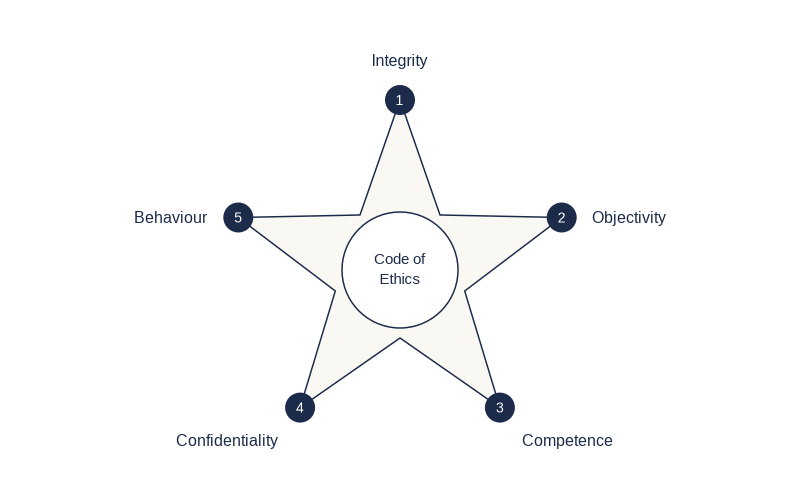
Code of Ethics, jo Institute of Chartered Accountants of India (ICAI) ne jaari kiya hai, IESBA Code ke framework par aadharit hai. IESBA ka matlab International Ethics Standards Board for Accountants hai. Is framework ko conceptual framework approach kehte hain: har nishidh kaam ki suchi dene ke bajaye, yeh professional se kehta hai ki threats pehchane, unka moolyankan kare, safeguards lagaye, aur agar threat ko swikarya star tak na laya ja sake to engagement mana kare ya chhod de.
Table 4.2: The five fundamental principles
| Principle | Plain meaning | Illustration |
|---|---|---|
| Integrity | Imaandari aur seedha vyavhaar | Galti dikhe to report mein likhi jaye |
| Objectivity | Pakshpaat aur anuchit prabhav se mukti | Dost ki company ho tab bhi auditor tatasth rahe |
| Professional competence and due care | Paryapt gyaan aur savdhaani se kaam | Jo kaam apni kshamata se bahar ho woh na le |
| Confidentiality | Client ki jaankari bina adhikaar ke prakat nahi hoti | Client ka data bahar walon se saajha nahi hota |
| Professional behaviour | Kanoon ka paalan aur peshe ki pratishtha | Niyam aur vidhi ka paalan |
4.3.1 Independence in mind aur in appearance
Independence of mind woh mansik sthiti hai jisme aisi raay di ja sakti hai jo nirnay ko bigadne wale prabhavon se na dabe. Independence in appearance un tathyon aur paristhitiyon se bachna hai jo itne mahatvapurn hon ki ek yuktisangat teesra vyakti auditor ki objectivity par sandeh kare. Dono chahiye. Agar objectivity vaastav mein bachi rahe par sandehaspad dikhe, tab bhi janata ka bharosa ghatta hai. Enron ke baad niyam isiliye sakht hue.
Ek asli audit report seedhi baat kehti hai. Udaharan ke liye, Infosys ke consolidated statements par auditor ki report kehti hai ki auditor ICAI ke Code of Ethics ke anusar Group se independent hai.[2] Is vakya ka matlab yeh hai ki independence report ke upyogkarta ke prati ek ghoshna hai, aur iska ullanghan us upyogkarta ke bharose ka bhi ullanghan hai.
4.3.2 Threat ki paanch categories
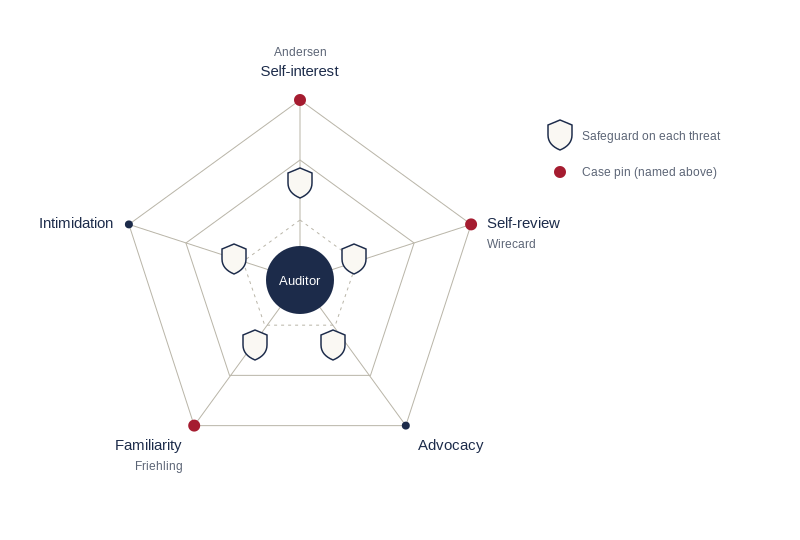
IESBA Code paanch threat categories pehchanta hai (self-interest, self-review, advocacy, familiarity aur intimidation) aur jab koi threat swikarya star par na ho tab safeguards maangta hai.[15]
Table 4.3: Threat categories, meaning and examples
| Threat | Meaning | Example |
|---|---|---|
| Self-interest | Auditor ka apna aarthik ya anya hit nirnay ko prabhavit kar sakta hai | Ek client ki fees par bahut nirbharta |
| Self-review | Auditor apne ya apni firm ke pehle ke kaam ka moolyankan karta hai | Books likhna aur phir unka audit karna |
| Advocacy | Auditor client ke paksh ka samarthan karta hai | Client ke share bechne mein madad |
| Familiarity | Lambi ya nikat jaan-pehchaan auditor ko zyada sahanubhutipurn bana deti hai | Saalon se ek hi vyakti ek hi client par |
| Intimidation | Dabav auditor ko objectively kaam karne se rokta hai | CFO auditor ko hatane ki dhamki deta hai |
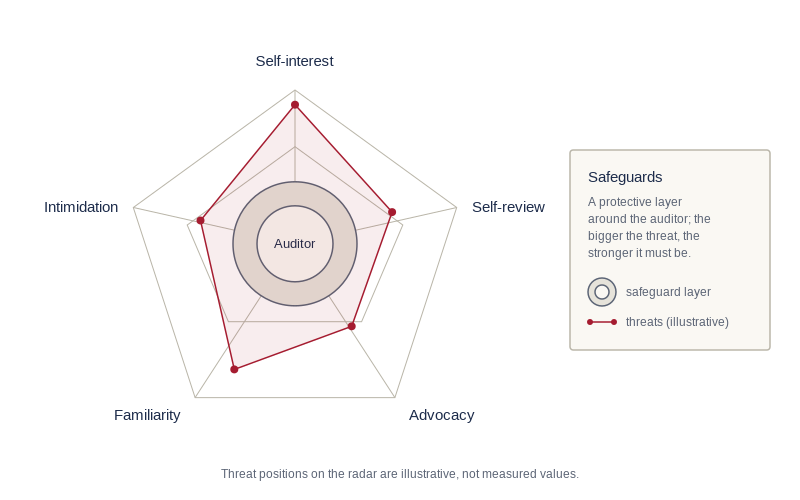
Critical discussion. Vyavhaar mein categories aapas mein milti hain. Ek tathya do threats bana sakta hai. Jo client number badalne ke liye inaam deta hai, woh self-interest aur intimidation dono banata hai. Pariksha mein surakshit tarika yeh hai ki pehle mukhya threat likhein aur phir doosri, har ek ka karan dekar.
4.4 Professional scepticism aur sahayak standards
Professional scepticism ko SA 200 ek aise rawaiye ke roop mein paribhashit karta hai jisme sawaal poochne wala mann, error ya fraud se hone wali misstatement ke sanketon ke prati satarkta, aur audit evidence ka critical moolyankan shamil hai.[14] "Sceptical" shabd ko aksar "sandehi" samajh liya jaata hai. Standard sawaal poochne ki aadat maangta hai, beimaani ki dharna nahi.
Is bhaag mein chaar standards baar baar aate hain. SA 200 auditor ke overall objectives aur professional scepticism par hai. SA 240 fraud se judi auditor ki zimmedariyon par hai. SA 220 engagement level par quality control par hai. SA 260 governance walon se communication par hai. (Numbers aur titles source chapter mein ICAI ki suchi se verify ho chuke hain.)
Management override is jokhim ko kehte hain ki management apni position ka upyog un controls ko bypass karne ke liye karta hai jo anyatha kaam karte. Ise khaas taur par khatarnak maana jaata hai kyunki jo log controls chalate hain wahi unhe bypass bhi kar sakte hain. Isiliye journal entries ka testing ek maanak pratikriya hai.
Agency theory ek saidhantik dhancha deti hai. Owners (principals) managers (agents) par poora bharosa nahi kar sakte, isliye bahari auditor ek monitoring cost ban jaata hai jo managers ke swarth ke jokhim ko kam karne ke liye uthaya jaata hai. Is drishti mein auditor ki independence hi nigrani ko vishwasniya banati hai.
4.5 Case study 1: Arthur Andersen aur Enron
What happened
Arthur Andersen Chicago ki ek accounting firm thi aur 2001 tak Big Five mein se ek thi. Woh energy company Enron ki auditor thi, aur WorldCom ke sandarbh mein bhi uska naam aaya. Firm 2002 ke beech tak dhah gayi.[1] Neeche ka kram public record se liya gaya hai.
Table 4.4: Andersen and Enron timeline
| Date | Event |
|---|---|
| 8 November 2001 | SEC Andersen ko subpoena bhejta hai; Enron 1.2 billion dollar kam kamai dikhane wala restatement file karta hai |
| 2 December 2001 | Enron Chapter 11 file karta hai, jo tab America ki sabse badi corporate bankruptcy thi |
| 3 January 2002 | Andersen ke vakeel ko chinta hoti hai ki Houston ke email records bahut saaf dikhte hain |
| 10 January 2002 | Andersen press release mein kehti hai ki Houston mein documents nasht kiye gaye |
| 1 February 2002 | Enron board ki Powers Committee report karti hai ki Andersen ne apni professional zimmedari poori nahi ki |
| 15 June 2002 | Andersen obstruction of justice mein doshi paayi jaati hai |
| 31 August 2002 | Andersen apne CPA licences surrender karti hai |
| 31 May 2005 | US Supreme Court conviction palat deti hai |
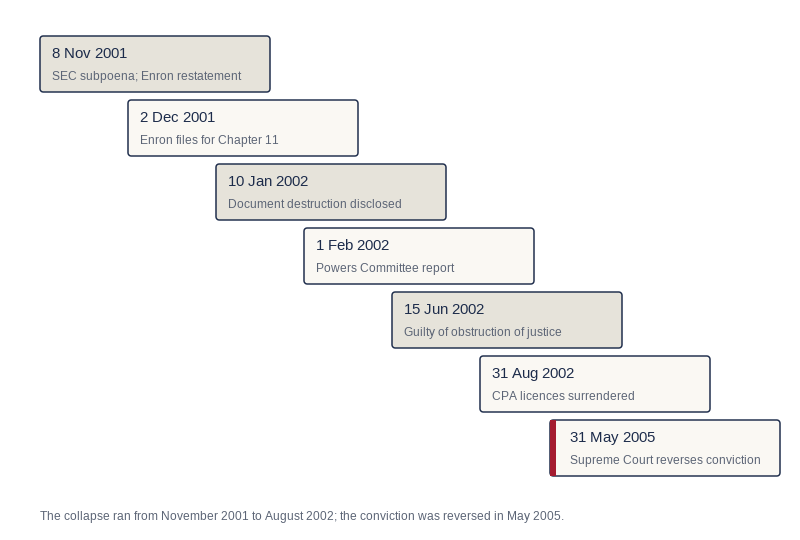
Table ke tathya aur tithiyan Arthur Andersen par Wikipedia lekh se li gayi hain.[1] Firm ko 15 June 2002 ko Enron audit se jude documents shred karne ke liye obstruction of justice mein doshi paaya gaya. Kyunki SEC convicted felons ke audits sweekar nahi karti, firm ne 31 August 2002 ko CPA licences surrender kiye. Firm ke 28,000 karmchariyon mein se do-tihai chale gaye. 31 May 2005 ko Supreme Court ne conviction ko ekmat se palat diya, kyunki jury ko diye gaye nirdesh bahut dhundhle the, par tab tak lagbhag 200 karmchari hi bache the.[1]
Records ka nashta
SEC investigation ki khabar public hone ke baad Andersen ne kai ton documents shred kiye aur lagbhag 30,000 emails aur computer files delete kiye.[4] David Duncan, jo Enron account ke lead partner the, aur Nancy Temple, jo firm ke legal department mein vakeel thin, zimmedar managers ke roop mein ullekhit hue. Temple ke mool email mein non-finalised documents ka zikr tha jo firm ki document retention policy ke anusar sambhaale jaane the.[1]
Naitik mudda yeh nahi hai ki retention policies anuchit hain. Document retention policy ek saadharan niyam hai jo karmchariyon ko batata hai ki records kitne samay rakhne hain. Mudda yeh hai ki jab koi sanstha yuktisangat roop se mukadme ki ashanka kare, to uska kartavya hota hai ki wo sambandhit jaankari surakshit rakhe. Isse legal hold ya litigation hold ki soch kehte hain.[6] Us kshan ke baad routine deletion policy lagana saadharan safai ko obstruction bana deta hai.
Aantarik aalochak ko hataya jaana
Carl Bass, jo Andersen ke professional standards group ke sadasya the, saalon tak Enron ke accounting par sawaal uthate rahe. Unhe Enron ki maang par Enron account se hata diya gaya.[1] Jo aantarik visheshagya sawaal uthata hai, firm ko usi ki raksha karni chahiye. Client ki maang par hataya jaana intimidation threat ka firm ke star par kaam karne ka udaharan hai.
Fees aur dabav
2000 mein Enron ne Andersen ko 25 million dollar audit fees aur 27 million dollar consulting fees di.[4] Wahi source batata hai ki Enron kabhi kabhi Ernst and Young ya PricewaterhouseCoopers ko accounting kaam dekar yeh chhavi banata tha ki Andersen ko badla ja sakta hai, taaki us par dabav bane.[4]
Regulatory outcome
Powers Committee ne nishkarsh nikaala ki Andersen ne apni professional zimmedariyan poori nahi ki.[1] In scandals ko Sarbanes-Oxley Act of 2002 ke banne ka ek kaaran maana gaya.[1] Us Act ka Title VIII financial records mein hera-pheri, unhe nasht karne ya badalne, ya investigations mein haastakshep ke liye aapraadhik dand lagata hai aur whistleblowers ko suraksha deta hai.[5]
Critical discussion
Supreme Court ka palatna naitik seekh ko nahi badalta. Ek conviction jo baad mein palti jaye, firm ke patan ko nahi palatti. Bharose ka toot jaana, verdict nahi, firm ko le doobaa. Ek saavdhan chhatra do prashnon ko alag rakhega: kya kanooni conviction thik thi, aur kya aacharan peshe ki naitikta ke anukul tha.
Exam trap. "Andersen ki conviction aaj bhi khadi hai" kathan galat hai. Supreme Court ne ise 2005 mein palat diya, par firm tab tak kaam karna band kar chuki thi.
Lessons
- Saboot nasht karna naitikta ka sabse gambhir ullanghan hai, chahe policy ka naam liya jaye.
- Jo aantarik visheshagya shanka uthaye use suna jaye, hataya na jaye.
- Independence ka matlab hai ki client ki ichchha yeh tay nahi karegi ki audit par kaun kaam kare.
4.6 Case study 2: Friehling aur Madoff
What happened
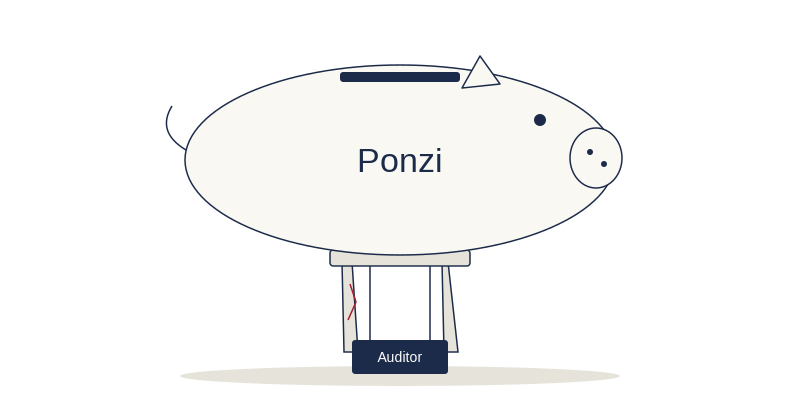
Bernard Madoff ne ek Ponzi scheme chalayi jise itihaas ki sabse badi gyaat Ponzi scheme bataya gaya, jiska anumaan fabricated gains milakar 65 billion dollar hai.[7] Ponzi scheme woh yojana hai jisme purane niveshkon ko asli munafe se nahi, balki naye niveshkon ke paise se bhugtan kiya jaata hai. Madoff ko 11 December 2008 ko giraftar kiya gaya aur 12 March 2009 ko usne 11 federal felonies maani.[7] SIPC trustee ne niveshkon ke asli seedhe nuksaan ka anumaan 18 billion dollar lagaya, aur Madoff ko 150 saal ki federal jail ki saza hui.[7]
The audit failure
Auditor of record Friehling & Horowitz thi, Rockland County ki do-vyakti wali firm jisme sirf ek active accountant tha, David G. Friehling. Woh Madoff parivaar ka nikat mitra tha aur Madoff ke ek fund mein niveshak bhi.[8] 2007 mein hedge fund consultant Aksia ne apne clients ko invest na karne ki salah di, yeh kehkar ki itni chhoti firm itne bade operation ko paryapt roop se serve kare, yeh sochna bhi kathin hai.[8]
November 2009 mein Friehling ne guilty plea ki aur maana ki usne Madoff ke filings ko audit karne ke bajaye sirf rubber-stamp kiya.[7] May 2015 mein Judge Laura Taylor Swain ne use ek saal home detention aur ek saal supervised release ki saza di; cooperation ki wajah se woh jail se bach gaya.[9]
Table 4.5: Threat mapping for Friehling and Madoff
| Threat or principle | Where it appears |
|---|---|
| Self-interest | Auditor khud Madoff fund mein niveshak tha |
| Familiarity | Woh Madoff parivaar ka nikat mitra tha |
| Competence and due care | Bahut bade operation ke liye ek active accountant |
| Integrity | Filings rubber-stamp hue aur audit nahi hua |
Critical discussion
Yeh case dikhata hai ki independence aur kshamata alag kasautiyan hain aur dono poori honi chahiye. Financial statements ke upyogkarta shayad hi poochte hain ki auditor kaun hai; woh sirf yeh dekhte hain ki statements "audited" hain ya nahi. Isliye dastakhat ek aisi pratishtha dhote hain jo do-vyakti ki firm sambhaal nahi sakti thi. Jo sawaal Aksia ne uthaya, ki auditor ka size kaam ke size ke barabar hai ya nahi, woh koi bhi upyogkarta pooch sakta hai.
Exam trap. Is case mein auditor ke saamne independence ki samasya ke saath competence ki samasya bhi thi. "Kaun si threat" wale prashn mein ek se zyada option tark-sangat ho sakte hain. Prashn mein mukhya threat dhundhiye.
4.7 Case study 3: Wirecard aur 2016 se 2018 ke audits
Shabdon par savdhani
Teen kathanon ko alag rakhna zaroori hai: allegation (aisa dawa jiska faisla nahi hua), regulatory finding (kisi nigrani sanstha ka nirnay) aur conviction (adalat ka faisla). June 2020 mein EY par yeh aarop laga ki woh Wirecard mein 1.9 billion euro ki nakdi ke gaayab hone ko pakad nahi saka aur uski auditing kharab thi.[13] EY ne kaha ki Wirecard ke ek trustee ne auditor ko deceive karne ki koshish ki.[12] Baad mein German audit oversight body APAS ne 31 March 2023 ko nirnay diya ki 2016 se 2018 ke audits mein professional duties ka ullanghan hua. Usne audit firm par 500,000 euro aur vyaktigat auditors par 23,000 se 300,000 euro ke beech ke jurmaane lagaye.[10] Reuters ke anusar firm ko do saal ke liye naye public-interest audits lene se bhi roka gaya, aur us avadhi ke liye Wirecard ki annual reports mein auditor EY likha hai (APAS ke press release mein firm ka naam nahi hai).[11] APAS ne fraud ya independence ke ullanghan ka finding nahi diya.
Wirecard mein kya hua
Wirecard Germany ki payments company thi. Usne 25 June 2020 ko insolvency file ki jab 1.9 billion euro gaayab bataye gaye.[12] Do Philippine banks ne kaha ki unke paas yeh raashi na hai na kabhi thi.[12] June 2023 mein Singapore ki State Court ne Wirecard ke do finance executives ko saza di: James Wardhana, international finance manager, ko 21 mahine aur Chai Ai Lim, Wirecard Asia ki Head of Finance, ko 10 mahine.[12] (Pichhle draft ka ek aur saza-vivaran pushti nahi ho saka, isliye hata diya gaya.)
Jab Financial Times ne reports chhapi, Wirecard ne unhe false, inaccurate, misleading aur defamatory kaha aur mukadme ka elaan kiya.[12] Jo client sawaalon ka jawab kanooni dhamkiyon se de, woh ek chetavani ka sanket hai.
Scepticism vyavhaar mein: saboot ka raasta
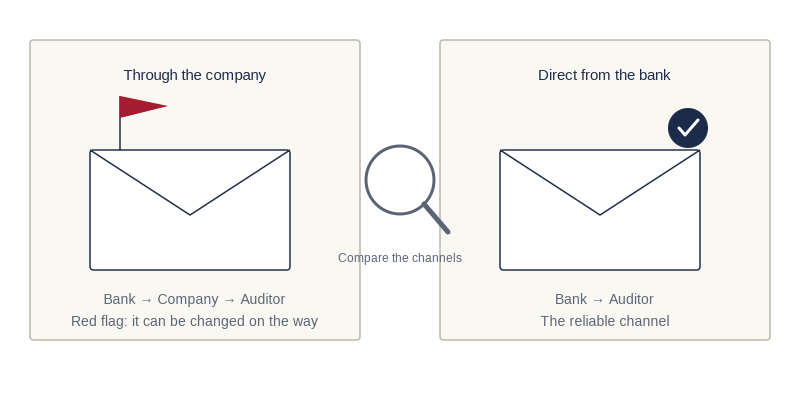
Audit evidence tab zyada mazboot hota hai jab woh swatantra source se aaye. Bank confirmation tabhi external evidence hai jab woh seedha bank se auditor tak pahunche. Agar woh company ke haathon se hokar guzre, to woh company ka hi saboot hai jo bahari saboot ke roop mein dikhta hai. Vyavharik niyam yeh hai ki confirmation requests auditor ke niyantran mein bheji aur praapt ki jayen.
Scope par niyantran
2019 mein Wirecard ne khud KPMG ko ek swatantra special audit ke liye lagaya, aur 28 April 2020 ko KPMG ne kaha ki use kuch aaropon ke liye paryapt documentation nahi mila.[12] Yeh dikhata hai ki jo client documents tak pahunch ko niyantrit karta hai, woh review ke vyavharik scope ko seemit kar sakta hai. Yeh KPMG ke special audit se nikla ek saamanya sabak hai aur EY ke khilaf kisi aarop ko nahi darshata.
Lessons
- Cash confirmation seedha bank se mangayiye, company ke raste se nahi.
- Agar documentation na mile to report mein likhiye.
- Aalochakon ke khilaf kanooni dhamkiyan ek chetavani ka sanket hain.
Exam trap. "Wirecard mein EY ne fraud kiya" kathan galat hai. EY par kharab auditing ka aarop laga, EY ne kaha ki use deceive kiya gaya, aur 2023 mein APAS ne professional duties ke ullanghan par jurmana lagaya, fraud ya independence ke ullanghan ke finding ke bina. Allegation, finding aur conviction teen alag cheezein hain.
4.8 Comparative analysis
Table 4.6: The five threats, cases and safeguards
| Threat | Meaning | Case illustration | Safeguard |
|---|---|---|---|
| Self-interest | Apna aarthik hit | Enron mein consulting fees; Friehling ka investment | Fee limits, investment na rakhna, non-audit services par rok |
| Self-review | Apna hi kaam check karna | Books likhna aur unka audit karna | Alag team ya service se inkaar |
| Advocacy | Client ka paksh lena | Client ke share bechne mein madad | Aisi bhumika se inkaar |
| Familiarity | Zyada nikat jaan-pehchaan | Friehling aur Madoff parivaar | Partner rotation, naya reviewer |
| Intimidation | Dabav ya dhamki | Andersen par dabav; Carl Bass ka hataya jaana | Audit committee se baat, resign karna |
Table 4.7: Rotation rules compared
| Jurisdiction | Rule |
|---|---|
| USA, SOX Title II section 203 | Audit partner rotation |
| UK, FRC Ethical Standard 3 (2009 version) | Engagement partner adhiktam paanch saal, phir paanch saal ka gap, do aur saal tak ki lachak ke saath |
| UK, public interest entities ke liye vartman vyavhaar | Paanch saal tenure aur paanch saal cooling-off, ek PwC UK report ke anusar |
| EU recommendation 2002 | Listed clients par saat saal ke baad partner rotation |
| India, dhara 139(2) | Listed companies: individual ek term, firm do term, paanch saal cooling-off |
US, UK 2009 aur EU ki entries auditor independence par Wikipedia lekh se hain.[15] UK ka vartman niyam PwC report se hai.[16] Bharat ki entry kanoon ke text se hai.[3] UK mein "do aur saal" ki lachak ki vartman sthiti FRC ke text se verify nahi ki gayi hai.
4.9 Illustrative scenario: ek trainee ki pehli client file
Yeh scenario kalpanik hai. Kisi asli company ya vyakti ka irada nahi hai. Ek trainee ko ek stockist client diya gaya hai. Woh stock register ko physical count se milata hai aur paata hai ki register mein shelves se zyada stock dikhta hai. Phir maalik trainee se kehta hai ki bank ko figures jaane se pehle register ke figures "adjust" kar do.
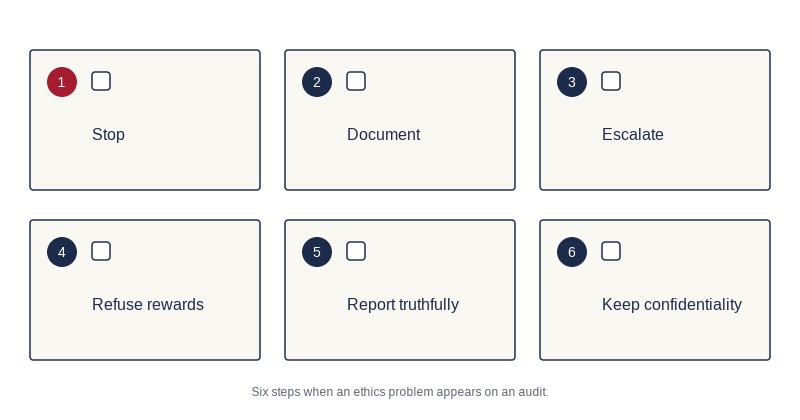
The six-step checklist
- Stop. Koi record, note ya count sheet mat badliye.
- Document. Likhiye ki kya dekha, kab, aur kisne kya kaha.
- Escalate. Engagement partner ya senior ko jaldi aur likhit mein bataiye.
- Refuse any reward or pressure. Dono self-interest aur intimidation threats hain.
- Report truthfully. Agar saboot kam hai to limitation ya misstatement likhiye.
- Keep confidentiality, siwaye jahan kanoon disclosure maange.
Checklist ek shikshan upay hai jo integrity, objectivity aur confidentiality ke siddhanton se aur Andersen ki is seekh se nikalta hai ki saboot nasht karna galat hai. Yeh kanooni text nahi hai.
Four practice scenarios
Scenario 1. Client kehta hai ki agar difference report na ho to fees double hogi. Threats: self-interest aur intimidation. Karyawahi: offer reject karein aur senior ko bataayein.
Scenario 2. Senior kehta hai ki difference "chhoti hai, ignore karo". Vishleshan: materiality ka nirnay senior ka hai, par observation likhne ka kartavya trainee ka rehta hai. Nirnay saboot par aadharit hona chahiye. SA 220 ke tahat engagement team ke andar matbhed firm ki policies aur procedures ke anusar suljhaye jaate hain, aur SA 230 ke tahat mahatvapurn maamle aur nishkarsh working papers mein document kiye jaate hain.[17] (SA 220 ke para 22 ke shabd sirf ek search snippet mein dekhe gaye the, poora standard nahi khola gaya.)
Scenario 3. Client ka accountant trainee se ek email delete karne ko kehta hai. Karyawahi: mana karein. Delete karna saboot ke saath chhedchhad hai, jo Andersen ki seekh hai. Senior ko bataayein.
Scenario 4. Client kehta hai ki bank letter client ke office ke raste se aayega. Karyawahi: aagrah karein ki letter seedha bank se auditor ko aaye. Warna jhoothi letter ka jokhim rehta hai, jaisa Wirecard case mein.
Worked problems
Problem 4.1: Enron mein fee mix
2000 mein audit fees 25 million dollar aur consulting fees 27 million dollar thi.[4] Total fees mein consulting ka hissa nikaaliye aur tippani kijiye.
Solution. Total fees = 25 + 27 = 52 million dollar. Consulting ka hissa = 27 / 52 = 0.519, yaani lagbhag 51.9 pratishat. Audit ka hissa = 25 / 52 = lagbhag 48.1 pratishat. Isliye consulting fees audit fees se zyada thi. Firm ke paas audit se pare bhi client ko santusht rakhne ka aarthik karan tha, jo ek self-interest threat hai.
Problem 4.2: Andersen ka workforce
Andersen ke peak par 28,000 karmchari the aur conviction ke baad do-tihai chale gaye.[1] Kitne gaye aur us stage par kitne bache, nikaaliye. Phir 2005 ke palatne ke samay bache lagbhag 200 karmchariyon se tulna kijiye.
Solution. 28,000 ka do-tihai = 18,667 (roundoff). Bache = 28,000 minus 18,667 = 9,333 (roundoff). 2005 tak sirf lagbhag 200 bache, jo 28,000 ka lagbhag 0.7 pratishat hai (200 / 28,000 = 0.0071). Licences surrender hone ke baad bhi giravat jaari rahi, jo is baat ko pusht karti hai ki akele verdict ne nahi, bharose ke nuksaan ne firm ko khatam kiya.
Problem 4.3: Timeline ke antaral
(a) SEC subpoena (8 November 2001) aur Enron ke Chapter 11 file karne (2 December 2001) ke beech kitne din? (b) Conviction (15 June 2002) aur licences surrender (31 August 2002) ke beech kitne din?
Solution. (a) 8 November se 30 November tak 22 din; 2 December tak 2 din aur, kul 24 din. (b) 15 June se 30 June tak 15 din; July ke 31 din; August 31 tak 31 din, kul 15 + 31 + 31 = 77 din.
Problem 4.4: APAS ke jurmaane ka anupaat
APAS ne audit firm par 500,000 euro aur vyaktigat auditors par 23,000 se 300,000 euro ka jurmana lagaya.[10] Sabse bade vyaktigat jurmaane ko firm ke jurmaane ke pratishat ke roop mein, aur sabse chhote ko bhi, nikaaliye.
Solution. Sabse bada: 300,000 / 500,000 = 60 pratishat. Sabse chhota: 23,000 / 500,000 = 4.6 pratishat.
Problem 4.5: Threat classification
Har tathya ko classify kijiye: (i) auditor audited company ke shares rakhta hai; (ii) auditor ne financial statements taiyar kiye; (iii) auditor ne wahi team ke saath wahi client kai saal audit kiya; (iv) auditor ko bataya gaya ki agar woh sahmat nahi hua to badal diya jayega; (v) auditor ne client ko share issue market karne mein madad ki.
Solution. (i) Self-interest. (ii) Self-review. (iii) Familiarity. (iv) Intimidation. (v) Advocacy.
Problem 4.6: Kaun si dhara?
Companies Act, 2013 ki dhara bataiye: auditor ka removal; woh services jo auditor nahi de sakta; fraud ki reporting; fees tay karna.
Solution. Removal: dhara 140. Prohibited services: dhara 144. Fraud reporting: dhara 143(12). Fees tay karna: dhara 142.
Chapter summary
Companies Act, 2013 auditor ke pad ko dhara 139 se 144 ke zariye paribhashit karta hai: appointment aur rotation, removal, eligibility, remuneration, powers aur duties, aur prohibited services. Eligibility Chartered Accountants aur firms tak seemit hai, aur company mein hit rakhne walon ke liye disqualifications hain. ICAI ka Code of Ethics, jo IESBA framework par aadharit hai, paanch siddhanton par tikta hai: integrity, objectivity, professional competence and due care, confidentiality aur professional behaviour. Independence ke do bhaag hain, in mind aur in appearance, aur dono zaroori hain. Threat ki paanch categories self-interest, self-review, advocacy, familiarity aur intimidation hain, jinka uttar safeguards hain. SA 200 ke anusar professional scepticism sawaal poochne ka rawaiya hai, avishwas nahi. Andersen case mein records nasht karne aur aantarik aalochak ko hataye jaane ne ek firm ko khatam kar diya, bhale hi conviction baad mein palti gayi. Friehling case mein client se vyaktigat sambandh wali ek-accountant firm ne sirf naam ka audit diya. Wirecard case mein allegation, regulatory finding aur conviction ka antar zaroori hai, aur yeh bhi ki saboot auditor tak kis raste se pahunchta hai. Rotation ke niyam alag alag deshon mein alag hain aur unke prabhav par research mixed hai.
Review questions
Short-answer questions
- Dhara 141 ke tahat auditor kaun ban sakta hai, aur officers aur employees kyun disqualified hain?
- Independence of mind aur independence in appearance ka antar samjhaiye.
- Ethics ke paanch fundamental principles likhiye.
- Paanch threat categories likhiye aur har ek ka ek udaharan dijiye.
- Dhara 144 statutory auditor ko internal audit services dene se kyun rokti hai?
- Dhara 140 ki dohri sharat (special resolution aur Central Government ki manzoori) ka uddeshya kya hai?
- SA 200 ke anusar professional scepticism ko paribhashit kijiye.
- Legal hold kya hai, aur woh document retention policy se kaise judta hai?
- Madoff ki firm ki audit quality ke liye Friehling & Horowitz ka size kyun prasangik tha?
- Wirecard ke udaharan se allegation, regulatory finding aur conviction mein antar bataiye.
Multiple-choice questions
Q1. Companies Act, 2013 ki kaun si dhara auditor ke removal se judi hai? (a) Dhara 139 (b) Dhara 140 (c) Dhara 142 (d) Dhara 144 Answer: (b). Dhara 140 mein special resolution aur Central Government ki manzoori chahiye.
Q2. Dhara 144 ke tahat statutory auditor kaun si service nahi de sakta? (a) Audit (b) Saadharan roop se statutory certification (c) Internal audit (d) Inme se koi nahi Answer: (c). Internal audit self-review threat ki wajah se prohibited suchi mein hai.
Q3. Jo auditor client ke financial statements banata hai aur phir unka audit karta hai, use kaun si threat hai? (a) Familiarity (b) Advocacy (c) Intimidation (d) Self-review Answer: (d). Auditor apne hi kaam ka moolyankan kar raha hoga.
Q4. Andersen ne apne CPA licences kab surrender kiye? (a) 15 June 2002 (b) 31 August 2002 (c) 31 May 2005 (d) 2 December 2001 Answer: (b). Surrender 15 June 2002 ki conviction ke baad hua.
Q5. Sarbanes-Oxley Act ka kaun sa Title records ke nasht ya badle jaane par aapraadhik dand se judta hai? (a) Title I (b) Title II (c) Title VIII (d) Title III Answer: (c). Title VIII mein aapraadhik dand aur whistleblower suraksha hai.
Q6. November 2009 mein David Friehling ne kya maana? (a) Usne poora audit kiya (b) Usne filings rubber-stamp kiye (c) Usne sign karne se inkaar kiya (d) Usne istifa diya Answer: (b). Usne maana ki audit ke bajaye Madoff ke filings rubber-stamp kiye.
Q7. Wirecard case ke baare mein kaun sa kathan sahi hai? (a) APAS ne paaya ki EY ne fraud kiya (b) APAS ne professional duties ke ullanghan par jurmana lagaya, fraud finding ke bina (c) EY ko jail hui (d) EY par kabhi koi aarop nahi laga Answer: (b). 2023 ka nirnay sirf professional duties par tha.
Q8. Bank confirmation tab mazboot external evidence hai jab woh (a) client ki finance team ke haath se guzre (b) client ke accountant dwara bheji jaye (c) seedha bank se auditor tak pahunche (d) audit committee chair ko mile Answer: (c). Raasta tay karta hai ki saboot sach mein external hai ya nahi.
Q9. SA 200 ke anusar professional scepticism mein kya shamil hai? (a) Sawaal poochne wala mann (b) Beimaani ki dharna (c) Koi bhi saboot na maanna (d) Management representations par nirbharta Answer: (a). Scepticism ek sawaal poochne wala rawaiya aur saboot ka critical moolyankan hai.
Q10. Kisko Enron ki maang par Enron account se hataya gaya jab usne uske accounting par sawaal uthaye? (a) David Duncan (b) Nancy Temple (c) Carl Bass (d) David Friehling Answer: (c). Carl Bass Andersen ke professional standards group ke sadasya the.
Notes and references
[1] Wikipedia, "Arthur Andersen", https://en.wikipedia.org/wiki/Arthur_Andersen, accessed 2026-11-27. Supports: Chicago firm, one of the Big Five by 2001, collapsed by mid-2002; SEC subpoena and Enron restatement of 1.2 billion dollars on 8 November 2001; Enron Chapter 11 on 2 December 2001 as largest corporate bankruptcy then; 3 and 10 January 2002 events; Powers Committee report of 1 February 2002; Carl Bass removed at Enron's request; conviction on 15 June 2002; CPA licences surrendered 31 August 2002; loss of two-thirds of 28,000 employees; Supreme Court reversal on 31 May 2005 with about 200 employees remaining; role of the scandals in the Sarbanes-Oxley Act; Duncan and Temple. [2] Infosys, consolidated auditor's report FY25, https://www.infosys.com/investors/reports-filings/quarterly-results/2024-2025/q4/documents/consolidated/consol-fy25-annual-auditorsreport.pdf, accessed 2026-11-27. Supports: independence statement under the ICAI Code of Ethics. [3] ICSI, Companies Act text, section 139(2), https://e-book.icsi.edu/Actpagedisplay.aspx?PAGENAME=17523, accessed 2026-11-27. Supports: rotation terms for listed companies and five-year cooling-off. [4] Wikipedia, "Enron scandal", https://en.wikipedia.org/wiki/Enron_scandal, accessed 2026-11-27. Supports: shredding of several tons of documents and deletion of nearly 30,000 emails and files; 25 million dollars audit and 27 million dollars consulting fees in 2000; Enron's use of other firms to pressure Andersen. [5] Wikipedia, "Sarbanes-Oxley Act", https://en.wikipedia.org/wiki/Sarbanes%E2%80%93Oxley_Act, accessed 2026-11-27. Supports: Title VIII criminal penalties and whistleblower protection. [6] The Sedona Conference, "Commentary on Legal Holds", https://www.thesedonaconference.org/sites/default/files/publications/Commentary%20on%20Legal%20Holds.pdf, accessed 2026-11-27. Supports: duty to preserve when litigation is reasonably anticipated. [7] Wikipedia, "Bernie Madoff", https://en.wikipedia.org/wiki/Bernie_Madoff, accessed 2026-11-27. Supports: largest known Ponzi scheme, estimated 65 billion dollars; arrest on 11 December 2008; guilty plea on 12 March 2009 to 11 felonies; SIPC trustee estimate of 18 billion dollars; 150-year sentence; Friehling's guilty plea in November 2009. [8] Wikipedia, "Madoff investment scandal", https://en.wikipedia.org/wiki/Madoff_investment_scandal, accessed 2026-11-27. Supports: Friehling & Horowitz as two-person firm with one active accountant, family friend and investor; Aksia's 2007 advice. [9] Wikipedia, "David G. Friehling", https://en.wikipedia.org/wiki/David_G._Friehling, accessed 2026-11-27. Supports: May 2015 sentence of home detention and supervised release. [10] APAS (Bundesamt fuer Wirtschaft und Ausfuhrkontrolle), press release, https://www.apasbafa.bund.de/SharedDocs/Pressemitteilungen/APAS/EN/2023_01_wirecard.html, accessed 2026-11-27. Supports: decision of 31 March 2023; fine of 500,000 euros and individual fines of 23,000 to 300,000 euros. [11] Reuters, "German regulator hands EY 2-year audit ban over Wirecard scandal", 3 April 2023, https://www.reuters.com/world/europe/german-regulator-hands-ey-2-year-audit-ban-over-wirecard-scandal-handelsblatt-2023-04-03/, accessed 2026-11-27. Supports: two-year ban on new public-interest audits; EY named in Wirecard annual reports. [12] Wikipedia, "Wirecard", https://en.wikipedia.org/wiki/Wirecard, accessed 2026-11-27. Supports: insolvency on 25 June 2020; 1.9 billion euros missing; Philippine banks' statements; EY's statement about a trustee; Singapore sentences of June 2023; KPMG special audit and statement of 28 April 2020; Wirecard's response to the Financial Times. [13] Wikipedia, "Big Four accounting firms", https://en.wikipedia.org/wiki/Big_Four_accounting_firms, accessed 2026-11-27. Supports: accusation against EY in June 2020. [14] ICAI, SA Chart 200 to 330, https://live.icai.org/bos/vcc/pdf/SA_Chart_200_330.pdf, accessed 2026-11-27. Supports: definition of professional scepticism in SA 200. [15] Wikipedia, "Auditor independence", https://en.wikipedia.org/wiki/Auditor_independence, accessed 2026-11-27. Supports: five IESBA threat categories; US, UK 2009 and EU rotation rules; mixed evidence on tenure. [16] PwC UK, Transparency Report 2023 (ethics), https://www.pwc.co.uk/transparencyreport/assets/pdf/uk-transparency-report-2023_ethics.pdf, accessed 2026-11-27. Supports: five-year tenure with five-year cooling-off for public interest entities. [17] ICAI, SA 230 text, https://cpeapp.icai.org/downloadBGM/5b39b17b010f9.pdf, accessed 2026-11-27. Supports: audit documentation covers significant matters, conclusions and professional judgments.